
Scabies
Reading File
Scabies is a highly contagious skin infestation caused by the mite Sarcoptes scabiei var. hominis, presenting with intense pruritus (especially nocturnal) and characteristic burrows. Let me pull the full clinical details from the medical library.
Searching sources...
Finding Sources
Searching PubMed
scabies treatment management
Good - I have the top sources. Now let me read the most detailed sections from Fitzpatrick's Dermatology (the gold standard), Rosen's Emergency Medicine, and Goldman-Cecil Medicine in parallel.
Reading File
Reading File
Reading File
Now let me get more from Fitzpatrick's (the most authoritative dermatology text) and fetch a clinical image.
Reading File
Loading Image
Let me get the rest of the Fitzpatrick's content (diagnosis, treatment) and fetch a key clinical image of burrows.
Reading File
Loading Image
I now have excellent material. Let me compile the comprehensive answer.
Scabies
Overview
Scabies is a parasitic infestation of the skin caused by Sarcoptes scabiei var. hominis, a host-specific mite of the class Arachnida. The mite lives its entire life cycle within the human epidermis. It affects over 100 million people worldwide annually, with no predilection for age, race, or socioeconomic status - though prevalence in some underdeveloped countries ranges from 4% to 100% of the general population.
- Fitzpatrick's Dermatology, p. 3303
The Mite
- Pearl-white, translucent, oval, eyeless, with 4 pairs of stubby legs
- Adult female: 0.4 x 0.3 mm (just below naked-eye visibility); male slightly smaller
- Cannot fly or jump
- Survives off the host for up to 3 days (in a test tube) or 7 days in mineral oil - this enables fomite transmission
- A normal host harbors 3-50 mites; infants/elderly may harbor 50-250; crusted scabies patients can harbor millions
Life Cycle
The female mite excavates a sloping burrow in the stratum corneum at 0.5-5 mm/day, reaching the stratum granulosum boundary. Along a 1 cm tunnel she lays 0-4 eggs/day (up to 50 eggs over her 30-day life). Eggs hatch in 10-12 days; larvae mature to nymphs on the skin surface. The male mite lives on the surface and enters burrows only to mate.
Transmission
- Primary route: Close personal contact (skin-to-skin, including sexual contact and household contact)
- Fomite transmission: Much more common in crusted scabies (6,000 mites/g have been detected in bed linens, floors, curtains). Live mites have been recovered from bedroom floors, overstuffed chairs, and couches in infected households
Clinical Features
Incubation & Symptoms
- Initial infestation: symptoms appear 4-6 weeks after exposure (some patients take up to 3 months; some are never sensitized)
- Reinfestation: symptoms within 2-3 days (sensitized immune response)
- Cardinal symptom: Intense pruritus, classically worse at night
Distribution
Affects interdigital web spaces, sides of fingers, volar wrists/lateral palms, elbows, axillae, scrotum/penis (males), labia/areolae (females), buttocks. Head and neck are typically spared in healthy adults but involved in infants, elderly, and immunocompromised patients.
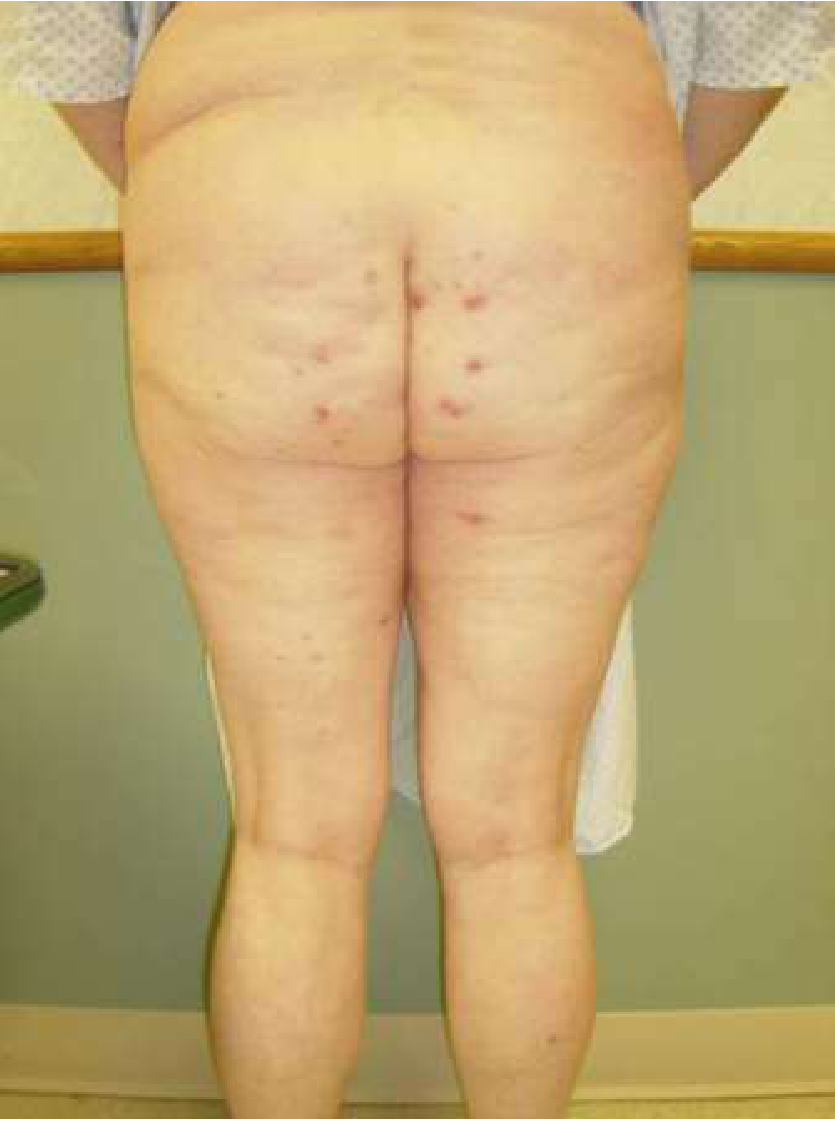
Skin Lesions
- Excoriations, eczematous dermatitis, small papules/pustules (<5 mm)
- Pathognomonic lesion: the burrow - a thin, thread-like, linear or J-shaped/S-shaped tunnel, 1-10 mm long
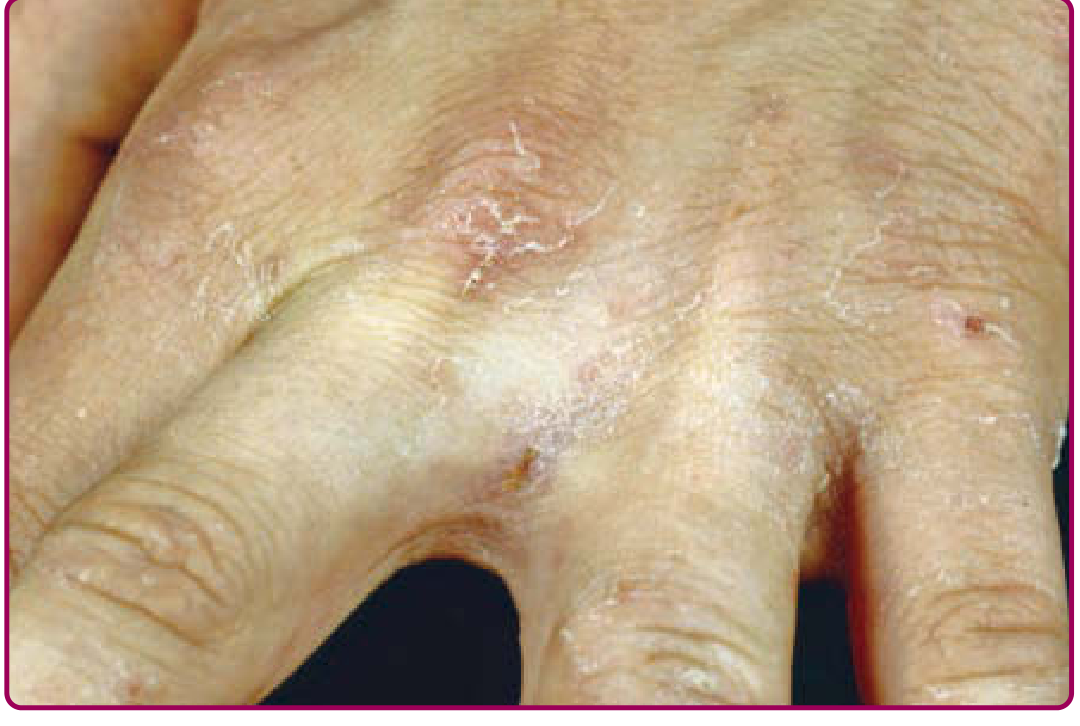
Crusted (Norwegian) Scabies
A severe form seen in immunosuppressed patients (HIV, leukemia), the elderly, those with dementia or neuropathy (leprosy, paraplegia). Features:
- Hyperkeratotic plaques on palms and soles; nail thickening and dystrophy
- Harbors thousands to millions of mites
- Minimal or absent pruritus (paradoxically)
- Extremely contagious - anyone in the general vicinity is at risk
Diagnosis
Diagnosis is primarily clinical (history + characteristic distribution). Confirmation methods:
| Method | Details |
|---|---|
| Mineral oil scraping | Scrape burrow longitudinally with a #15 scalpel, examine under low power - reveals mite, oval gray eggs, fecal pellets (scybala) |
| Dermoscopy | "Delta-wing jet" sign - dense mite head parts, translucent body, eggs, and S-shaped burrow |
| Ink test | Rub black felt-tip marker over lesion, wipe with alcohol - burrow retains ink and appears darker |
| Skin biopsy | Diagnostic if mite is transected in stratum corneum |
| Confocal microscopy | Can visualize mite in vivo |
No serologic test for human scabies currently exists.
Differential Diagnosis
- Pityriasis rosea
- Papular urticaria
- Secondary syphilis
- Folliculitis
- Contact dermatitis / atopic dermatitis
- Dermatitis herpetiformis
- Lichen planus
- Psoriasis
- Seborrheic dermatitis
Treatment
First-Line
| Drug | Regimen |
|---|---|
| Permethrin 5% cream | Apply from neck down (include under nails, umbilicus, nipples, genitalia); leave 8-12 hours overnight, then wash off. Repeat in 1-2 weeks. Treat face/scalp in infants. |
| Oral ivermectin | 200 mcg/kg orally; repeat in 14 days (limited ovicidal activity - second dose required). Slightly lower cure rate than permethrin in some studies. |
- Goldman-Cecil Medicine, p. 1572; Rosen's Emergency Medicine, p. 2411
Alternative
- Lindane 1% lotion or cream: apply neck down, wash off after 8 hours. Contraindicated in children <10 years (neurotoxicity risk). Now largely abandoned given safety concerns.
- Permethrin 1% lotion (less effective than 5%)
For Crusted Scabies
- Combination of oral ivermectin (multiple doses) + topical permethrin is recommended
- Due to massive mite burden, more aggressive treatment is needed
Key Management Points
- Treat all close contacts simultaneously, including asymptomatic household members - they may be carriers
- Decontaminate clothing and bedding: machine wash at >60°C or seal in a plastic bag for 72 hours (mites die off the host within 3 days)
- Post-treatment pruritus can persist for 2-4 weeks due to ongoing hypersensitivity reaction to dead mites/eggs - does not indicate treatment failure
- Oral antihistamines or topical corticosteroids may be used to manage residual pruritus
- Scabies nodules (firm, persistent nodules - especially on genitals) may persist for months after successful treatment
Special Populations
| Group | Key Differences |
|---|---|
| Infants | Face/scalp/palms/soles involved; vesicopustules common; burrows on palms/soles |
| Elderly | Intermediate mite burden (50-250); may progress to crusted form |
| Immunosuppressed | High risk for crusted scabies; treat more aggressively |
| Pregnant women | Permethrin is preferred (Category B); ivermectin use in pregnancy is less well-established |
Complications
- Secondary bacterial infection (impetigo from Staphylococcus aureus or Streptococcus pyogenes) - particularly in resource-limited settings, this is a significant driver of post-streptococcal glomerulonephritis
- Post-scabetic itch (persistent pruritus after cure)
- Scabies nodules
Sources: Fitzpatrick's Dermatology, pp. 3303-3308 | Rosen's Emergency Medicine, pp. 2410-2411 | Goldman-Cecil Medicine
Treatment guidelines in india karnataka
Searching for Karnataka/India-specific scabies treatment guidelines.
Searching sources...
Searching the Web
scabies treatment guidelines India Karnataka NVBDCP ICMR 2024 2025
Searching the Web
Karnataka health department scabies standard treatment guidelines STG
The ICMR Standard Treatment Workflow (STW) is the primary national guideline applicable across India including Karnataka. Let me extract the full ICMR document and check for any Karnataka-specific STG.
Reading Web Page
https://www.icmr.gov.in/icmrobject/uploads/STWs/1725967365_s…
Searching the Web
Karnataka RNTCP NVHCP standard treatment guidelines skin infections scabies 2023 2024 site:karnataka.gov.in OR site:nhmkarnataka.gov.in
I have everything needed. There is no separate Karnataka-state-specific scabies guideline - Karnataka follows the national framework. Here is the comprehensive answer:
Scabies Treatment Guidelines - India (ICMR STW) - Applicable to Karnataka
Important note: Karnataka does not have a separate state-specific scabies treatment protocol. The state follows the ICMR Standard Treatment Workflow (STW) for Scabies issued by the Department of Health Research, Ministry of Health & Family Welfare, Government of India (July 2022, ICD-10: B86). This is the authoritative guideline used at all levels of the healthcare system across India including Karnataka's NHM facilities, PHCs, CHCs, and government hospitals.
The full ICMR STW is available at icmr.gov.in.
Core Principle (ICMR STW Motto)
"TREAT THE ENTIRE SKIN, NOT LESIONS ALONE; TREAT THE FAMILY/CONTACTS, NOT THE PATIENT ALONE"
First-Line Treatment
1. Permethrin 5% Cream (Topical - Preferred)
| Parameter | Details |
|---|---|
| Application area | Entire skin surface from neck downwards; in infants, also face and scalp |
| Special areas | Interdigital web spaces, axillae, under fingernails/toenails, wrists, external genitalia, buttocks |
| Skin prep | Apply on dry, clean skin |
| Duration | Leave on for 8-12 hours (advise late evening application, kept overnight) |
| Reapplication | Re-apply if hands are washed during the contact period to maintain 8-hour contact |
| Quantity | Adults and children ≥5 years: ~30 g per application; children <5 years: ~15 g |
| Repeat dose | Repeat after 7-14 days |
| Safety | Safe in infants, pregnancy, and breastfeeding |
2. Oral Ivermectin (for poor compliance or inadequate response to topicals)
| Parameter | Details |
|---|---|
| Dose | 200 mcg/kg body weight (up to 12 mg maximum) |
| Frequency | Two doses, 1 week apart |
| Administration | Taken with food (improves bioavailability) |
| Contraindications | Infants, children <5 years or <15 kg, pregnancy - avoid |
3. Alternative Topical: 1% Gamma Benzene Hexachloride (GBHC/Lindane)
- Apply same as permethrin (neck down, 8-12 hours, wash off)
- Avoid in infants (neurotoxicity risk)
- Now used less frequently due to safety concerns
Symptomatic / Adjunct Treatment
- Antihistamines: Prescribe as needed for itch relief (e.g., cetirizine, chlorpheniramine)
- Post-treatment itch: Reassure patients that itching can persist for several weeks after successful treatment - does not mean treatment failure; continue antihistamines
Crusted (Norwegian) Scabies - Intensive Regimen
| Day | Treatment |
|---|---|
| Days 1, 2, 8, 9, 15 | Oral Ivermectin 200 mcg/kg |
| Days 22, 29 | Add if severe/refractory |
| Daily for 7 days, then twice weekly until cure | Topical Permethrin 5% cream |
| Over crusts | Keratolytic (3-6% salicylic acid) to improve penetration |
- Nodular lesions: Potent topical steroid (Clobetasol propionate) or intralesional Triamcinolone acetonide 10 mg/mL for persistent scabies nodules
Post-Treatment Advice
| Situation | Action |
|---|---|
| Itching continues for >3-4 weeks or new lesions appear | Suspect reinfestation - likely all contacts were not treated |
| Clothes, towels, bed linen | Wash with hot water and dry in sun (items used in preceding 3 days) |
| Non-washable items | Seal in plastic bag for at least 3 days (mites die off-host within 72 hours) |
| Secondary bacterial infection | Treat as per bacterial skin infection STW (Staphylococcal/Streptococcal coverage) |
General Measures (Public Health / Contact Management)
- All family members and close contacts must be treated simultaneously, even if asymptomatic - to prevent re-infestation
- Screen and treat sexual partners
- In institutional settings (hostels, schools, old-age homes, prisons), consider selective or mass treatment depending on outbreak size
- Patient education is essential on correct application technique
Prescribing at Different Levels of Care in Karnataka
| Level | Setting | Guideline Authority |
|---|---|---|
| Sub-centre / HWC | Community Health Officer | ICMR STW / IPHS 2022 |
| PHC / CHC | Medical Officer | ICMR STW |
| District / Taluk Hospital | Dermatologist / Physician | ICMR STW + Fitzpatrick's standard of care |
| Tertiary (Govt. Medical Colleges - BMCH, MMCH, KIMS, etc.) | Dermatology department | Full specialist protocol including crusted scabies management |
Summary Quick-Reference Card
SCABIES - ICMR STW (India / Karnataka)
━━━━━━━━━━━━━━━━━━━━━━━━━━━━━━━━━━━━
FIRST LINE:  Permethrin 5% cream, neck down, 8-12h overnight
             Repeat at 7-14 days
             Adults: 30g | Children <5yr: 15g

ORAL:        Ivermectin 200 mcg/kg (max 12mg) with food
             Two doses, 1 week apart
             ✗ Avoid in: <5yr / <15kg / pregnancy

ALTERNATIVE: GBHC 1% (avoid in infants)

CRUSTED:     Ivermectin D1,2,8,9,15 + Permethrin daily x7d
             then twice weekly + salicylic acid keratolytic

ADJUNCT:     Antihistamines for itch
             Clobetasol for nodules

CONTACTS:    Treat ALL simultaneously
LINEN:       Hot wash or bag for 3 days
━━━━━━━━━━━━━━━━━━━━━━━━━━━━━━━━━━━━
Source: ICMR Standard Treatment Workflow - Scabies (July 2022), Department of Health Research, MoHFW, Government of India - the operative national guideline for Karnataka.
How to differentiate from fungal infection based on clinical features
Scabies vs fungal infections can usually be separated by distribution, lesion morphology, and the character of itching - notably nocturnal itch strongly favors scabies. Let me pull the detailed clinical differentials from the textbooks.
Searching sources...
Finding Sources
Finding Sources
Finding Sources
Finding Sources
Reading File
Reading File
Finding Sources
Reading File
Reading File
Reading File
Finding Sources
I now have comprehensive data from multiple authoritative sources. Here is the full clinical differentiation:
Scabies vs Fungal Infection: Clinical Differentiation
This is one of the most common diagnostic dilemmas in tropical dermatology, particularly in India, where Tinea corporis (including the now-endemic T. indotineae) and scabies co-exist and can sometimes overlap.
Head-to-Head Comparison
| Feature | Scabies | Tinea (Dermatophytosis) |
|---|---|---|
| Causative agent | Sarcoptes scabiei var. hominis (mite/parasite) | Dermatophytes (T. rubrum, T. indotineae, M. canis etc.) |
| Itch character | Intense, predominantly nocturnal - hallmark | Mild to moderate; may include burning; not specifically nocturnal |
| Itch severity | Severe, often unbearable at night | Usually mild-moderate; chronic, low-grade |
| Incubation | 4-6 weeks (first exposure); 2-3 days (reinfection) | 1-3 weeks |
| Lesion morphology | Papules, vesicles, pustules, burrows (pathognomonic) | Annular, ring-shaped plaques with raised scaly advancing border + central clearing ("ringworm") |
| Burrows | Present - thread-like, J/S-shaped, 1-10 mm - pathognomonic | Absent |
| Scale pattern | Minimal/excoriations; scale mainly from scratching | Active scaly border is hallmark; scale follows the advancing ring edge |
| Central clearing | Absent | Present - classic central clearing is a key feature of tinea corporis |
| Distribution | Interdigital webs, wrists (volar), axillae, genitals, areolae, buttocks - bilateral and symmetric | Trunk, extremities, face, groin (tinea cruris), feet (tinea pedis) - often asymmetric |
| Sparing of face/scalp | Yes (in adults) - face/neck spared | Tinea faciei can involve face; tinea capitis involves scalp |
| Family/contact spread | Multiple household members affected simultaneously - very characteristic | Possible (especially zoophilic tinea - pet contact), but less typical pattern |
| Nocturnal worsening | Yes - strongly characteristic | No |
| Genital involvement | Very common (scrotum, penis, labia) | Tinea cruris spares scrotum/penis (distinguishes it from candidal intertrigo) |
| Nail changes | Not typically (unless crusted scabies) | Onychomycosis common in tinea pedis/manuum |
| Preceding animal contact | No specific contact | Zoophilic tinea - cat/dog/cattle exposure |
| Response to steroids | Temporary itch relief, worsens infestation | Steroids suppress inflammation → "tinea incognito" - lesions lose classic appearance |
The Most Discriminating Features
1. The Burrow - Pathognomonic for Scabies
A thin, thread-like, grayish-white or skin-colored tunnel of 1-10 mm, often J- or S-shaped, found in interdigital web spaces, volar wrists, and finger sides. No equivalent in fungal infection.
- Confirm with ink test: apply black felt-tip ink, wipe with alcohol - burrow retains ink
- Fitzpatrick's Dermatology, p. 3305
2. Nocturnal Pruritus
Scabies itch is characteristically worst at night (mite activity increases with warmth of bedding). Tinea pruritus does not have a diurnal pattern. This single feature has high specificity for scabies.
3. Distribution Pattern
| Body site | Scabies | Tinea |
|---|---|---|
| Interdigital web spaces (hands) | Classic | Tinea manuum - uncommon here |
| Volar wrists | Classic | Uncommon |
| Genitals (scrotum/penis) | Very common | Tinea cruris spares scrotum |
| Axillae | Common | Uncommon |
| Trunk (annular rings) | Absent | Classic for tinea corporis |
| Groin crease | Can occur | Tinea cruris - very common |
| Feet (interdigital) | Uncommon | Classic for tinea pedis |
| Scalp | Spared in adults | Tinea capitis - children |
4. Household Clustering
Multiple members of the same household itching simultaneously - strongly suggests scabies. Tinea rarely spreads so rapidly through a household in the same pattern.
5. Lesion Shape
- Scabies: no central clearing, no ring shape; diffuse papulovesicular eruption
- Tinea corporis: annular/circinate plaques with a well-defined scaly advancing border and central clearing - sometimes called "ringworm" pattern
The Notorious Overlap: Tinea Incognito vs Scabies
A clinically important pitfall in India - patients with tinea who have been given topical steroids ("steroid-modified tinea" / tinea incognito) lose the classic ring-shaped appearance and present with diffuse, poorly-defined, pruritic patches that can look like scabies. Clues:
- History of prior topical steroid use
- Loss of annular pattern
- Absence of burrows
- KOH scraping from the edge of the lesion shows hyphae
Quick Bedside Differentiating Tests
| Test | Scabies | Tinea |
|---|---|---|
| KOH preparation (skin scraping) | Negative for hyphae | Hyphae/arthrospores visible |
| Mineral oil scraping of burrow | Mite, eggs, scybala visible | Negative |
| Ink/burrow test | Positive (ink retained in burrow) | Negative |
| Wood's lamp | No fluorescence | M. canis - greenish fluorescence (not all dermatophytes); Tinea versicolor - yellow-green |
| Dermoscopy | "Delta-wing jet" sign (mite head), eggs, S-shaped burrow | Superficial white scales; no mite structures |
Summary Mnemonic
"SCABIES = Scratch, Contacts, At night, Burrows, Interdigital, Entire family, Scrotum"
"TINEA = Traverse outward (ring), Itches mildly, No nocturnal worsening, Elevated scaly border, Asymmetric"
Additional Confounders to Keep in Mind
- Candidal intertrigo (intertriginous areas, satellite pustules, moist red rash) can mimic scabies in groin/axillae - but no burrows, satellite lesions present, not nocturnal
- Pityriasis versicolor (Malassezia) - hypo/hyperpigmented macules, fine scale, no itch or mild itch, no burrows; trunk/upper back distribution
- Scabies + tinea co-infection can occur; both must be treated
Sources: Fitzpatrick's Dermatology, pp. 3304-3308 | Dermatology 2-Volume Set 5e (Bolognini), Table 77.9 | Rosen's Emergency Medicine, p. 2410


+4 more
Tell me whether these are scabies or fungal infection
Let me analyse all 4 images carefully before giving my assessment.
analyse_media
analyse_media
analyse_media
analyse_media
I have detailed analysis of all 4 images. Here is my clinical assessment:
Clinical Assessment of All 4 Images
Disclaimer: This is a clinical image interpretation for educational/decision-support purposes. It does not replace an in-person examination, KOH scraping, or formal dermatological diagnosis. Please correlate with history (nocturnal itch, family contacts affected, duration).
Image-by-Image Analysis
Image 1 (WA0000) - Dorsum of foot, circled lesion
What is seen: A solitary, small, firm papule/nodule on the dorsal foot. Hyperpigmented rim with slightly pale/dimpled center. No scale, no burrows, no ring pattern.
Assessment: Neither classic scabies nor classic tinea
- Could be a prurigo nodule (from chronic scratching), a healing insect bite reaction, or a dermatofibroma
- The location (dorsal foot) is atypical for both scabies and tinea corporis
- If this is from chronic scratch-induced trauma, it may be a secondary response to underlying scabies elsewhere
Image 2 (WA0003) - Buttock/outer thigh region
What is seen: A single well-demarcated, hypopigmented plaque with fine dry scale. No central clearing. No burrows. Relatively uniform hypopigmentation across the lesion.
Assessment: Leans toward FUNGAL (Tinea corporis or Pityriasis versicolor)
- Fine surface scale + hypopigmentation on a hair-bearing area fits tinea or pityriasis versicolor (Malassezia)
- The absence of an annular ring could mean: early tinea, or pityriasis versicolor (which does not form rings - just macular/patch hypopigmentation with fine scale)
- Could also be post-inflammatory hypopigmentation from a healed lesion
- No features of scabies here (no burrows, no papulovesicles, no characteristic interdigital/wrist distribution)
Image 3 (WA0001) - Leg/thigh
What is seen: A clearly annular (ring-shaped) lesion with a well-defined, raised, active pale-pink border, peripheral fine scale, and prominent central clearing. No burrows.
Assessment: FUNGAL INFECTION - Tinea corporis ✅
- This is the most classic image of the set
- Annular shape + raised scaly advancing border + central clearing = textbook tinea corporis
- The peripheral collarette scale on the inner margin of the border is characteristic
- Complete absence of burrows makes scabies very unlikely for this lesion
- In the Indian context with T. indotineae prevalence, this pattern is extremely common
Image 4 (WA0004) - Leg/thigh
What is seen: Multiple discrete crusted nodules with:
- Thick, adherent yellowish-brown keratotic central crust/plug
- Hemorrhagic (bloody) crust on one - indicating recent vigorous scratching
- Hyperpigmented raised rim around each
- No burrows, no ring pattern, no central clearing
Assessment: Most consistent with SCABIES NODULES or Prurigo Nodularis secondary to scabies ✅
- These are hyperkeratotic crusted nodules - a well-recognized presentation of scabies nodules (nodular scabies), which are firm, pruritic, reddish-brown nodules caused by a hypersensitivity reaction to mite antigens
- The location (inner thigh/genital-adjacent region) is a classic site for scabies nodules - they preferentially occur on covered areas: genitals, buttocks, inner thighs, axillae
- The vigorous scratching evidenced by hemorrhagic crust strongly suggests intense pruritus - hallmark of scabies
- This is distinct from tinea, which does not produce this type of heavily crusted nodule with pruritic scratch marks
Overall Summary
| Image | Body Site | Most Likely Diagnosis | Key Feature |
|---|---|---|---|
| WA0000 | Dorsal foot | Prurigo nodule / insect bite reaction (secondary) | Solitary firm papule, no burrows, no ring |
| WA0003 | Buttock/thigh | Tinea corporis or Pityriasis versicolor | Scaly hypopigmented plaque |
| WA0001 | Leg/thigh | Tinea corporis (fungal) | Classic ring + central clearing + scaly border |
| WA0004 | Inner thigh | Scabies nodules (scabies) | Multiple crusted nodules + scratch marks + intense itch site |
Clinical Impression
This patient likely has both conditions simultaneously - which is not uncommon in India.
- WA0001 + WA0003 → Tinea corporis / fungal infection
- WA0004 → Scabies nodules (nodular scabies), a form that persists for weeks-months post-infestation or indicates active heavy infestation
This is a mixed presentation. Key questions to ask:
- Is the itch worse at night? - If yes, strongly favors active scabies
- Are other family members itching? - If yes, strongly favors scabies
- Any involvement of finger web spaces, wrists, genitals? - Scabies distribution
- Any prior steroid cream use? - Can mask tinea (tinea incognito) and worsen scabies
Recommended Bedside Confirmation
- KOH scraping from the scaly border of the ring lesion (WA0001) → hyphae = tinea confirmed
- Mineral oil scraping from one of the crusted nodules (WA0004) → mite/eggs = scabies confirmed
- If both confirm - treat simultaneously with permethrin 5% (scabies) + topical antifungal (tinea)
Household members are also affected and itching worse at night
Your credits are exhausted. You can purchase a top-up or subscribe to a plan to continue using Orris. If you're already subscribed, your daily credits will reset tomorrow.
Household members are also affected and itching worse at night
Your credits are exhausted. You can purchase a top-up or subscribe to a plan to continue using Orris. If you're already subscribed, your daily credits will reset tomorrow.
This is a shared conversation. Sign in to Orris to start your own chat.