
Right humerus bone
Reading File
Finding Sources
Searching Images
right humerus bone anatomy
Reading File
Reading File
Finding Sources
Reading File
Loading Image
Finding Sources
Reading File
Reading File
Loading Image
Here is a comprehensive overview of the right humerus — the long bone of the upper arm extending from the shoulder to the elbow.
Right Humerus — Anatomy
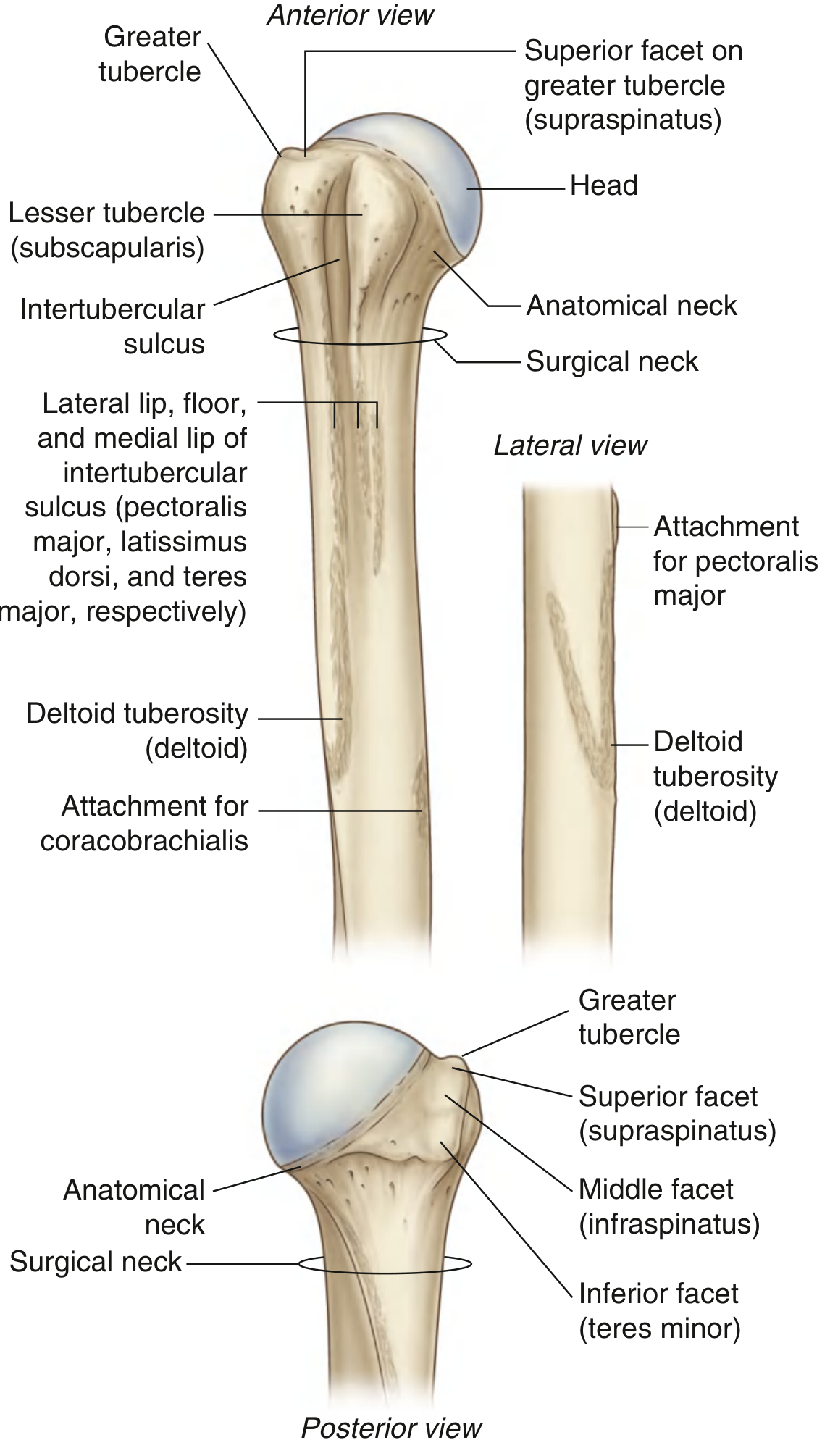
Proximal End
| Structure | Details |
|---|---|
| Head | Half-spherical; projects medially and superiorly; articulates with the glenoid cavity of the scapula |
| Anatomical neck | Short constriction immediately distal to the head; separates head from tubercles |
| Surgical neck | Horizontal region between the expanded proximal end and the narrower shaft; common fracture site; the axillary nerve and posterior circumflex humeral artery pass immediately posterior to it |
| Greater tubercle | Lateral; three facets — superior (supraspinatus), middle (infraspinatus), inferior (teres minor) |
| Lesser tubercle | Anterior; single large impression for subscapularis |
| Intertubercular sulcus (bicipital groove) | Separates the two tubercles; the tendon of the long head of biceps brachii runs through it; walls/floor attach pectoralis major (lateral lip), latissimus dorsi (floor), and teres major (medial lip) |
Shaft (Diaphysis)
- Deltoid tuberosity: V-shaped roughening on the lateral surface at mid-shaft; insertion of the deltoid muscle
- Coracobrachialis attachment: thin roughening on the medial surface at the same level
- Spiral (radial) groove: runs posterolaterally across the shaft; the radial nerve and profunda brachii artery travel here; nerve exits ~10–15 cm proximal to the lateral epicondyle
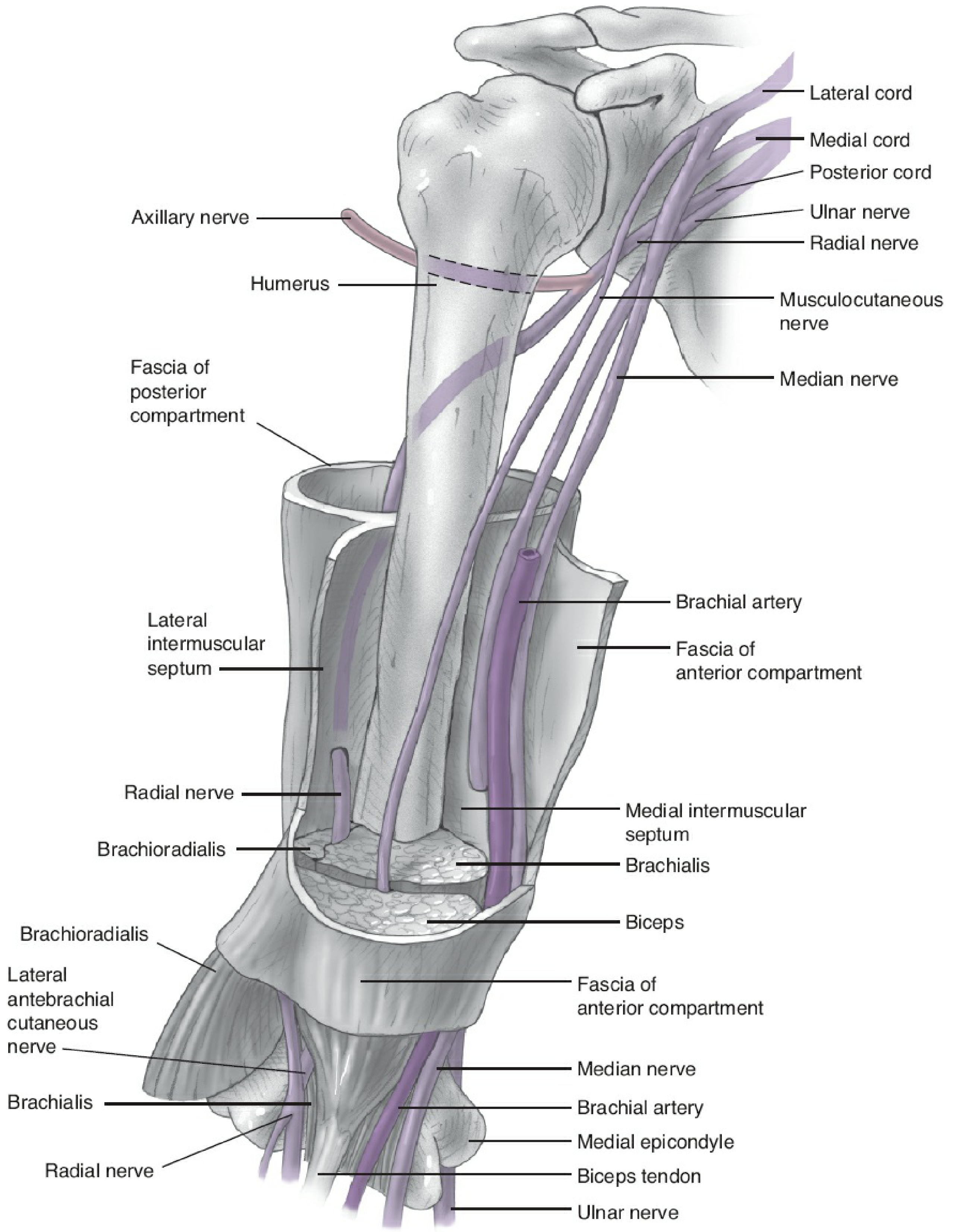
- The humerus is surrounded by two compartments: anterior (biceps, brachialis, coracobrachialis) and posterior (triceps), separated by intermuscular septa
Distal End (Condyle)
| Structure | Details |
|---|---|
| Capitulum | Hemispherical, lateral; articulates with the radial head |
| Trochlea | Pulley-shaped, medial; articulates with the trochlear notch of the ulna; extends to the posterior surface |
| Medial epicondyle | Large palpable prominence; attachment for forearm flexors; ulnar nerve passes in the groove on its posterior surface |
| Lateral epicondyle | Less prominent; attachment for forearm extensors |
| Radial fossa | Anterior, above capitulum; receives radial head during flexion |
| Coronoid fossa | Anterior, above trochlea; receives coronoid process of ulna during flexion |
| Olecranon fossa | Posterior, above trochlea (largest fossa); receives olecranon of ulna during extension |
Key Neurovascular Relations
| Nerve | Relation to Humerus | At Risk With |
|---|---|---|
| Axillary nerve | Passes posterior to surgical neck, 4–7 cm below acromion tip | Surgical neck fracture, shoulder dislocation |
| Radial nerve | Spirals in posterior radial groove | Mid-shaft fracture (Holstein-Lewis) |
| Ulnar nerve | Passes behind medial epicondyle | Medial epicondyle fracture |
| Median nerve | Medial aspect of anterior compartment | Supracondylar fracture |
| Musculocutaneous nerve | Lateral to median nerve, anterior compartment | Distal interlocking during nailing |
Clinical Notes
- Surgical neck fractures are the most common proximal humeral fractures; anatomical neck fractures are rare
- The radial nerve is the most commonly injured nerve in humeral shaft fractures due to its course in the spiral groove
- The deltoid tuberosity serves as a key reference point: the radial nerve exits the spiral groove approximately 10–15 cm proximal to the lateral epicondyle and never less than 7.5 cm from the distal articular surface
- Proximal fragment abduction in mid-shaft fractures proximal to the pectoralis major insertion is caused by unopposed deltoid pull
Sources: Gray's Anatomy for Students; Rockwood and Green's Fractures in Adults, 10th ed.; Imaging Anatomy, Vol. 3
Right humerus bone
The answer is already fully in our conversation context from the previous turn. Here is the complete overview again:
Right Humerus — Anatomy
Proximal End
| Structure | Details |
|---|---|
| Head | Half-spherical; projects medially and superiorly; articulates with the glenoid cavity of the scapula |
| Anatomical neck | Short constriction immediately distal to the head; separates head from tubercles |
| Surgical neck | Horizontal region between the expanded proximal end and the narrower shaft; common fracture site; the axillary nerve and posterior circumflex humeral artery pass immediately posterior to it |
| Greater tubercle | Lateral; three facets — superior (supraspinatus), middle (infraspinatus), inferior (teres minor) |
| Lesser tubercle | Anterior; single large impression for subscapularis |
| Intertubercular sulcus (bicipital groove) | Separates the two tubercles; tendon of long head of biceps brachii runs through it; walls/floor attach pectoralis major (lateral lip), latissimus dorsi (floor), teres major (medial lip) |
Shaft (Diaphysis)
- Deltoid tuberosity: V-shaped roughening on the lateral surface at mid-shaft; insertion of the deltoid muscle
- Coracobrachialis attachment: thin roughening on the medial surface at the same level
- Spiral (radial) groove: runs posterolaterally; the radial nerve and profunda brachii artery travel here; nerve exits ~10–15 cm proximal to the lateral epicondyle
- Surrounded by two compartments: anterior (biceps, brachialis, coracobrachialis) and posterior (triceps), separated by intermuscular septa
Distal End (Condyle)
| Structure | Details |
|---|---|
| Capitulum | Hemispherical, lateral; articulates with the radial head |
| Trochlea | Pulley-shaped, medial; articulates with the trochlear notch of the ulna; extends to the posterior surface |
| Medial epicondyle | Large palpable prominence; attachment for forearm flexors; ulnar nerve passes posterior to it |
| Lateral epicondyle | Less prominent; attachment for forearm extensors |
| Radial fossa | Anterior, above capitulum; receives radial head during flexion |
| Coronoid fossa | Anterior, above trochlea; receives coronoid process of ulna during flexion |
| Olecranon fossa | Posterior, above trochlea (largest fossa); receives olecranon during extension |
Key Neurovascular Relations
| Nerve | Relation to Humerus | At Risk With |
|---|---|---|
| Axillary nerve | Passes posterior to surgical neck, 4–7 cm below acromion | Surgical neck fracture, shoulder dislocation |
| Radial nerve | Spirals in posterior radial (spiral) groove | Mid-shaft fracture |
| Ulnar nerve | Passes behind medial epicondyle | Medial epicondyle fracture |
| Median nerve | Medial aspect of anterior compartment | Supracondylar fracture |
| Musculocutaneous nerve | Lateral to median nerve, anterior compartment | Distal interlocking during nailing |
Clinical Notes
- Surgical neck fractures are the most common proximal humeral fractures; anatomical neck fractures are rare
- The radial nerve is the most commonly injured nerve in humeral shaft fractures due to its course in the spiral groove
- The radial nerve exits the spiral groove ~10–15 cm proximal to the lateral epicondyle and never less than 7.5 cm from the distal articular surface
- Proximal fragment abduction in mid-shaft fractures proximal to the pectoralis major insertion is caused by unopposed deltoid pull
Sources: Gray's Anatomy for Students; Rockwood and Green's Fractures in Adults, 10th ed.; Imaging Anatomy, Vol. 3
This is a shared conversation. Sign in to Orris to start your own chat.