Monophasic synovial sarcoma

Reading File
Finding Sources
Searching PubMed

"synovial sarcoma"

Searching the Web

NCI synovial sarcoma treatment PDQ

Finding Sources
Reading Web Page

https://www.cancer.gov/types/soft-tissue-sarcoma/hp/child-so…

Reading File
Reading File

Monophasic synovial sarcoma

A malignant soft-tissue tumor, usually occurring in adolescents and young adults. Despite its name, it does not arise from synovium and may occur anywhere, most often as a deep periarticular mass in the extremities.

Histology

  • Consists of one recognizable cell type only, usually the monophasic spindle-cell form.
  • Uniform, densely packed spindle cells form intersecting fascicles, often with a herringbone pattern.
  • Unlike biphasic synovial sarcoma, it lacks obvious epithelial glandular structures.
  • Monophasic epithelial synovial sarcoma is rare.
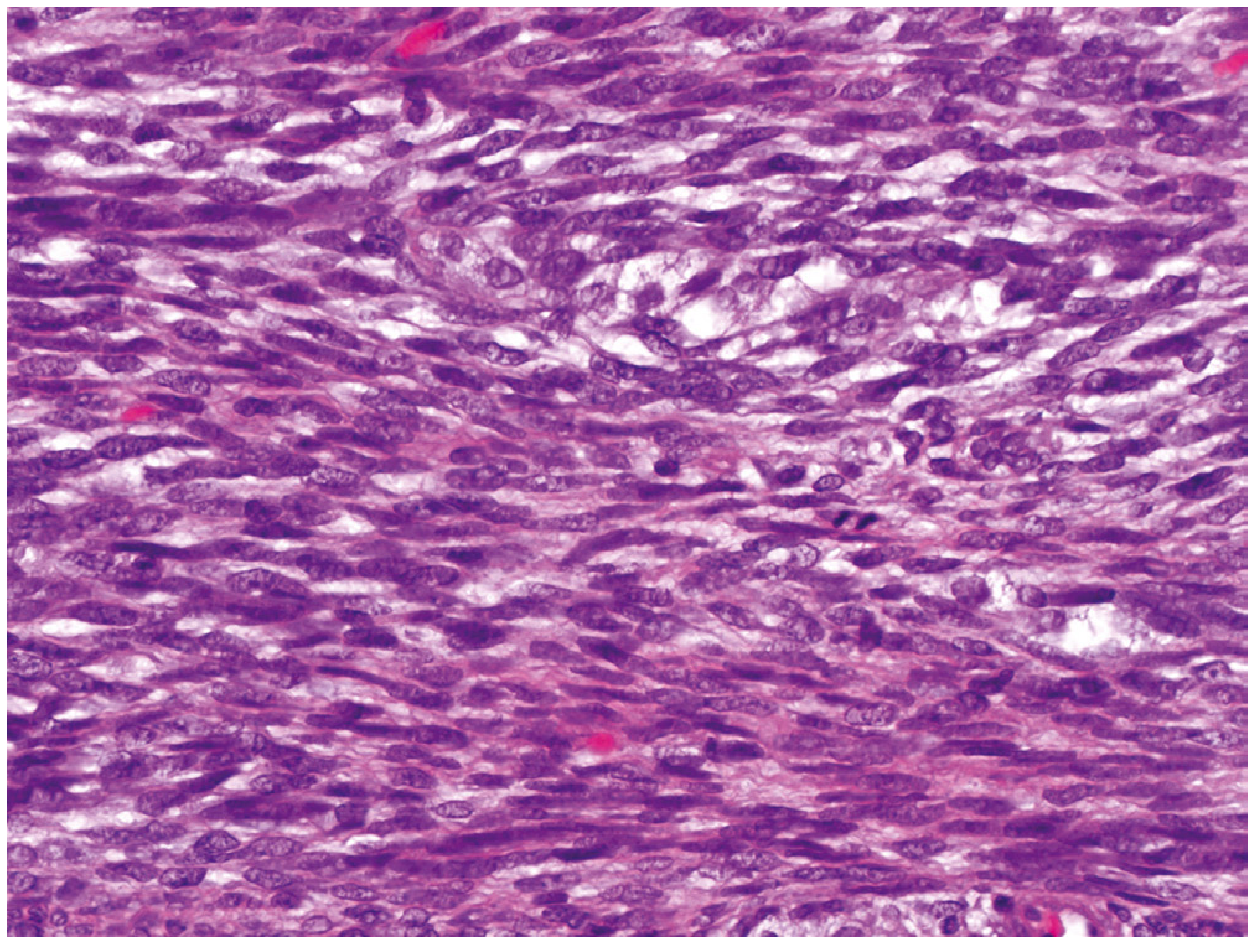
Monophasic spindle-cell synovial sarcoma with herringbone fascicles
Firestein & Kelley's Textbook of Rheumatology, p. 2757.

Immunohistochemistry

Typical supportive markers:
  • TLE1: usually diffuse, strong nuclear positivity
  • EMA and cytokeratins: often focal, sometimes weak in the spindle-cell variant
  • SS18::SSX fusion-specific immunostaining may support diagnosis
TLE1 is helpful but is not completely specific, so molecular confirmation is preferred when morphology or immunophenotype is uncertain.

Molecular hallmark

  • t(X;18)(p11.2;q11.2)
  • Produces SS18::SSX fusion, most often SS18::SSX1 or SS18::SSX2
  • Demonstrated by FISH, RT-PCR, next-generation sequencing, or fusion-specific immunohistochemistry.
This rearrangement is found in both monophasic and biphasic forms and is the defining diagnostic feature. Firestein & Kelley's Textbook of Rheumatology, p. 2757.

Differential diagnosis

Because it is a spindle-cell tumor, important differentials include:
  • Malignant peripheral nerve sheath tumor
  • Fibrosarcoma
  • Solitary fibrous tumor
  • Leiomyosarcoma
  • Fibromatosis
  • Other undifferentiated spindle-cell sarcomas
The combination of morphology, epithelial-marker expression, TLE1, and especially an SS18::SSX fusion resolves most difficult cases.

Management

Management should be planned at a specialist sarcoma center:
  • Wide surgical resection with negative margins is the core treatment for localized disease.
  • Radiotherapy is commonly added for larger, deep, high-grade, marginally resected, or anatomically difficult tumors.
  • Ifosfamide and doxorubicin-based chemotherapy may be considered for selected high-risk, unresectable, recurrent, or metastatic disease.
  • Lung is a common metastatic site, so chest staging and long-term surveillance are required.
The NCI synovial sarcoma guidance confirms that diagnosis rests on immunohistochemistry plus the characteristic t(X;18)/SS18::SSX rearrangement, and notes common use of ifosfamide-doxorubicin regimens in appropriate cases.
Key exam line: Monophasic synovial sarcoma is a spindle-cell sarcoma with herringbone fascicles, TLE1/EMA/cytokeratin positivity, and the pathognomonic SS18::SSX fusion from t(X;18).

Go through the research articles and give me more information regarding its prognosis and treatment

Reading File
Reading File
Searching PubMed

"synovial sarcoma" AND prognosis

Searching PubMed

"synovial sarcoma" AND treatment

Searching PubMed

"synovial sarcoma" AND "T-cell receptor"

Searching PubMed

"synovial sarcoma" AND chemotherapy

Finding Sources
Searching the Web

FDA afamitresgene autoleucel synovial sarcoma approval eligibility 2024

Searching the Web

ESMO EURACAN GENTURIS soft tissue sarcoma clinical practice guideline synovial sarcoma 2024

Searching PubMed

afamitresgene autoleucel synovial sarcoma

Searching PubMed

"synovial sarcoma" AND survival

Searching PubMed

pazopanib trabectedin synovial sarcoma

Reading Web Page

https://www.fda.gov/drugs/resources-information-approved-dru…

Reading Article

PMID: 32851862

Reading Article

PMID: 36399116

Reading Article

PMID: 35672231

Reading Article

PMID: 32421444

Reading Article

PMID: 28391003

Reading Article

PMID: 33822979

Reading Article

PMID: 40112518

Prognosis

Monophasic synovial sarcoma is treated according to the same risk factors as other synovial sarcomas. Histologic subtype alone is generally less important than stage, tumor size, site, resectability, surgical margin, and metastatic status.

What predicts outcome

More favorable
  • Localized tumor, especially ≤5 cm
  • Complete, margin-negative resection, called R0 resection
  • Extremity, particularly lower-limb, location rather than an axial/visceral site
  • Long interval before recurrence
  • Complete removal of limited lung metastases in carefully selected cases
Less favorable
  • Tumor >5 cm, with risk increasing further above 10 cm
  • Deep or central/axial location, inability to obtain clear margins
  • Local recurrence
  • Metastasis, especially pulmonary metastasis
  • Poorly differentiated morphology and high-risk clinical features
A 2025 UK cohort of 94 patients, 62% of whom had monophasic tumors, found that increasing size and metastatic recurrence were strongly adverse. The cohort’s median overall survival was 83 months, but this is an overall estimate across stages and treatments, not an individual prediction. Robertson-Smith et al., 2025, PMID 40112518

Localized disease

Outcomes may be quite good for truly low-risk tumors. In a prospective pediatric/adolescent pooled analysis of completely resected localized synovial sarcomas ≤5 cm, surgery alone produced:
  • 3-year event-free survival: 90%
  • All recurrences were local
  • No metastatic relapses
  • 100% overall survival, with salvage treatment for local relapse
This evidence applies specifically to selected patients under 21 years with a complete resection, not automatically to adults or larger tumors. Ferrari et al., 2017, PMID 28391003
The textbook series cited previously reported, among 150 patients with nonmetastatic disease, disease-free survival of 59% at 5 years and 52% at 10 and 15 years. This illustrates a characteristic feature of synovial sarcoma: late recurrence can occur, so surveillance needs to be prolonged. Firestein & Kelley's Textbook of Rheumatology, p. 2757.

Metastatic or unresectable disease

The prognosis changes substantially once disease is advanced. A systematic review of 39 studies found:
  • Progression-free survival across systemic-treatment studies: 1.0 to 7.7 months
  • Overall survival: 6.7 to 29.2 months
These are broad historic ranges from heterogeneous studies, rather than a prediction for a particular patient. Kogushi et al., 2020, systematic review, PMID 32851862
For selected patients with resectable metastases, predominantly lung metastases, metastasectomy can be worthwhile. A systematic review/meta-analysis of 598 patients found median survival after metastasectomy ranging from 21 to 80 months; complete resection and a disease-free interval >12 months were favorable. However, all included studies were retrospective, so selection bias is substantial. Wang et al., 2022, systematic review/meta-analysis, PMID 35672231

Treatment

Care should be planned by a multidisciplinary sarcoma team, ideally before biopsy and definitely before definitive surgery. Pathology should confirm SS18::SSX fusion because spindle-cell tumors can mimic monophasic synovial sarcoma.

1. Localized, resectable tumor

Wide surgical excision with an R0 margin is the central curative treatment.
Radiotherapy
  • Often used preoperatively or postoperatively when the tumor is large, deep, high grade, close to critical structures, or margins are close/positive.
  • Its primary role is improving local control.
  • In the 2025 UK retrospective cohort, surgery plus radiotherapy was associated with better survival, but this cannot prove radiotherapy itself caused the difference because treatment assignment was non-random. Robertson-Smith et al., 2025
Chemotherapy
  • Synovial sarcoma is relatively more chemotherapy-sensitive than many other adult soft-tissue sarcomas, particularly to ifosfamide and doxorubicin.
  • It is not needed for every localized case.
  • For low-risk, completely resected tumors ≤5 cm, evidence supports omitting perioperative chemotherapy, particularly in children and adolescents. A systematic review found no significant survival or event-free-survival benefit in this setting. Nakamura et al., 2021, systematic review, PMID 33822979
  • For large, deep, high-grade, borderline-resectable, or otherwise high-risk tumors, neoadjuvant or adjuvant chemotherapy is individualized. The aim may be tumor shrinkage, limb preservation, and reduction of distant relapse risk.
A phase III trial in high-risk localized soft-tissue sarcoma, including 70 synovial sarcomas, found that conventional anthracycline plus ifosfamide was superior to histology-tailored chemotherapy for 5-year overall survival, 76% versus 66%. Thus, when neoadjuvant chemotherapy is chosen, doxorubicin plus ifosfamide remains a standard reference regimen. Gronchi et al., 2020, randomized phase III trial, PMID 32421444

2. Unresectable, recurrent, or metastatic tumor

Treatment depends on symptoms, tumor burden, pace of growth, prior therapy, whether all disease can be removed or ablated, and patient fitness.
First systemic treatment
  • Doxorubicin plus ifosfamide is commonly used for fit patients when tumor shrinkage is important.
  • Single-agent doxorubicin may be selected when toxicity concerns outweigh the need for the higher response rate associated with combination therapy.
  • Local options should still be reconsidered for oligometastatic disease: resection, stereotactic radiotherapy, or thermal ablation may help selected patients.
After previous chemotherapy Common options include:
  • Pazopanib
  • Trabectedin
  • Other sarcoma-directed options selected according to prior treatments, regulatory availability, and patient factors
  • A clinical trial whenever feasible
A meta-analysis of 16 studies of previously treated metastatic synovial sarcoma found median overall survival after pazopanib or trabectedin of about 10 months, with pooled response proportions of 18.9% for pazopanib and 12.3% for trabectedin. These are benchmarks from mostly non-randomized data, not evidence that one drug is definitively better. Carroll et al., 2022, meta-analysis, PMID 36399116

3. MAGE-A4-directed T-cell therapy

For a biologically selected subgroup, afamitresgene autoleucel (Tecelra) is an important newer option in the United States.
Eligibility requires:
  • Adult with unresectable or metastatic synovial sarcoma
  • Prior chemotherapy
  • Tumor positive for MAGE-A4
  • Specific HLA-A*02 subtypes
In the registration study, the objective response rate was 43.2% among treated patients; median duration of response was 6 months, with 39% of responding patients maintaining response for at least 12 months. It has important risks, including potentially severe or fatal cytokine release syndrome, prolonged cytopenias due to lymphodepletion, and infection. It must be delivered at an experienced cellular-therapy center. The FDA approval summary describes the selection criteria, outcomes, and boxed warning. FDA documentation indicates that its initial accelerated approval was converted to traditional approval in June 2026 after confirmatory data.

Practical surveillance implication

Because late pulmonary metastases and late local recurrences occur, follow-up is long term. This normally includes regular clinical examination and chest imaging, with local-site imaging when clinically indicated. Exact schedules differ between centers and should reflect initial stage, margins, anatomic site, and treatment. The ESMO soft-tissue sarcoma guideline resource supports specialist-center diagnosis, treatment, and follow-up.
Bottom line: A small, localized, completely resected monophasic synovial sarcoma can have a favorable outcome and sometimes needs surgery alone. Large, deep, incompletely resectable, recurrent, or metastatic disease carries materially higher risk and often needs multimodality treatment. For advanced disease, ifosfamide-based therapy, selected local treatment of metastases, pazopanib/trabectedin, clinical trials, and MAGE-A4-directed T-cell therapy for eligible patients are the main evidence-supported pathways.
This is a shared conversation. Sign in to Orris to start your own chat.