
Tell me all about UTI in infectious ward from harrison
urinary tract infection pathophysiology bacteria ascending infection
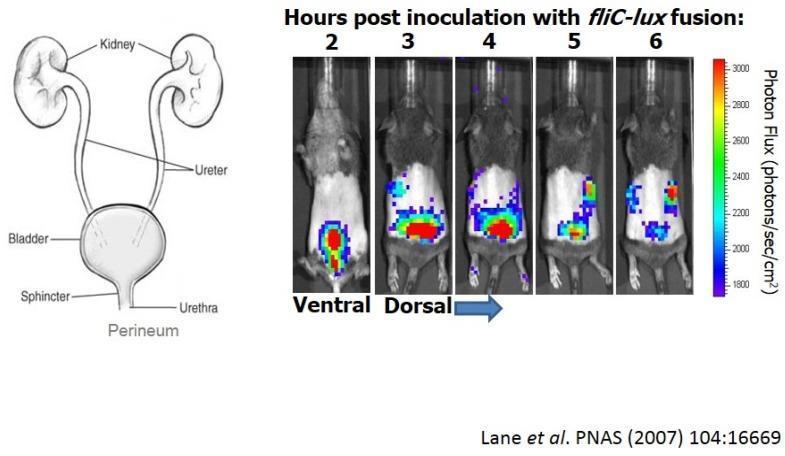
Educational panel illustrating the progression of an ascending urinary tract infection (UTI) using bioluminescence imaging in a murine model. The left panel contains an anatomical diagram of the human urinary tract, labeling the kidneys, ureters, bladder, sphincter, urethra, and perineum. The right panel displays a time-course series of whole-animal bioluminescence imaging at 2, 3, 4, 5, and 6 hours post-inoculation with uropathogenic E. coli (UPEC) strain CFT073 containing a fliC-lux fusion. At 2 hours (ventral view), the light signal (photon flux) is concentrated in the bladder region. From 3 to 4 hours (dorsal view), the signal intensifies, indicating robust flagellin gene expression. By 5 and 6 hours, the signal migrates superiorly, demonstrating the ascent of bacteria through the ureters to the bilateral kidneys. A color-coded scale indicates photon flux intensity, ranging from 1800 (purple/blue) to 3000 (red) photons/sec/cm². The image illustrates bacterial virulence, gene expression during infection, and the transition from cystitis to pyelonephritis.
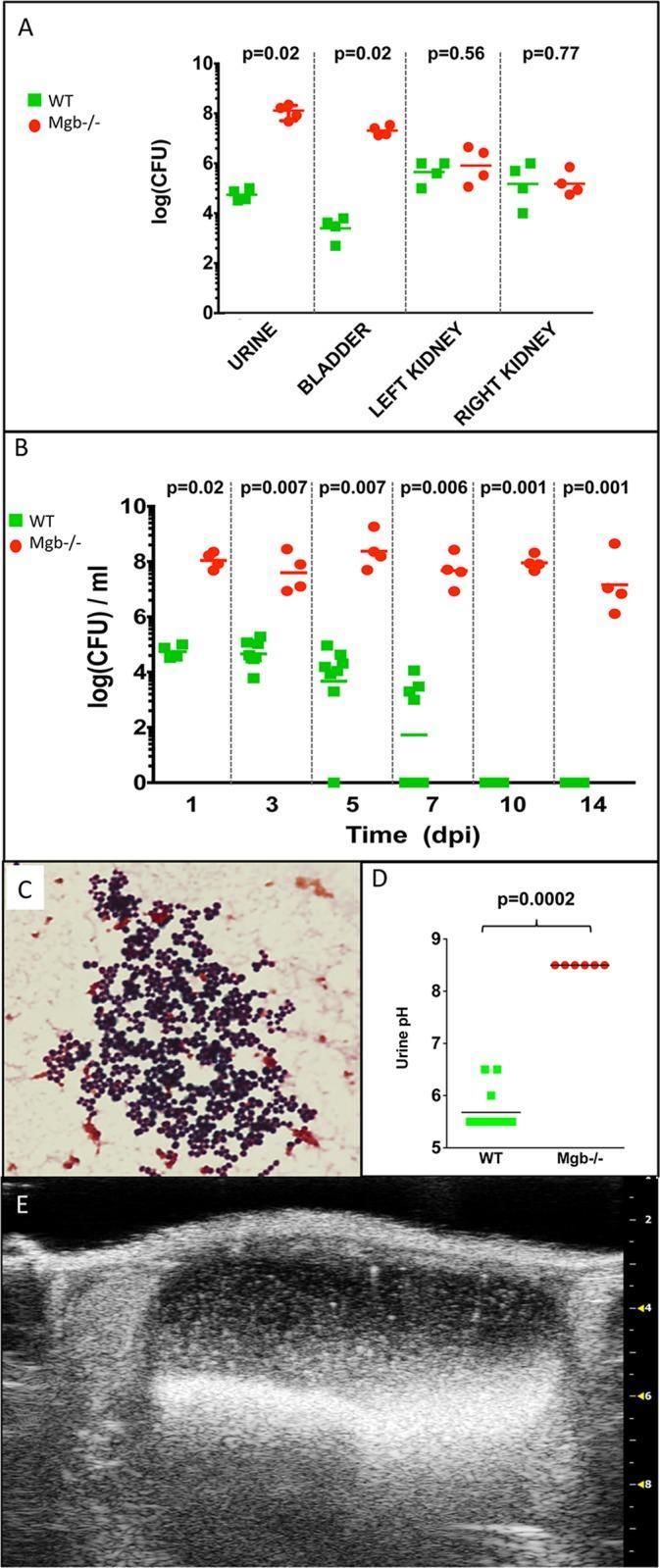
A multi-panel figure illustrating the pathophysiology of urinary tract infection (UTI) and urolithiasis in a megabladder (Mgb-/-) mouse model compared to wild-type (WT). (A) Scatter plot showing bacterial recovery (log(CFU)) 1 day post-infection (dpi) with coagulase-negative staphylococci (CONS292), demonstrating significantly higher colonization in Mgb-/- urine and bladder (p=0.02) compared to WT, while renal colonization remains similar. (B) Longitudinal graph showing persistent bacteriuria in Mgb-/- mice up to 14 dpi, whereas WT mice clear the infection by 10 dpi. (C) Gram stain of Mgb-/- urine at 14 dpi showing Gram-positive cocci in characteristic clusters. (D) Comparison chart of urine pH at 10 dpi, indicating significant alkalinization in Mgb-/- mice (pH ~8.5) versus acidic WT urine (pH ~5.5, p=0.0002). (E) Longitudinal ultrasound view of an Mgb-/- bladder at 14 dpi reveals hyperechoic, echogenic debris within the lumen, which was confirmed as struvite bladder stones. The image illustrates the relationship between urinary stasis, urea-splitting bacterial infection, alkaline pH, and the formation of infectious urolithiasis.
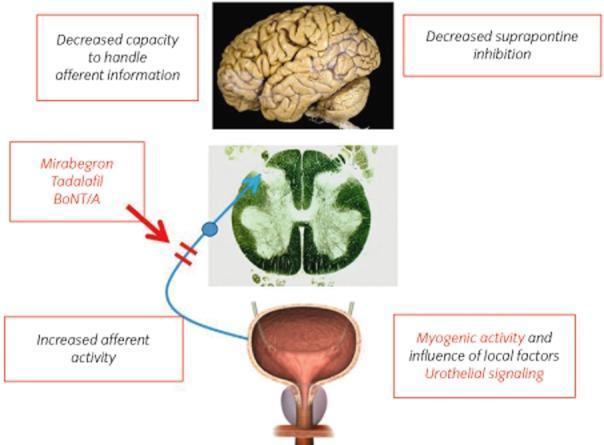
A pathophysiology diagram illustrating the neural pathways and pharmacological targets associated with overactive bladder (OAB). The visual comprises a clinical photograph of a human brain, a histological cross-section of the spinal cord, and an anatomical illustration of the urinary bladder. A blue line indicates the ascending afferent signal pathway originating from the bladder, where text boxes highlight 'increased afferent activity,' 'myogenic activity,' and 'urothelial signaling' as local drivers of dysfunction. The pathway ascends through the spinal cord toward the brain. Central nervous system involvement is annotated with 'decreased suprapontine inhibition' and a 'decreased capacity to handle afferent information,' explaining the loss of cortical control over voiding. Pharmacological intervention is represented by a red arrow pointing to a block in the afferent pathway, listing therapeutic agents including Mirabegron, Tadalafil, and Botulinum neurotoxin A (BoNT/A). This diagram serves as an educational tool for urology and neurology, detailing the communication between the peripheral organ and the central nervous system in lower urinary tract symptoms.
Urinary Tract Infections: Cystitis, Prostatitis, and Pyelonephritis
Harrison's Principles of Internal Medicine, 22nd Edition (2025)
Historical Context
Definitions
| Term | Meaning |
|---|---|
| UTI | Symptomatic infection somewhere along the urinary tract |
| Cystitis | Symptomatic infection of the bladder |
| Pyelonephritis | Symptomatic infection of the kidneys |
| Prostatitis | Symptomatic infection of the prostate |
| Asymptomatic Bacteriuria (ASB) | Bacteria in urine WITHOUT associated symptoms |
| Uncomplicated UTI | Infection confined to the bladder in a catheter-free patient |
| Complicated UTI | Infection extending beyond the bladder (prostatitis, pyelonephritis, bacteremia, UTI with urinary catheter) |
Key distinction: UTI requires symptoms. Bacteria alone (even with pyuria) in an asymptomatic patient = ASB, NOT UTI. This has major clinical implications.
- Pregnant patients (untreated ASB → pyelonephritis, preterm delivery, low birth weight)
- Patients about to undergo urologic procedures with mucosal injury (lithotripsy, TURP)
Epidemiology and Risk Factors
- UTI is extremely common, one of the leading reasons for antibiotic use in all healthcare settings.
- Far more prevalent in women than men; most research has focused on healthy young women.
- Anatomical: Congenital urinary tract abnormalities, cystoceles, pelvic organ prolapse, urinary obstruction or retention, urolithiasis
- Behavioral: Sexual activity (especially new/multiple partners), spermicide use
- Hormonal/physiologic: Postmenopausal status (reduced estrogen → mucosal changes)
- Urinary catheters: Indwelling or intermittent catheterization
- Functional/structural: Urinary retention, neurogenic bladder, diabetes mellitus, immunosuppression
Microbiology / Causative Organisms
- Uropathogenic Escherichia coli (UPEC) is the most common causative organism, responsible for ~80% of uncomplicated cystitis.
- Other common pathogens: Staphylococcus saprophyticus (especially in young sexually active women), Klebsiella pneumoniae, Proteus mirabilis, Enterococcus faecalis
- Complicated UTIs may involve a broader spectrum including Pseudomonas aeruginosa, Enterobacter, and resistant organisms (ESBL-producers, carbapenem-resistant organisms)
- Mixed cultures usually represent contamination (except in long-term catheterization, chronic urinary retention, or urinary-GI/genital fistulae)
Pathogenesis
- Uropathogens colonize the periurethral area (especially in women, whose short urethra facilitates ascent).
- Bacteria ascend into the bladder.
- In pyelonephritis, bacteria ascend further via ureters to the renal pelvis and parenchyma.
- UPEC expresses multiple virulence factors: type 1 fimbriae (bladder adhesion), P fimbriae (upper tract invasion), flagella (motility/ascent), iron acquisition systems, toxins (e.g., hemolysin).
Asymptomatic Bacteriuria (ASB)
- Both UTI and ASB feature bacteria in the urine, usually accompanied by pyuria.
- ASB = bacteria without symptoms; usually does NOT require treatment.
- Treating ASB without symptoms → no benefit, potential harm (promotes resistance, disrupts normal flora).
- Screen and treat ASB in: pregnant women, and pre-urologic procedure patients.
Clinical Manifestations
Cystitis
Pyelonephritis
- Emphysematous pyelonephritis: Gas-forming infection of the renal parenchyma; predominantly in diabetics; high mortality; often requires urgent nephrectomy or percutaneous drainage.
- Renal abscess: Focal suppurative infection; may require drainage.
- Xanthogranulomatous pyelonephritis: Chronic destructive infection, often with Proteus or E. coli, associated with staghorn calculi.
Prostatitis
- Acute bacterial prostatitis: Sudden fever, chills, dysuria, pelvic/perineal pain, tender/boggy prostate on DRE. Can progress to prostatic abscess.
- Chronic bacterial prostatitis: Recurrent UTI with same organism; more subtle symptoms; important reservoir for recurrent UTI in men.
Diagnosis
Urinalysis
- Pyuria (>10 WBCs/HPF by traditional cutoff): Present in nearly all cases of cystitis. Note - modern data suggest this cutoff has poor specificity (~36%) particularly in older women. A cutoff closer to 250 WBCs/HPF may better correlate with symptoms.
- Nitrite test: Positive when nitrate-reducing bacteria (Enterobacteriaceae) are present.
- Leukocyte esterase: Proxy for pyuria; moderate sensitivity/specificity.
- Hematuria: Present in ~30% of cystitis cases.
Urine Culture
- Colony count >10² bacteria/mL is more sensitive (95%) than the traditional 10⁵/mL threshold for diagnosis of acute cystitis in women.
- Cultures take 24h for growth; susceptibilities another 24-48h.
- A positive culture alone (without symptoms) = ASB, not UTI.
- Mixed bacterial species typically = contamination.
When to Culture
- Not needed for routine uncomplicated cystitis in otherwise healthy women (treat empirically).
- Indicated for: men with UTI, pregnant women, complicated UTI, pyelonephritis, recurrent UTI, treatment failure, hospitalized patients, unusual/atypical presentations.
Imaging
- Not needed for uncomplicated cystitis.
- Renal ultrasound or CT: Indicated for pyelonephritis with treatment failure, suspected renal abscess, emphysematous changes, obstruction, or renal calculi.
- CT urogram: Gold standard for structural evaluation.
Treatment
General Principles
- Antibiotic treatment is warranted for any true (symptomatic) UTI.
- NSAID-only treatment: Delays clinical response and predisposes to more invasive infections - not recommended.
- "Delayed prescribing" (fill only if no improvement): Has potential to reduce unnecessary antibiotic use but risks prolonging discomfort and small increased risk of progression to pyelonephritis.
- Antimicrobial stewardship priorities: Avoid treating ASB, avoid ordering urine cultures in patients without UTI symptoms, avoid overly long antibiotic durations.
- Local resistance patterns must guide empirical antibiotic choice. TMP-SMX was first IDSA choice in 1999 but local resistance now limits this as a universal recommendation.
Uncomplicated Cystitis (Women)
| Drug | Duration | Notes |
|---|---|---|
| Nitrofurantoin macrocrystals | 5 days | First-line; avoid if CrCl <30, pregnancy near term |
| TMP-SMX (160/800 mg) | 3 days | First-line if local resistance <20%; avoid in first trimester/near term |
| Fosfomycin trometamol | Single dose (3g) | First-line option; good for ESBL organisms |
| Pivmecillinam | 3-7 days | First-line in countries where available |
| Fluoroquinolones (ciprofloxacin, levofloxacin) | 3 days | Effective but reserve for complicated/resistant cases; avoid as first-line for uncomplicated cystitis |
| Beta-lactams (cephalexin, amoxicillin-clavulanate) | 5-7 days | Less preferred due to collateral damage to normal flora and lower efficacy |
Complicated UTI / Pyelonephritis
- Fluoroquinolone (ciprofloxacin 500 mg BID x 7 days, or levofloxacin 750 mg x 5 days) - if local fluoroquinolone resistance <10%.
- TMP-SMX (DS BID x 14 days) if susceptibility confirmed.
- Oral beta-lactams (less effective).
- Parenteral therapy required: IV ceftriaxone, IV fluoroquinolone, IV piperacillin-tazobactam, or carbapenems (ertapenem, meropenem) for MDR organisms.
- Empirically cover for ESBL-producing organisms in patients with prior MDR infection, recent healthcare exposure, travel to high-resistance regions.
- Step-down to oral once clinical improvement and susceptibilities known.
- Duration: 7-14 days depending on severity.
UTI in Men (Cystitis / Prostatitis)
- Cystitis in men is considered complicated (by definition) given the presence of prostate tissue that may harbor infection.
- Fluoroquinolones and TMP-SMX have good prostatic penetration → preferred for suspected prostatitis.
- Acute bacterial prostatitis: IV antibiotics initially if severe (ciprofloxacin or ceftriaxone); step down to oral fluoroquinolone for 4-6 weeks total (or TMP-SMX if susceptible).
- Chronic bacterial prostatitis: Oral fluoroquinolone or TMP-SMX for 4-6 weeks minimum. Difficult to eradicate due to biofilm and poor drug penetration into prostatic tissue.
- Urological evaluation needed for men with recurrent UTI.
UTI in Pregnant Patients
- Drugs of choice: Aminopenicillins (ampicillin, amoxicillin) and cephalosporins (but aminopenicillin resistance is widespread - do not use empirically without culture).
- Nitrofurantoin: Usable all trimesters if beta-lactams unavailable (ACOG 2023 guidance); one retrospective study suggested first-trimester teratogenicity, but not confirmed.
- TMP-SMX (sulfonamides): Avoid first trimester (teratogenicity concern) and near term (neonatal kernicterus); ACOG allows use if no alternatives.
- Fluoroquinolones: Avoid (fetal cartilage development concerns).
- Duration of treatment:
- ASB/cystitis in pregnancy: 5-7 days (shorter durations lack evidence).
- Pyelonephritis: Parenteral beta-lactam therapy ± aminoglycosides.
Catheter-Associated UTI (CAUTI)
- CAUTI = UTI occurring in a patient with an indwelling urinary catheter (or within 48h of removal).
- Most important prevention: Remove the catheter as soon as it is no longer needed.
- Definition challenge: Catheterized patients routinely develop ASB; treating ASB in catheterized patients does not reduce UTI rates and promotes resistance.
- Treat CAUTI only if: Patient has symptoms attributable to the urinary tract (fever, suprapubic pain, CVA tenderness, change in mental status in elderly, hemodynamic instability).
- When treating CAUTI: Change or remove the catheter before/during treatment; send urine culture.
- Antibiotic choice: Based on culture results; empirical coverage depends on local resistance patterns and patient risk factors.
Candiduria
- Increasingly common in ICU patients, those on broad-spectrum antibiotics, and diabetics with indwelling catheters.
-
50% of urinary Candida isolates are non-C. albicans species.
- Management:
- Asymptomatic candiduria: Remove catheter (resolves in >1/3 of cases); do NOT routinely treat.
- Symptomatic cystitis or pyelonephritis: Treat.
- Asymptomatic but high-risk (neutropenia, pre-urologic procedure, low-birth-weight infants): Treat.
- First-line: Fluconazole 200-400 mg/day for 7-14 days (achieves high urinary levels).
- Fluconazole-resistant Candida: Oral flucytosine and/or parenteral amphotericin B.
- Bladder irrigation with amphotericin B: Not recommended.
- Newer azoles/echinocandins: Not first-line (relatively unstudied for urinary infections).
Prevention of Recurrent UTI in Women
| Strategy | Evidence |
|---|---|
| Post-coital voiding | Low-cost, reasonable to recommend |
| Increased fluid intake | Reduces recurrence (RCT evidence) |
| Vaginal estrogen (postmenopausal women) | Effective; restores normal vaginal flora |
| Cranberry products | Modest evidence; may reduce recurrence; not universally endorsed |
| Methenamine hippurate | Effective in some populations; low resistance risk |
| Continuous low-dose prophylaxis (TMP-SMX, nitrofurantoin, cephalexin) | Highly effective; risk of resistance/side effects |
| Post-coital prophylaxis | Effective for women with coitus-related recurrences |
| Patient-initiated (self-start) therapy | Appropriate for reliable patients with confirmed diagnosis pattern |
| Intravaginal Lactobacillus | Promising; limited evidence |
| Vaccines (e.g., Uromune, OM-89) | Emerging; some positive trials |
Special Populations Summary
| Population | Key Points |
|---|---|
| Elderly | Symptoms may be atypical; avoid diagnosing UTI based on confusion alone; pyuria cutoff unreliable |
| Pregnant | Screen and treat ASB; cephalosporins/aminopenicillins preferred; avoid FQs and sulfonamides |
| Men | All UTI is "complicated"; evaluate for prostatitis, urologic abnormality |
| Diabetics | Higher risk for emphysematous pyelonephritis, fungal UTI, MDR organisms |
| Catheterized/CAUTI | Remove catheter; only treat if symptomatic; avoid treating ASB |
| Immunocompromised | Higher risk for upper tract involvement and atypical organisms |
| Neutropenic | Treat candiduria even if asymptomatic |
Key Antimicrobial Stewardship Messages (Harrison's)
- Do not treat ASB (except in pregnancy and pre-urologic procedures).
- Do not order urine cultures in patients without UTI symptoms.
- Use the shortest effective antibiotic course.
- Fluoroquinolones should be reserved for complicated UTI, not used as first-line for uncomplicated cystitis.
- Know your local resistance patterns - they drive empirical choice more than any single guideline.
- NSAID-only treatment is not appropriate.