
Differentiate between Sweat glands and Sebaceous glands 5 marks Question
Reading File
Finding Sources
Finding Sources
Reading File
Reading File
Finding Sources
Reading File
Reading File
Reading File
I now have comprehensive information from Junqueira's Basic Histology and Histology: A Text and Atlas to compile a thorough differentiation table. Let me also fetch a relevant diagram image.
Loading Image
I have all the information needed. Here is a comprehensive 5-mark differentiation:
Sweat Glands vs. Sebaceous Glands
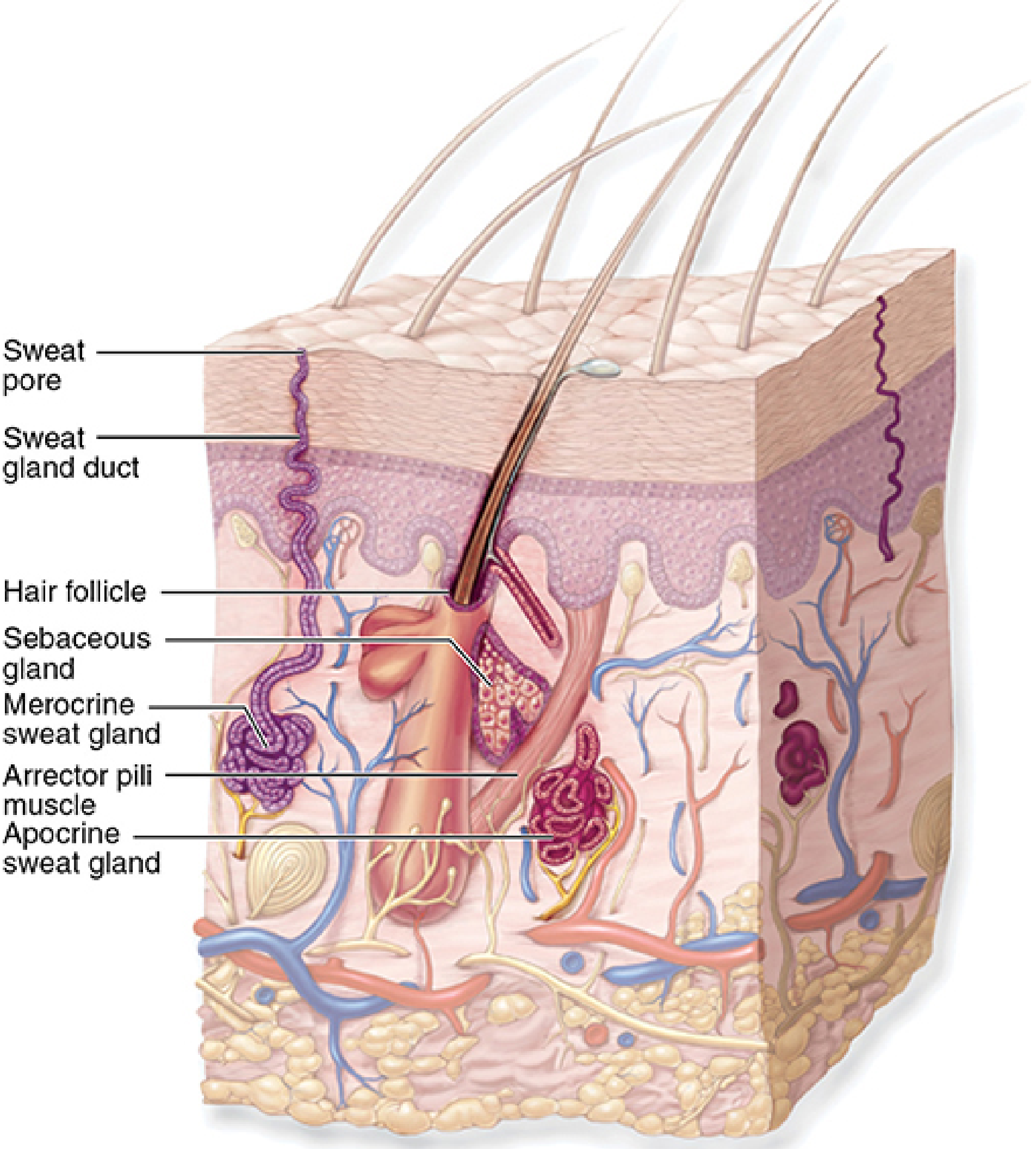
| Feature | Sweat Glands (Sudoriferous) | Sebaceous Glands |
|---|---|---|
| Type of gland | Simple coiled tubular (eccrine) or simple branched tubular (apocrine) | Simple branched alveolar (acinar) |
| Mode of secretion | Merocrine (eccrine) — secretory product released by exocytosis without cell destruction; apocrine glands use a mix of merocrine and apocrine mechanisms | Holocrine — the entire secretory cell dies and becomes the secretory product; cell debris is discharged along with lipid |
| Secretory product | Sweat — watery, hypotonic fluid containing water, NaCl, urea, ammonia, and small amounts of glycoproteins | Sebum — complex oily mixture of wax esters, squalene, cholesterol, and triglycerides |
| Distribution | Widely distributed over entire body surface; most numerous on palms and soles (~620/cm²); eccrine glands total ~3 million | Associated almost exclusively with hair follicles (pilosebaceous units); absent in palms and soles; open directly onto epidermis only in hairless regions (eyelids, penis, nipples) |
| Duct opening | Open independently onto the skin surface via a sweat pore; ducts spiral through the epidermis | Open into the hair follicle canal (pilosebaceous canal), not directly onto the skin surface in most areas |
| Cell types in secretory unit | Three cell types: clear cells (produce watery sweat), dark cells (secrete bactericidal glycoproteins), and myoepithelial cells (aid expulsion) | Sebocytes — lipid-laden cells that differentiate from basal progenitors; no myoepithelial cells involved in secretion |
| Function | Thermoregulation (primary); electrolyte excretion; bactericidal activity; emotional response (palms/soles) | Lubrication and waterproofing of hair and skin; bacteriostatic (via fatty acids); pheromone signaling (apocrine-like scent in axillae) |
| Hormonal control | Eccrine: innervated by cholinergic sympathetic fibres; also respond to adrenaline | Strongly stimulated by androgens (testosterone, adrenal androgens); secretion increases dramatically at puberty |
| Histological appearance | Secretory coil stains poorly (pale); duct stains darker with two layers of small cuboidal cells; small lumens | Clusters of large, pale-staining sebocytes with vacuolated cytoplasm (lipid dissolved out during processing); peripherally located flattened progenitor cells |
| Clinical relevance | Excess sweating = hyperhidrosis; reduced sweating = anhidrosis; sweat gland tumors (syringoma, eccrine poroma) | Blockage → comedones/acne vulgaris; hyperactivity at puberty → acne; sebaceous cysts (epidermoid cysts) |
Key Points to Remember (Exam Focus)
- Secretion type is the core distinction: Sweat glands = merocrine; Sebaceous glands = holocrine.
- Product nature: Sweat is aqueous and thermoregulatory; sebum is lipid-rich and lubricating.
- Duct destination: Sweat → skin surface; sebum → hair follicle.
- Myoepithelial cells are present in sweat glands (aid secretion) but absent in sebaceous glands.
- Hormonal trigger: Sebaceous glands are androgen-dependent; sweat glands are neurally (cholinergic) controlled.
Sources: Junqueira's Basic Histology: Text and Atlas, 17e, pp. 933–937; Histology: A Text and Atlas with Correlated Cell and Molecular Biology, pp. 1278–1396
This is a shared conversation. Sign in to Orris to start your own chat.