
How to manage thoracic duct injury post MRND?
Reading File
Now let me search the medical library and PubMed in parallel for thoracic duct injury management post MRND.
Finding Sources
Searching PubMed
"thoracic duct injury" AND "neck dissection"
Let me search more specifically for chyle leak management post neck dissection and read the most relevant textbook sections:
Finding Sources
Searching PubMed
"chyle leak" AND "neck dissection" AND management
Excellent - found the key sections. Let me read the Cummings and Scott-Brown sections in parallel:
Reading File
Reading File
Let me read the rest of the Scott-Brown section and fetch the intraoperative image:
Reading File
Reading File
Loading Image
I now have comprehensive information. Let me compile the full answer.
Thoracic Duct Injury After Modified Radical Neck Dissection (MRND)
Incidence & Anatomy
Chyle leak complicates neck dissection (including MRND) in 1-8% of cases. The vast majority (up to 95%) occur on the left side, where the thoracic duct enters the base of the neck, crosses between the internal jugular vein (IJV) and the anterior scalene muscle, and terminates at the junction of the left IJV and left subclavian vein. Up to 25% can occur on the right due to injury to the right lymphatic duct. Because the duct exists as a plexus of tributaries rather than a single vessel, any of these branches can cause a chylous fistula if transected or incompletely ligated.
Approximately 2-4 litres of chyle flows through the thoracic duct daily, varying with dietary fat intake.
- Cummings Otolaryngology Head and Neck Surgery, p. 2324
- Scott-Brown's Otorhinolaryngology Head & Neck Surgery, p. 565
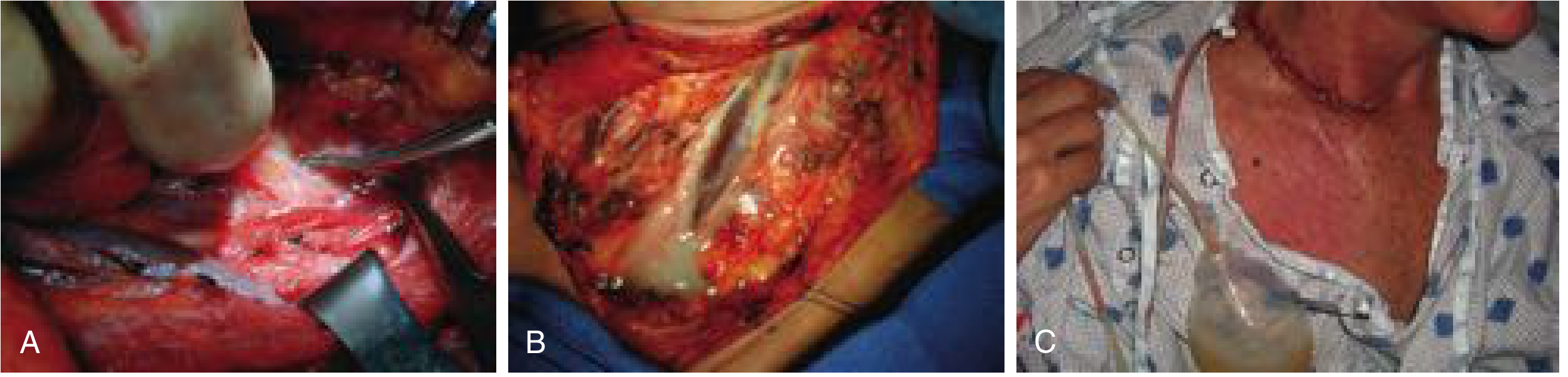
Fig. 119.9 - Chylous Fistula
(A) Intact thoracic duct during dissection. (B) Intraoperative chyle leak during left neck dissection. (C) Postoperative milky drain output after resumption of oral feeding.
Intraoperative Recognition & Management
Detection:
- Ask the anesthesiologist to administer positive ventilatory pressure - this causes pooling of milky fluid or visualization of discrete lymph vessels.
Intraoperative repair:
- Meticulous ligation of the duct and all identifiable branches with non-absorbable sutures (e.g., silk)
- Use of the operating microscope for better visualization
- Adjunctive measures: fat grafting, application of Surgicel or a sclerosing agent to the region
- Mass ligation of all fatty tissue in the area (mass ligature of the "floor" of the dissection)
Postoperative Diagnosis
Clinical recognition:
- Drain output changes from serosanguinous to milky/creamy - typically after resumption of oral feeding
- Drain fluid TG level >100 mg/dL AND greater than serum TG = diagnostic of chyle leak
- Drain fluid TG >110 mg/dL is diagnostic (Scott-Brown's)
- TG <50 mg/dL usually rules it out (unless fasted or malnourished)
- If TG is between 50-110 mg/dL, chylomicron analysis by electrophoresis is confirmatory
Classification by output:
| Category | Volume | Management |
|---|---|---|
| Low output | <500 mL/24 hrs | Conservative |
| High output | >500 mL/24 hrs | More likely requires intervention |
| Very high output | >1000 mL/24 hrs | TPN considered first-line |
Essential investigation: Chest X-ray to rule out concurrent chylothorax.
Management Algorithm
Step 1: Conservative Management (for low-output leaks)
This is the mainstay for most leaks and works by reducing chyle production:
-
Dietary modification (nutritional cornerstone):
- Medium-chain triglyceride (MCT) diet - MCTs are absorbed directly into the portal circulation, bypassing the lymphatic system, thus dramatically reducing chyle flow
- A fat-free or high-MCT enteral formula is used
- Avoid long-chain triglycerides (LCTs) which enter the bloodstream via chyle
-
Pressure dressing over the neck wound to encourage skin-flap adherence and tamponade the leak
-
Closed drainage (keep the drain in situ) to promote adherence of flaps and monitor output
-
Somatostatin analogue - Octreotide:
- Reduces splanchnic blood flow and GI chyle production
- Administered subcutaneously or IV
- Beneficial adjunct; a systematic review (PMID 36110865) supports its role in stopping post-surgical chyle leak
-
Orlistat (pancreatic lipase inhibitor, over-the-counter):
- Reduces dietary fat absorption, thereby reducing chyle production
- May be equally efficacious to octreotide in some cases
Step 2: Total Parenteral Nutrition (TPN)
- Indicated for very high output leaks (>1000 mL/24 hrs) or when dietary manipulation fails
- Eliminates enteral fat absorption entirely, giving the fistula opportunity to heal
- Should not be first-line unless extreme output
Step 3: Surgical/Interventional Re-exploration
Indicated when:
- High-output leak (>500-1000 mL/24 hrs based on institutional threshold) not responding to conservative management
- Chyloma refractory to needle aspiration, pressure dressings, and dietary restriction
- Failure of conservative measures after ~2 weeks (most clinicians)
Options:
- Re-exploration and surgical ligation - direct exploration of the neck wound, identification of the leaking duct/tributaries, and re-ligation with non-absorbable sutures +/- sclerosant/muscle flap placement
- Percutaneous lymphangiography + embolization of the thoracic duct - promising for recalcitrant leaks; less invasive than open re-exploration
- Video-assisted thoracoscopic surgery (VATS) ligation of the thoracic duct - recommended by some as preferred treatment for persistent chyle leaks; approaches the duct at the thoracic level
Management of Chylothorax (Rare Complication)
If concurrent chylothorax develops (via retrograde pressure or mediastinal extension):
- Dietary modifications
- Thoracentesis or thoracostomy tube drainage
- Somatostatin analogue injection
- Rarely: thoracoscopic or open thoracotomy for thoracic duct ligation in the chest
Summary Algorithm
Thoracic Duct Injury Post MRND
        |
        +--> Intraoperative recognition?
        |         YES -> Positive pressure ventilation, meticulous ligation,
        |                non-absorbable sutures +/- Surgicel/sclerosant
        |
        +--> Postoperative (milky drain, TG >100 mg/dL)
                  |
                  +--> CXR to rule out chylothorax
                  |
                  +--> LOW OUTPUT (<500 mL/day):
                  |    MCT diet + pressure dressing + closed drain ± octreotide ± orlistat
                  |    -> Most will close spontaneously
                  |
                  +--> HIGH OUTPUT (>500-1000 mL/day):
                  |    Above + consider TPN
                  |    -> If no improvement in 5-7 days: surgical re-exploration
                  |
                  +--> REFRACTORY / CHYLOMA:
                       Percutaneous embolization OR VATS thoracic duct ligation
Recent Evidence
- A 2024 systematic review (PMID 37014458) on nutritional management of chyle leak after head and neck surgery proposed a structured protocol, reinforcing MCT-based dietary management as the cornerstone.
- A comprehensive 2024 review (PMID 38419516) in J Korean Assoc Oral Maxillofac Surg covers the full spectrum of diagnosis and management strategies.
- Octreotide's role is supported by a 2022 systematic review (PMID 36110865).
Key point: Early dietitian involvement is essential. Most low-output leaks will resolve with MCT diet and pressure dressings alone. High-output or persistent leaks should not be managed conservatively for more than 5-7 days before escalating to re-exploration or embolization.
- Cummings Otolaryngology Head and Neck Surgery, pp. 2324-2325
- Scott-Brown's Otorhinolaryngology Head & Neck Surgery, p. 565
This is a shared conversation. Sign in to Orris to start your own chat.