
BCG vaccination according to park textbook of ps,
BCG Vaccination
History
(1) Aim
(2) Vaccine
- BCG is the only widely used live bacterial vaccine.
- Consists of living attenuated bovine strain of tubercle bacilli.
- Derived from the original Calmette strain.
- Many substrains have evolved due to different production methods.
- WHO recommended strain: "Danish 1331" (used at BCG Laboratory, Guindy, Chennai since January 1967).
- Quality control: International Reference Centre at Copenhagen.
(3) Types of Vaccine
- Liquid (fresh) vaccine
- Freeze-dried vaccine - more stable, superior keeping quality; present-day vaccines are distributed in this form.
- Stable for several weeks at ambient tropical temperature.
- Up to 1 year if kept away from direct light and refrigerated at below 10°C.
- Must be protected from light during storage (wrapped in double layer of red or black cloth).
- Normal saline is the recommended diluent (distilled water may cause irritation).
- Reconstituted vaccine must be used within 3 hours; leftover vaccine must be discarded.
(4) Dosage
| Age | Dose |
|---|---|
| Standard dose | 0.1 mg in 0.1 ml |
| Newborns < 4 weeks | 0.05 ml (reduced because newborn skin is thin; full dose risks penetrating deeper tissue, causing local abscess and axillary lymphadenopathy) |
(5) Administration
- Route: Strictly intradermal using a "Tuberculin" syringe (Omega microstat syringe with 1 cm, 26-gauge intradermal needle).
- Syringe-and-needle technique is the most precise method.
- Other methods (bifurcated needle, dermo-jet) are less accurate.
- Subcutaneous injection increases risk of abscess formation.
- Site: Just above the insertion of the left deltoid muscle (left upper arm).
- Skin must not be contaminated with antiseptic/detergent; if alcohol is used, it must evaporate before injection.
- No other injection should be given into the BCG-vaccinated arm for at least 6 months.
(6) Age Policy
- India (high-TB prevalence countries): BCG given very early in infancy:
- At birth (for institutional deliveries), OR
- At 6 weeks simultaneously with DPT and polio
- BCG given early in life provides high protection, especially against:
- Severe forms of childhood tuberculosis
- Tuberculous meningitis
- Low-prevalence countries: Restriction to high-risk groups (hospital personnel, tuberculin-negative contacts of TB cases especially MDR-TB).
(7) Normal Phenomena After Vaccination
| Timeframe | Expected Finding |
|---|---|
| 2-3 weeks post-injection | Papule develops at injection site |
| ~5 weeks | Papule reaches 4-8 mm diameter |
| Subsequently | Subsides or forms a shallow ulcer (usually crust-covered) |
| 6-12 weeks | Spontaneous healing leaving a permanent, round scar of 4-8 mm |
| 8 weeks (sometimes 14 weeks) | Individual becomes Mantoux-positive |
(8) Complications
| Complication | Frequency |
|---|---|
| Prolonged ulceration / suppurative lymphadenitis | 1-10% of vaccinations |
| Osteomyelitis | Rare |
| Disseminated BCG infection | < 1 per million vaccinations (usually with severe cellular immunodeficiency) |
| Death | Very rare |
- First: Aspiration
- If unsuccessful: Incision + local applications of PAS or INH powder (daily)
- No systemic INH needed
- Patient should be reassured of harmless nature
(9) Protective Value
- Duration of protection: 15 to 20 years.
- Mechanism: Local BCG infection generates immunity associated with tuberculin hypersensitivity.
- First prospective controlled trial: 80% effectiveness over 20 years.
- Range of protection in various trials worldwide: 0 to 80% (highly variable).
- South India trial found poor protection, possibly due to prior exposure to non-tuberculous environmental mycobacteria (e.g., M. vaccae, M. non-chromogenicum) conferring partial immunity and masking BCG benefit. M. kansasii and M. scrofulaceus have an antagonistic action against BCG.
- Infants and young children vaccinated before contact with environmental mycobacteria do derive protection.
- WHO holds it unreasonable to stop current BCG vaccination programmes.
(10) Revaccination
- Duration of protection is still disputed even 90 years after vaccine development.
- BCG revaccination is NOT included in India's official EPI (Expanded Programme on Immunization) schedule.
- Booster doses are not routinely indicated.
(11) Contraindications
- Generalized eczema or infective dermatosis
- Hypogammaglobulinaemia
- Known/suspected congenital immunodeficiency
- Leukaemia, lymphoma, or generalized malignant diseases
- Patients under immunosuppressive treatment (corticosteroids, alkylating agents, antimetabolites, radiation)
- Symptomatic HIV infection
- Pregnancy
(12) Direct BCG Vaccination
- Direct BCG vaccination (without prior tuberculin test) is India's national policy.
- Allows faster, more complete coverage at lower cost.
- No adverse effects reported in tuberculin-positive reactors.
- Best practice: administer BCG during infancy before contact with environmental mycobacteria.
(13) Impact
- BCG is less effective than active case-finding and chemotherapy.
- Offers only partial protection.
- A 1982 WHO Expert Committee concluded BCG can prevent tuberculosis in uninfected individuals but has only relatively small epidemiological effect on overall risk of infection in the community.
(14) BCG Vaccination and HIV Infection
- Previous WHO recommendation: In high TB-burden countries, BCG should be given to all healthy infants at birth unless the child had symptomatic HIV infection.
- Revised recommendation (GACVS): Children known to be HIV-infected, even if asymptomatic, should NOT be immunized with BCG vaccine, because:
- HIV-infected children vaccinated at birth who later developed AIDS were at increased risk of disseminated BCG disease.
- Benefits of preventing severe TB are outweighed by risks.
- However: Most infants born to HIV-infected mothers are themselves uninfected (due to PMTCT interventions) and would benefit from BCG.
- Accurate HIV diagnosis in the first year of life is technically challenging and expensive; WHO recommends HIV testing at around 6 weeks of age, but this is often after BCG has already been given.
(15) Combined Vaccination
- BCG may be given simultaneously with:
- Oral polio vaccine
- DPT vaccine (in a different arm) - without reducing immune responses or increasing complications
- Mixed vaccines containing BCG have not yet been introduced.
Criteria for Switching from General to Selective BCG Vaccination ("Low Endemicity" Criteria)
- (a) Average annual notification rate of smear-positive pulmonary TB < 5 per 100,000
- (b) Average annual notification rate of tubercular meningitis in children under 5 years < 1 per 10 million population over previous 5 years
- (c) Average annual risk of TB infection < 0.1%
Summary
BCG vaccination is a fundamental component of a national tuberculosis programme. Despite contradictory trial evidence, BCG plays a valuable role in preventing severe forms of childhood tuberculosis - especially meningitis and miliary tuberculosis. BCG is part of WHO's Expanded Programme on Immunization (EPI). The greatest need remains in developing countries where TB is still a major health problem.
- Park's Textbook of Preventive and Social Medicine, pp. 231-232
Search for recent clinical guidelines on BCG in HIV-positive infants
BCG vaccine HIV-infected infants
BCG vaccination HIV positive infants guidelines WHO 2024 2025
BCG vaccine HIV infants safety disseminated
https://cdn.who.int/media/docs/default-source/immunization/i…
BCG vaccination HIV exposed infants ART immunocompromised
WHO BCG HIV infant 2024 2025 ART delay recommendation GACVS
BCG vaccine HIV children immunization
https://www.mdpi.com/2076-393X/14/1/40
PMID: 40334156
PMID: 38822485
PMID: 37814073
Recent Clinical Guidelines: BCG Vaccination in HIV-Positive Infants
Overview of the Core Problem
WHO / GACVS Current Recommendations (Updated December 2025)
| Infant Category | Recommendation |
|---|---|
| Confirmed HIV-infected (by early virological testing) | Delay BCG until ART started AND infant is immunologically stable (CD4% >25%) |
| HIV-infected, on ART, clinically well, immunologically stable (CD4% >25% if <5 yrs; CD4 ≥200 if >5 yrs) | Should be vaccinated with BCG |
| HIV-exposed but uninfected (HEU) - unknown status, no clinical signs, mother HIV+ | Vaccinate - benefits outweigh risks regardless of whether mother is on ART |
| Born to women of unknown HIV status | Vaccinate - benefits outweigh risks |
| Known HIV-infected (even asymptomatic) | Do NOT vaccinate with BCG |
Rationale Behind These Recommendations
- Disseminated BCG disease risk approaches 1% in HIV-positive infants - data from Argentina and South Africa. This is enormously higher than the <1 per million risk in immunocompetent infants.
- HIV severely impairs BCG-specific T-cell responses in the first year of life - meaning BCG may provide little or no protection against TB in these infants, removing the benefit side of the risk-benefit equation.
- HAART/ART may reduce dBCG disease rate and immune reconstitution inflammatory syndrome (IRIS) risk, supporting the "delay-until-stable-on-ART" strategy.
- Early virological testing (recommended by WHO at ~6 weeks of age) is often technically demanding and expensive in high-burden settings, and is frequently done after BCG has already been administered.
The Practical Dilemma in Low-Resource Settings
- BCG vaccination should continue at birth for all infants regardless of HIV exposure, given the high TB endemicity in such populations.
- Close follow-up of infants known to be born to HIV-infected mothers is mandatory to detect and treat any BCG-related complications early.
- Where adequate HIV services exist (early virological testing + rapid ART initiation), BCG should be deferred until HIV status is confirmed.
Recent PubMed Evidence
Comparison: Park's Textbook vs. Current Guidelines
| Point | Park's Textbook (older edition) | Current WHO 2025 |
|---|---|---|
| HIV-positive symptomatic infant | Do NOT vaccinate | Do NOT vaccinate |
| HIV-positive asymptomatic infant | Not clearly addressed | Do NOT vaccinate (GACVS revised) |
| HIV-exposed but uninfected | Not specifically addressed | Vaccinate (benefits > risks) |
| HIV+ on ART, clinically stable | Not addressed | CAN vaccinate if CD4% >25% |
| Delay strategy with early testing | Not addressed | Defer BCG until HIV status confirmed, then start ART first |
Summary
- Known HIV-infected infant = BCG contraindicated, even if asymptomatic
- Unknown status in a high-burden setting = vaccinate at birth, follow up closely
- HIV-exposed but confirmed uninfected = vaccinate normally
- HIV-infected but stable on ART (CD4% >25%) = BCG can be given
cardinal symptoms of tb
Cardinal Symptoms of Tuberculosis
Respiratory (Pulmonary) Symptoms
1. Cough
- The most common and earliest symptom
- Initially dry and non-productive, progressing to productive (purulent or mucoid sputum) as cavitation develops
- Chronic cough lasting >2-3 weeks is the key screening threshold
- Cough may develop late in primary TB, usually only after tubercle cavitation
2. Hemoptysis (Blood in Sputum)
- Ranges from blood-streaked sputum to frank hemoptysis
- Indicates cavitation or erosion of a blood vessel by the TB lesion
- One of the most specific "alarm" symptoms that should trigger immediate TB workup
- Described across all major textbooks as a cardinal feature
3. Chest Pain
- Usually pleuritic in nature - sharp, worsening on breathing/coughing
- Suggests pleural involvement (pleuritis or pleural effusion)
- May also arise from extensive parenchymal disease
4. Dyspnea (Breathlessness)
- Occurs with extensive lung disease, pleural effusion, or miliary TB
- Usually a later feature in the course of disease
Constitutional (Systemic) Symptoms
5. Fever
- Characteristically low-grade with an evening rise in temperature (pyrexia of insidious onset)
- Often described as a "diurnal fever" - temperature peaks in the late afternoon/evening
- The patient may be unaware of fever, only noticing the associated night sweats
6. Night Sweats
- Drenching night sweats - the patient wakes soaked
- Caused by the evening fever and its subsequent defervescence overnight
- Highly characteristic of TB and other chronic granulomatous/infectious diseases
7. Weight Loss and Anorexia
- Progressive, unexplained weight loss
- Anorexia (loss of appetite) typically precedes the weight loss
- In advanced disease, leads to frank cachexia (wasting)
- Caused by cytokine-driven catabolism (TNF-α, IL-1, IL-6) and reduced caloric intake
8. Fatigue and Malaise
- Generalized weakness, lassitude, and easy fatigability
- Often the earliest and most subtle constitutional complaint
- Patients frequently attribute it to overwork or stress, delaying presentation
Summary Table
| Symptom | Type | Key Feature |
|---|---|---|
| Chronic cough (>2 weeks) | Respiratory | Earliest, most common |
| Hemoptysis | Respiratory | Blood-stained/frank; cavitation sign |
| Chest pain (pleuritic) | Respiratory | Pleural involvement |
| Dyspnea | Respiratory | Late feature |
| Fever (low-grade, evening rise) | Constitutional | Insidious onset |
| Night sweats | Constitutional | Drenching, nocturnal |
| Weight loss / Anorexia | Constitutional | Progressive, unexplained |
| Fatigue / Malaise | Constitutional | Earliest and most subtle |
Primary vs. Reactivation TB - Symptom Differences
| Feature | Primary TB | Reactivation TB |
|---|---|---|
| Initial infection | Often asymptomatic | Symptoms present |
| Systemic symptoms | Mild - cough, fever, malaise | Fever, night sweats, weight loss (prominent) |
| Pulmonary symptoms | Cough, chest pain | Productive cough, hemoptysis, dyspnea, pleuritic pain |
| Progression | Slowly progressive | More prominent symptoms, upper lobe cavitation |
| Detection | Often by TST or CXR | Clinical symptoms + CXR |
- Tintinalli's Emergency Medicine, p. 796
Classic "Alarm" Triad for TB Screening
Hemoptysis + Night sweats + Weight loss
- Tintinalli's Emergency Medicine: "Clues that suggest tuberculosis include hemoptysis, night sweats, and weight loss."
- Textbook of Family Medicine: "Cough, hemoptysis, night sweats, fever, and weight loss suggest the need to investigate for tuberculosis."
Extrapulmonary TB - Additional Cardinal Features by Site
| Site | Cardinal Symptom |
|---|---|
| Lymph nodes (Scrofula) | Painless cervical lymphadenopathy |
| Spine (Pott's disease) | Back pain, kyphosis, paraplegia |
| Meninges (TBM) | Headache, neck stiffness, altered sensorium |
| Peritoneum | Abdominal pain, ascites, doughy abdomen |
| Pericardium | Chest pain, dyspnea, JVP elevation |
| Kidney (Renal TB) | Sterile pyuria, hematuria, flank pain |
| Miliary TB | High fever, hepatosplenomegaly, choroid tubercles |
A Note on Atypical Presentations
- Tietz Textbook of Laboratory Medicine: "Typical signs and symptoms of tuberculosis may be absent in individuals with advanced AIDS, resulting in a delay in diagnosis."
make the bcg vaccination into a flowchart for revison
A detailed medical revision flowchart titled "BCG Vaccination - Complete Overview (Park's Textbook)" covering all the following topics in a structured top-to-bottom flow with color-coded boxes: START: BCG Vaccination (large blue header box) Branch 1 - VACCINE (green box): - Live attenuated bovine strain (Calmette strain) - WHO recommended: Danish 1331 strain - Types: Freeze-dried (preferred) vs Liquid - Storage: Below 10°C, away from light, wrapped in red/black cloth - Diluent: Normal saline only - Reconstituted vaccine: Use within 3 hours, discard leftovers Branch 2 - DOSAGE & ADMINISTRATION (orange box): - Standard dose: 0.1 mg in 0.1 ml - Newborns <4 weeks: 0.05 ml (thin skin) - Route: STRICTLY INTRADERMAL (26G needle, tuberculin syringe) - Site: Left upper arm (above deltoid insertion) - No injection in same arm for 6 months Branch 3 - AGE POLICY (yellow box): - India (high TB burden): At birth (institutional) OR 6 weeks (with DPT + OPV) - Low-prevalence countries: Selective vaccination (high-risk groups only) - Low endemicity criteria: smear+ TB <5/100,000 OR TB meningitis <1/10 million OR annual risk <0.1% Branch 4 - POST-VACCINATION PHENOMENA (purple box): - 2-3 weeks: Papule develops - 5 weeks: Papule 4-8 mm diameter - 6-12 weeks: Heals → permanent scar 4-8 mm - 8-14 weeks: Mantoux becomes positive Branch 5 - COMPLICATIONS (red box): - Ulceration/lymphadenitis: 1-10% - Disseminated BCG: <1 per million (except immunodeficient) - Management of abscess: Aspiration → if failed: incise + local PAS/INH powder (NO systemic INH) Branch 6 - PROTECTIVE VALUE (teal box): - Duration: 15-20 years - Efficacy range: 0-80% (variable worldwide) - First trial efficacy: 80% over 20 years - South India trial: Poor result (environmental mycobacteria interference) - Best protection: Infants vaccinated before environmental mycobacteria exposure Branch 7 - CONTRAINDICATIONS (dark red box): - Eczema / infective dermatosis - Hypogammaglobulinaemia - Congenital immunodeficiency - Leukaemia / lymphoma / malignancy - Immunosuppressive therapy - Symptomatic HIV infection - Pregnancy Branch 8 - HIV-SPECIFIC POLICY (pink box): - Known HIV-infected (even asymptomatic): DO NOT vaccinate - HIV-exposed but uninfected: VACCINATE (benefits > risks) - HIV+ on ART, clinically stable, CD4% >25%: CAN vaccinate - Unknown status in high-burden setting: Vaccinate at birth + close follow-up - Early virological testing available: Defer BCG until HIV status confirmed Branch 9 - COMBINED VACCINATION (light blue box): - Can be given WITH OPV (same time) - Can be given WITH DPT (different arm) - No mixed BCG vaccines available yet BOTTOM BOX - KEY POINTS FOR REVISION: - Only widely used live bacterial vaccine - Part of WHO EPI - Revaccination NOT included in India's EPI - Direct BCG (no prior tuberculin test) = India's national policy - Less effective than case-finding + chemotherapy Clean white background, clear arrows connecting sections, color-coded boxes with bold headers, small readable text, compact layout suitable for medical exam revision
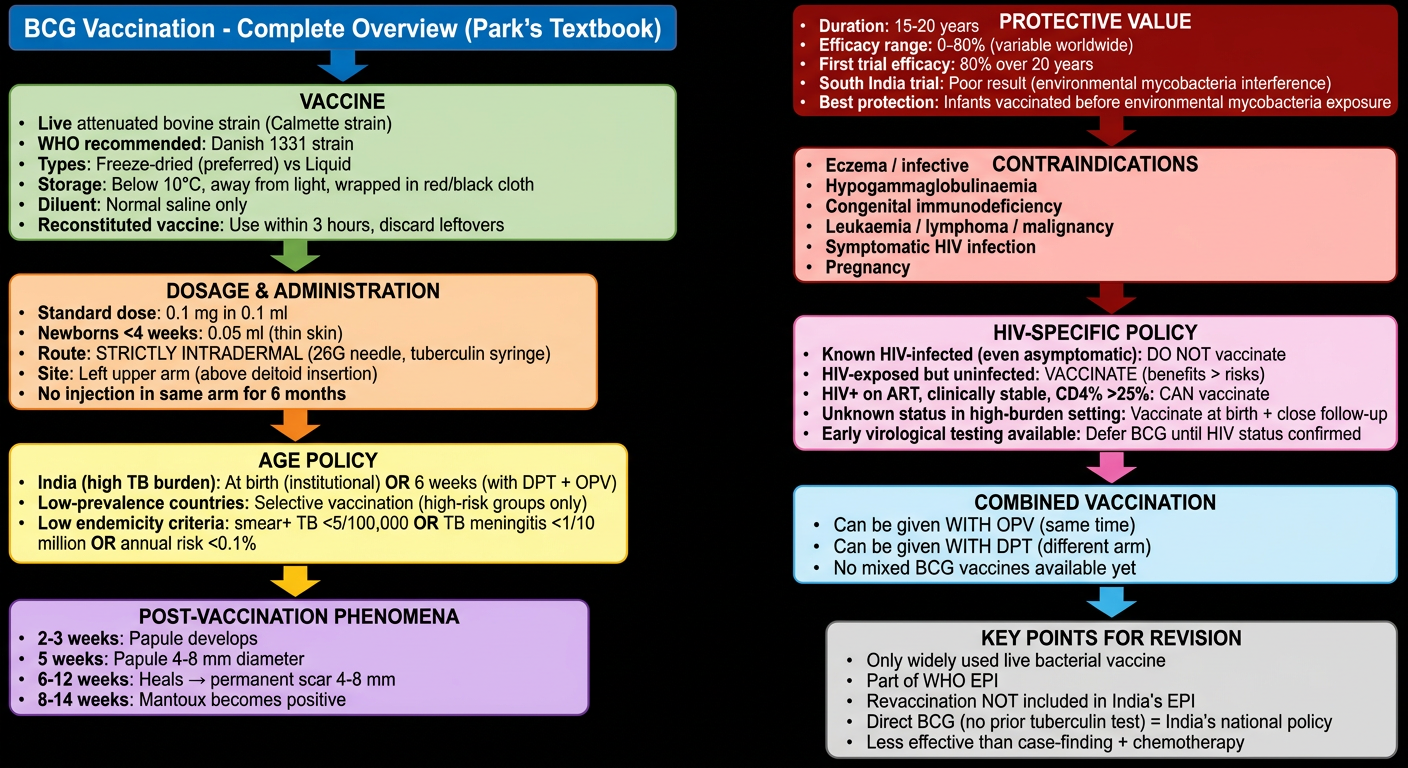
| Color | Section |
|---|---|
| 🟢 Green | Vaccine (strain, types, storage) |
| 🟠 Orange | Dosage & Administration |
| 🟡 Yellow | Age policy & low-endemicity criteria |
| 🟣 Purple | Post-vaccination phenomena (timeline) |
| 🔴 Red | Complications & management |
| 🩵 Teal | Protective value & efficacy |
| 🟥 Dark red | Contraindications |
| 🩷 Pink | HIV-specific policy (updated GACVS) |
| 💙 Light blue | Combined vaccination & key revision points |
- Dose: 0.1 ml standard / 0.05 ml for newborns <4 weeks
- Scar: 4-8 mm, appears by 6-12 weeks
- Mantoux positive: by 8 weeks (max 14 weeks)
- Complications: Lymphadenitis 1-10%, disseminated <1/million
- Duration: 15-20 years protection
- Efficacy: 0-80% (variable) - first trial showed 80%
resurgence of diphtheria
diphtheria resurgence outbreak epidemiology
diphtheria outbreak vaccination waning immunity
diphtheria resurgence 2024 2025 outbreak causes WHO epidemiology
PMID: 38018582
PMID: 34543411
https://www.panafrican-med-journal.com/content/series/51/1/2…
Resurgence of Diphtheria
What is the "Resurgence"?
Historical Context
| Era | Situation |
|---|---|
| Pre-vaccine | Diphtheria was a leading killer of children worldwide |
| 1940s-1980s | Mass immunization with DTP led to dramatic decline |
| 1990s (Former Soviet Union) | Largest modern diphtheria epidemic - over 157,000 cases and 5,000 deaths across FSU states (Russia, Ukraine, etc.) due to collapse of immunization infrastructure |
| 2000s-2010s | Sporadic outbreaks in South Asia, Africa, Southeast Asia |
| 2020s | Major resurgence - African Region, Yemen, Indonesia, Nigeria, Somalia, India |
Causes of Resurgence - Park's Textbook Framework
"These epidemics are largely due to: (1) decreasing immunization coverage among infants and children, (2) waning immunity to diphtheria in adults, (3) movement of large groups of population, and (4) an irregular supply of vaccine."
- Park's Textbook of Preventive and Social Medicine
1. Declining / Inadequate Vaccination Coverage
- The most fundamental cause
- Low DTP3 coverage leaves large cohorts of unprotected children
- Incomplete primary series (1-2 doses only) gives partial and unreliable protection
- In developing countries: insufficient supply, poor cold chain, low uptake due to poor health literacy, negative sociocultural/religious beliefs
2. Waning Immunity in Adults
- Childhood vaccination confers protection that fades over time
- A landmark 2022 systematic review and meta-analysis (Gao et al., Journal of Infectious Diseases) confirmed evidence of waning post-vaccination immunity for both diphtheria and pertussis, while tetanus and polio vaccines provided sustained protection [PMID: 34543411]
- Adults who received childhood DTP but no boosters become susceptible over decades
- This creates a pool of susceptible adults, explaining the age-shift seen in outbreaks: cases are increasingly in older children, adolescents, and adults rather than infants
3. Population Movement and Displacement
- Mass migration, refugee crises, and conflict-driven displacement break immunization chains
- Overcrowding in camps and urban slums facilitates transmission
- Current example: Southern Algeria - high national DTP coverage (98%) but resurgence in border regions due to mass displacement from neighboring conflict-affected countries
4. Irregular Vaccine Supply
- Fragile supply chains, especially in conflict zones
- Shortage of Diphtheria Antitoxin (DAT) - critical for treatment but manufactured by very few pharmaceutical companies due to low commercial demand globally
- Nigeria's 2022-2023 outbreak review identified DAT unavailability as the primary driver of high mortality [PMID: 38018582]
5. Reduced Natural Boosting
- Park notes: "Changes in lifestyle allow far less opportunity to maintain natural immunity, such as through frequent skin infection with C. diphtheriae"
- In the past, repeated subclinical exposure naturally boosted immunity; modern sanitation reduces this
6. Vaccine Toxoid vs. Carrier State
- Critically: immunization does not prevent the carrier state - it only prevents disease
- This means even in well-vaccinated populations, C. diphtheriae can circulate silently
- Park's: "The vaccine being a toxoid is not directed against organisms. Therefore immunization does not prevent the carrier state; consequently, the non-immune individuals are not protected by a high level of population immunity."
- Implication: immunization rates must remain very high - there is no herd immunity buffer
Current Global Resurgence (2023-2026) - WHO Data
African Region - Major Ongoing Crisis
| Country | Period | Suspected Cases | Deaths | CFR |
|---|---|---|---|---|
| Guinea | Jan 2025 - Feb 2026 | 795+ | 151 | 19-25.8% |
| Algeria | 2024-2025 | 915 | 119 | 13% |
| Chad | Jan - Oct 2025 | 4,341 | 46 | 1.1% |
| Nigeria | 2023-ongoing | Large outbreak | Significant | ~3.5% |
| Niger | 2023-ongoing | Part of regional crisis | Multiple | ~3.5% |
| Somalia | Aug 2025 | 1,811 suspected | 89 | ~5% |
| South Africa | Late 2024 - 2026 | 158 respiratory cases | 19 | ~12% (adults predominant) |
- Over 50% of suspected cases are unvaccinated or of unknown vaccination status
- Most cases in children under 15 years
- Some outbreaks (South Africa, Algeria) showing adult predominance (70% adults in South Africa) - indicating waning immunity as the driver
- Guinea's CFR of 19-25.8% is among the highest ever recorded in modern outbreaks, driven by DAT unavailability and delayed health-seeking
Yemen and Middle East
India
Why Diphtheria is Particularly Prone to Resurgence
| Feature | Consequence |
|---|---|
| Toxoid vaccine (not whole-organism) | Does NOT prevent carriage; no herd immunity benefit |
| Waning immunity | Adults become susceptible without boosters every 10 years |
| Carrier state silent | Organism circulates undetected in community |
| DAT is the only treatment | Antitoxin not widely available; expensive to manufacture |
| Long incubation (2-5 days) | Spreads before detected |
| Droplet + contact transmission | Highly contagious in crowded settings |
Control Measures (Park's Textbook)
Case Management
- Diphtheria Antitoxin (DAT): Given immediately without waiting for lab confirmation
- Mild/early disease: 20,000-40,000 units
- Moderate nasopharyngeal: 40,000-60,000 units
- Severe/late (≥3 days): 80,000-100,000 units
- Always give 0.2 ml subcutaneous test dose first (horse serum allergy check)
- Antibiotics: Penicillin or erythromycin for 5-6 days (clears throat of organisms, reduces toxin production)
- Isolation: Minimum 14 days OR until 2 consecutive negative throat/nasal swabs 24 hours apart
Contact Management
- Throat swabs + immunity status check
- Booster within 5 years? → No action needed
- Booster >5 years ago? → Give booster only
- Non-immunized? → Prophylactic penicillin/erythromycin + 1,000-2,000 units DAT + active immunization
- Daily surveillance for ≥7 days
Community - Prevention
- Primary immunization of all infants as early as possible (DPT series)
- Booster doses every 10 years throughout life
- Use of Td (tetanus-diphtheria) vaccine rather than monovalent tetanus toxoid to maintain adult diphtheria immunity
- Catch-up vaccination beyond 5 years of age in outbreak settings
- Strengthening cold chain and vaccine supply
Key Exam Points on Diphtheria Resurgence
- Classic example: FSU epidemic 1990-1997 (157,000 cases) - gold standard for resurgence due to immunization collapse
- Four causes (Park's): Low coverage + waning adult immunity + population movement + irregular vaccine supply
- Critical point: Diphtheria toxoid does NOT prevent carriage → no herd immunity → requires near-100% coverage
- Age shift: Outbreaks now affect adults and adolescents (not just children) due to waning immunity
- Treatment bottleneck: DAT is scarce globally - manufactured by few companies
- Waning immunity confirmed: Systematic review (Gao et al. 2022, J Infect Dis) shows diphtheria and pertussis immunity wanes post-vaccination; tetanus and polio do not [PMID: 34543411]
- Current crisis: African Region 2023-2026 - >57,000 cases, CFR up to 25.8% in Guinea
Discuss the occupations that have a higher risk of exposure to COVID disease. Explain the essential measures of prevention undertaken to protect them
occupational COVID-19 risk healthcare workers prevention
PMID: 37015285
PMID: 36863978
PMID: 37546332
occupational COVID-19 high risk jobs WHO NIOSH prevention measures 2023 2024
https://pmc.ncbi.nlm.nih.gov/articles/PMC11325298
Occupations at Higher Risk of COVID-19 Exposure and Preventive Measures
Why Occupation Matters
- Public-facing work (contact with many people)
- Working indoors (poor ventilation, aerosol accumulation)
- Working in close physical proximity to others (< 2 metres)
High-Risk Occupations - Classification
Tier 1: Very High Risk (Patient/Confirmed Case Contact)
1. Healthcare Workers (HCWs)
- Doctors, nurses, paramedics in COVID wards, ICUs, emergency departments
- Anaesthesiologists/ICU intensivists performing aerosol-generating procedures (AGPs): intubation, bronchoscopy, suctioning, nebulization, CPR
- Laboratory technicians handling respiratory samples (RT-PCR testing)
- Radiographers / medical imaging operators
- Mortuary and post-mortem staff (body fluids, aerosols)
- Ambulance and pre-hospital emergency workers
2. Social Care Workers
- Nursing home / residential care facility staff (elderly residents = high fatality risk)
- Disability care workers
- Home health aides and personal carers
Tier 2: High Risk (Essential Frontline Workers)
3. Education Workers
- Teachers and school staff (crowded, indoor, close contact with children who may be asymptomatic carriers)
- Childcare workers and early childhood educators
- Consistently cited across studies as having elevated COVID risk - reported in Denmark, UK, and multiple other countries
4. Food Supply Chain Workers
- Meat processing / poultry plant workers - notorious super-spreader environments (cold, humid, crowded, loud = shouting, poor ventilation)
- Food preparation staff (chefs, kitchen workers)
- Food products machine operators
- Grocery store / supermarket staff (customer-facing, high-contact)
5. Transportation Workers
- Public bus and rail drivers (enclosed spaces, multiple passengers)
- Taxi/rideshare drivers
- Airline crew (recirculated air, confined space)
- Truck and delivery drivers (loading docks, shared cabs)
- Study in 6 Asian countries identified drivers and transportation staff among the most-infected non-healthcare groups.
6. Retail and Customer Service Workers
- Supermarket cashiers, sales staff
- Pharmacists and pharmacy technicians
- High public-facing exposure with variable masking compliance by customers
7. Protective Services and Security Personnel
- Police officers, prison officers
- Security guards
- Reported in UK data as having elevated COVID-19 mortality risk
8. Waste Management and Sanitation Workers
- Handle potentially contaminated materials
- Work in proximity with multiple public spaces
Tier 3: Moderate Risk (Non-Essential but High-Exposure Settings)
- Construction workers (shared tools, shared transport, crowded worker accommodation)
- Personal services (barbers, beauticians, spa workers - close face-to-face contact)
- Religious leaders / clergy (congregational settings)
- Journalists and media personnel (field reporting in crowded settings)
OSHA Hierarchy of Controls Framework for COVID Prevention
Elimination → Substitution → Engineering Controls → Administrative Controls → PPE
Prevention Measures by Category
1. Engineering Controls (Physical/Environmental)
| Measure | Application |
|---|---|
| Ventilation improvement | Increase fresh air exchange, HEPA filters, negative-pressure rooms for AGPs |
| Physical barriers | Plexiglass/acrylic shields at reception desks, counters, pharmacies |
| Spatial redesign | Reduce density, stagger workstations, mark 1-2 m distancing |
| Air purifiers with HEPA filtration | Classrooms, waiting rooms, offices |
| Isolation rooms | Negative-pressure rooms for aerosol-generating procedures in healthcare |
| UV germicidal irradiation (UVGI) | Air disinfection in high-risk areas |
2. Administrative Controls (Policy and Workflow)
| Measure | Details |
|---|---|
| Vaccination | Priority vaccination of all Tier 1 and Tier 2 workers; boosters as recommended |
| Pre-shift health screening | Temperature checks, symptom questionnaires at workplace entry |
| Shift staggering | Reduce simultaneous worker density during peak hours |
| Remote work (WFH) | Where job role permits; eliminates exposure entirely |
| Cohort staffing | Divide teams into fixed cohorts - limits spread if one member is infected |
| COVID testing protocols | Regular rapid antigen or RT-PCR testing for high-risk workers |
| Isolation and sick-leave policies | Clear paid sick leave to prevent presenteeism (working while sick) |
| Contact tracing | Rapid identification and quarantine of exposed contacts |
| Risk communication and training | PPE donning/doffing training, hand hygiene education |
| Visitor restrictions | Limit non-essential visitors to workplaces/healthcare facilities |
| Separate break rooms and staggered breaks | Prevent congregation in common areas without masks |
3. Personal Protective Equipment (PPE)
| Setting | Minimum PPE Required |
|---|---|
| Standard patient care (non-COVID) | Surgical mask, gloves, hand hygiene |
| COVID confirmed/suspected - non-AGP | Surgical/N95 mask + eye protection (goggles/face shield) + gloves + gown |
| Aerosol-generating procedures (AGPs) | N95/FFP2/FFP3 respirator + full face shield + gloves + fluid-resistant gown + apron |
| Laboratory (respiratory samples) | N95/FFP2 + eye protection + gloves + gown in BSL-2 cabinet |
| Retail/education | At minimum - surgical mask, hand sanitizer available |
| Transport/delivery | Mask when in enclosed vehicle with passengers; window ventilation |
4. Hand Hygiene and Surface Decontamination
- Alcohol-based hand rub (ABHR) with ≥60% ethanol at all entry/exit points
- Soap and water for visibly soiled hands (≥20 seconds)
- Regular disinfection of high-touch surfaces: door handles, elevator buttons, cash registers, patient trolleys, shared equipment
- Park's: "Clean and disinfect frequently touched surfaces daily with household disinfectant containing diluted bleach"
5. Vaccination - Priority Group Strategy
| Priority | Occupational Group |
|---|---|
| Phase 1A (highest) | Healthcare workers (all), social care workers (nursing homes) |
| Phase 1B | Essential frontline workers (teachers, police, transport, grocery) |
| Phase 2 | Other essential workers, higher-risk general population |
6. Occupational Health Surveillance
- Regular serological/PCR monitoring of HCW cohorts
- Return-to-work protocols after COVID illness (including Long COVID assessment)
- Mental health support - HCWs and essential workers experienced significant burnout, PTSD, and moral injury during the pandemic
- Recognition of COVID-19 as an occupational disease (Poland formal guidelines, 2023) enables compensation and legal protection [PMID: 38104343]
Summary: Risk Stratification and Matched Prevention
| Occupation | Primary Risk Factor | Key Prevention Measure |
|---|---|---|
| Healthcare workers (AGPs) | Aerosol inhalation | N95 + face shield + negative pressure room |
| Nurses / ward staff | Close droplet contact | N95/surgical mask + gown + frequent hand hygiene |
| Social care / nursing home | Prolonged close contact with vulnerable | Vaccination, regular testing, PPE |
| Teachers / educators | Indoor crowding | Ventilation, masks, vaccination |
| Food processing workers | Crowded, cold indoor | Cohorting, physical barriers, ventilation, masks |
| Transport workers | Enclosed indoor with public | Barriers, masks, window ventilation |
| Retail / grocery | Public-facing | Masks, barriers, hand sanitizer stations |
| Security / police | Close contact in varied settings | Masks, vaccination, distancing protocols |