
About immunity
Asking for Preferences
What aspect of immunity are you interested in? · What level of detail do you need?
For mbbs first year
The user is an MBBS first-year student asking about immunity. This is a medical topic, so I need to read the medical library skill first.
Reading File
Now let me search for immunity content in the medical library - this is a broad topic for MBBS first year (covers immunology, physiology, and biochemistry).
Finding Sources
Finding Sources
I can see Roitt's Essential Immunology and Janeway's Immunobiology are in the library. Let me search for the key immunology topics for MBBS first year, plus get the TOC of Roitt's.
Finding Sources
Finding Sources
Finding Sources
Excellent! Guyton and Hall has a dedicated section on types of immunity - perfect for MBBS first year. Let me read multiple key sections in parallel.
Reading File
Reading File
Reading File
Great content from Guyton and Robbins. Now let me get more detail on lymphocytes, antibodies, complement and cell-mediated immunity for a complete MBBS first-year overview.
Reading File
Finding Sources
Loading Image
I now have rich content from Guyton & Hall (physiology), Roitt's, and Robbins Pathology. Let me get a bit more on antibodies/immunoglobulins and the complement system for completeness.
Reading File
Finding Sources
Now let me get the antibody image and immunoglobulin classes data:
Loading Image
Reading File
I now have comprehensive content to write a thorough MBBS first-year guide on immunity. Let me compile everything.
Immunity - Complete MBBS First Year Notes
Sources: Guyton & Hall Medical Physiology, Robbins & Kumar Basic Pathology, Roitt's Essential Immunology, Park's Preventive Medicine
1. Definition
Immunity is the ability of the body to resist or overcome infection and disease (Latin: immunitas = freedom from). It involves a complex system of cells, tissues, and molecules that work together to protect us from infectious agents.
2. Types of Immunity
Immunity is broadly divided into two major types:
IMMUNITY
├── INNATE (Non-specific)
└── ACQUIRED (Adaptive / Specific)
        ├── Humoral (B-cell mediated)
        └── Cell-mediated (T-cell mediated)
3. Innate Immunity (Non-Specific)
Innate immunity is present from birth and is NOT affected by prior contact with the infectious agent. It acts immediately upon encounter with a pathogen.
Components of Innate Immunity:
| Component | Function |
|---|---|
| Skin & mucous membranes | First physical barrier |
| Lysozyme | Mucolytic enzyme - causes lysis of bacteria |
| Basic polypeptides | Inactivate gram-positive bacteria |
| Complement system | ~20 proteins; destroys bacteria |
| NK (Natural Killer) cells | Kill virally infected cells, tumor cells |
| Phagocytes (neutrophils, macrophages) | Engulf and kill microorganisms |
| Dendritic cells | Antigen capture and presentation |
| Interferons | Antiviral cytokines |
Pattern Recognition (Key Exam Concept):
- Phagocytes and dendritic cells express Pattern Recognition Receptors (PRRs)
- PRRs recognize PAMPs (Pathogen-Associated Molecular Patterns) - structures shared among microbes
- PRRs also recognize DAMPs (Damage-Associated Molecular Patterns) - released from dead/injured cells
- The most important PRRs are Toll-Like Receptors (TLRs)
- Plasma membrane TLRs detect bacterial products like LPS (lipopolysaccharide)
- Endosomal TLRs detect viral/bacterial RNA and DNA
- Activation of TLRs triggers cytokine production and inflammation
Innate immunity uses ~100 receptors to recognize thousands of molecular patterns. - Robbins & Kumar Basic Pathology
4. Acquired (Adaptive) Immunity
Acquired immunity develops AFTER exposure to a foreign agent. It provides extreme specificity and memory.
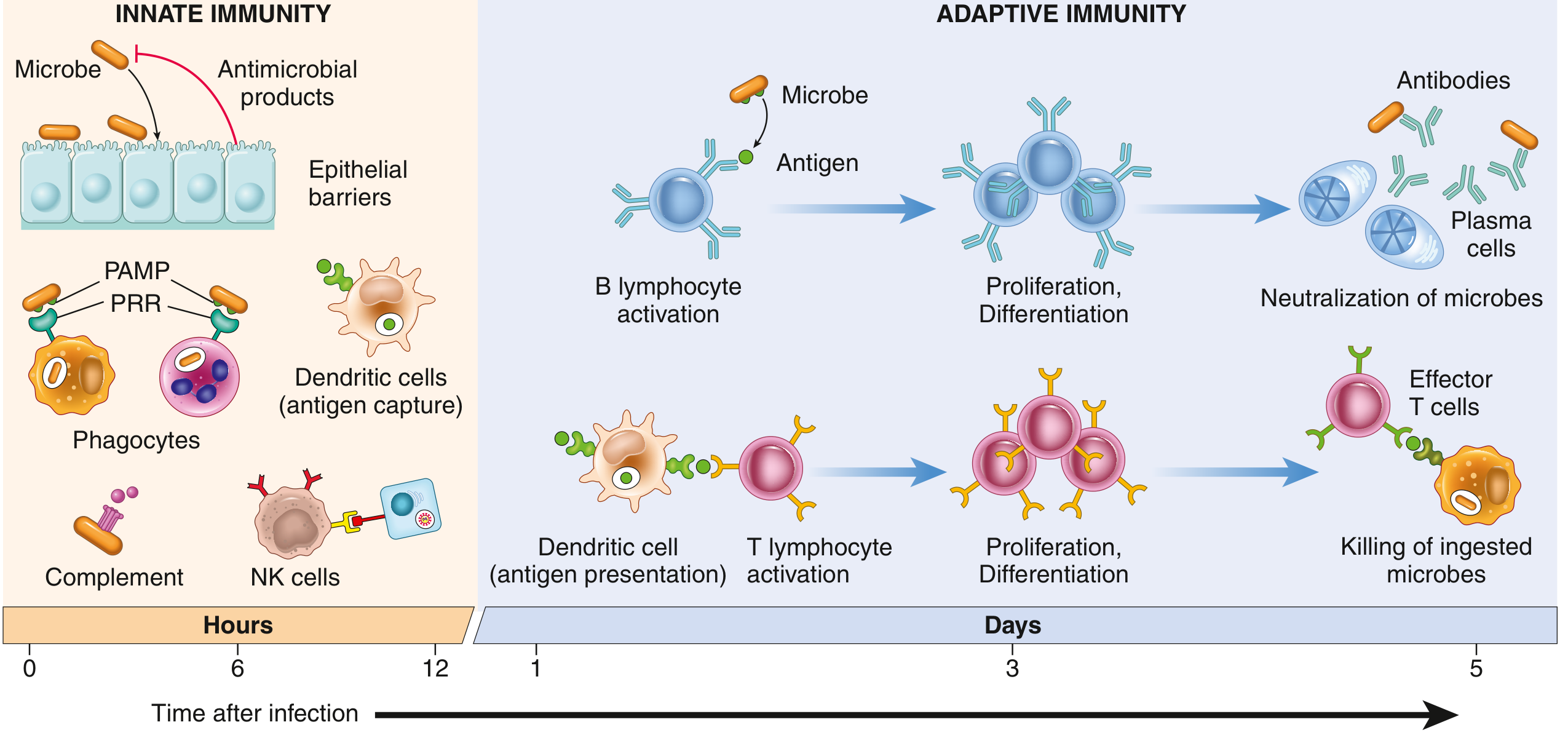
Key Features:
- Takes days to develop (vs. hours for innate)
- Highly specific to a particular antigen
- Has immunological memory
- Mediated by lymphocytes (T cells and B cells)
Two Types of Acquired Immunity:
| Feature | Humoral Immunity | Cell-Mediated Immunity |
|---|---|---|
| Cells involved | B lymphocytes | T lymphocytes |
| Products | Antibodies (immunoglobulins) | Activated T cells (effector T cells) |
| Target | Extracellular pathogens, toxins | Intracellular pathogens, viruses, tumor cells, transplanted tissue |
| Also called | B-cell immunity | T-cell immunity |
5. Antigens
An antigen is any substance that triggers an immune response. Key features:
- Usually proteins or large polysaccharides
- Molecular weight usually >8,000 daltons
- Have surface molecular groups called epitopes (antigenic determinants) - these are the actual binding sites for antibodies
- The term antigen = "antibody generator"
6. Lymphocytes - The Cells of Acquired Immunity
Both T and B lymphocytes originate from multipotent hematopoietic stem cells in the bone marrow.
T Lymphocytes (Preprocessed in the Thymus):
- After formation in bone marrow, they migrate to the thymus for preprocessing
- Develop diversity - each T cell reacts against a different antigen
- Responsible for cell-mediated immunity
- Subtypes: Helper T cells (CD4+), Cytotoxic T cells (CD8+), Regulatory T cells
B Lymphocytes (Preprocessed in the Bursa/Bone Marrow):
- Preprocessed in the liver (during mid-fetal life) and bone marrow (late fetal + after birth)
- Named after the Bursa of Fabricius (first discovered in birds)
- Responsible for humoral immunity
- When activated, differentiate into plasma cells that produce antibodies
7. Antibodies (Immunoglobulins)
Antibodies are gamma globulins (immunoglobulins) in the blood. They make up about 20% of all plasma proteins.
Structure:
- Composed of 2 heavy + 2 light polypeptide chains (Y-shape)
- Held together by disulfide (S-S) bonds
- Each chain has:
- Variable region - unique for each antibody; binds the specific antigen
- Constant region - determines properties like complement activation, diffusivity, placental transfer
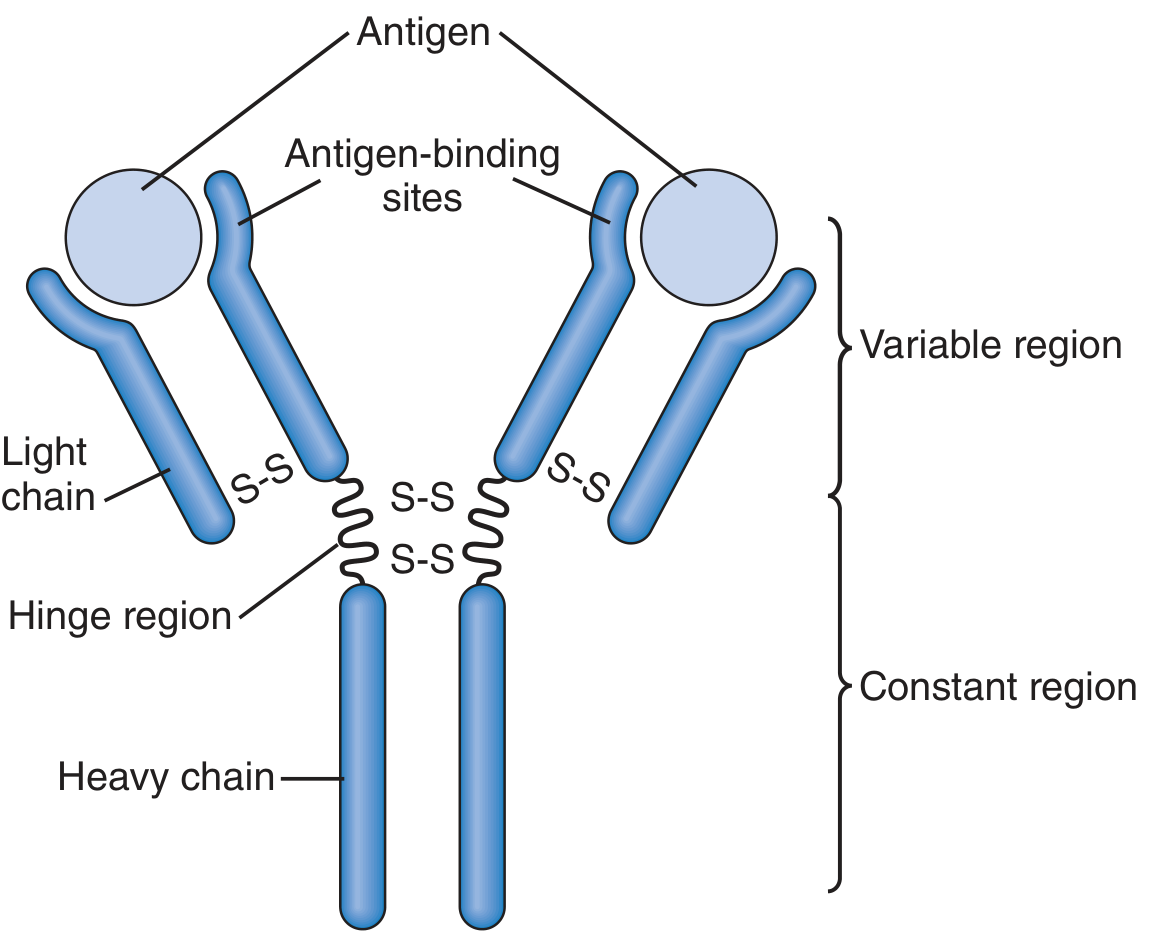
5 Classes of Immunoglobulins (GAMED mnemonic):
| Class | % of serum Ig | Key Features |
|---|---|---|
| IgG | ~80% | Most abundant; crosses placenta (passive immunity to fetus); anti-viral, anti-toxic; half-life 21 days |
| IgA | ~13% | Found in secretions (saliva, milk, colostrum, tears, mucus); first line defense at mucous membranes; half-life 6-8 days |
| IgM | ~6% | First antibody produced after infection; high agglutinating & complement-fixing ability; produced by fetus; half-life 7 days |
| IgD | <1% | Function not fully established; acts as antigen receptor on B cells |
| IgE | Trace | Involved in allergic reactions and defense against parasites (worms) |
"The human immunoglobulin system is composed of 5 major classes (IgG, IgM, IgA, IgD and IgE) and sub-classes within them." - Park's Preventive Medicine
8. Primary vs. Secondary Immune Response
| Feature | Primary Response | Secondary (Anamnestic) Response |
|---|---|---|
| Exposure | First contact with antigen | Second/subsequent contact |
| Lag period | Longer (~1-2 weeks) | Shorter (~1-3 days) |
| Antibody level | Lower | Much higher |
| Antibody type | IgM first, then IgG | Predominantly IgG |
| Duration | Shorter | Longer |
| Basis | Naive lymphocytes | Memory cells |
This is the basis for booster doses in vaccination.
9. Complement System
- A system of approximately 20 proteins in plasma
- Part of innate immunity but also bridges to adaptive immunity
- Three activation pathways: Classical (antibody-triggered), Lectin, and Alternative pathways
- Functions:
- Opsonization - coating of microbes to enhance phagocytosis
- Lysis - membrane attack complex (MAC) punches holes in bacteria
- Inflammation - recruits more immune cells
- Clearance of immune complexes
10. Summary Diagram: Innate vs Adaptive Immunity
| Feature | Innate Immunity | Adaptive Immunity |
|---|---|---|
| Present at birth | Yes | No (develops after exposure) |
| Speed of response | Immediate (minutes-hours) | Slow (days) |
| Specificity | Non-specific | Highly specific |
| Memory | No | Yes |
| Key cells | Phagocytes, NK cells, Dendritic cells | T cells, B cells |
| Key molecules | Complement, Lysozyme, Interferons | Antibodies, Cytokines |
| Diversity | ~100 receptors (PRRs) | Millions of antigen receptors |
11. Quick Revision - High-Yield Points for MBBS Exams
- Innate = non-specific, no memory; Adaptive = specific, has memory
- T cells preprocessed in Thymus; B cells in Bone marrow/Bursa
- B cells → Plasma cells → Antibodies (Humoral immunity)
- T cells → Effector T cells (Cell-mediated immunity)
- IgG = most abundant; crosses placenta; longest half-life
- IgM = first to appear in infection; best for complement fixation
- IgA = secretory; found in body fluids; mucosal immunity
- IgE = allergy and anti-parasitic immunity
- Antigen must be >8000 Da to be immunogenic
- Epitopes are the actual antigenic determinants on antigens
- PAMPs are recognized by PRRs (especially TLRs) - innate immunity key concept
- Secondary response is faster and stronger - basis for vaccination booster doses
Sources: Guyton and Hall Textbook of Medical Physiology (14e), Robbins & Kumar Basic Pathology, Roitt's Essential Immunology, Park's Textbook of Preventive and Social Medicine
This is a shared conversation. Sign in to Orris to start your own chat.