
Skin ulcer surgery case presentation
I need to clarify what you're looking for before diving in.
Asking for Preferences
What do you need for this skin ulcer surgery case presentation? · Which type of skin ulcer should the case focus on? · Who is the audience?
Searching sources...
Pulling from the medical library and recent literature simultaneously.
Reading File
Searching PubMed
"diabetic foot ulcer" AND "surgical management"
Searching the Web
diabetic foot ulcer surgical case presentation attending level 2024 2025
Now querying the medical library for detailed content on diabetic foot ulcer pathophysiology, classification, and surgical management.
Finding Sources
Searching PubMed
"diabetic foot ulcer" AND debridement AND classification
Finding Sources
Reading Web Page
https://pmc.ncbi.nlm.nih.gov/articles/PMC13108413
Excellent - I have strong content from Campbell's Operative Orthopaedics, Harrison's, and current literature. Let me pull the key textbook sections now.
Reading File
Reading File
Reading File
Finding Sources
I now have comprehensive content. Let me fetch a few relevant clinical images from Campbell's, then compile the full case presentation.
Loading Image
Reading File
I now have everything needed for a thorough attending-level case presentation. Let me compile it.
Diabetic/Neuropathic Foot Ulcer - Surgical Case Presentation
Audience: Attending Surgeon Level | Format: Full Case Write-Up
CHIEF COMPLAINT
"My foot has had a sore on the bottom for 2 months that won't heal."
HISTORY OF PRESENT ILLNESS
A 63-year-old male with a 22-year history of poorly controlled Type 2 diabetes mellitus (HbA1c 10.4%) presents with a 2-month history of a painless plantar wound beneath the right second metatarsal head. The ulcer was initially noted after removing a shoe and finding bloody discharge - the patient denies any specific trauma and states he did not notice it developing. He reports no fever but acknowledges mild malodor over the past 2 weeks. He denies rest pain or claudication.
Pertinent Positives:
- Plantar callus buildup noted for years at the same site
- Peripheral sensory loss bilaterally - he cannot feel light touch past the mid-foot ("glove-and-stocking")
- Wears standard off-the-shelf athletic shoes
Pertinent Negatives:
- No prior foot ulcers or amputations
- No claudication or rest pain
- No fevers, chills, or systemic sepsis
PAST MEDICAL / SURGICAL HISTORY
| Problem | Detail |
|---|---|
| T2DM | 22 years, on metformin + insulin glargine, poorly controlled |
| Hypertension | Lisinopril 10 mg daily |
| Hyperlipidemia | Atorvastatin 40 mg |
| Peripheral neuropathy | Diagnosed 4 years prior, gabapentin |
| CKD Stage 3 | eGFR 42 mL/min/1.73m² |
| No prior surgeries | -- |
Medications: Insulin glargine 28U qHS, metformin 1000 mg BID (held for contrast), lisinopril 10 mg, atorvastatin 40 mg, gabapentin 300 mg TID, aspirin 81 mg
Allergies: NKDA
Social Hx: Retired mechanic, non-smoker (quit 8 years ago), occasional alcohol, lives alone
PHYSICAL EXAMINATION
Vitals: T 37.8°C | HR 88 | BP 142/86 | RR 16 | SpO2 96% RA | BMI 32
Focused Lower Extremity Exam (Right Foot)
Vascular:
- Femoral pulse 2+, popliteal 2+
- Dorsalis pedis: diminished (1+)
- Posterior tibial: diminished (1+)
- Capillary refill: 3 seconds
- Skin: thin, shiny, hairless below mid-calf bilaterally
Neurologic:
- Vibration sense absent to mid-foot bilaterally (128 Hz tuning fork)
- Monofilament (10-g Semmes-Weinstein): absent response at all plantar sites
- Proprioception: impaired at the hallux
Wound Assessment (Right Second Metatarsal Head - Plantar Surface):
- Location: plantar, beneath 2nd MTP head
- Dimensions: 2.5 cm × 1.8 cm, depth ~1.2 cm
- Margins: hyperkeratotic/callused rim, edges not undermined
- Base: pale pink granulation with central yellowish slough (~30% slough coverage)
- Exudate: moderate, serous-purulent
- Periwound: erythema extending 2 cm from wound margin, induration, warmth
- Probe-to-bone test: POSITIVE
- No fluctuance, no crepitus, no skin bullae
Musculoskeletal:
- Hammertoe deformity at 2nd digit
- Rigid equinus deformity (Silfverskiold test: positive - gastrocnemius-soleus contracture contributing to elevated forefoot pressure)
- No Charcot joint deformity on this presentation
CLASSIFICATION
Wagner Classification (Table 91.1 - Campbell's Operative Orthopaedics 15e)
| Grade | Description | This Patient |
|---|---|---|
| 0 | Pre-ulcerative/callus only | - |
| I | Superficial ulcer | - |
| II | Deeper, to tendon/capsule/bone | - |
| III | Deep ulcer with abscess/osteomyelitis | ✅ Grade III |
| IV | Forefoot gangrene | - |
| V | Full foot gangrene | - |
Grade III: Deep ulcer with positive probe-to-bone = presumptive osteomyelitis; requires surgical debridement or partial amputation.
SINBAD Score (IWGDF-endorsed)
| Domain | Score |
|---|---|
| Site: plantar forefoot | 1 |
| Ischemia: ABI borderline but pulses present | 0 |
| Neuropathy: severe (monofilament absent) | 1 |
| Bacterial infection: clinical signs present | 1 |
| Area: >1 cm² | 1 |
| Depth: into bone | 1 |
| Total | 5/6 - High risk |
WORKUP
Laboratory
| Test | Value | Interpretation |
|---|---|---|
| HbA1c | 10.4% | Severely uncontrolled |
| WBC | 14,200/µL | Leukocytosis |
| CRP | 88 mg/L | Elevated inflammatory marker |
| ESR | 74 mm/hr | Elevated, supports osteomyelitis |
| Serum prealbumin | 14 mg/dL | Mild malnutrition |
| BMP | Cr 1.8, BUN 28 | CKD Stage 3, no acute kidney injury |
| Blood cultures | Pending | Drawn given leukocytosis |
Imaging
Plain radiograph (right foot, AP/lateral/oblique):
- Cortical irregularity and periosteal reaction at the 2nd metatarsal head
- Sub-metatarsal head soft tissue gas NOT present (no necrotizing fasciitis on plain film)
MRI Foot (gadolinium-enhanced) - Gold Standard for Osteomyelitis:
- T1: low signal in 2nd metatarsal head marrow (normal marrow replaced)
- T2/STIR: high signal in metatarsal head and adjacent soft tissue edema
- Gadolinium: enhancement of soft tissue tract and intramedullary marrow
- Impression: Osteomyelitis of 2nd metatarsal head with contiguous soft tissue infection; no discrete abscess; no deep space (plantar compartment) involvement
MRI is the most specific imaging modality for diabetic foot osteomyelitis. A positive probe-to-bone test carries ~89% positive predictive value for osteomyelitis. - Harrison's Principles of Internal Medicine 22E
Vascular Assessment
- ABI (right): 0.78 (borderline, PAD not excluded)
- Toe-brachial index: 0.52 (important in diabetic patients as tibial vessels may be falsely non-compressible on ABI)
- Duplex ultrasound: Triphasic flow in popliteal, biphasic in anterior tibial and peroneal arteries; posterior tibial diminished flow
- Vascular surgery consultation requested given borderline perfusion
DIAGNOSIS
Primary: Wagner Grade III diabetic neuropathic plantar foot ulcer with osteomyelitis of the 2nd metatarsal head
Contributing Pathomechanics:
- Peripheral sensorimotor neuropathy → loss of protective sensation, intrinsic muscle wasting, hammertoe → elevated plantar pressure at 2nd MTP head
- Autonomic neuropathy → anhidrosis → fissured, callused skin
- Rigid equinus deformity (gastrocnemius tightness) → chronic forefoot overloading
- Poorly controlled hyperglycemia → impaired neutrophil function, reduced wound angiogenesis, reduced collagen synthesis
"The primary goals of treatment of diabetic foot ulcers are healing of the ulcer, prevention of secondary infection and recurrence, and avoidance of amputation... a 44% 5-year mortality and mean survival of 50 months after onset of a new diabetic foot ulcer have been reported." - Campbell's Operative Orthopaedics 15e, 2026
MANAGEMENT
Immediate (Emergency Department / Admission)
- Admit to surgery service - Wagner Grade III ulcer with osteomyelitis is a surgical emergency
- IV antibiotics (empiric, broad-spectrum, pending tissue cultures):
- Vancomycin 25 mg/kg IV q8-12h (MRSA coverage + CKD dose adjustment)
- Piperacillin-tazobactam 3.375 g IV q6h (gram-negative and anaerobic coverage)
- Note: In CKD Stage 3, dose-adjust all renally cleared agents
- Strict non-weight bearing - bed rest, limb elevation
- Glycemic control: Insulin infusion protocol, target BG 140-180 mg/dL inpatient; Endocrinology consult
- Wound cultures: Obtain deep tissue intraoperatively (surface swabs are unreliable - colonization vs. true infection)
- NPO after midnight for OR
Surgical Plan - Operating Room
Indication for Surgery: Wagner Grade III ulcer, probe-to-bone positive, MRI-confirmed osteomyelitis, moderate-severity infection with systemic signs (leukocytosis, elevated inflammatory markers)
Procedure: Surgical Debridement + 2nd Metatarsal Head Resection (Partial Ray)
Surgical Steps:
- Positioning: Supine, ankle roll under ipsilateral hip for slight internal rotation access; tourniquet applied (300 mmHg) but inflation deferred until bleeding assessment
- Incision: Elliptical excision of ulcer margins; plantar longitudinal or racquet incision to gain access to metatarsal head
- Exploration: Assess all deep tissue planes - plantar fascia, flexor tendons, metatarsal head, MTP joint
- Sharp debridement: Remove ALL non-viable tissue including: callus rim, slough, necrotic tendon, infected synovium, periosteum
- Bone resection: Metatarsal head resection using oscillating saw or rongeur - resection margins sent for culture and histopathology (confirm osteomyelitis; rule out Charcot)
- Frozen section / permanent histology: Bone margins for residual infection
- Irrigation: 3 liters pulsatile saline lavage
- Wound closure: Primarily open (or partially closed over a drain) - allows for re-look debridement in 48-72 hours; do NOT close a contaminated wound primarily
- Apply NPWT (Negative Pressure Wound Therapy): VAC dressing to provide moist environment, reduce edema, stimulate granulation
Intraoperative Cultures: Deep tissue (not surface swab) sent for aerobic/anaerobic culture; bone fragment for pathology
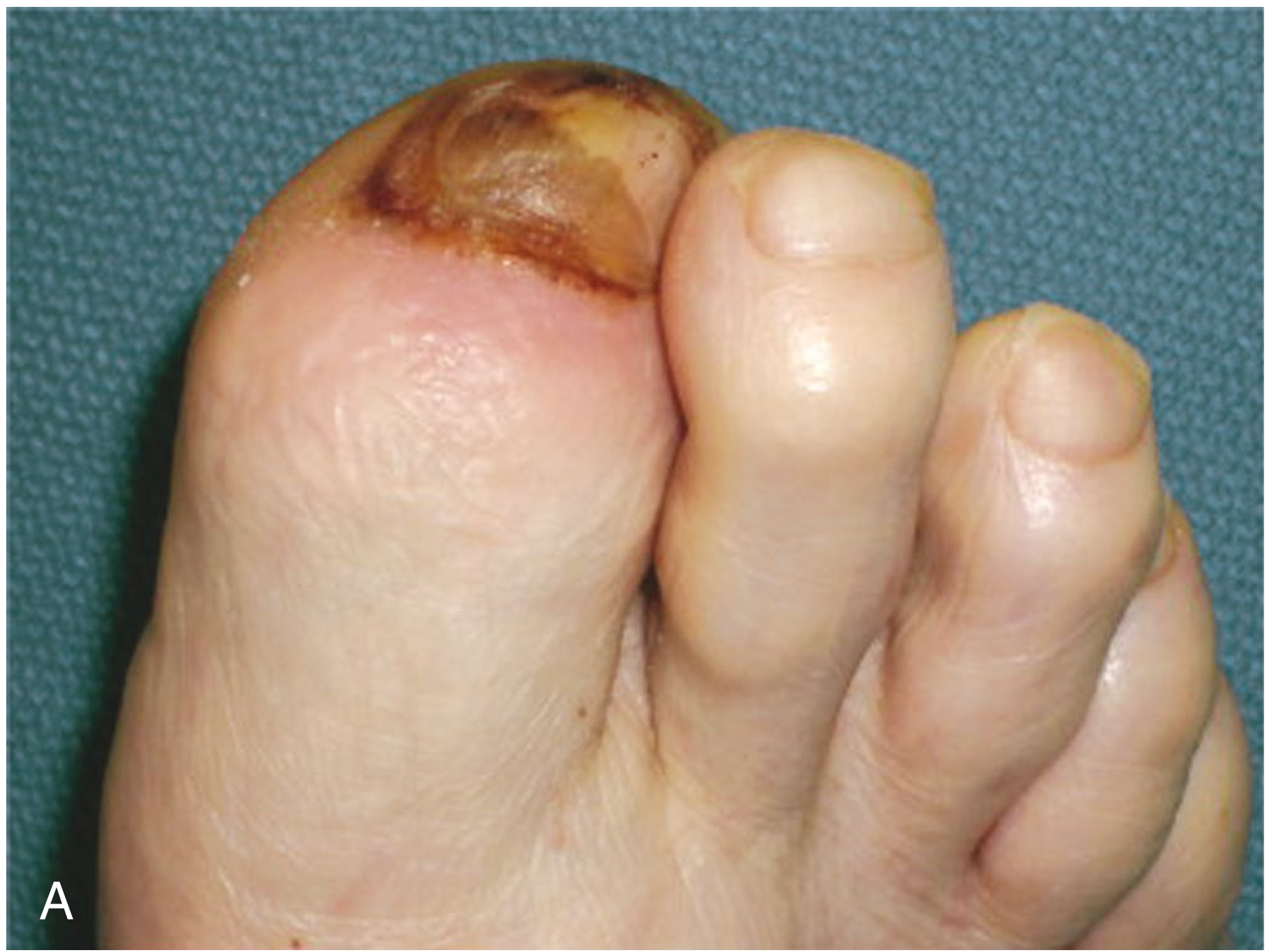
Postoperative Management
Wound Care:
- NPWT dressing changes every 2-3 days
- Re-look debridement in 48-72 hours if clinical improvement insufficient
- Moist wound healing principles: avoid hydrogen peroxide and betadine, which damage viable tissue; use saline irrigation
- "Avoid harsh chemicals such as hydrogen peroxide and betadine because these can damage the viable tissue in the ulcer and further delay healing." - Campbell's Operative Orthopaedics 15e
Antibiotic Therapy:
- Narrow antibiotic coverage once deep tissue culture results finalize (typically 48-72 hours)
- Duration for osteomyelitis: 4-6 weeks total (IV to PO transition based on bioavailability)
- If MRSA confirmed: IV vancomycin or oral linezolid/TMP-SMX (based on local antibiogram)
Off-Loading (Post-Wound Healing):
- Total contact cast (TCC) - gold standard for plantar ulcer offloading; removes mechanical trauma that retards healing
- Non-removable knee-high walkers as alternative
- Strict non-weight bearing during early post-debridement phase
Glycemic Optimization:
- HbA1c target <7.5% long-term; acknowledge this is not achievable acutely
- Inpatient: insulin infusion protocol
- Transition to structured outpatient regimen with endocrinology
Vascular Assessment:
- If wound shows <50% area reduction at 4 weeks: reassess for PAD and consider vascular intervention
- Revascularization (endovascular or bypass) if significant ischemia identified
Adjunct / Advanced Wound Therapies (if no improvement at 4 weeks)
Per Harrison's Principles of Internal Medicine 22E (2025) - for wounds failing standard 5 pillars (offloading, debridement, physiologic dressings, revascularization, infection control):
| Modality | Evidence Level |
|---|---|
| Platelet-derived growth factor (becaplermin) | FDA approved |
| Acellular matrix (human skin allograft) | Moderate |
| Negative pressure wound therapy (NPWT) | Strong - level I [PMID 39892227] |
| Hyperbaric oxygen therapy | Moderate; useful with ischemia |
| Bioengineered skin substitutes | Moderate |
| Autologous growth factor concentrate | Emerging RCT data |
SURGICAL DECISION-MAKING FRAMEWORK
Reconstructive Ladder (for Wound Coverage)
- Secondary healing (granulation + contraction) - preferred initial strategy in contaminated wounds
- Delayed primary closure (after 48-72h re-look)
- Split-thickness skin graft (STSG) - once clean, granulating wound bed established
- Local flap reconstruction - for exposed tendon/bone after debridement
- Free flap - rarely required; only if large structural defect and adequate perfusion
Limb-Salvage vs. Amputation Decision
| Favor Limb Salvage | Favor Amputation |
|---|---|
| Intact perfusion (ABI >0.5, TBI >0.3) | Unsalvageable ischemia |
| Focal osteomyelitis only | Gas gangrene / necrotizing fasciitis |
| No sepsis | Uncontrolled sepsis |
| Patient able to comply | Non-ambulatory patient |
| Viable soft tissue for coverage | Extensive bone/joint destruction |
This patient: Limb salvage attempted with 2nd metatarsal head resection + NPWT, vascular consult for borderline perfusion, aggressive glycemic control
COMPLICATIONS TO ANTICIPATE
| Complication | Mechanism | Prevention |
|---|---|---|
| Transfer ulcer (1st or 3rd MTP head) | Metatarsal head resection alters pressure distribution | Custom orthotics post-healing |
| Wound dehiscence | Ischemia, poor glycemic control, colonization | Optimize glucose; delay closure |
| Proximal extension / re-infection | Inadequate initial debridement | Re-look at 48h; wide margins |
| Progressive PAD | Underlying macrovascular disease | Serial ABI; vascular follow-up |
| Charcot neuroarthropathy | Unrecognized hyperemia phase post-trauma | Serial radiographs; offload aggressively |
| Amputation (minor to major) | ~30% progress to more proximal level | Multidisciplinary care model |
PROGNOSIS
- Diabetic foot ulcers carry a 44% 5-year mortality - comparable to many cancers
- 3-year recurrence rate with CLTI is analogous to cancer recurrence patterns (Armstrong et al., IWJ 2025)
- Patient education reduces lower extremity amputation risk by 50-85%
- A multidisciplinary team (orthopaedics, vascular surgery, infectious disease, endocrinology, podiatry, orthotics, wound nursing) has been shown to be cost-effective and reduces amputation rates significantly
MULTIDISCIPLINARY TEAM INVOLVEMENT
| Specialist | Role |
|---|---|
| Orthopedic / Podiatric Surgeon | Primary debridement, bone resection, deformity correction |
| Vascular Surgery | ABI assessment, revascularization if needed |
| Infectious Disease | Antibiotic stewardship, duration, MRSA management |
| Endocrinology | Glucose optimization, insulin protocol |
| Wound Care Nursing | Dressing management, NPWT, education |
| Orthotics | Off-loading device, custom footwear post-healing |
| Dietitian/Nutrition | Malnutrition (low prealbumin), wound healing optimization |
TEACHING POINTS FOR ATTENDINGS
- Probe-to-bone test is highly predictive of osteomyelitis (~89% PPV) - a positive result in this setting mandates MRI and surgical planning
- Surface swabs are unreliable - always send deep tissue cultures from the operating room; surface colonization does not equal infection
- Diabetic foot ulcers are surgical emergencies - delayed intervention leads to proximal infection extension and higher amputation levels
- Wagner Grade III = OR, not clinic - cannot treat presumed osteomyelitis with antibiotics alone in the presence of devitalized tissue
- Off-loading is as important as surgery - failure to off-load is the most common cause of non-healing despite technically adequate debridement
- Rigid equinus is an underrecognized contributor - Achilles tendon lengthening or gastrocnemius recession (Strayer procedure) significantly reduces recurrent forefoot ulceration
- The reconstructive ladder is always context-dependent - in a diabetic foot, simpler is often better; free flaps carry high failure rates in ischemic/infected fields
- Multidisciplinary care is not optional - it reduces amputation rates and is cost-effective, particularly in patients over 70 years
KEY REFERENCES
| Source | Contribution |
|---|---|
| Campbell's Operative Orthopaedics 15th Ed, 2026 | Wagner classification, debridement technique, surgical management algorithm |
| Harrison's Principles of Internal Medicine 22E, 2025 | Five pillars of DFU management, osteomyelitis diagnosis, antibiotic selection |
| Rosen's Emergency Medicine, 9e | Urgent surgical indications, empiric antibiotic coverage |
| Fitzpatrick's Dermatology | Wound care principles, offloading |
| StatPearls - DFU & Complications, 2025 | SINBAD, WIfI, IWGDF/IDSA classification systems |
| Comprehensive DFU Management, PMC 2025 | Surgical intervention algorithm, NPWT evidence, revascularization |
| Surgical Approaches to DFU - Reconstructive Ladder, 2025 | Plastic surgery reconstruction algorithm |
This case presentation covers all elements expected at attending level: a richly detailed clinical encounter, evidence-based classification (Wagner + SINBAD), structured decision-making frameworks for limb salvage vs. amputation, step-by-step surgical approach, and postoperative pitfalls. Let me know if you'd like this converted to a PowerPoint/slide deck, expanded into any specific subsection (e.g., antibiotic dosing table, vascular workup, Charcot foot differential), or reformatted as a Word document.
This is a shared conversation. Sign in to Orris to start your own chat.