

Create a similar flashcard.
What topic should the new flashcard cover?
A colorful medical flashcard titled "Electrolyte Imbalances" in large decorative bubble letters at the top — Na in teal, K in pink, Ca in gold, Mg in purple. Below the title, a bordered table with columns: Electrolyte | Normal Value | HIGH (Hyper) | LOW (Hypo). Rows: - Na (sodium): 135-145 mEq/L | Hypernatremia (red up arrow) | Hyponatremia (blue down arrow) - K (potassium): 3.5-5.0 mEq/L | Hyperkalemia (red up arrow) | Hypokalemia (blue down arrow) - Ca (calcium): 8.5-10.5 mg/dL | Hypercalcemia (red up arrow) | Hypocalcemia (blue down arrow) - Mg (magnesium): 1.7-2.2 mg/dL | Hypermagnesemia (red up arrow) | Hypomagnesemia (blue down arrow) In the middle section, four illustrated cartoon organs/icons in a row: 1. A brain icon labeled "Neuro symptoms" under "Na imbalance" 2. A heart icon labeled "Cardiac arrhythmias" under "K imbalance" 3. Bones/skeleton icon labeled "Bone & Muscle" under "Ca imbalance" 4. Muscle icon labeled "Neuromuscular" under "Mg imbalance" At the bottom, a large bordered summary table using the mnemonic "SALT": - S (teal bubble letter) | Sodium | High Na → thirst, confusion | Hypernatremia (pink background) / Hyponatremia (light blue background) - A (pink bubble letter) | Aldosterone/K | High K → peaked T waves, bradycardia; Low K → U waves, weakness | Hyperkalemia / Hypokalemia (gold background) - L (gold bubble letter) | Low Ca signs: Chvostek, Trousseau | High Ca → stones, bones, groans | Hypocalcemia / Hypercalcemia (light purple background) - T (purple bubble letter) | Twitch/Tremor (Mg) | High Mg → loss of reflexes; Low Mg → tremors, seizures | Hypermagnesemia / Hypomagnesemia (light green background) White background, clean layout, colorful pastel color-coded rows, red up arrows and blue down arrows for high/low values, medical illustration style similar to a nursing/medical student study card.
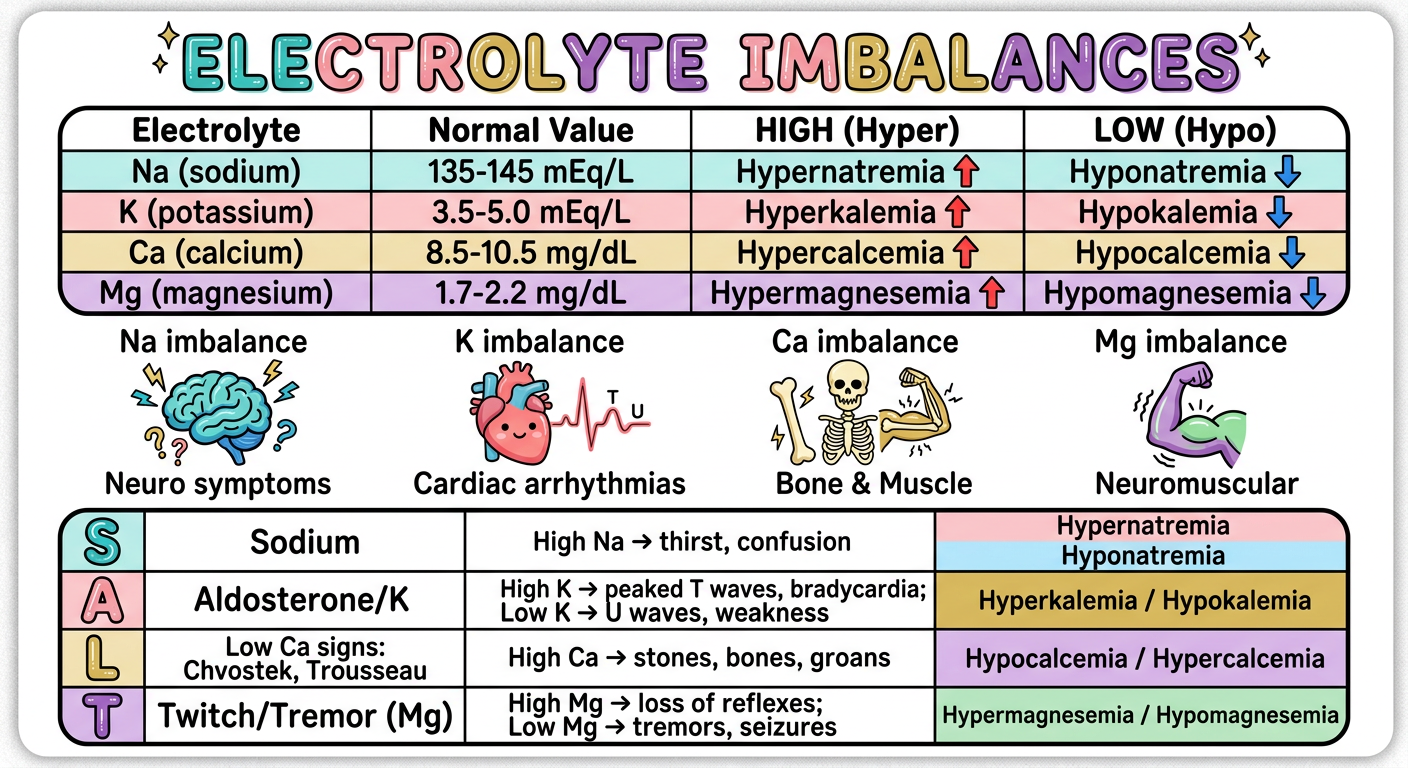
- Decorative bubble letters (Na, K, Ca, Mg) at the top in matching colors
- Reference table with normal values and red/blue arrows for Hyper/Hypo states
- Organ illustrations linking each electrolyte to its key affected system
- SALT mnemonic at the bottom summarizing key clinical findings, color-coded by electrolyte - mirroring the ROME mnemonic format from your original card
Create a similar flashcard. Same topic, different orientation. Add 'The Purkinje Perspectives' for my YT channel short.
A colorful medical flashcard in LANDSCAPE / HORIZONTAL orientation (wide format, like a YouTube Short thumbnail, 16:9 ratio) about ABG (Arterial Blood Gas) interpretation for medical students. TOP LEFT: Large decorative bubble letters "A", "B", "G" — A in teal, B in pink, G in gold. Next to them, small text subtitle "Arterial Blood Gas". TOP RIGHT CORNER: Branding text "The Purkinje Perspectives" in elegant stylish font, small, in deep navy or dark teal color. LEFT COLUMN (about 35% width): A bordered reference table with header row in teal: - Column headers: Component | Normal Value | Alkalosis | Acidosis - Row 1: pH | 7.35–7.45 | red ↑ | blue ↓ - Row 2: PaCO₂ (circled in pink/mauve) | 35–45 mmHg | blue ↓ | red ↑ — label to left: "Respiratory" - Row 3: HCO₃ (circled in teal) | 22–26 mEq/L | red ↑ | blue ↓ — label to left: "Renal/Metabolic" Gold annotation on right side of table: "Draw this table for guide" CENTER COLUMN (about 30% width): Four illustrated medical organ icons stacked or arranged in 2x2 grid: 1. Lungs (lighter pink) — labeled "↓ Low PaCO₂ → Respiratory Alkalosis" 2. Lungs (darker pink) — labeled "↑ High PaCO₂ → Respiratory Acidosis" 3. Kidney (red) — labeled "↑ High HCO₃ → Metabolic Alkalosis" 4. Kidney (dark red) — labeled "↓ Low HCO₃ → Metabolic Acidosis" RIGHT COLUMN (about 35% width): The ROME mnemonic summary table: - Large decorative letters R, O, M, E on the left in different colors (pink, gold, teal, orange) - R = Respiratory, O = Opposite - pH↓ CO₂↑ → "Respiratory Acidosis" in pink/lavender background - pH↑ CO₂↓ → "Respiratory Alkalosis" in gold/tan background - M = Metabolic, E = Equal - pH↓ HCO₃↓ → "Metabolic Acidosis" in teal/mint background - pH↑ HCO₃↑ → "Metabolic Alkalosis" in peach/salmon background BOTTOM CENTER: Small watermark-style text "The Purkinje Perspectives" in light gray. Overall style: White background, pastel color scheme, colorful bubble letters, clean medical illustration style like a nursing/med student study card. Wide landscape layout optimized for YouTube Shorts (9:16 tall is wrong — use 16:9 wide).
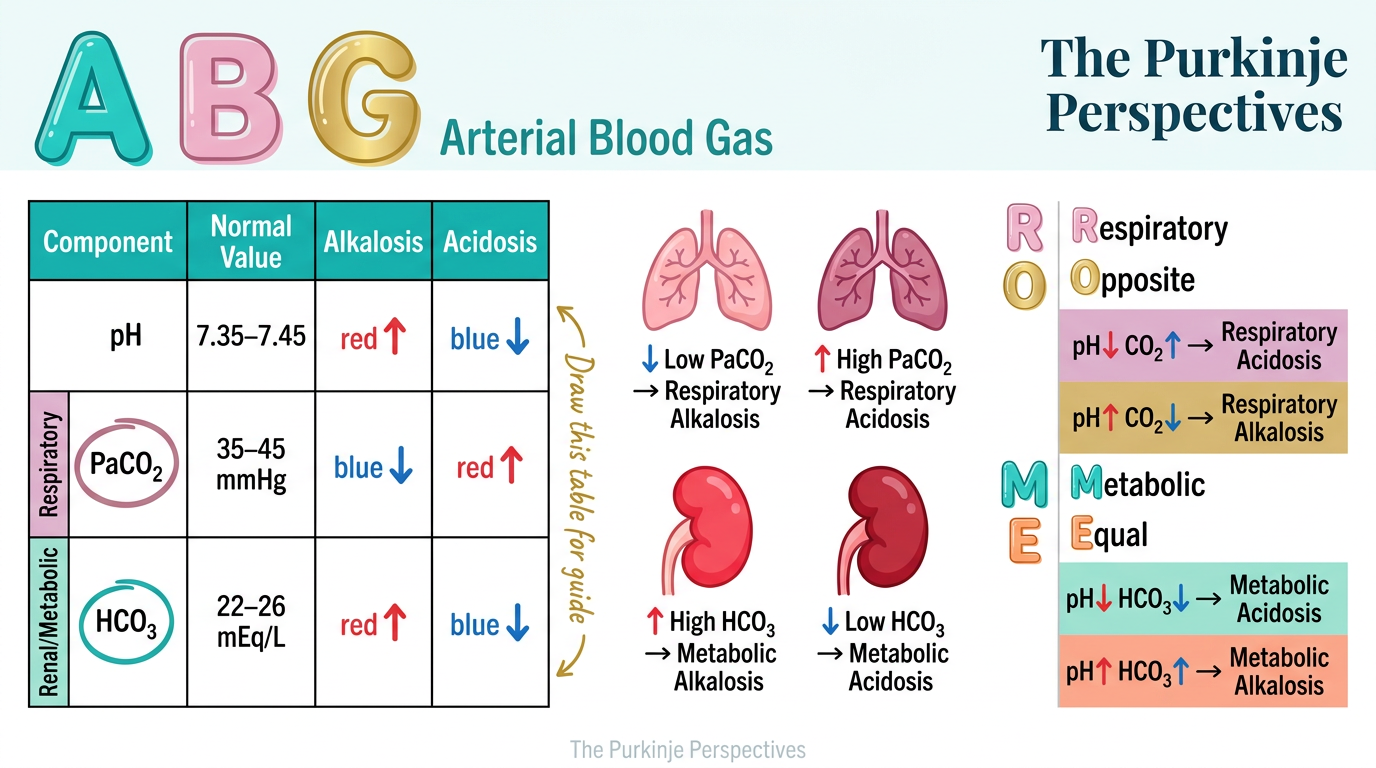
- A B G bubble letters in teal, pink, and gold at the top left
- Reference table with normal values and alkalosis/acidosis arrows, with Respiratory and Renal/Metabolic labels
- Lung and kidney illustrations showing the four ABG disorders
- ROME mnemonic table with color-coded outcome boxes
- "The Purkinje Perspectives" branding in the top right corner and as a bottom watermark
Remove the words red and blue.
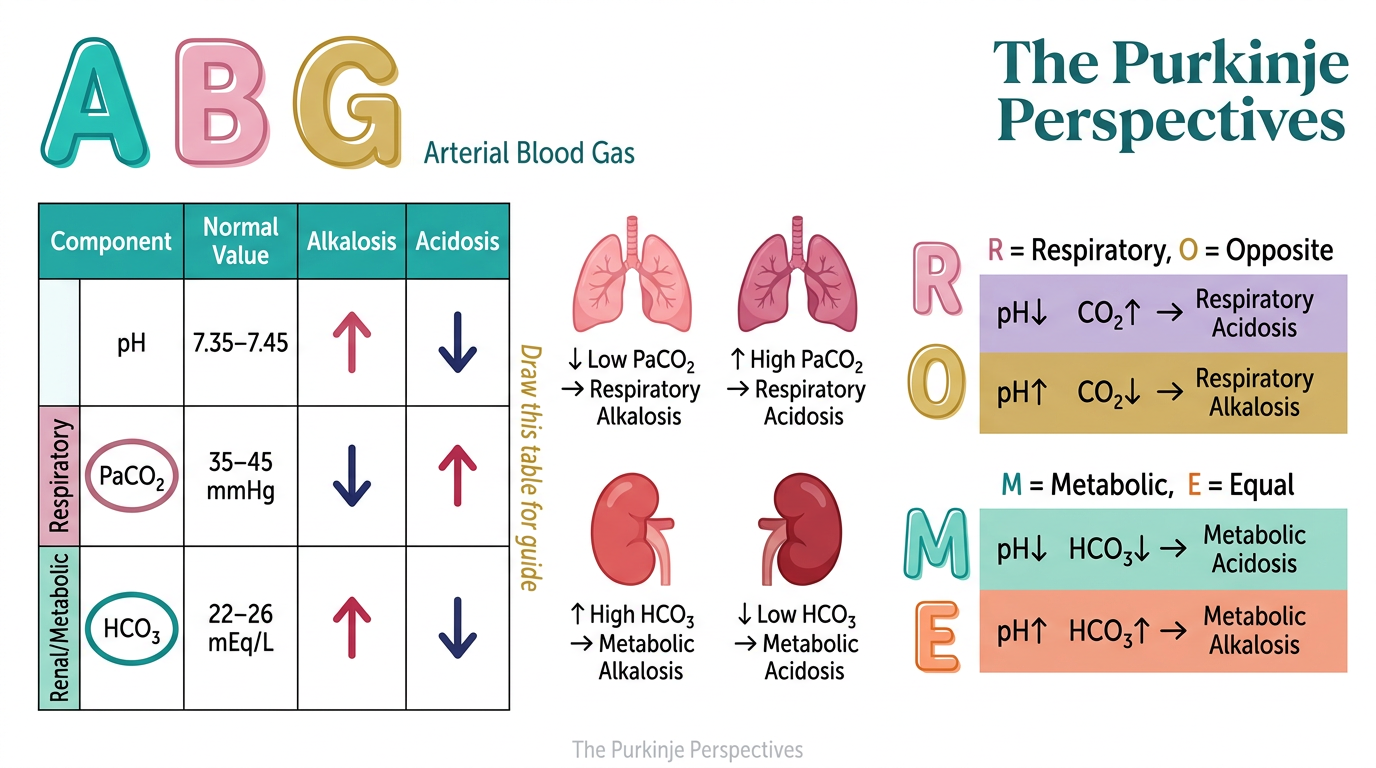
A colorful medical flashcard in LANDSCAPE / HORIZONTAL orientation (wide format, 16:9 ratio) about ABG (Arterial Blood Gas) interpretation for medical students. TOP LEFT: Large decorative bubble letters "A", "B", "G" — A in teal, B in pink, G in gold. Next to them, small text subtitle "Arterial Blood Gas". TOP RIGHT CORNER: Branding text "The Purkinje Perspectives" in elegant stylish font, small, in deep navy or dark teal color. LEFT COLUMN (about 35% width): A bordered reference table with header row in teal: - Column headers: Component | Normal Value | Alkalosis | Acidosis - Row 1: pH | 7.35–7.45 | ↑ (arrow colored rose/crimson) | ↓ (arrow colored navy/indigo) - Row 2: PaCO₂ (circled in pink/mauve) | 35–45 mmHg | ↓ (navy arrow) | ↑ (crimson arrow) — label to left: "Respiratory" - Row 3: HCO₃ (circled in teal) | 22–26 mEq/L | ↑ (crimson arrow) | ↓ (navy arrow) — label to left: "Renal/Metabolic" Gold annotation on right side of table: "Draw this table for guide" NOTE: Do NOT write the words "red" or "blue" anywhere on the card. CENTER COLUMN (about 30% width): Four illustrated medical organ icons arranged in 2x2 grid: 1. Lungs (lighter pink) — labeled "↓ Low PaCO₂ → Respiratory Alkalosis" 2. Lungs (darker pink) — labeled "↑ High PaCO₂ → Respiratory Acidosis" 3. Kidney (red) — labeled "↑ High HCO₃ → Metabolic Alkalosis" 4. Kidney (dark red) — labeled "↓ Low HCO₃ → Metabolic Acidosis" RIGHT COLUMN (about 35% width): The ROME mnemonic summary table: - Large decorative letters R, O, M, E on the left in different colors (pink, gold, teal, orange) - R = Respiratory, O = Opposite - pH↓ CO₂↑ → "Respiratory Acidosis" in lavender background - pH↑ CO₂↓ → "Respiratory Alkalosis" in gold/tan background - M = Metabolic, E = Equal - pH↓ HCO₃↓ → "Metabolic Acidosis" in mint/teal background - pH↑ HCO₃↑ → "Metabolic Alkalosis" in peach/salmon background BOTTOM CENTER: Small watermark-style text "The Purkinje Perspectives" in light gray. Overall style: White background, pastel color scheme, colorful bubble letters, clean medical illustration style. Wide landscape layout 16:9. No color names written as text anywhere on the card.
Generate a short LinkedIn description for this flashcard.
Sound human.