
Explain effect of different anesthetic agent on cerebral autoregulation
Reading File
Now I'll search the library for relevant content on anesthetic effects on cerebral autoregulation, running parallel searches:
Finding Sources
Finding Sources
Searching PubMed
"cerebral autoregulation" AND "anesthetic agents"
Excellent results. Now let me read the key sections from Miller's and Barash's:
Reading File
Reading File
Good data on volatile agents. Now let me get the IV anesthetics section and the broader effects section from Miller's:
Reading File
Finding Sources
Finding Sources
Let me now read the IV anesthetics section from Miller's and the Barash table for a complete picture:
Reading File
Reading File
Now let me get the ketamine and opioids/benzodiazepines section, and the nitrous oxide section from Miller's:
Reading File
I now have comprehensive data. Let me also fetch the key autoregulation diagram images:
Reading File
I now have enough comprehensive information to write a thorough, well-structured answer. Let me also quickly get the N₂O and dexmedetomidine sections from Miller's:
Reading File
I have sufficient data to compile a comprehensive answer. Let me now produce it:
Effect of Anesthetic Agents on Cerebral Autoregulation
Background: What Is Cerebral Autoregulation?
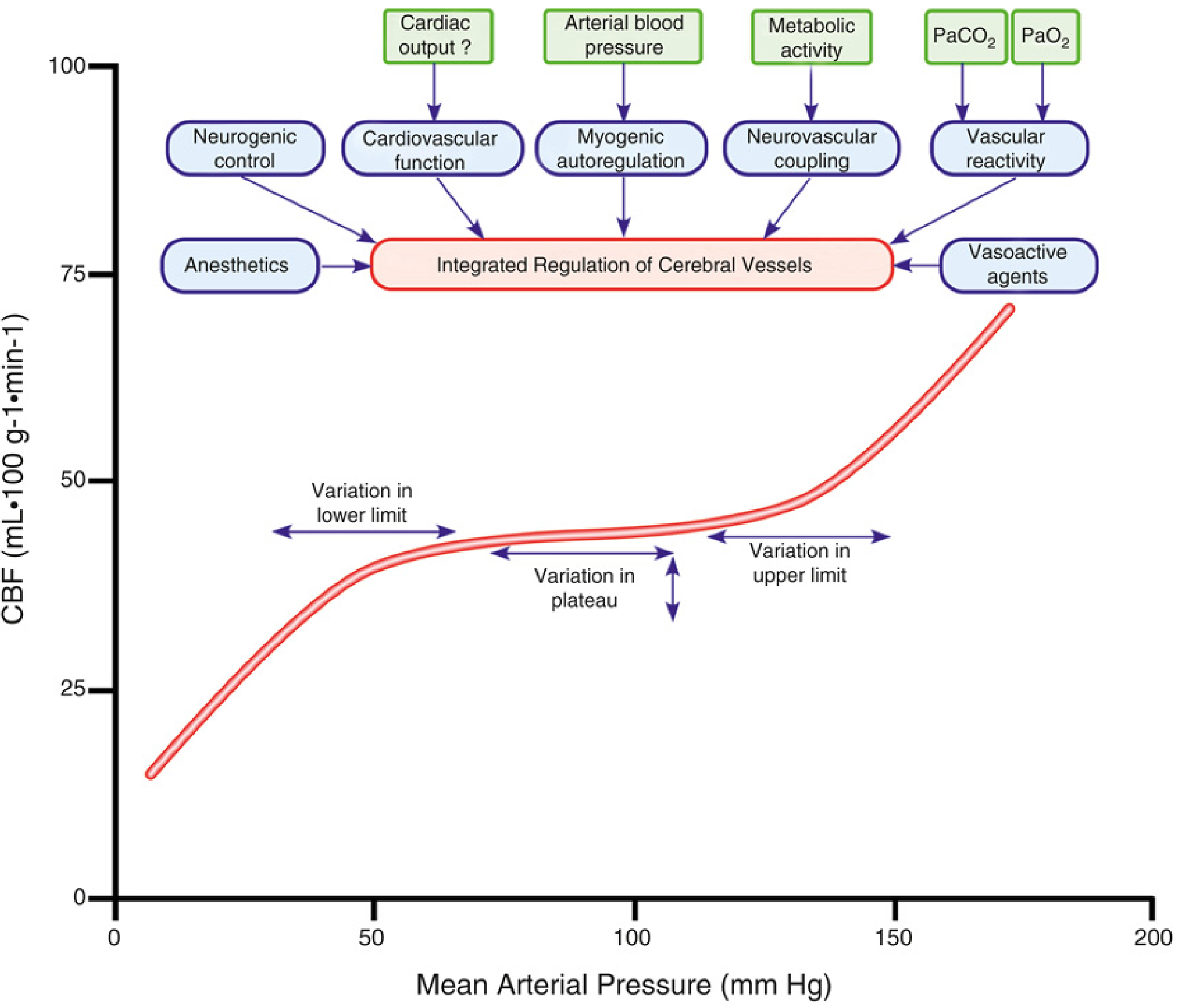
Cerebral autoregulation (CA) is the intrinsic capacity of the cerebral vasculature to maintain a relatively constant cerebral blood flow (CBF) across a range of mean arterial pressures (MAP) — classically ~50–150 mmHg. It is a dynamic process influenced by myogenic tone, neurovascular coupling, arterial CO₂/O₂ tensions, autonomic activity, and cardiovascular function. When CA is intact, the autoregulatory plateau keeps CBF independent of MAP; when impaired, CBF becomes pressure-passive.
Anesthetic agents affect CA at multiple levels:
- Suppression of cerebral metabolic rate (CMRO₂)
- Direct cerebral vasodilation
- Alteration of arterial blood gases
- Suppression of autonomic activity
- Modulation of cardiovascular function
— Miller's Anesthesia, 10e (Fig. 10.10)
I. Intravenous Anesthetic Agents
General Principle
IV sedative-hypnotics (propofol, barbiturates, etomidate, benzodiazepines) reduce CBF indirectly — by decreasing CMRO₂ first, then through flow-metabolism coupling, CBF falls secondarily. Autoregulation and CO₂ reactivity are preserved with these agents. — Barash Clinical Anesthesia, 9e
1. Propofol
- Reduces CBF by 53–79% and whole-brain metabolic rate by 48–58% vs. awake state
- Both CO₂ reactivity and cerebral autoregulation are fully preserved, even at doses producing EEG burst suppression
- Compared with volatile anesthetics, propofol-fentanyl reduces subdural pressure and AVDO₂ in neurosurgical patients
- Clinically preferred for neuroanesthesia due to preserved autoregulation and ICP control
— Miller's Anesthesia, 10e, p. 991–992
2. Barbiturates (Thiopental, Pentobarbital)
- Parallel, dose-dependent reductions in CMR and CBF
- Cause EEG burst suppression at high doses (maximal CMR suppression occurs at this point)
- Autoregulation and CO₂ responsiveness are maintained, even during deep pentobarbital anesthesia
- Note: Tolerance develops quickly — doses needed for burst suppression increase within 24–72 hours in head-injured patients
— Miller's Anesthesia, 10e, p. 991
3. Etomidate
- Produces roughly parallel reductions in CBF (~34%) and CMR (~45%)
- EEG suppression pattern similar to barbiturates; CMR suppression is regionally variable — predominantly forebrain
- CO₂ reactivity is preserved; autoregulation has not been formally evaluated but is presumed preserved given the flow-metabolism coupling mechanism
- Reduces ICP without lowering CPP — useful for induction in neurosurgical patients
- Caveat: adrenocortical suppression limits use beyond episodic application
— Miller's Anesthesia, 10e, p. 992–993
4. Benzodiazepines
- Modest, dose-dependent reductions in CBF and CMR via flow-metabolism coupling
- Autoregulation and CO₂ reactivity are preserved
- Ceiling effect on CMR suppression (unlike barbiturates/propofol, they cannot produce complete EEG suppression)
5. Ketamine — The Exception
Ketamine is the outlier among IV agents:
- Increases CBF and CMRO₂ — unlike all other IV anesthetics
- CBF increases by cerebral vasodilation and heightened neuronal activation (glutamate system)
- Little effect on autoregulation or CO₂ reactivity — racemic ketamine does not abolish cerebrovascular autoregulation
- Can increase ICP; best avoided as the sole agent in patients with impaired intracranial compliance
- May be cautiously used with concurrent sedatives (e.g., propofol, benzodiazepines), which blunt its ICP-raising effects
— Barash Clinical Anesthesia, 9e; Miller's Anesthesia, 10e, p. 1002
6. Opioids (Morphine, Fentanyl, Remifentanil)
- Have relatively little intrinsic effect on CBF, CMRO₂, autoregulation, or CO₂ responsiveness
- Modest reductions in CBF and CMR observed at high doses (partly nonspecific — attributable to reduction in arousal)
- Morphine (2 mg/kg + 70% N₂O): autoregulation intact between MAP 60–120 mmHg
- Fentanyl: CO₂ responsiveness and autoregulation unaffected; hyperemic CBF response to hypoxia remains intact
- Histamine-releasing opioids (e.g., morphine at high doses) can cause cerebral vasodilation via histamine
— Miller's Anesthesia, 10e, p. 993–994
7. Dexmedetomidine
- α₂-adrenergic agonist — reduces CBF through sympatholytic and CMRO₂-suppressive effects
- Autoregulation is generally preserved
- CO₂ reactivity intact
- Useful adjunct in neurocritical care and awake craniotomy
II. Inhaled Anesthetic Agents
General Principle
Volatile agents have a fundamentally different profile from IV agents:
- All are direct cerebral vasodilators (act on vascular smooth muscle)
- Also suppress CMRO₂ in a dose-dependent manner
- Net CBF = balance between metabolic suppression (↓CBF) vs. direct vasodilation (↑CBF)
- Autoregulation is impaired in a dose-dependent fashion — at high doses, CBF becomes fully pressure-passive
— Miller's Anesthesia, 10e, p. 1004; Barash Clinical Anesthesia, 9e
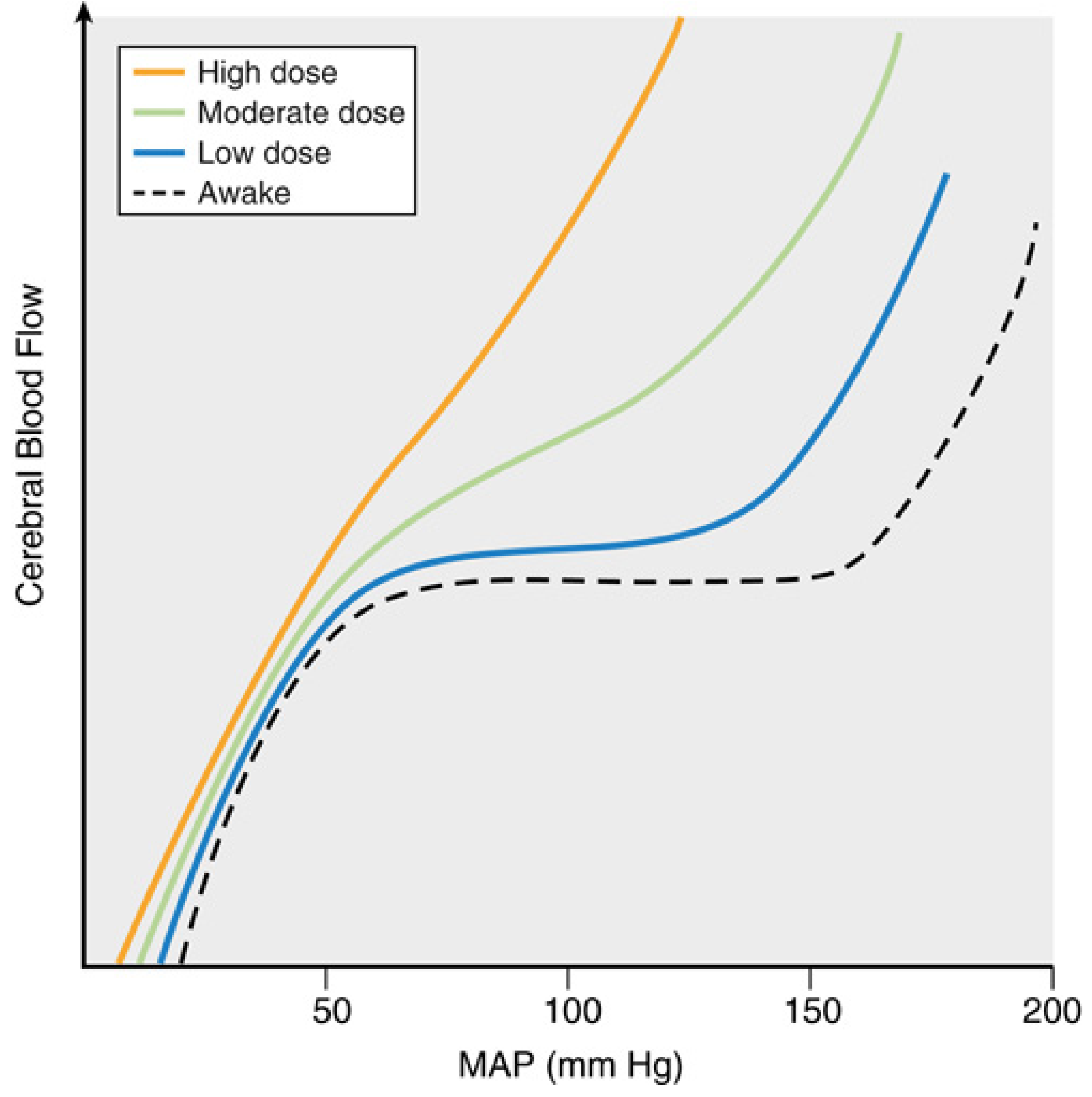
MAC-Dose Relationship for CBF (all modern agents):
| MAC Dose | Net CBF Effect | Autoregulation Status |
|---|---|---|
| 0.5 MAC | ↓ CBF (metabolic suppression dominates) | Preserved |
| 1.0 MAC | Unchanged (effects balanced) | Mildly impaired |
| >1.0 MAC | ↑ CBF (vasodilation dominates) | Progressively impaired |
| High doses | CBF pressure-passive | Abolished |
1. Isoflurane
- At 1.1 MAC: CBF ↑ ~19%, CMR ↓ ~45%
- Reduces autoregulation in a dose-dependent manner
- Minimal ICP increase in most patients; blunted or blocked by hyperventilation or barbiturate co-administration
- Better profile than halothane for cerebral vasodilation at equivalent MAC
2. Sevoflurane
- At 1 MAC: Preserves autoregulation (most favorable among volatile agents)
- At 1.5 MAC: Dynamic CA is better preserved than isoflurane at equivalent dose — likely due to lesser direct vasodilatory potency
- PET studies: ~50% reduction in CBF and CMRO₂ at 1 MAC
- Preferred volatile agent for neuroanesthesia due to relatively preserved CA up to 1 MAC
- Mild ICP increase at >1 MAC; less airway irritation than desflurane (lower bucking/coughing risk → less ICP transient)
— Barash Clinical Anesthesia, 9e; Miller's Anesthesia, 10e
3. Desflurane
- Dose-dependent reduction in autoregulation, similar to isoflurane
- Dynamic CA reduced in a dose-dependent manner; similar to isoflurane profile
- Greater pungency/airway irritation → higher risk of coughing/bucking → ICP transients
- At 1 MAC: CBF ↓ 22%, CMR ↓ 35% vs. awake (slightly less metabolic suppression than sevoflurane)
4. Halothane (Historical)
- Most potent cerebral vasodilator among volatile anesthetics
- At 1.1 MAC: CBF ↑ up to 191% with simultaneous modest CMR decrease (~10%)
- Greatest impairment of autoregulation among volatile agents
- No longer widely used; largely replaced by sevoflurane/desflurane
5. Nitrous Oxide (N₂O)
- Direct cerebral vasodilator; minimal effect on CMRO₂
- Effect on autoregulation is context-dependent:
- When used with propofol: autoregulation preserved
- When added to sevoflurane: CA further impaired
- Caution in neurosurgical patients — may augment the vasodilatory effects of volatile agents
— Barash Clinical Anesthesia, 9e
III. Adjuvant Agents
Lidocaine
- IV lidocaine (5 mg/kg) reduces CBF (~24%) and CMR (~20%)
- Useful adjunct for acute ICP control (e.g., during intubation, suctioning, pin placement)
- Does not impair autoregulation at clinical doses
— Miller's Anesthesia, 10e, p. 1002
Summary Table
| Agent | CBF Effect | CMRO₂ | Autoregulation | CO₂ Reactivity | ICP |
|---|---|---|---|---|---|
| Propofol | ↓↓ | ↓↓ | Preserved | Preserved | ↓ |
| Thiopental | ↓↓ | ↓↓ | Preserved | Preserved | ↓ |
| Etomidate | ↓ | ↓↓ | Presumed preserved | Preserved | ↓ |
| Midazolam | ↓ | ↓ | Preserved | Preserved | ↓ |
| Ketamine | ↑↑ | ↑ | Little effect | Preserved | ↑ |
| Opioids | Minimal ↓ | Minimal ↓ | Preserved | Preserved | Minimal |
| Dexmedetomidine | ↓ | ↓ | Preserved | Preserved | ↓ |
| Isoflurane | ↑ (dose-dep.) | ↓↓ | Dose-dependent impairment | Preserved | ↑ mild |
| Sevoflurane | ↑ (>1 MAC) | ↓↓ | Preserved ≤1 MAC; impaired >1 MAC | Preserved | ↑ mild |
| Desflurane | ↑ (dose-dep.) | ↓↓ | Dose-dependent impairment | Preserved | ↑ mild |
| Halothane | ↑↑↑ | ↓ | Markedly impaired | Preserved | ↑↑ |
| Nitrous Oxide | ↑ | Minimal ↓ | Context-dependent | Preserved | ↑ variable |
| Lidocaine | ↓ | ↓ | Preserved | Preserved | ↓ |
Key Clinical Points
-
Total IV anesthesia (TIVA) with propofol is the preferred technique for patients with impaired intracranial compliance or disrupted autoregulation — it reduces CBF, lowers ICP, and preserves CA.
-
Sevoflurane ≤1 MAC is the safest volatile agent for neuroanesthesia — autoregulation is maintained; above 1 MAC, impairment begins.
-
Volatile agents impair CA in a MAC-dependent manner — at high doses all become cerebral vasodilators and CBF becomes pressure-passive. CO₂ reactivity remains intact even when autoregulation is abolished.
-
Ketamine is the only IV agent that increases CBF and ICP; use cautiously (with sedative co-administration) in neuroanesthesia.
-
N₂O should be used cautiously in neurosurgery — its vasodilatory effect is additive with volatile agents and can further impair CA.
-
Autoregulation is not binary — there is inter-individual variability in the lower limit of autoregulation (LLA), and all anesthetic agents shift the autoregulatory curve rather than abolishing it abruptly.
Sources: Miller's Anesthesia, 10e (Ch. 10); Barash, Cullen & Stoelting's Clinical Anesthesia, 9e (Ch. 18, 37); Morgan & Mikhail's Clinical Anesthesiology, 7e
This is a shared conversation. Sign in to Orris to start your own chat.