
Does left ventricular hypertrophy cause pulmonary edema
Left ventricular hypertrophy (LVH) can cause pulmonary edema, but through an indirect mechanism. LVH leads to diastolic dysfunction - the thickened, stiff ventricle fails to relax and fill properly, raising left ventricular end-diastolic pressure (LVEDP). This elevated pressure backs up into the left atrium and pulmonary veins, increasing pulmonary capillary hydrostatic pressure and causing fluid to leak into the alveoli (pulmonary edema).
Searching sources...
Reading File
Finding Sources
Finding Sources
Searching PubMed
"left ventricular hypertrophy" AND "pulmonary edema"
Now let me read the key sections in detail:
Reading File
Reading File
Reading File
Loading Image
Yes, left ventricular hypertrophy (LVH) can cause pulmonary edema. Here is a detailed explanation of the mechanism and clinical context, drawn from multiple authoritative textbooks.
How LVH Causes Pulmonary Edema
The Core Pathway: Diastolic Dysfunction
LVH itself does not directly flood the lungs - it does so by making the ventricle stiff and impairing its ability to relax. This sequence of events is called diastolic dysfunction, and it is the primary link between LVH and pulmonary edema:
- LVH makes the ventricle stiff - The thickened myocardium loses its compliance. It cannot relax properly during diastole.
- Impaired relaxation raises LVEDP - Because the ventricle does not relax normally, end-diastolic pressure rises even at normal filling volumes. As Morgan & Mikhail's Clinical Anesthesiology explains: "Failure of the heart to relax during diastole leads to elevated left ventricular end-diastolic pressure, which is transmitted to the left atrium and pulmonary vasculature."
- Pressure backs up into the lungs - Elevated LVEDP is transmitted retrograde into the left atrium and then the pulmonary veins, raising pulmonary capillary hydrostatic pressure (PAWP).
- Starling forces drive fluid into alveoli - When pulmonary capillary wedge pressure (PAWP) exceeds ~20 mmHg, the hydrostatic pressure overcomes oncotic pressure, and fluid leaks from the pulmonary microvasculature into the interstitium and alveoli = pulmonary edema.
This is illustrated in the pressure-volume loop diagram below. In diastolic dysfunction, the LV loop shifts to a narrower, taller position (less volume tolerated at much higher pressures) compared to normal:
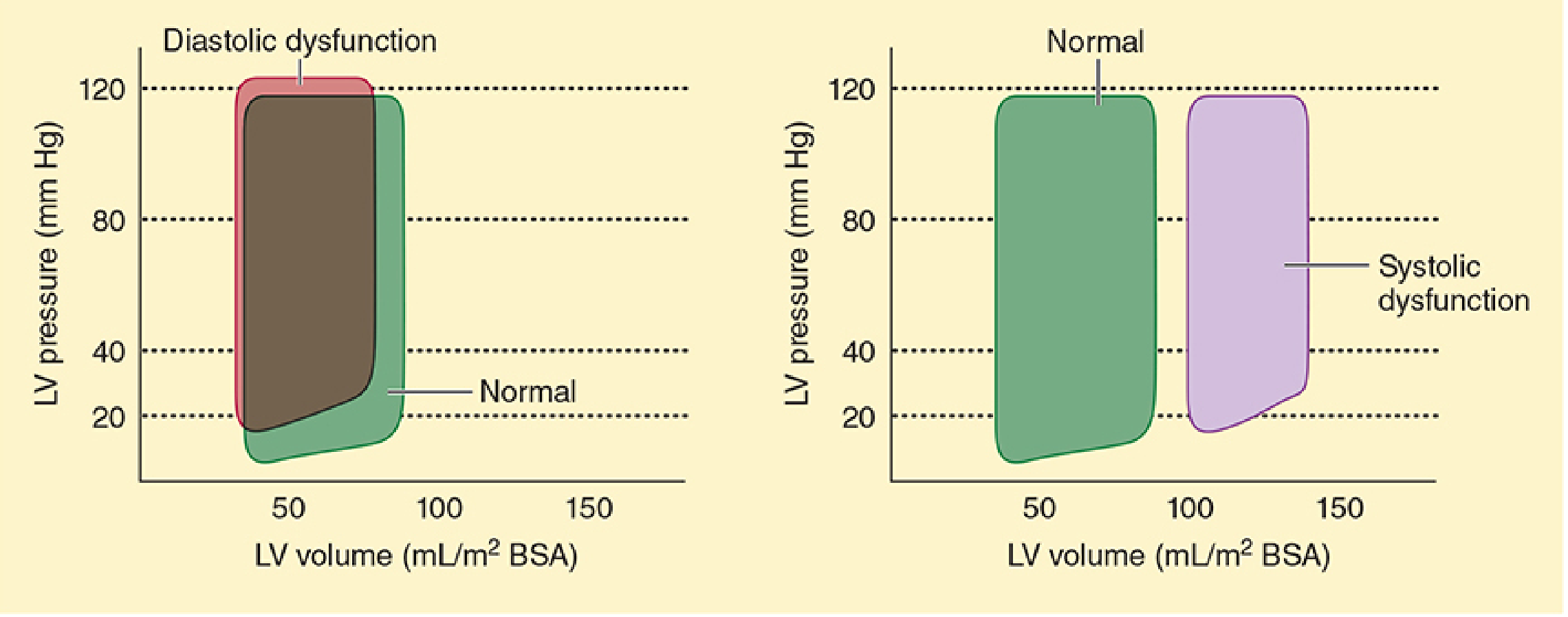
Note that in diastolic dysfunction (left panel, red loop), the ventricle operates at higher pressures for the same or even smaller volumes compared to normal (green loop) - this elevated diastolic pressure is what backs up into the pulmonary circulation.
LVH + Acute Hypertension = Flash Pulmonary Edema
A very important clinical scenario is acute hypertensive pulmonary edema. As Tintinalli's Emergency Medicine states directly:
"Most patients have existing poorly controlled hypertension with cardiac remodeling and left ventricular hypertrophy, stiffness, and diastolic dysfunction. With an acute rise in blood pressure, there is an increase in afterload and a decrease in venous capacitance. This leads to fluid shifts from the splanchnic and peripheral vascular beds into the pulmonary circulation."
In this setting, LVH is the underlying structural substrate, and a sudden blood pressure spike is the acute trigger. The treatment focuses on afterload reduction (vasodilators, primarily nitrates) rather than aggressive diuresis, since the problem is fluid redistribution, not true volume overload.
Key Points Summary
| Feature | Detail |
|---|---|
| Mechanism | LVH → diastolic dysfunction → elevated LVEDP → pulmonary venous hypertension → pulmonary edema |
| LV ejection fraction | Preserved (HFpEF) - systolic function is often normal |
| Prevalence | ~30% of acute cardiogenic pulmonary edema cases have diastolic dysfunction as the primary cause (Murray & Nadel's Respiratory Medicine) |
| Common triggers | Uncontrolled hypertension, acute myocardial ischemia |
| Other causes of LVH-linked diastolic dysfunction | Hypertrophic cardiomyopathy, aortic stenosis, diabetes mellitus, infiltrative cardiomyopathy |
| Treatment principle | Afterload reduction (nitrates), cautious diuresis; avoid positive inotropes (systolic function is intact) |
Important Nuance
LVH itself is usually a compensatory response to pressure overload (e.g., hypertension, aortic stenosis). While it initially helps maintain cardiac output, over time the concentric hypertrophy creates the stiff, non-compliant ventricle that impairs filling and raises diastolic pressures. Pulmonary edema may be the first presenting sign of this process - Murray & Nadel's Textbook of Respiratory Medicine notes that "pulmonary edema may be the only manifestation of silent myocardial infarction or diastolic dysfunction of the left ventricle."
Does enalapril ace inhibitors to prevent further remodeling and Amlodipine calcium channel blocker vasodilator plus diuretic furosemide ....prevents further disease
Yes, this combination is a well-established strategy. Enalapril blocks the renin-angiotensin-aldosterone system (RAAS) to reverse/prevent cardiac remodeling and LVH, amlodipine reduces afterload and blood pressure, and furosemide offloads fluid congestion. Together they address the pathophysiology from multiple angles.
Searching sources...
Finding Sources
Finding Sources
Finding Sources
Finding Sources
Finding Sources
Reading File
Finding Sources
Finding Sources
Reading File
Finding Sources
Here is a thorough breakdown of how each drug in this combination works, what the evidence shows, and the important caveats:
Enalapril (ACE Inhibitor) - Preventing and Reversing Cardiac Remodeling
Mechanism
Enalapril blocks angiotensin-converting enzyme, preventing the conversion of Angiotensin I to Angiotensin II (Ang II). This matters enormously in the context of LVH and heart failure because Ang II:
- Directly stimulates myocyte hypertrophy
- Promotes cardiac fibrosis (collagen deposition in the myocardium)
- Causes vasoconstriction, increasing afterload
- Stimulates aldosterone, causing sodium and water retention
By blocking these effects, enalapril hits the disease at its root cause.
What ACE Inhibitors Do to the Remodeled Heart
According to Goodman & Gilman's Pharmacological Basis of Therapeutics, ACE inhibitors in heart failure:
- Reduce ventricular dilation and tend to restore the heart to its normal elliptical shape
- Reverse ventricular remodeling via changes in preload/afterload
- Prevent the growth effects of Ang II on myocytes
- Attenuate cardiac fibrosis induced by Ang II and aldosterone
- Reduce pulmonary capillary wedge pressure, left ventricular filling volumes, and left atrial pressures
- Reduce systemic vascular resistance and increase cardiac output
Clinical Evidence - Landmark Trials
The evidence base for enalapril is exceptionally strong:
- CONSENSUS trial (1987): Enalapril reduced mortality by 40% in severe heart failure (NYHA class IV)
- SOLVD trial (1992): Enalapril reduced mortality and delayed the development of overt heart failure even in asymptomatic patients with reduced ejection fraction - meaning it prevents progression before symptoms develop
- Goodman & Gilman's states: "Unless contraindicated, ACEIs should be given to all patients with impaired left ventricular systolic function whether or not they have symptoms of overt heart failure... Several large clinical studies have demonstrated that inhibition of ACE in patients with systolic dysfunction prevents or delays the progression of heart failure, decreases the incidence of sudden death and MI, decreases hospitalization, and improves quality of life."
Important note: ACE inhibitors work best when there is systolic dysfunction (reduced EF). In pure diastolic dysfunction (HFpEF) with preserved EF - which is what LVH classically produces - the benefit on mortality is less clear, though they still help with blood pressure control and may slow LVH progression.
Amlodipine (Dihydropyridine Calcium Channel Blocker) - Vasodilation and Afterload Reduction
Mechanism
Amlodipine blocks L-type voltage-gated calcium channels in vascular smooth muscle, causing vasodilation. This:
- Reduces systemic vascular resistance (afterload reduction)
- Lowers blood pressure, reducing the pressure overload stimulus that drives LVH
- Has a long half-life (~35-50 hours), making it suitable for once-daily dosing
Role in LVH and Hypertension
By consistently lowering blood pressure, amlodipine removes the pressure overload that caused LVH in the first place. Blood pressure lowering by any agent can promote regression of LVH over time. Amlodipine is particularly useful because it is well-tolerated and effective.
Critical Caveat - Amlodipine in Heart Failure with Reduced EF
This is important: most calcium channel blockers (particularly non-dihydropyridines like verapamil and diltiazem) are contraindicated in systolic heart failure because they depress myocardial contractility. Amlodipine is different - it is the one CCB considered safe in heart failure. The PRAISE-2 trial specifically studied amlodipine in severe non-ischemic heart failure and found it was neutral on mortality - meaning it neither helped nor harmed. So:
- Amlodipine is safe to use in heart failure (unlike other CCBs)
- It is primarily used for blood pressure control and symptom management in this setting
- It is not a first-line disease-modifying agent for heart failure itself
In hypertension with LVH (without significant systolic dysfunction), amlodipine is excellent as part of combination therapy.
Furosemide (Loop Diuretic) - Decongestive Therapy
Mechanism
Furosemide blocks the Na-K-2Cl cotransporter in the thick ascending limb of the loop of Henle, causing powerful natriuresis and diuresis. It also has an early venodilatory effect (even before diuresis begins), which reduces preload.
Role in Pulmonary Edema and Heart Failure
Lippincott Illustrated Reviews Pharmacology states: "Loop diuretics are the drugs of choice for treatment of pulmonary edema and acute/chronic peripheral edema caused from heart failure or renal impairment. Because of their rapid onset of action, particularly when given intravenously, the drugs are useful in emergency situations such as acute pulmonary edema."
Katzung's Basic and Clinical Pharmacology adds: "Both furosemide and ethacrynic acid have also been shown to reduce pulmonary congestion and left ventricular filling pressures in heart failure before a measurable increase in urinary output occurs" - the early venodilatory effect accounts for the rapid symptomatic relief seen within minutes of IV dosing.
Important Limitation
Furosemide relieves symptoms and reduces congestion, but it has no proven mortality benefit in heart failure. It does not reverse remodeling or address the underlying pathophysiology. It is a symptomatic treatment, not a disease-modifying one.
The Full Picture: How This Triple Combination Works Together
| Drug | Primary Action | Disease-Modifying? | Evidence Level |
|---|---|---|---|
| Enalapril | Blocks RAAS, reduces afterload + preload, prevents fibrosis/hypertrophy | Yes - proven mortality benefit in HFrEF | Very strong (CONSENSUS, SOLVD) |
| Amlodipine | Vasodilation, afterload reduction, BP control | Partial (via BP lowering, LVH regression) | Safe; neutral on HF mortality (PRAISE-2) |
| Furosemide | Removes excess fluid, reduces congestion | No - symptomatic relief only | Strong for symptom control |
Does this combination "prevent further disease"?
- Yes, mostly - especially the enalapril component. It directly prevents the structural worsening (remodeling, fibrosis, chamber dilation) that leads to progressive heart failure.
- Amlodipine helps by maintaining BP control and reducing the pressure overload burden.
- Furosemide keeps the patient comfortable and prevents the acute decompensations (pulmonary edema episodes) that themselves worsen the heart.
One modern consideration: current guidelines now prefer sacubitril/valsartan (ARNI) over enalapril alone for HFrEF, as the PARADIGM-HF trial showed it to be superior to enalapril in reducing mortality and hospitalizations. However, enalapril remains a valid, evidence-based choice and is far more accessible globally.
This is a shared conversation. Sign in to Orris to start your own chat.