
Chronic renal failure
Reading File
Finding Sources
Finding Sources
Searching PubMed
"chronic kidney disease" management
The best sources are Brenner and Rector's The Kidney (the gold-standard nephrology reference). Let me read the key sections in parallel.
Reading File
Reading File
Reading File
Good. I have staging data. Let me now pull the comprehensive management, pathophysiology, and complications sections from Brenner & Rector's and Family Medicine textbook.
Reading File
Finding Sources
Finding Sources
Excellent. Let me now read the Comprehensive Clinical Nephrology and Goldman-Cecil Medicine sections for the full clinical picture.
Reading File
Reading File
Reading File
Finding Sources
Reading File
Reading File
I now have comprehensive content. Let me also quickly search for an image to include and check causes/etiology.
Finding Sources
Searching Images
chronic kidney disease CKD stages pathophysiology diagram
I now have all the information needed to compile a comprehensive answer. Let me synthesize it:
Chronic Renal Failure (Chronic Kidney Disease — CKD)
Definition
Chronic kidney disease (CKD) is defined as kidney damage or decreased kidney function persisting for 3 months or longer, based on:
- Glomerular filtration rate (GFR) < 60 mL/min/1.73 m²
- Albuminuria > 30 mg/day
- Pathological, blood, urine, or imaging abnormalities
— Goldman-Cecil Medicine, p. 1342
Staging (KDIGO Classification)
| Stage | Description | GFR (mL/min/1.73 m²) |
|---|---|---|
| G1 | Kidney damage, normal GFR | ≥ 90 |
| G2 | Mild decrease | 60–89 |
| G3a | Mild-to-moderate decrease | 45–59 |
| G3b | Moderate-to-severe decrease | 30–44 |
| G4 | Severe decrease | 15–29 |
| G5 | Kidney failure (ESRD) | < 15 |
Albuminuria is staged separately: A1 (<30 mg/g), A2 (30–300 mg/g), A3 (>300 mg/g). Risk of progression and complications scales with both the GFR category and albuminuria category.
— Textbook of Family Medicine, p. 1191; Goldman-Cecil Medicine
Causes / Etiology
The most common causes worldwide:
- Diabetic nephropathy (leading cause; ~40% of ESRD)
- Hypertensive nephrosclerosis
- Glomerulonephritis (IgA nephropathy, FSGS, membranous, etc.)
- Polycystic kidney disease (ADPKD, ARPKD)
- Obstructive uropathy / chronic pyelonephritis
- Lupus nephritis / vasculitis
- Drug-induced nephrotoxicity (NSAIDs, analgesics, aminoglycosides, contrast)
- Ischemic nephropathy / renovascular disease
Non-diabetic causes should be considered even in diabetic patients if GFR declines rapidly, hypertension is refractory, active urine sediment is present, or systemic disease is suspected. — Brenner & Rector's The Kidney
Pathophysiology
Nephron Loss & Hyperfiltration
Progressive nephron loss triggers compensatory hyperfiltration in surviving nephrons (increased single-nephron GFR). This initially maintains total GFR but causes glomerular hypertension → proteinuria → further glomerulosclerosis → a self-perpetuating cycle of nephron loss. GFR is therefore a poor early indicator of disease burden; significant parenchymal loss occurs before GFR drops. — Brenner & Rector's The Kidney
Key Pathways
- Renin-angiotensin-aldosterone system (RAAS) activation → hypertension, proteinuria, fibrosis
- TGF-β → tubulointerstitial fibrosis
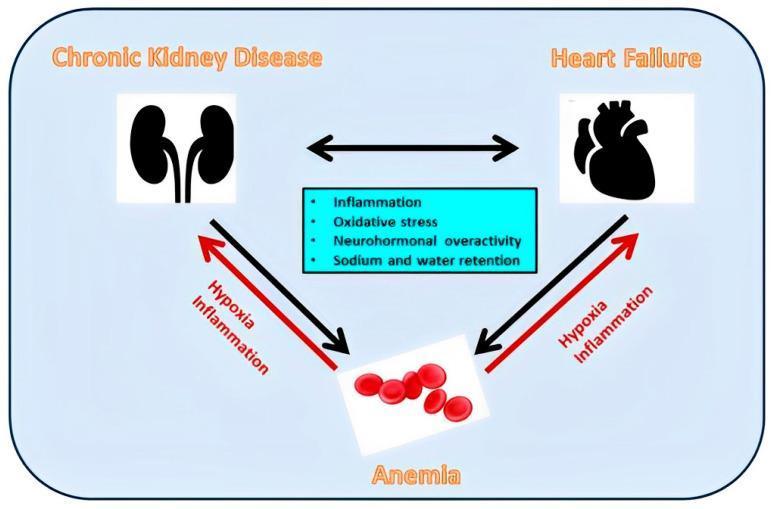
- Oxidative stress & inflammation → endothelial injury, cardiovascular disease
- Impaired erythropoietin production → anemia
- Phosphate retention → secondary hyperparathyroidism → renal osteodystrophy
Clinical Manifestations
CKD is usually asymptomatic in early stages (G1–G2). Manifestations emerge progressively:
Stages G1–G2
- New/worsening hypertension
- Proteinuria (may cause edema in nephrotic range)
- Incidental electrolyte or urinalysis abnormalities
Stages G3–G4
- Anemia (fatigue, weakness, exertional dyspnea) — due to ↓ erythropoietin
- Renal osteodystrophy — pathologic fractures, soft-tissue/vascular calcification
- Hyperphosphatemia → elevated Ca×P product → calciphylaxis, vascular calcification → LV hypertrophy, heart failure
- Metabolic acidosis — normal anion gap at G3b; high anion gap (retained phosphate/sulfate) at G4–G5
- Hyperkalemia — especially with RAAS blockade; mild (5.0–5.5 mEq/L) to severe (>6.5 mEq/L) at advanced stages
- Malnutrition / muscle and fat wasting
- Sexual dysfunction — amenorrhea, impotence, oligospermia
Stage G5 — Uremic Syndrome (GFR <15 mL/min/1.73 m²)
- Fluid overload / hypertension
- Peripheral neuropathy
- Pruritus (uremic)
- Pericarditis (uremic)
- GI symptoms — nausea, vomiting, anorexia
- Encephalopathy — altered mental status, seizures
- Increased infection risk
— Goldman-Cecil Medicine, pp. 1342–1343
Diagnosis
Systematic evaluation includes:
- Serum creatinine + eGFR (CKD-EPI equation preferred; MDRD also used)
- Urine albumin-to-creatinine ratio (ACR)
- Complete urinalysis (casts, hematuria, proteinuria)
- Renal ultrasound (size, echogenicity, obstruction, cysts)
- Serum electrolytes, bicarbonate, CBC, PTH, phosphate, calcium
- HbA1c if diabetic etiology suspected
- Complement, ANA, ANCA if glomerulonephritis suspected
- Kidney biopsy — when etiology is uncertain and affects management
Key point: Serum creatinine alone is inadequate — a "normal" creatinine may correspond to substantially reduced GFR in older patients, women, or those with low muscle mass. — Textbook of Family Medicine, p. 1192
Management
Principles
Management is cause-specific + stage-based, cumulative across stages. — Goldman-Cecil Medicine, p. 1341
Lifestyle & Diet
- Sodium restriction (<2 g/day) for hypertension
- Protein intake: 0.6–0.8 g/kg/day at G3–G5 (slows solute retention, may slow progression)
- Total calories: 25–35 kcal/kg/day (prevent protein-calorie malnutrition)
- Mediterranean/DASH diet; tobacco cessation; physical activity
- Registered dietitian involvement is essential
Blood Pressure Control
- Target SBP <130 mmHg (some guidelines recommend <120 mmHg)
- ACE inhibitor or ARB — first-line for albuminuria with or without diabetes; reduces albuminuria and slows GFR decline
- Add diuretics or calcium-channel blockers as needed
- Finerenone (non-steroidal mineralocorticoid receptor antagonist) — effective in diabetic CKD with albuminuria (20 mg/day if eGFR >60; 10 mg/day if eGFR 25–59)
SGLT2 Inhibitors & GLP-1 Agonists
SGLT2 inhibitors (canagliflozin 100 mg, dapagliflozin 5 mg, empagliflozin 10 mg daily) reduce albuminuria, slow GFR decline, and reduce risk of kidney failure and cardiovascular events — in both diabetic and non-diabetic CKD with albuminuria. GLP-1 agonists also reduce albuminuria in type 2 diabetes. — Goldman-Cecil Medicine, p. 1343
Glycemic Control
- HbA1c target similar to non-CKD diabetes; may be less strict in elderly/comorbid patients
Lipid-Lowering Therapy
- Statins recommended (cardiovascular benefit); however, no direct benefit on CKD progression
Management of Specific Complications
| Complication | Target | Treatment |
|---|---|---|
| Anemia | Hb 90–110 g/L | Treat iron deficiency first; then erythropoiesis-stimulating agents (ESA, e.g., darbepoetin alpha 0.45 μg/kg q4 weeks) when Hb <9 g/dL; HIF-stabilizers (non-US approved for pre-dialysis) |
| Metabolic acidosis | Bicarbonate >22 mmol/L | Sodium bicarbonate 650 mg BD, titrate to target |
| Metabolic bone disease / Secondary HPT | Ca 2.2–2.35, PO₄ <1.8 mmol/L | Phosphate binders; active vitamin D (calcitriol 0.25–0.5 μg/day); calcimimetics (cinacalcet 30 mg/day) on dialysis; parathyroidectomy if refractory |
| Hyperkalemia >5.5 mEq/L | K <5.5 mEq/L | Dietary restriction (<2 g/day K); potassium-binding agents; loop diuretics; insulin/glucose for acute elevations; dialysis if severe |
| Malnutrition | Adequate intake | Dietitian support; 25–35 kcal/kg/day |
| Edema (nephrotic) | — | Diuretics ± albumin infusion if refractory |
— Comprehensive Clinical Nephrology 7th Ed., p. 1123; Goldman-Cecil Medicine, pp. 1343–1345
Referral to Nephrology
Refer when:
- eGFR < 30 mL/min/1.73 m² (stage G4–G5)
- ACR ≥ 300 mg/g (A3)
- Rapid progression (sustained GFR drop >5 mL/min/1.73 m²/year or change of GFR category)
- Unexplained hematuria, resistant hypertension, persistent K abnormalities, hereditary kidney disease
— Comprehensive Clinical Nephrology 7th Ed., Box 82.1
Kidney Replacement Therapy (Stage G5)
When conservative care no longer controls uremic symptoms:
- Hemodialysis — most common; thrice-weekly; high risk of cardiovascular complications
- Peritoneal dialysis — home-based; continuous or intermittent
- Kidney transplantation — preferred; extends life and quality of life over dialysis
Shared decision-making and advance care planning should begin well before uremia develops. — Goldman-Cecil Medicine, p. 1345
Prevention
- Primary: Treat hypertension, diabetes, obesity; avoid nephrotoxic drugs; healthy lifestyle
- Secondary: Early detection via ACR + eGFR screening in at-risk patients (diabetics, hypertensives, family history of CKD); RAAS blockade and SGLT2 inhibition to slow progression
- Tertiary: Prevent cardiovascular complications (leading cause of death in CKD)
Key Points to Remember
- CKD is defined by persistence >3 months — acute kidney injury can mimic CKD until chronicity is established.
- Serum creatinine is unreliable alone — eGFR and ACR together define risk.
- Cardiovascular disease is the #1 cause of death in CKD, not kidney failure.
- SGLT2 inhibitors are now established as kidney-protective in both diabetic and non-diabetic CKD with albuminuria.
- ESAs should target Hb 10–11 g/dL only — higher targets worsen cardiovascular outcomes.
- Avoid NSAIDs, iodinated contrast, gadolinium, and other nephrotoxins.
Sources: Goldman-Cecil Medicine (22nd Ed.); Comprehensive Clinical Nephrology (7th Ed.); Brenner & Rector's The Kidney; Textbook of Family Medicine (9th Ed.)
This is a shared conversation. Sign in to Orris to start your own chat.