
Double sequential defibrillator
I'll look this up in the medical library and recent literature simultaneously.
Searching sources...
Reading File
Searching PubMed
double sequential defibrillation refractory ventricular fibrillation
Now let me search the medical library and pull abstracts from the top studies in parallel.
Finding Sources
Reading Article
PMID: 37482919
Reading Article
PMID: 39127020
Excellent - the textbook has a dedicated section. Let me read it and the DOSE VF trial abstract in parallel.
Reading File
Reading Article
PMID: 38522736
Now let me get the longer Tintinalli section on DSED under cardiac resuscitation and the Braunwald content.
Reading File
Finding Sources
I now have all the information needed for a thorough answer. Let me also fetch the VF management flowchart image for context.
Loading Image
Here is a complete overview of double sequential defibrillation (DSED).
Double Sequential Defibrillation (DSED)
What It Is
Double sequential defibrillation - also called dual sequential external defibrillation (DSED) - is a rescue technique that uses two separate defibrillators with two sets of pads to deliver two rapid successive shocks in patients with shock-refractory ventricular fibrillation (VF). The goal is to dramatically increase total delivered energy and overcome the failure of standard single-shock defibrillation.
- Tintinalli's Emergency Medicine, p. 198 & 202
- Braunwald's Heart Disease, p. 3341
Indication
DSED is considered for shock-refractory VF, defined as:
- VF persisting despite 3 or more successive standard shocks, plus adequate CPR and antiarrhythmic drugs (epinephrine, amiodarone, or lidocaine)
- Some definitions also include: 3+ sustained episodes of VT/VF or ICD shocks within 24 hours
It is a last-resort escalation, not a first-line strategy.
Technique
- Standard pad position (anterior-lateral): first defibrillator pads placed in the usual apex-sternum orientation.
- Second pad position (anterior-posterior): second defibrillator pads placed anteriorly and posteriorly - creating two orthogonal shock vectors.
- Both defibrillators are charged to maximal output simultaneously.
- Shocks are delivered in rapid succession (nearly simultaneously), requiring coordination between two operators.
The anterior-posterior second pad placement ensures that the two electrical vectors traverse different myocardial territories, theoretically depolarizing a larger total mass of fibrillating myocardium.
Proposed Mechanism
The exact mechanism is debated. Leading theories include:
- Reduced VF threshold: the combined energy lowers the threshold needed to terminate VF
- Overriding the relative refractory period: the second shock finds previously refractory myocardium now excitable, completing depolarization of the entire ventricular mass
- Increased current through untreated fibrillating tissue: the orthogonal vectors cover myocardial regions missed by a single vector
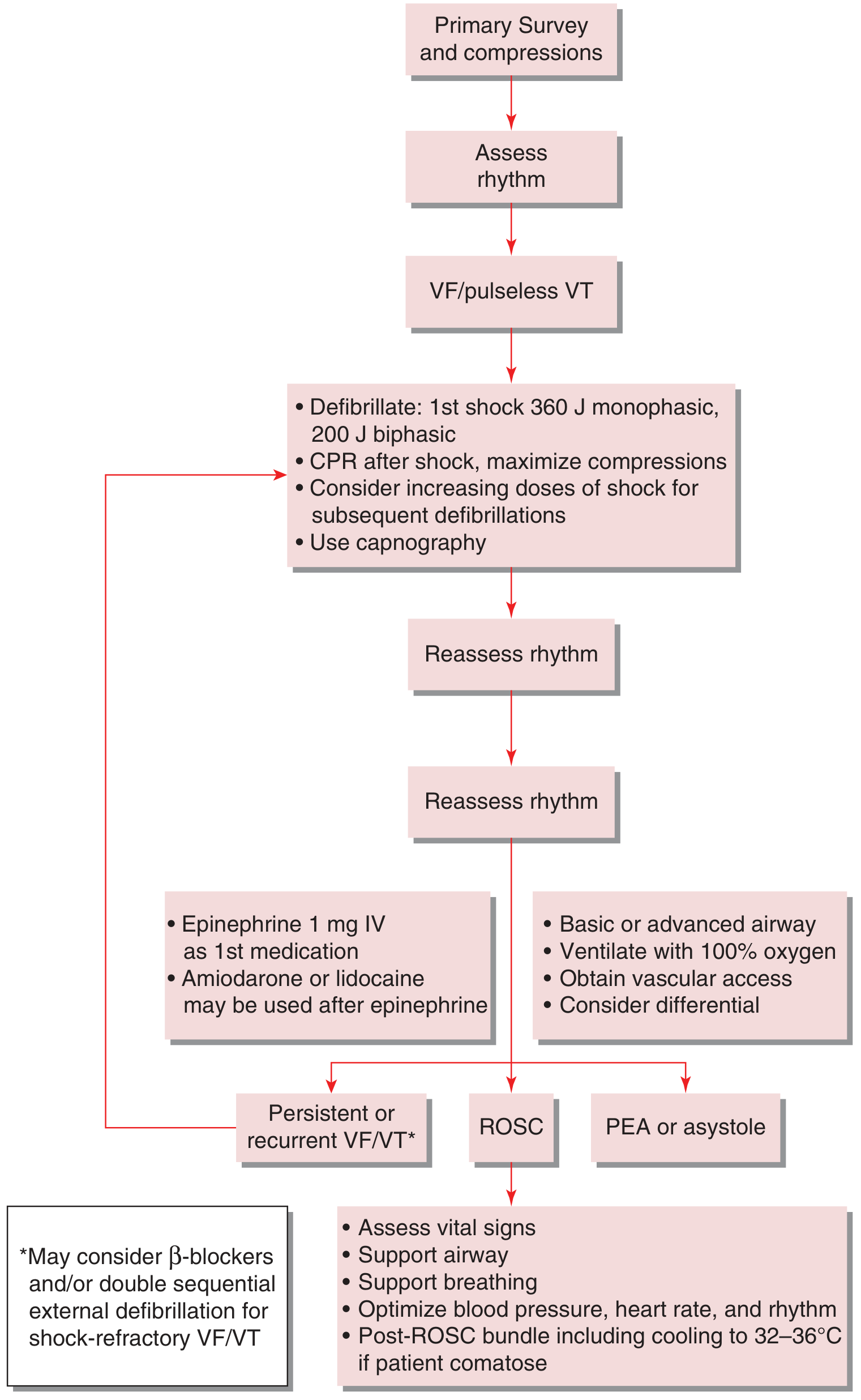
VF/pulseless VT Management Algorithm
The flowchart below (from Tintinalli's) shows where DSED fits - as a consideration at the "persistent or recurrent VF/VT" branch, alongside beta-blockers:
Clinical Evidence
DOSE VF Trial (the key RCT)
The DOSE VF cluster RCT (Cheskes et al.) is the landmark trial. A 2024 secondary analysis (PMID 38522736) of 345 patients found:
- DSED was superior to standard defibrillation for survival, ROSC, and neurologically favorable outcome
- The benefit applied to both shock-refractory VF (0% vs 28.6% survival, p=0.041) and recurrent VF
- Vector-change (VC) defibrillation improved VF termination but was not superior for survival or ROSC
Recent Systematic Reviews and Meta-analyses
Two high-quality meta-analyses published 2023-2024 reached more cautious conclusions:
| Study | Finding |
|---|---|
| Abuelazm et al., 2023 - network meta-analysis, 7 studies, n=1632 (PMID 37482919) | DSED not significantly superior to standard defibrillation for survival, ROSC, or neurological outcome - evidence still inconclusive |
| Yu et al., 2024 - meta-analysis, 6 trials, n=1360 (PMID 39127020) | The single RCT favored DSED, but pooled cohort studies showed no benefit. Double simultaneous (not sequential) defibrillation was associated with lower ROSC rates - caution advised |
Bottom line from evidence: The DOSE VF RCT supports DSED benefit, but pooled observational data do not. An important distinction is that simultaneous double defibrillation appears potentially harmful - the "sequential" (rapid succession, not true simultaneous) approach is preferred.
DSED vs. Vector-Change Defibrillation
These are two distinct strategies often studied together:
| Feature | DSED | Vector-Change (VC) |
|---|---|---|
| Equipment | Two defibrillators | One defibrillator |
| Mechanism | Higher total energy, dual vector | New current vector through previously resistant tissue |
| Evidence | Best data from DOSE VF RCT | Good for VF termination, less clear for survival |
| Complexity | Higher (requires two operators) | Lower |
Vector-change simply repositions the pads (e.g., anterior-posterior instead of anterior-lateral) before a repeat shock and is logistically easier.
Safety and Practical Concerns
- Equipment damage: Manufacturers have raised concerns about electrical damage to defibrillators when two units fire in close proximity.
- Operator safety: Risk of inadvertent rescuer electrocution is low with proper precautions (double gloves or electrically safe gloves), but must be considered. No rescuer deaths have been reported in published literature.
- Coordination: Requires two trained operators and two defibrillators - not always available in the field.
- Not in standard ACLS guidelines as a primary recommendation - it is a "may consider" option for refractory cases.
Summary
DSED is a reasonable escalation option for refractory VF after standard defibrillation and antiarrhythmics have failed. The DOSE VF trial provides the best evidence in its favor, particularly for true shock-refractory VF. Meta-analyses pooling observational data are less favorable, which likely reflects the generally dire prognosis of refractory VF overall. The technique is logistically demanding and carries device damage risk, but offers a potentially life-saving option when nothing else has worked.
Evidence note: The 2026 DOSE VF secondary analysis (PMID 41856454, May 2026) examining defibrillation current and pad position on ROSC may further refine pad positioning guidance - that is the most current RCT data available.
This is a shared conversation. Sign in to Orris to start your own chat.