
Physiology of G I track in detail for like a competitive exams and in clude it's function , enzyme and their roles
Reading File
Now let me search the medical library for comprehensive GI physiology content in parallel:
Finding Sources
Finding Sources
Searching Images
gastrointestinal tract digestive system anatomy diagram
Finding Sources
Finding Sources
Finding Sources
Reading File
Good. Now let me read the broader GI physiology sections from Guyton - going earlier in the block:
Reading File
Finding Sources
Reading File
Finding Sources
Reading File
Reading File
I now have extensive data from Guyton and Hall. Let me also get the block 7 for salivary, esophageal and earlier GI content:
Finding Sources
I now have extensive content from Guyton and Hall covering the full GI physiology. Let me compile the comprehensive answer now with all the material I've gathered from blocks 7 and 8.
Loading Image
Searching Images
pancreatic digestive enzymes secretion diagram
I now have comprehensive data from Guyton & Hall. Let me compile the full competitive exam-level GI physiology guide.
🫁 Physiology of the Gastrointestinal (GI) Tract - Complete Competitive Exam Guide
(Source: Guyton and Hall Textbook of Medical Physiology)
OVERVIEW: The GI Tract at a Glance
The GI tract is a continuous tube from mouth to anus designed to perform 5 core functions:
| Function | Description |
|---|---|
| Motility | Mixing and propulsion of food |
| Secretion | Enzymes, mucus, acid, bile, bicarbonate |
| Digestion | Breakdown of food into absorbable units |
| Absorption | Uptake of nutrients, water, electrolytes |
| Excretion | Elimination of waste |
SECTION 1: MOUTH AND SALIVARY GLANDS
Salivary Secretion (~1000-1500 mL/day)
Three pairs of salivary glands:
- Parotid glands - serous secretion (amylase-rich)
- Submandibular glands - mixed serous + mucous
- Sublingual glands - mainly mucous
Composition of saliva:
- Water (99.5%), electrolytes (Na+, K+, Cl-, HCO3-)
- pH: 6.0-7.0 (slightly acidic to neutral)
- Ptyalin (salivary amylase) and lingual lipase
Salivary Enzymes & Their Roles
| Enzyme | Substrate | Product | Optimal pH |
|---|---|---|---|
| Ptyalin (Salivary Amylase) | Starch (alpha-1,4 glycosidic bonds) | Maltose, dextrins | 6.7-7.0 |
| Lingual Lipase | Triglycerides | Partial glycerides + fatty acids | 3.5-6.0 |
| Lysozyme | Bacterial cell walls | Antibacterial action | - |
| IgA | Antigens | Immune protection | - |
Key Exam Facts - Saliva:
- Saliva is hypotonic compared to plasma
- Aldosterone increases Na+ reabsorption and K+ secretion in salivary ducts
- Parasympathetic stimulation (VII, IX CN) = profuse watery saliva
- Sympathetic stimulation = scant, thick mucous saliva
- Salivary amylase is inactivated by stomach acid (pH < 4)
- Lingual lipase survives in the stomach and digests ~30% of fat
SECTION 2: ESOPHAGUS
Functions:
- Transport of food from pharynx to stomach (peristalsis)
- Prevention of reflux (Lower Esophageal Sphincter - LES)
- Mucous secretion for lubrication and protection
Esophageal Peristalsis:
- Primary peristalsis - continuation of swallowing reflex (mediated by vagus nerve and enteric nervous system)
- Secondary peristalsis - initiated by distention of esophagus alone (no swallowing needed; removes remaining food)
Lower Esophageal Sphincter (LES):
- Normally contracted at 15-35 mmHg (prevents GERD)
- Relaxes via VIP (Vasoactive Intestinal Peptide) and NO (Nitric Oxide)
- Stimulated to contract by: gastrin, motilin, substance P
- Inhibited (relaxed) by: secretin, CCK, GIP, glucagon
SECTION 3: STOMACH
Anatomy of Gastric Secretory Regions:
- Oxyntic (Gastric) glands - Fundus and Body (proximal 80%) - secrete HCl, pepsinogen, intrinsic factor, mucus
- Pyloric glands - Antrum (distal 20%) - secrete mucus and gastrin
Cell Types in Oxyntic Glands:
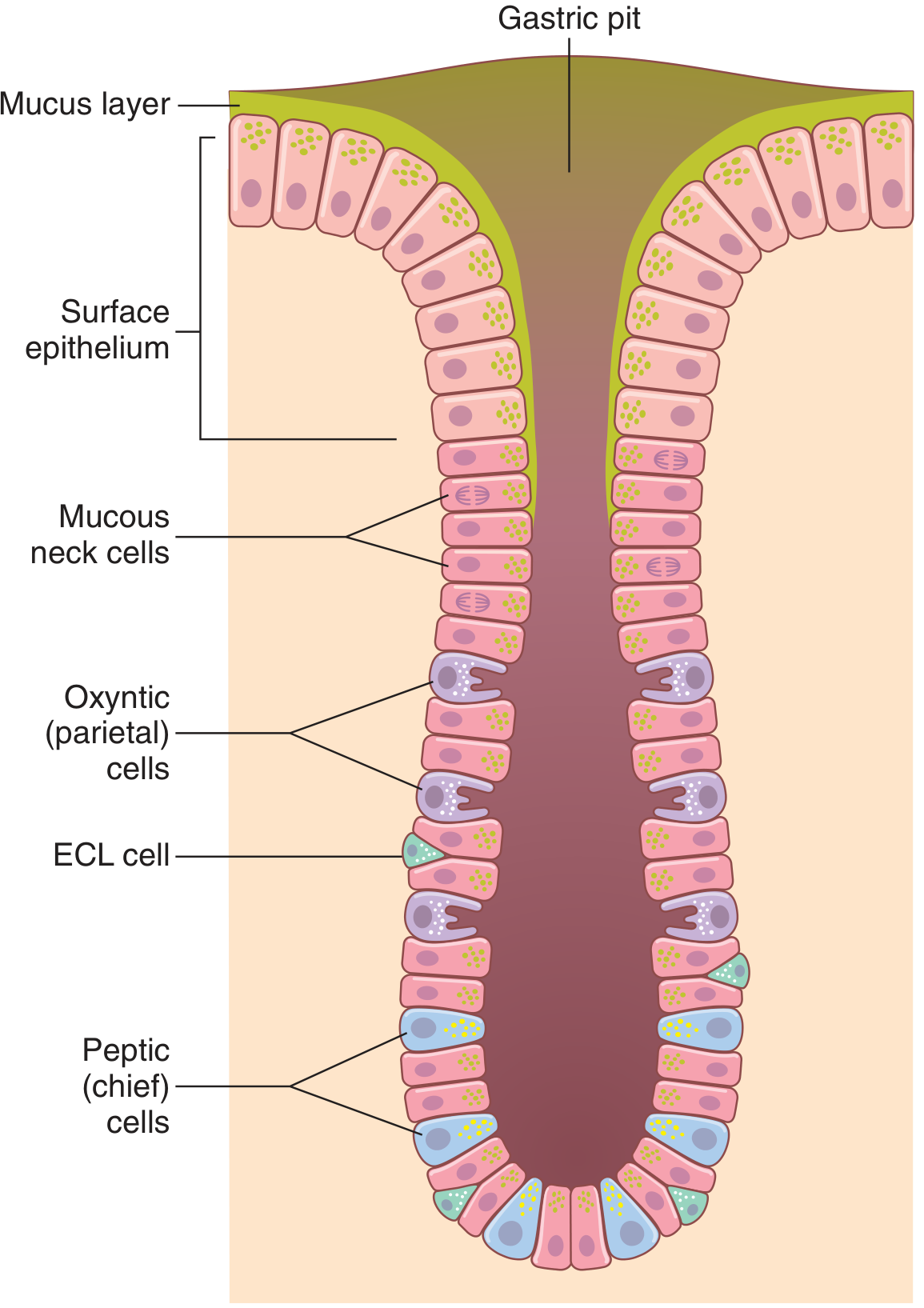
| Cell Type | Location | Secretion | Function |
|---|---|---|---|
| Mucous neck cells | Neck of gland | Mucus | Protection, lubrication |
| Parietal (Oxyntic) cells | Body of gland | HCl + Intrinsic factor | Protein denaturation, B12 absorption |
| Peptic (Chief) cells | Base of gland | Pepsinogen | Precursor to pepsin |
| G cells | Pyloric antrum | Gastrin | Stimulates HCl and pepsinogen |
| ECL cells | Body/fundus | Histamine | Stimulates parietal cells |
| D cells | Antrum | Somatostatin | Inhibits gastrin and HCl |
HCl Secretion by Parietal Cells
Key mechanism - H+/K+ ATPase (Proton Pump):
- Located on the canalicular membrane of parietal cells
- For every H+ pumped into lumen, one K+ is pumped into cell
- H+ concentration in gastric juice: ~160 mmol/L (pH ~0.8)
- This is 3 million times higher than blood H+ concentration
- Requires >1500 cal of energy per liter of gastric juice
Three pathways stimulating acid secretion:
- Acetylcholine (ACh) - from vagus nerve - acts on M3 receptors
- Gastrin - from G cells - acts on CCK-B receptors
- Histamine - from ECL cells - acts on H2 receptors (most potent)
Exam Tip: Omeprazole (PPI) blocks H+/K+ ATPase. Ranitidine blocks H2 receptors.
Phases of Gastric Secretion:
| Phase | Trigger | Mechanism | % of Total |
|---|---|---|---|
| Cephalic | Sight, smell, thought of food | Vagus nerve (ACh) | 30% |
| Gastric | Food in stomach (distension + proteins) | Long and short vasovasal reflexes; gastrin | 60% |
| Intestinal | Chyme in duodenum | Intestinal gastrin, enterooxygenin | 10% |
Pepsin (from Pepsinogen):
- Chief cells secrete pepsinogen (inactive)
- Pepsinogen activated to pepsin by:
- HCl (pH < 2) - initial activation
- Pepsin itself (autocatalysis)
- Pepsin digests proteins at pH 1.8-3.5
- Inactivated at pH > 5
- Pepsin cleaves peptide bonds adjacent to aromatic amino acids (Phe, Tyr, Trp)
Intrinsic Factor:
- Secreted by parietal cells
- Required for absorption of Vitamin B12 in terminal ileum
- Loss of parietal cells → pernicious anemia (megaloblastic)
Gastric Motility - Stomach Emptying:
- Pyloric pump - antral peristalsis propels chyme through pylorus
- Gastric emptying regulated by enterogastric reflexes from duodenum
- Inhibited by: acidic chyme (pH <3.5-4), fat products, hyper/hypotonic fluids, distension
- Rate of emptying depends on: volume, consistency, fat content of meal
- Liquids empty faster than solids; carbohydrates > protein > fat
SECTION 4: SMALL INTESTINE
Three Segments:
- Duodenum (25 cm) - digestion zone; receives bile + pancreatic juice
- Jejunum (2.5 m) - major absorption zone
- Ileum (3.5 m) - absorbs bile acids, B12; leads to ileocecal valve
Secretions of the Small Intestine (~1800 mL/day):
- Formed by enterocytes of Crypts of Lieberkühn
- pH: 7.5-8.0 (slightly alkaline)
- Brunner's glands (in duodenum) - secrete mucus rich in HCO3- (protect duodenum from stomach acid)
Brush Border Enzymes (Membrane-bound):
| Enzyme | Substrate | Product |
|---|---|---|
| Sucrase | Sucrose | Glucose + Fructose |
| Maltase | Maltose | 2 Glucose |
| Isomaltase (alpha-dextrinase) | Isomaltose, alpha-limit dextrins | Glucose |
| Lactase | Lactose | Glucose + Galactose |
| Peptidases (aminopeptidase, dipeptidase) | Small peptides | Amino acids |
| Intestinal lipase | Neutral fats | Glycerol + Fatty acids |
| Enterokinase (Enteropeptidase) | Trypsinogen | Trypsin |
Key Exam Point: Enterokinase is the KEY enzyme - it activates trypsinogen to trypsin, which then activates all other pancreatic proteases (cascade activation).
Small Intestinal Motility:
- Mixing (segmentation) contractions - stationary, rhythmic; mix chyme with secretions
- Propulsive (peristaltic) contractions - move chyme aborally
- Migrating Motor Complex (MMC) - occurs between meals; sweeps residue toward colon every 90 min; "intestinal housekeeper"
- Basal electrical rhythm (BER/slow waves): duodenum = 12/min, ileum = 8-9/min
SECTION 5: PANCREAS
Pancreatic Secretion (~1500 mL/day):
- Acinar cells - secrete digestive enzymes
- Ductal cells - secrete HCO3- (pH 8.0; up to 145 mmol/L bicarbonate)
Pancreatic Enzymes and Their Roles:
PROTEOLYTIC ENZYMES (secreted as inactive zymogens):
| Enzyme | Inactive Form | Activator | Action |
|---|---|---|---|
| Trypsin | Trypsinogen | Enterokinase (then autocatalysis) | Cleaves peptide bonds at Lys, Arg |
| Chymotrypsin | Chymotrypsinogen | Trypsin | Cleaves at Phe, Tyr, Trp |
| Elastase | Proelastase | Trypsin | Cleaves at Ala, Gly, Val, Ser |
| Carboxypeptidase A | Procarboxypeptidase A | Trypsin | Cleaves C-terminal aromatic/aliphatic AAs |
| Carboxypeptidase B | Procarboxypeptidase B | Trypsin | Cleaves C-terminal Lys, Arg |
WHY ZYMOGENS? Prevents autodigestion of the pancreas. Pancreatitis = premature activation of trypsinogen inside acinar cells.
AMYLOLYTIC ENZYMES:
| Enzyme | Substrate | Product |
|---|---|---|
| Pancreatic amylase | Starch, glycogen (alpha-1,4 bonds) | Maltose, maltotriose, alpha-limit dextrins |
LIPOLYTIC ENZYMES:
| Enzyme | Substrate | Product |
|---|---|---|
| Pancreatic lipase | Triglycerides (at sn-1, sn-3 positions) | 2-monoglycerides + 2 fatty acids |
| Cholesterol esterase | Cholesterol esters | Cholesterol + fatty acids |
| Phospholipase A2 | Phospholipids | Lysophospholipids + fatty acids |
Note: Pancreatic lipase requires colipase (co-factor) to function in the presence of bile salts.
NUCLEOLYTIC ENZYMES:
- RNase - digests RNA
- DNase - digests DNA
Regulation of Pancreatic Secretion:
| Stimulus | Source | Effect |
|---|---|---|
| Secretin | S cells of duodenum/jejunum (when pH <4.5) | Copious HCO3- and water secretion by ductal cells |
| CCK (Cholecystokinin) | I cells of duodenum/jejunum (fats + proteins) | Enzyme secretion by acinar cells |
| Acetylcholine (Vagus) | Parasympathetic nerves | Enzyme secretion |
Phases of Pancreatic Secretion:
| Phase | Contribution |
|---|---|
| Cephalic | ~20% (vagal; enzyme-rich, low volume) |
| Gastric | ~5-10% (vagal; enzyme-rich, low volume) |
| Intestinal | ~70-80% (secretin + CCK; enzyme + HCO3- rich) |
SECTION 6: LIVER AND BILE
Bile Secretion (~600-1000 mL/day):
- Produced continuously by hepatocytes
- Stored and concentrated in gallbladder (up to 10x concentration)
- Released by CCK stimulation (contraction of gallbladder + relaxation of Sphincter of Oddi)
Composition of Bile:
| Component | Function |
|---|---|
| Bile salts (bile acids) | Emulsification of fats; form micelles |
| Bilirubin | Waste product of heme catabolism |
| Cholesterol | Precursor; excreted in bile |
| Phospholipids (lecithin) | Help solubilize cholesterol |
| Electrolytes | Na+, K+, HCO3- |
Bile Salts - Key Facts:
- Primary bile acids: cholic acid and chenodeoxycholic acid (synthesized from cholesterol in liver)
- Conjugated with glycine/taurine → bile salts (more water soluble)
- Secondary bile acids: deoxycholic acid, lithocholic acid (formed by gut bacteria)
- Enterohepatic circulation - 95% of bile salts reabsorbed in terminal ileum, return via portal vein to liver (recycled 2-3 times per meal)
Functions of Bile:
- Emulsification - bile salts break fat globules into tiny droplets (increased surface area for lipase)
- Micelle formation - solubilize fat digestion products for absorption
- Vitamin absorption - fat-soluble vitamins A, D, E, K depend on bile
- Cholesterol excretion - main route for cholesterol elimination
- Excretion of bilirubin, drugs, toxins
SECTION 7: LARGE INTESTINE
Functions:
- Absorption of water and electrolytes (converts liquid chyme to solid stool)
- Storage of waste
- Mucus secretion (no villi, no digestive enzymes - only mucus-secreting cells)
- Bacterial fermentation of undigested carbohydrates
Large Intestinal Motility:
- Haustral contractions - slow mixing movements (every 8-15 min)
- Mass movements - propulsive contractions; occur 1-3x/day; triggered by gastrocolic reflex (food entering stomach)
- Transit time: 18-72 hours
Fluid Handled by Large Intestine:
- ~1500 mL enters from ileocecal valve daily
- ~100-200 mL excreted in stool (maximum absorption capacity ~5-8 L/day)
Defecation Reflex:
- Intrinsic reflex - via enteric nervous system (weak)
- Parasympathetic defecation reflex - via pelvic nerves (S2-S4) - much more powerful
- Voluntary control via external anal sphincter (somatic, pudendal nerve)
SECTION 8: GI HORMONES - MASTER TABLE
| Hormone | Secreted By | Stimulus | Actions |
|---|---|---|---|
| Gastrin | G cells (antrum) | Protein, distension, vagus (ACh) | ↑ HCl, ↑ pepsinogen, ↑ gastric motility, trophic to GI mucosa |
| Secretin | S cells (duodenum) | Acid (pH <4.5) in duodenum | ↑ HCO3- from pancreas/bile, ↓ gastric acid, ↓ gastric emptying |
| CCK | I cells (duodenum/jejunum) | Fat + protein in duodenum | ↑ Pancreatic enzymes, ↑ gallbladder contraction, ↓ gastric emptying, ↑ sphincter of Oddi relaxation |
| GIP (Glucose-dependent Insulinotropic Peptide) | K cells (duodenum/jejunum) | Glucose, fat | ↑ Insulin secretion (incretin effect), ↓ gastric acid |
| Motilin | M cells (duodenum/jejunum) | Fasting state, fat | Initiates MMC ("interdigestive housekeeper") |
| VIP | Enteric neurons | Fat, ACh | Smooth muscle relaxation, ↑ intestinal secretion, vasodilation |
| Somatostatin | D cells (stomach, pancreas) | Acid, fat, protein | Inhibits everything (gastrin, acid, pancreatic enzymes, GI motility) |
| Ghrelin | Stomach (fundus) | Fasting | ↑ Appetite, ↑ GH release, ↑ gastric motility |
| GLP-1 | L cells (ileum, colon) | Fat + carbs | ↑ Insulin, ↓ glucagon, ↓ gastric emptying (incretin) |
| Peptide YY | L cells (ileum, colon) | Fat | ↓ Appetite, ↓ gastric emptying ("ileal brake") |
SECTION 9: DIGESTION AND ABSORPTION SUMMARY
Carbohydrate Digestion & Absorption:
| Stage | Location | Enzyme | Products |
|---|---|---|---|
| Oral | Mouth | Salivary amylase (ptyalin) | Dextrins, maltose |
| Intestinal lumen | Duodenum/jejunum | Pancreatic amylase | Maltose, isomaltose, alpha-limit dextrins |
| Brush border | Jejunum | Sucrase, maltase, isomaltase, lactase | Monosaccharides (glucose, galactose, fructose) |
- Glucose + Galactose: absorbed via SGLT-1 (Na+-dependent, active transport)
- Fructose: absorbed via GLUT-5 (facilitated diffusion)
- All monosaccharides exit enterocyte via GLUT-2 into portal blood
Protein Digestion & Absorption:
| Stage | Location | Enzyme | Products |
|---|---|---|---|
| Stomach | Gastric lumen | Pepsin | Large polypeptides |
| Intestinal lumen | Duodenum | Trypsin, chymotrypsin, elastase, carboxypeptidase | Oligopeptides, dipeptides, amino acids |
| Brush border | Jejunum | Aminopeptidase, dipeptidase | Amino acids |
- Absorbed as amino acids via Na+-dependent cotransporters
- Di- and tripeptides absorbed via PepT1 (H+-cotransporter) - more efficient than amino acid absorption
Fat Digestion & Absorption:
| Stage | Location | Enzyme | Products |
|---|---|---|---|
| Stomach | Gastric lumen | Lingual/gastric lipase | Partial glycerides |
| Intestinal lumen | Duodenum | Pancreatic lipase + colipase | 2-monoglycerides + fatty acids |
| Micellar solubilization | Duodenum/jejunum | Bile salts | Mixed micelles |
| Absorption | Jejunum | (passive diffusion) | Fatty acids enter enterocytes |
- Long-chain fatty acids → re-esterified to triglycerides → chylomicrons → lymphatics (lacteals) → thoracic duct → blood
- Medium/short-chain fatty acids → portal blood directly
Fat-Soluble Vitamin Absorption:
- Vitamins A, D, E, K - require bile salts and micelles; absorbed with fat
- Vitamin B12 - requires intrinsic factor (IF); absorbed at terminal ileum via cubam receptor
- Folate - absorbed in proximal jejunum
- Iron - absorbed as Fe2+ (ferrous) in duodenum; facilitated by vitamin C and HCl
SECTION 10: INTESTINAL IMMUNE FUNCTION
- Peyer's patches - lymphoid aggregates in ileum; contain M cells that sample antigens
- IgA - secreted into gut lumen; first line of immune defense
- Tight junctions between enterocytes form a mucosal barrier
QUICK EXAM MNEMONICS
"SLAB" - Bile functions:
- Solubilize fats (micelle formation)
- Lipolysis assistance
- Absorption of fat-soluble vitamins
- Bilirubin + cholesterol excretion
"PEP" - Pancreatic enzyme activation:
- Proenzyme (zymogen) secreted
- Enterokinase activates trypsinogen → trypsin
- Protease cascade - trypsin activates all others
Gastric secretion stimulants - "ACE":
- Acetylcholine (vagus, M3 receptor)
- CCK-B (gastrin-like receptor)
- ECL histamine (H2 receptor)
HIGH-YIELD COMPETITIVE EXAM POINTS
| Topic | Key Fact |
|---|---|
| Most potent stimulant of HCl secretion | Histamine (via H2 receptors) |
| Rate-limiting enzyme of fat digestion | Pancreatic lipase (colipase needed) |
| Only site for B12 absorption | Terminal ileum |
| Only site for bile acid reabsorption | Terminal ileum |
| Enzyme that starts the pancreatic enzyme cascade | Enterokinase (brush border) |
| "Interdigestive housekeeper" | Migrating Motor Complex (MMC) triggered by motilin |
| Volume of saliva/day | ~1000-1500 mL |
| Volume of gastric juice/day | ~2000-3000 mL |
| Volume of pancreatic juice/day | ~1500 mL |
| Volume of bile/day | ~600-1000 mL |
| Volume of small intestinal secretion/day | ~1800 mL |
| Total fluid entering GI per day | ~9 L (only ~100-200 mL excreted) |
| Site of maximum water absorption | Small intestine |
| Intrinsic factor deficiency leads to | Pernicious anemia |
| Cholecystokinin contracts | Gallbladder AND relaxes Sphincter of Oddi |
| Secretin - main function | Neutralize duodenal acid (↑ HCO3-) |
| Congenital lactase deficiency vs. acquired | Acquired (adult-onset) is more common |
| Most abundant immunoglobulin in gut | IgA |
Based on: Guyton and Hall Textbook of Medical Physiology (14th Ed.), Unit XII - Gastrointestinal Physiology (Chapters 63-68)
Make the content according to inc of nursing student range
Here is the full GI Tract Physiology guide rewritten specifically for INC (Indian Nursing Council) nursing students - clear language, clinical relevance, nursing care links, and exam-focused format:
🏥 Physiology of the Gastrointestinal (GI) Tract
For INC Nursing Students | Competitive Exam Edition
WHAT IS THE GI TRACT?
The gastrointestinal tract (also called the alimentary canal or digestive tract) is a long muscular tube running from the mouth to the anus - approximately 9 meters long in adults.
Its main job: Break down food → absorb nutrients → remove waste.
5 Basic Functions (Remember: "M-S-D-A-E")
| Letter | Function | Simple Meaning |
|---|---|---|
| M | Motility | Moving food along the tract |
| S | Secretion | Releasing juices, enzymes, mucus |
| D | Digestion | Breaking food into tiny pieces |
| A | Absorption | Taking nutrients into the blood |
| E | Excretion | Removing waste as stool |
ORGANS OF THE GI TRACT (Sequence to Remember)
Mouth → Pharynx → Esophagus → Stomach → Small Intestine
→ Large Intestine → Rectum → Anus
Accessory organs (help digestion but food doesn't pass through them):
- Salivary glands
- Liver
- Gallbladder
- Pancreas
SECTION 1: MOUTH (ORAL CAVITY)
What happens here?
- Mechanical digestion - teeth cut, tear, grind food (mastication)
- Chemical digestion - saliva begins breakdown of starch
- Bolus formation - tongue shapes chewed food into a soft ball (bolus)
Salivary Glands (3 pairs):
| Gland | Location | Type of Secretion |
|---|---|---|
| Parotid | In front of ear | Watery, enzyme-rich |
| Submandibular | Under the jaw | Mixed (watery + thick) |
| Sublingual | Under the tongue | Mainly thick, mucous |
Total saliva produced per day: 1000-1500 mL
Composition of Saliva:
- 99.5% water
- Electrolytes (Na+, K+, HCO3-)
- Ptyalin (salivary amylase) - digests starch
- Lingual lipase - digests some fats
- Mucus - lubricates food
- IgA - immune protection
- Lysozyme - kills bacteria
Salivary Enzymes:
| Enzyme | Acts On | Breaks Into | Note |
|---|---|---|---|
| Ptyalin (Salivary Amylase) | Starch | Maltose + dextrins | Inactivated by stomach acid |
| Lingual Lipase | Fats (triglycerides) | Fatty acids | Continues working in stomach |
Control of Saliva:
- Parasympathetic stimulation (seeing, smelling food) → lots of watery saliva
- Sympathetic stimulation (stress, fear) → dry mouth, thick mucus
🩺 Nursing Application:
- Patients on anticholinergic drugs (atropine) get dry mouth (xerostomia)
- Nil per oral (NPO) patients need oral care to prevent drying and infection
- Parotid gland swelling = Mumps
SECTION 2: PHARYNX AND ESOPHAGUS
Swallowing (Deglutition) - 3 Phases:
| Phase | Control | Action |
|---|---|---|
| Oral phase | Voluntary | Tongue pushes bolus to pharynx |
| Pharyngeal phase | Involuntary (reflex) | Soft palate closes, epiglottis covers larynx, food enters esophagus |
| Esophageal phase | Involuntary | Peristalsis moves food to stomach |
Esophagus:
- Length: ~25 cm
- No digestive enzymes produced here
- Function: Transport food from throat to stomach
Peristalsis:
- Primary peristalsis - follows the swallowing reflex
- Secondary peristalsis - triggered if food remains; clears the esophagus
Lower Esophageal Sphincter (LES) / Cardiac Sphincter:
- Normally kept closed (prevents acid reflux)
- Opens when food arrives
- Weakness of LES → GERD (Gastroesophageal Reflux Disease)
🩺 Nursing Application:
- Keep head end of bed elevated 30-45° after feeding (prevents aspiration and GERD)
- Dysphagia (difficulty swallowing) - assess swallowing before oral feeds
- Achalasia - LES fails to relax; patient has difficulty swallowing
SECTION 3: STOMACH
Parts of the Stomach:
- Cardia - where esophagus meets stomach
- Fundus - upper dome-shaped part
- Body - main part
- Antrum/Pylorus - lower part; controls emptying
What the Stomach Does:
- Stores food (capacity ~1.5 liters, up to 4 liters when full)
- Churns food with gastric juice → chyme (semi-liquid paste)
- Begins protein digestion
- Secretes intrinsic factor (needed for B12 absorption)
- Slowly releases chyme into small intestine
Cells and Their Secretions:
| Cell | Location | Secretes | Function |
|---|---|---|---|
| Mucous cells | All over stomach | Mucus | Protects stomach lining from acid |
| Parietal (Oxyntic) cells | Fundus + Body | HCl + Intrinsic factor | Kills bacteria, activates pepsin; B12 absorption |
| Chief (Peptic) cells | Base of glands | Pepsinogen | Converted to pepsin → digests protein |
| G cells | Antrum (Pylorus) | Gastrin (hormone) | Stimulates more HCl production |
| ECL cells | Fundus + Body | Histamine | Most potent stimulus for HCl |
| D cells | Antrum | Somatostatin | Brakes system; inhibits acid |
Gastric Juice:
- Volume: 2000-3000 mL/day
- pH: 1.5 - 3.5 (very acidic)
- Contains: HCl, pepsin, mucus, intrinsic factor, water
Gastric Enzymes:
| Enzyme | Precursor | Activator | Acts On | Products |
|---|---|---|---|---|
| Pepsin | Pepsinogen | HCl (pH < 2) | Proteins | Large polypeptides |
| Gastric lipase | - | - | Fats | Partial glycerides |
Key Point: Pepsin is a protease - it starts protein digestion. It ONLY works in acid (pH 1.8-3.5). Antacids that raise pH above 5 will inactivate pepsin.
How HCl is Made (Parietal Cell):
- Uses H+/K+ ATPase pump (the proton pump)
- This pump is blocked by Proton Pump Inhibitors (PPIs) like omeprazole, pantoprazole
- Histamine (H2) blockers like ranitidine also reduce acid
3 Phases of Gastric Secretion (Very Common Exam Topic):
| Phase | What Triggers It | How It Works | % of Total Acid |
|---|---|---|---|
| Cephalic phase | Seeing, smelling, thinking about food | Brain signals via vagus nerve | 30% |
| Gastric phase | Food physically in the stomach (protein + stretch) | Local reflexes + Gastrin hormone | 60% |
| Intestinal phase | Chyme entering duodenum | Intestinal gastrin | 10% |
Stomach Emptying:
- Liquid meals empty faster than solid meals
- Fat slows gastric emptying the most
- Controlled by enterogastric reflex - if duodenum is full or acidic, it sends signals to slow the stomach
- Hormones that SLOW emptying: Secretin, CCK, GIP
🩺 Nursing Application:
- Peptic ulcer - H. pylori destroys mucus layer; treat with triple therapy (PPI + 2 antibiotics)
- Pernicious anemia - parietal cells destroyed → no intrinsic factor → no B12 absorption → megaloblastic anemia; treat with IM B12 injections
- Patients on NSAIDs are at risk for gastric ulcers (NSAIDs reduce prostaglandins that protect mucosa)
- Post-gastrectomy patients need B12 injections for life
- Dumping syndrome - after gastric surgery; rapid emptying of hypertonic food into small intestine → hyperosmotic diarrhea, hypoglycemia; advise small, frequent meals, avoid liquids with meals
SECTION 4: SMALL INTESTINE
Most Important Organ for Digestion and Absorption
Length: ~6-7 meters
3 Parts:
| Part | Length | Key Feature |
|---|---|---|
| Duodenum | 25 cm (C-shaped) | Receives bile + pancreatic juice; most digestion happens here |
| Jejunum | 2.5 m | Major site of nutrient absorption |
| Ileum | 3.5 m | Absorbs bile acids, Vitamin B12; leads to large intestine |
Special Features Increasing Absorption Surface Area:
- Plicae circulares (circular folds) - permanent folds of mucosa
- Villi - finger-like projections (0.5-1 mm tall); each contains a lacteal (lymph capillary) for fat absorption
- Microvilli (brush border) - tiny hair-like projections on each villus cell
Together these increase surface area from ~3,300 cm² to ~2,000,000 cm² (600-fold increase!)
Intestinal Secretions (~1800 mL/day):
- Produced by Crypts of Lieberkühn (between villi)
- pH: 7.5 - 8.0
- Contains watery fluid + brush border enzymes
- Brunner's glands (duodenum only) secrete alkaline mucus to protect against stomach acid
Brush Border Enzymes (Attached to Microvilli):
| Enzyme | Breaks Down | Products |
|---|---|---|
| Sucrase | Sucrose (table sugar) | Glucose + Fructose |
| Maltase | Maltose (from starch digestion) | Glucose + Glucose |
| Lactase | Lactose (milk sugar) | Glucose + Galactose |
| Isomaltase | Isomaltose, alpha-limit dextrins | Glucose |
| Aminopeptidase | Peptides (from N-terminal end) | Amino acids |
| Dipeptidase | Dipeptides | Amino acids |
| Enterokinase (Enteropeptidase) | Trypsinogen → Trypsin | Activates ALL pancreatic proteases |
Most important enzyme to remember for exams: ENTEROKINASE - it starts the whole protein digestion cascade
Intestinal Motility:
| Type | Description | Purpose |
|---|---|---|
| Segmentation contractions | Ring-like contractions back and forth | Mix chyme with enzymes |
| Peristalsis | Wave-like forward movement | Propel chyme toward large intestine |
| Migrating Motor Complex (MMC) | Occurs between meals every 90 min | Sweep remaining food/bacteria toward colon; called "intestinal housekeeper" |
🩺 Nursing Application:
- Lactose intolerance = deficiency of lactase → bloating, diarrhea after milk; advise lactose-free diet or lactase supplements
- Celiac disease = gluten destroys villi → malabsorption; gluten-free diet
- Short bowel syndrome - surgical removal of large part of small intestine → severe malabsorption; may need TPN (Total Parenteral Nutrition)
- Auscultate bowel sounds before starting oral feeds post-surgery; absent sounds = ileus
- Normal bowel sounds: 5-35 sounds/minute
SECTION 5: PANCREAS
Pancreatic Secretion (~1500 mL/day)
- pH: 8.0-8.3 (very alkaline - neutralizes stomach acid in duodenum)
- Two types of cells:
- Acinar cells - secrete digestive enzymes
- Ductal cells - secrete sodium bicarbonate (NaHCO3)
Pancreatic Enzymes (MOST IMPORTANT for exams):
Protein-Digesting Enzymes (all secreted as INACTIVE zymogens):
| Zymogen (Inactive) | Active Enzyme | Activated By | Action |
|---|---|---|---|
| Trypsinogen | Trypsin | Enterokinase (then itself) | Cleaves proteins at lysine/arginine bonds |
| Chymotrypsinogen | Chymotrypsin | Trypsin | Cleaves at aromatic amino acids |
| Proelastase | Elastase | Trypsin | Digests elastic fibers |
| Procarboxypeptidase | Carboxypeptidase | Trypsin | Trims amino acids from C-terminal end |
Why inactive? To PREVENT the pancreas from digesting itself. In acute pancreatitis, enzymes activate inside the pancreas → autodigestion → severe abdominal pain, raised serum amylase and lipase.
Fat-Digesting Enzymes:
| Enzyme | Acts On | Products | Note |
|---|---|---|---|
| Pancreatic lipase | Triglycerides | 2-monoglycerides + 2 fatty acids | Needs colipase + bile salts |
| Phospholipase A2 | Phospholipids | Lysophospholipids | |
| Cholesterol esterase | Cholesterol esters | Cholesterol + fatty acids |
Carbohydrate-Digesting Enzyme:
| Enzyme | Acts On | Products |
|---|---|---|
| Pancreatic amylase | Starch, glycogen | Maltose, dextrins |
Nucleic Acid-Digesting:
- RNase - digests RNA
- DNase - digests DNA
Control of Pancreatic Secretion:
| Hormone/Nerve | Where From | Trigger | What It Does |
|---|---|---|---|
| Secretin | S cells (duodenum) | Acid (pH <4.5) in duodenum | Stimulates HCO3- and water (neutralizes acid) |
| CCK | I cells (duodenum/jejunum) | Fat + protein in duodenum | Stimulates enzyme secretion |
| Vagus nerve (ACh) | Brain | Sight/smell of food | Stimulates enzymes (cephalic phase) |
Phases of Pancreatic Secretion:
| Phase | Trigger | Contribution |
|---|---|---|
| Cephalic | Vagus nerve | 20% |
| Gastric | Vagal + gastrin | 5-10% |
| Intestinal | Secretin + CCK | 70-80% (most important) |
🩺 Nursing Application:
- Acute pancreatitis - raised serum amylase (>3x normal) and lipase (more specific); keep patient NPO, IV fluids, pain management
- Chronic pancreatitis - enzyme deficiency → steatorrhea (fatty, foul-smelling stools); give pancreatic enzyme supplements (pancrelipase) with meals
- Cystic fibrosis - thick mucus blocks pancreatic ducts → enzyme deficiency in children
- Serum amylase also raised in: salivary gland disorders, intestinal obstruction
SECTION 6: LIVER AND BILE
Bile (~600-1000 mL/day):
- Made in hepatocytes (liver cells) continuously
- Stored and concentrated in gallbladder (up to 10x concentrated)
- Released into duodenum via common bile duct through Sphincter of Oddi
Composition of Bile:
| Component | Function |
|---|---|
| Bile salts | Emulsify fats; form micelles for fat absorption |
| Bilirubin | Breakdown product of red blood cells (hemoglobin) |
| Cholesterol | Excreted via bile |
| Phospholipids (Lecithin) | Help keep cholesterol dissolved |
| Water + Electrolytes | Bicarbonate, Na+, K+ |
Role of Bile in Fat Digestion:
- Emulsification - bile salts break large fat globules into tiny droplets → increases surface area for lipase to work
- Micelle formation - bile salts surround fat digestion products and carry them to the intestinal wall for absorption
- Without bile: fat passes into stool undigested = steatorrhea
Enterohepatic Circulation of Bile Salts:
- 95% of bile salts are reabsorbed at terminal ileum → return to liver via portal blood → re-secreted in bile
- Only 5% lost in stool (replaced by fresh synthesis from cholesterol)
- Recycled 2-3 times per meal
🩺 Nursing Application:
- Jaundice - bilirubin builds up in blood; skin/eyes turn yellow; 3 types:
- Pre-hepatic (hemolytic) - too much RBC breakdown
- Hepatic (liver disease) - liver can't process bilirubin
- Post-hepatic (obstructive) - bile duct blocked (e.g., gallstones)
- Gallstones (Cholelithiasis) - cholesterol precipitates in gallbladder; patient has right upper quadrant pain after fatty meals
- Fat-soluble vitamins (A, D, E, K) deficiency occurs when bile is absent (obstructive jaundice, bile duct ligation)
- Vitamin K deficiency → bleeding tendency; give Vitamin K before surgery in jaundiced patients
SECTION 7: LARGE INTESTINE
Parts (Remember: "CARTSR"):
Cecum → Ascending colon → Transverse colon → Descending colon → Sigmoid colon → Rectum → Anal canal
Length: ~1.5 meters
Functions:
- Water and electrolyte absorption (the main job)
- Storage of feces
- Mucus secretion (no digestive enzymes here)
- Bacterial fermentation of undigested carbs → Vitamin K, Vitamin B12, short-chain fatty acids, gases (CO2, H2, methane)
Key Point: The large intestine has NO villi and produces NO digestive enzymes - only mucus.
Fluid Balance:
- Receives ~1500 mL/day from small intestine
- Absorbs ~1300-1400 mL
- Excretes only 100-200 mL in stool
- Maximum absorption capacity: 5-8 liters/day (important in diarrhea management)
Movements of Large Intestine:
| Movement | Description | Rate |
|---|---|---|
| Haustral shuffling | Slow back-and-forth mixing | Every 8-15 min |
| Peristalsis | Slow forward movement | Continuous |
| Mass movements | Strong propulsive waves | 1-3 times/day (usually after meals) |
Gastrocolic Reflex:
- Food entering the stomach triggers mass movements in the colon
- That's why many people feel the urge to defecate after meals
Defecation Reflex:
- Feces fills rectum → rectal wall stretches
- Signals travel to sacral spinal cord (S2-S4)
- Internal anal sphincter (involuntary, smooth muscle) relaxes
- External anal sphincter (voluntary, skeletal muscle, pudendal nerve) - person consciously relaxes this
Loss of voluntary control = fecal incontinence (common after spinal cord injury, perineal injury)
🩺 Nursing Application:
- Constipation - encourage high-fiber diet, adequate fluids (1.5-2 L/day), physical activity, regular toilet routine
- Diarrhea - monitor fluid and electrolyte status; oral rehydration solution (ORS) composition: glucose + NaCl + KCl + sodium citrate
- Paralytic ileus - no bowel sounds, no flatus post-surgery; NPO, nasogastric decompression
- Hirschsprung's disease - congenital absence of ganglion cells → no peristalsis → intestinal obstruction in newborns; presents as failure to pass meconium within 48 hours
SECTION 8: GI HORMONES - SIMPLIFIED TABLE
| Hormone | Made In | Released By | Main Actions | Remember |
|---|---|---|---|---|
| Gastrin | G cells (stomach antrum) | Protein, stretch, vagus | ↑ HCl, ↑ pepsinogen, ↑ stomach movement | Stimulates stomach |
| Secretin | S cells (duodenum) | Acid in duodenum | ↑ HCO3- from pancreas, ↓ acid | "Secretin = Bicarbonate" |
| CCK | I cells (duodenum) | Fat + protein in duodenum | ↑ Pancreatic enzymes, contracts gallbladder, relaxes Sphincter of Oddi | "CCK = Fat digestion" |
| GIP | K cells (duodenum) | Glucose + fat | ↑ Insulin secretion, ↓ acid | Incretin hormone |
| Motilin | M cells (intestine) | Fasting, fat | Initiates MMC ("housekeeper") | Between meals |
| Somatostatin | D cells (stomach/pancreas) | Acid, fat | Inhibits gastrin, HCl, all GI secretions | "Somatostatin = STOP everything" |
| Ghrelin | Stomach (fundus) | Fasting/empty stomach | ↑ Hunger, ↑ GH | "Ghrelin = Growling hungry stomach" |
| VIP | Enteric neurons | Fat, nerve stimulation | Relaxes smooth muscle, ↑ intestinal secretion | Vasodilator |
SECTION 9: DIGESTION AND ABSORPTION - SIMPLIFIED
Where Each Nutrient is Digested:
| Nutrient | Starts in | Completed in | Absorbed in |
|---|---|---|---|
| Carbohydrates | Mouth (amylase) | Small intestine (brush border) | Jejunum (mainly) |
| Proteins | Stomach (pepsin) | Small intestine (trypsin etc.) | Jejunum |
| Fats | Stomach (gastric lipase) | Duodenum (pancreatic lipase + bile) | Jejunum |
| Vitamin B12 | Stomach (IF binds B12) | - | Terminal ileum ONLY |
| Bile salts | - | - | Terminal ileum ONLY |
| Iron | Stomach (HCl converts Fe3+ → Fe2+) | - | Duodenum |
| Calcium | - | - | Duodenum (Vitamin D-dependent) |
| Water | - | - | Small intestine (mostly), large intestine |
How Nutrients Enter the Blood:
- Glucose, amino acids, water-soluble vitamins → absorbed into blood capillaries → portal vein → liver
- Fats (long-chain) → packaged as chylomicrons → absorbed into lacteals (lymph) → thoracic duct → blood (bypasses liver)
SECTION 10: DAILY FLUID VOLUMES - HIGH YIELD TABLE
| Source | Volume Per Day |
|---|---|
| Saliva | 1000-1500 mL |
| Gastric juice | 2000-3000 mL |
| Bile | 600-1000 mL |
| Pancreatic juice | 1500 mL |
| Small intestinal secretion | 1800 mL |
| Total GI secretions | ~8-9 liters/day |
| Absorbed in small intestine | ~7.5 liters |
| Absorbed in large intestine | ~1.3-1.4 liters |
| Lost in stool | ~100-200 mL |
Exam Fact: Only 100-200 mL of the ~9 liters entering the GI per day is actually lost in stool. Diarrhea can rapidly cause dehydration and electrolyte imbalance!
NURSING MNEMONICS - QUICK REVISION
Phases of gastric secretion - "CGI" (like the animation!):
- Cephalic (30%) - thinking/smelling food
- Gastric (60%) - food in stomach
- Intestinal (10%) - chyme in duodenum
Hormones that SLOW gastric emptying - "SIGS":
- Secretin
- Inhibitory GIP
- Glucagon
- Somatostatin
Fat-soluble vitamins - "DEKA":
- D, E, K, A - all need bile for absorption
Terminal ileum absorbs - "B-BIB":
- B12 (intrinsic factor-bound)
- Bile salts (enterohepatic circulation)
- It's the Box (terminal ileum)
Pancreatic enzymes activated by trypsin - "CECA":
- Chymotrypsinogen → chymotrypsin
- Elastase (proelastase → elastase)
- Carboxypeptidase (proenyzme → active)
- All activated by trypsin (itself activated by enterokinase)
MOST ASKED INC EXAM QUESTIONS - QUICK ANSWERS
| Question | Answer |
|---|---|
| What is the pH of gastric juice? | 1.5 - 3.5 |
| Which hormone causes gallbladder contraction? | CCK (Cholecystokinin) |
| Where is Vitamin B12 absorbed? | Terminal ileum |
| What activates trypsinogen? | Enterokinase (from brush border) |
| Which cell secretes intrinsic factor? | Parietal (oxyntic) cell |
| What enzyme starts starch digestion? | Ptyalin (salivary amylase) |
| What is the most potent stimulant of HCl secretion? | Histamine (via H2 receptors) |
| What does secretin do? | Stimulates bicarbonate secretion from pancreas (neutralizes acid) |
| What is the normal bowel sound rate? | 5-35/minute |
| What causes steatorrhea (fatty stool)? | Bile deficiency OR pancreatic lipase deficiency |
| Site of iron absorption? | Duodenum |
| What is dumping syndrome? | Rapid gastric emptying post-surgery → hyperosmolar load in intestine |
| Which nerve controls external anal sphincter? | Pudendal nerve (S2-S4) |
| What is the "intestinal housekeeper"? | Migrating Motor Complex (MMC), triggered by motilin |
| Daily output of pancreatic juice? | 1500 mL |
| How is jaundice classified? | Pre-hepatic, Hepatic, Post-hepatic (obstructive) |
| What does lactase digest? | Lactose → glucose + galactose |
| What happens in pernicious anemia? | No intrinsic factor → no B12 absorption → megaloblastic anemia |
| Brunner's glands are found in? | Duodenum (secrete alkaline mucus) |
| What do Peyer's patches do? | Immune surveillance in ileum |
Content sourced from: Guyton and Hall Textbook of Medical Physiology - aligned with INC B.Sc. Nursing and GNM Nursing Curriculum
This is a shared conversation. Sign in to Orris to start your own chat.