
Occular tb full details for md exam answer 15 marks
Reading File
Now let me search the medical library comprehensively for ocular tuberculosis:
Finding Sources
Finding Sources
Searching PubMed
"ocular tuberculosis" diagnosis treatment
Finding Sources
Finding Sources
Kanski's has a dedicated section. Let me read it in full, plus the Wills Eye Manual section:
Reading File
Finding Sources
Reading File
Finding Sources
Finding Sources
I now have comprehensive content from Kanski's. Let me fetch the key images and get a couple more lines of context:
Reading File
Loading Image
Loading Image
I now have comprehensive information. Let me compose the full MD exam answer:
Ocular Tuberculosis — Complete MD Exam Answer (15 Marks)
1. Introduction & Epidemiology
Tuberculosis (TB) is a chronic granulomatous infection caused by Mycobacterium tuberculosis (rarely M. bovis or atypical mycobacteria such as M. avium in immunocompromised patients). TB is primarily a pulmonary disease but spreads haematogenously to extrapulmonary sites — ocular involvement commonly occurs without clinically overt systemic disease, making it a great imitator. Immune deficiency (HIV, diabetes, malnutrition, immunosuppressive therapy) is a major risk factor.
2. Pathogenesis
Two mechanisms operate:
| Mechanism | Description |
|---|---|
| Direct infection | Haematogenous seeding of uveal tissue (choroid most vascular) → granuloma formation with caseating necrosis |
| Hypersensitivity | Immune-mediated reaction to mycobacterial antigens — explains many anterior uveitis episodes, phlyctenulosis, serpiginoid choroiditis, and possibly Eales disease |
3. Ocular Manifestations (Site-by-Site)
A. Eyelids
- Lupus vulgaris — reddish-brown nodules; a form of cutaneous TB
B. Conjunctiva
- Conjunctivitis — granulomatous, with associated preauricular lymphadenopathy (Parinaud oculoglandular syndrome)
- Phlyctenulosis — hypersensitivity-mediated; small, nodular, limbal or corneal lesions with intense injection; classic in children
C. Cornea
- Interstitial keratitis — stromal haze, vascularisation; less common than syphilis but well-documented
- Marginal ulcers (hypersensitivity)
D. Sclera
- Scleritis (anterior or posterior) — nodular or diffuse; can be necrotising
E. Anterior Uvea (Most Common Segment in TB Uveitis)
- Usually granulomatous anterior uveitis
- Mutton-fat keratic precipitates (KPs) on corneal endothelium
- Iris nodules (Koeppe at pupil margin, Busacca in iris stroma)
- Broad posterior synechiae (PS), peripheral anterior synechiae
- Secondary glaucoma, complicated cataract
F. Vitreous
- Viritis — very common; may be secondary to anterior, intermediate, or posterior primary foci
- Snowballs, snowbanking
- Macular complications: cystoid macular oedema (CMO), epiretinal membrane
G. Choroid (Most Characteristic Posterior Segment Lesion)
- Choroidal granuloma (tubercle) — focal, elevated, dome-shaped yellowish lesion; unilateral or bilateral; solitary or multiple. A large abscess-like lesion = tuberculoma
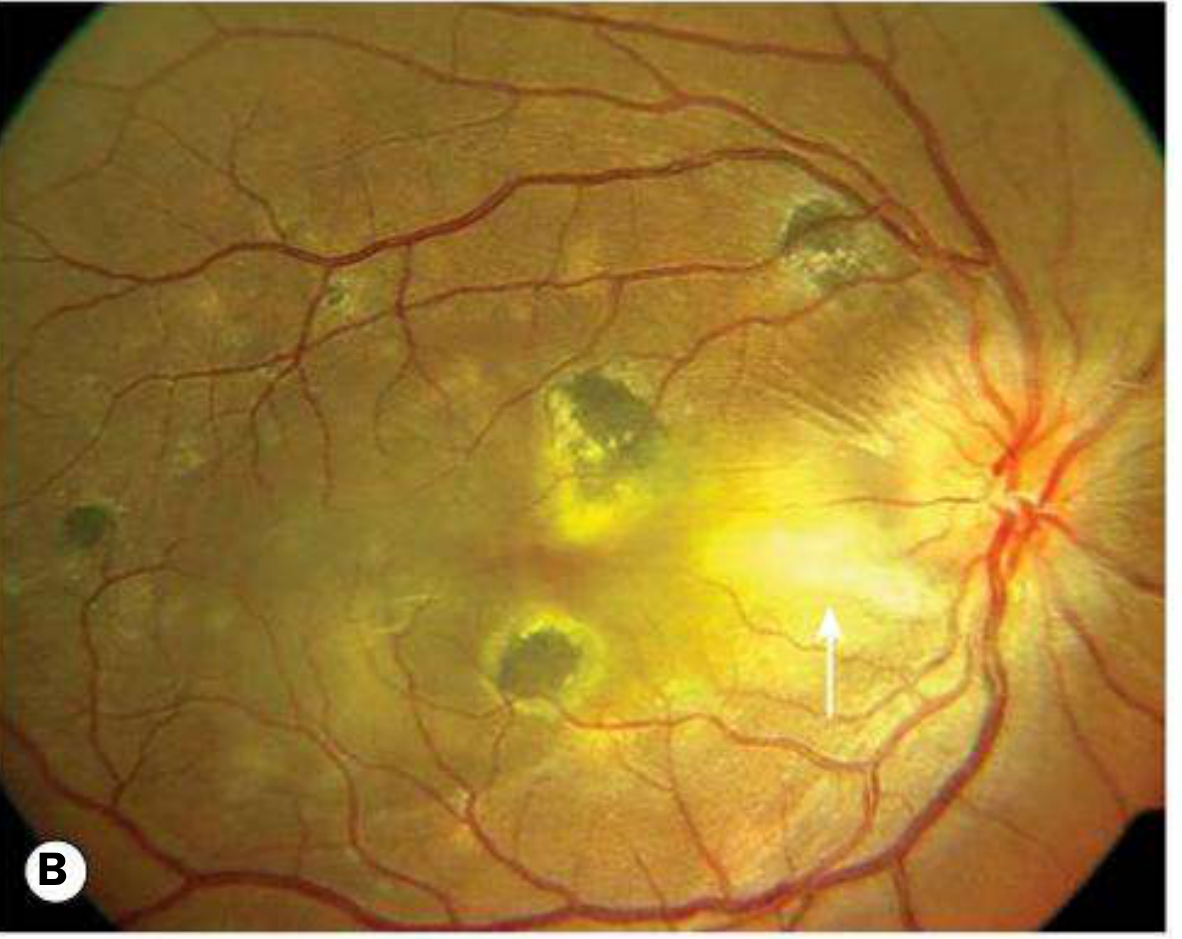
- Serpiginoid (multifocal serpiginous-like) choroiditis — multifocal lesions spreading centrifugally; tracking retinal vessels has reasonable specificity for TB; distinguished from true serpiginous choroiditis by distribution and response to ATT
- Miliary choroidal tubercles — pathognomonic of miliary TB; multiple tiny bilateral choroidal lesions; vital sign on ophthalmoscopy in suspected miliary TB
H. Retina & Retinal Vasculitis
- Retinal vasculitis, preferentially venous (periphlebitis/sheathing of retinal veins)
- Retinal haemorrhages
- Vascular occlusion → branch retinal artery/vein occlusion → extensive ischaemia
- Pre-retinal and disc neovascularisation (NVI/NVE) → vitreous haemorrhage
- Eales disease — recurrent vitreous haemorrhage in young males from idiopathic retinal periphlebitis; TB hypersensitivity is a leading aetiological hypothesis
- Exudative retinal detachment
I. Optic Nerve
- Optic neuritis / neuroretinitis — may be direct infiltration or para-infectious
- Optic atrophy (late)
4. Fundus Images (Kanski's Clinical Ophthalmology)
Fig. A — Choroidal granuloma (Tubercle): Solitary dome-shaped yellowish elevated lesion in posterior pole.
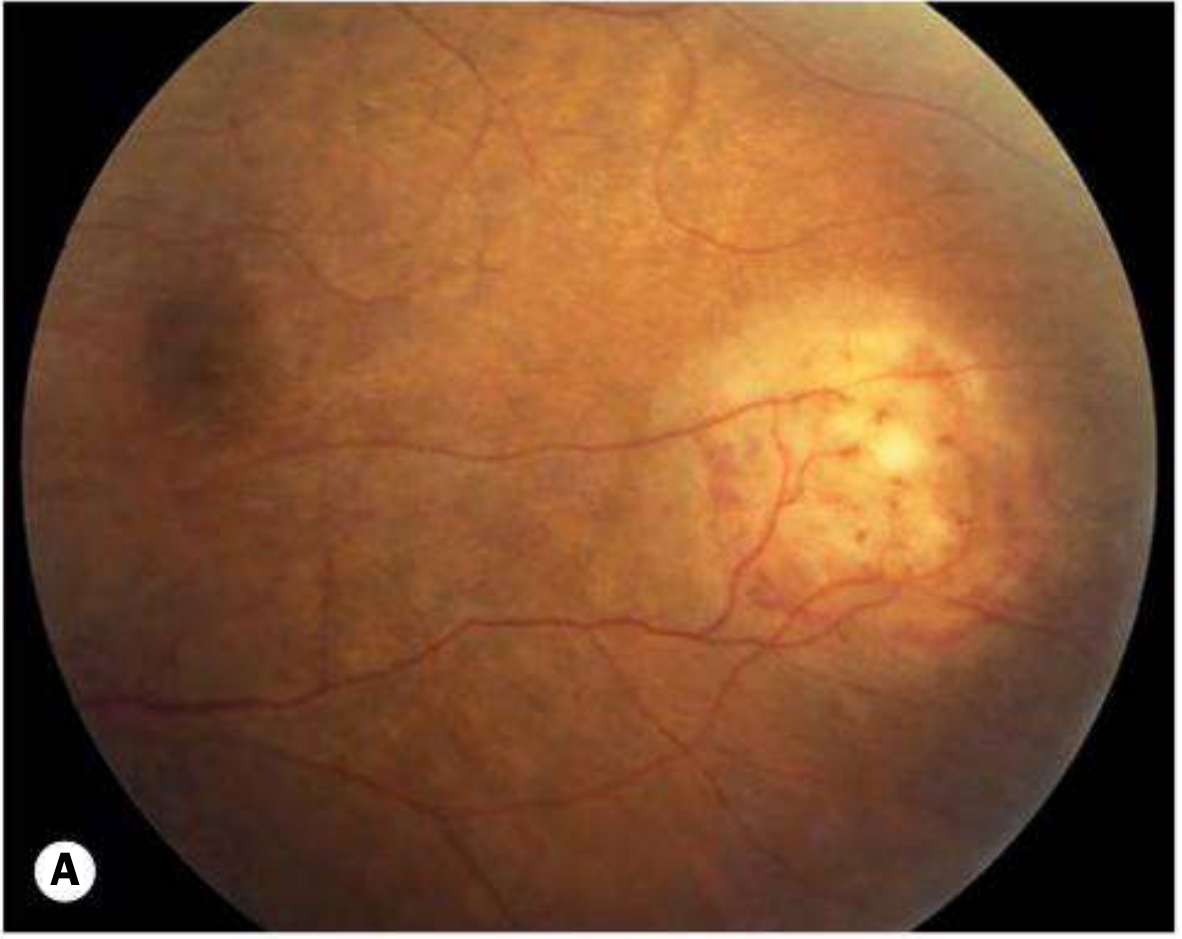
Fig. B — Active multifocal choroidal TB: Multiple pale-yellow lesions with arrow indicating confluent active foci; overlying exudate and disc oedema.
5. Diagnosis
Diagnosis of ocular TB is often clinical — based on clinical picture + evidence of TB exposure or latency + exclusion of other causes. A formal systemic assessment by an appropriate specialist is mandatory.
Systemic Investigations
| Test | Details |
|---|---|
| Tuberculin skin test (Mantoux) | Positive ≥48h; false-negatives in anergy (HIV, malnutrition); false-positives with BCG |
| IGRA — Interferon-Gamma Release Assay (QuantiFERON-TB Gold) | ~80% sensitivity in active disease; independent of BCG vaccination; preferred in BCG-vaccinated populations |
| T-SPOT.TB | Counts antimycobacterial effector T cells producing IFN-γ; can detect latent TB; sensitivity 81%, specificity 86% |
| Sputum — AFB smear + culture | Ziehl-Neelsen staining; Löwenstein-Jensen medium; PCR |
| Chest X-ray | Primary complex, Ghon's focus, apical fibronodular lesions, hilar lymphadenopathy |
| CT / PET-CT | Mediastinal nodes, pulmonary cavities, extrapulmonary TB |
| HIV status | Must be determined in all patients |
Ocular Investigations
| Test | Details |
|---|---|
| Aqueous/vitreous sampling | AFB smear + ZN stain; culture on Löwenstein-Jensen; PCR (highly specific, variable sensitivity — gold standard for ocular fluid) |
| Fundus fluorescein angiography (FFA) | Establishes choroidal activity; confirms preretinal NV; demonstrates ischaemia |
| Fundus autofluorescence (FAF) | Activity staging — lesions become progressively hypoautofluorescent with healing |
| OCT | Macular evaluation — CMO, subretinal fluid, ERM |
| B-scan ultrasonography | Posterior scleritis, choroidal thickening, retinal detachment |
Diagnostic criteria (Gupta et al. / SUN Workshop): Probable ocular TB = compatible ocular lesion + positive IGRA/TST + evidence of systemic TB (radiological or biopsy) + no alternative diagnosis. Confirmed = direct demonstration of AFB or positive PCR/culture from ocular fluids.
6. Treatment
Anti-Tubercular Therapy (ATT)
Prolonged multi-drug therapy, prescribed and monitored by a specialist with experience in systemic TB management.
Standard regimen (WHO):
- Intensive phase (2 months): Isoniazid (H) + Rifampicin (R) + Pyrazinamide (Z) + Ethambutol (E) — 2HRZE
- Continuation phase (4–10 months): Isoniazid + Rifampicin — 4HR (extrapulmonary TB often treated for 9–12 months total)
Key drug ocular side effects:
- Ethambutol → optic neuropathy (monitor visual acuity, colour vision, fields regularly)
- Rifabutin (used in HIV co-infection in place of rifampicin) → anterior uveitis (often hypopyon)
- Isoniazid → optic neuritis (rare); supplement pyridoxine (B6)
Role of Corticosteroids
- Topical steroids: for anterior segment inflammation (cycloplegia also for posterior synechiae prevention)
- Systemic steroids: used concomitantly with ATT to reduce inflammation-induced damage, particularly in early weeks when paradoxical worsening of fundal appearance may occur
- Must NEVER be given without ATT cover
- Especially indicated for: optic neuritis, extensive choroiditis, CMO, exudative RD, orbital TB
Additional Ocular Treatment
| Indication | Treatment |
|---|---|
| Posterior synechiae | Cycloplegics (atropine) + topical steroids |
| Raised IOP / secondary glaucoma | IOP-lowering agents; trabeculectomy if refractory |
| Retinal neovascularisation | Laser photocoagulation to ischaemic retina |
| Vitreous haemorrhage | Observation → vitrectomy if non-clearing |
| Cataract | Phacoemulsification after inflammation controlled |
Evidence Update
Treatment with ATT in patients with uveitis associated with latent TB halves the risk of uveitis recurrence and delays first recurrence onset. (Kanski's 10th edition)
7. Differential Diagnosis
| Condition | Key Distinguishing Feature |
|---|---|
| Sarcoidosis | ACE level, serum lysozyme, bilateral hilar adenopathy; "candle wax" retinal periphlebitis |
| Syphilis | Serological tests (VDRL, TPHA, FTA-ABS) |
| Toxoplasmosis | Focal retinochoroiditis adjacent to scar; IgG/IgM serology |
| Serpiginous choroiditis (idiopathic) | Geographic spread from disc, no response to ATT |
| Eales disease | Young males, peripheral retinal periphlebitis, vitreous haemorrhage; IGRA positive in many |
| Viral uveitis (CMV, HSV, VZV) | Viral serology; aqueous PCR |
| Lymphoma (PVRL) | Vitreous biopsy; IL-10/IL-6 ratio |
8. Complications
- Complicated cataract (steroid-induced or inflammatory)
- Secondary glaucoma (trabecular blockage, posterior synechiae → seclusio pupillae → iris bombé)
- Macular scarring, CMO → permanent visual loss
- Retinal detachment (exudative or tractional)
- Vitreous haemorrhage → opacification
- Phthisis bulbi (end-stage)
- Optic atrophy
9. Summary Table — Ocular TB at a Glance
| Feature | Key Points |
|---|---|
| Organism | M. tuberculosis (rarely M. bovis, atypical mycobacteria) |
| Mechanism | Haematogenous spread + hypersensitivity |
| Most common segment | Posterior (choroid) in developing countries; anterior (uveitis) also very common |
| Pathognomonic sign | Miliary choroidal tubercles (in miliary TB) |
| Specific posterior sign | Serpiginoid choroiditis tracking retinal vessels |
| Diagnostic test of choice (ocular fluid) | PCR for M. tuberculosis |
| Systemic test (preferred in BCG-vaccinated) | IGRA (QuantiFERON-TB Gold) |
| Treatment duration | Minimum 9 months (ATT) |
| Dangerous drug side effect | Ethambutol optic neuropathy; Rifabutin uveitis |
| Steroids | Use WITH ATT cover only |
References:
- Kanski's Clinical Ophthalmology: A Systematic Approach, 10th Edition, pp. 497–500
- Wills Eye Manual, 8th Edition — Retinal Periphlebitis / Uveitis sections
- Tintinalli's Emergency Medicine — Miliary TB, Choroidal Tubercles
This is a shared conversation. Sign in to Orris to start your own chat.