
Inj.Acth
Reading File
Searching sources...
Injection ACTH (Adrenocorticotropic Hormone / Corticotropin) is a pituitary hormone used therapeutically. Let me pull detailed information from the medical library.
Finding Sources
Finding Sources
Searching the Web
Inj ACTH corticotropin uses dose mechanism pharmacology
Good - found dedicated sections in Goodman & Gilman's. Let me read those sections and the Katzung section simultaneously.
Reading File
Reading File
Reading File
Good - I got the heading level info. Now let me read the detailed ACTH content from Goodman & Gilman:
Reading File
The output was truncated. Let me get the specific pharmacology details from the block:
Reading File
Reading File
Reading File
Reading File
Reading File
I now have comprehensive information to provide a thorough answer. Let me also fetch the POMC diagram image to include visually.
Loading Image
Loading Image
I now have comprehensive textbook content and excellent diagrams. Here is the complete answer:
Injection ACTH (Corticotropin)
What Is It?
ACTH (Adrenocorticotropic Hormone / Corticotropin) is a 39-amino-acid peptide secreted by corticotrophs of the anterior pituitary gland, making up about 20% of anterior pituitary cells. It is synthesized as part of a larger precursor protein called pro-opiomelanocortin (POMC), which is cleaved by serine endoproteases (PCSK1/3 and PCSK2) to yield ACTH and several other biologically active peptides including endorphins, lipotropins, and melanocyte-stimulating hormones (MSHs).
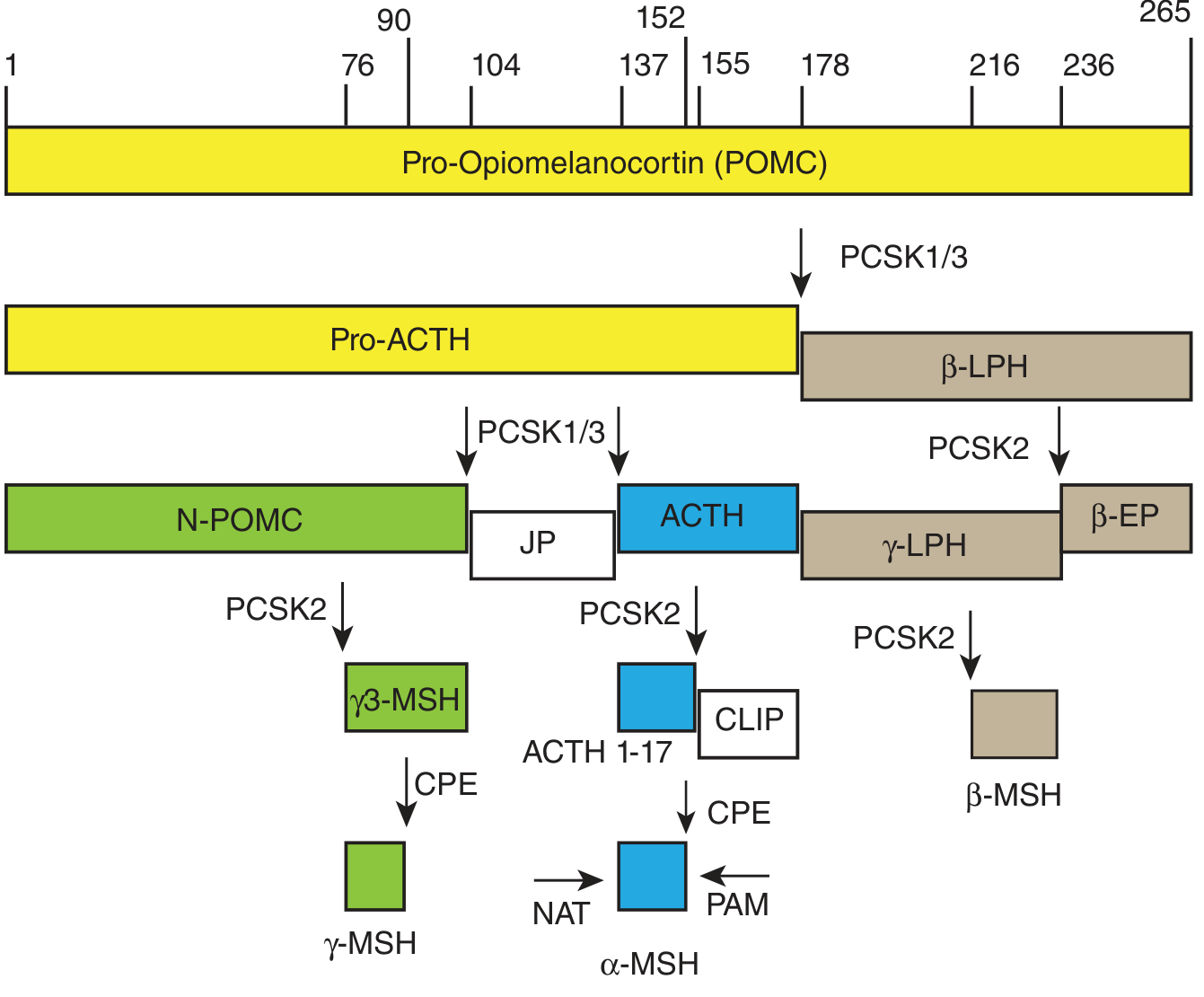
Mechanism of Action
ACTH acts via MC2R (melanocortin receptor 2) on adrenal cortex cells. The receptor signal cascade is:
ACTH → MC2R → Gs → Adenylyl cyclase → ↑cAMP → PKA activation → Steroidogenesis
This process has two temporal phases:
- Acute phase (seconds to minutes): Increased supply of cholesterol substrate to steroidogenic enzymes via mobilization of cholesterol esters and upregulation of StAR (steroid acute regulatory) protein, which translocates cholesterol across mitochondrial membranes - the rate-limiting step.
- Chronic phase (hours to days): Increased transcription of steroidogenic enzymes (CYP11A1, CYP11B1, CYP17A1, CYP21A2, 3β-HSD).

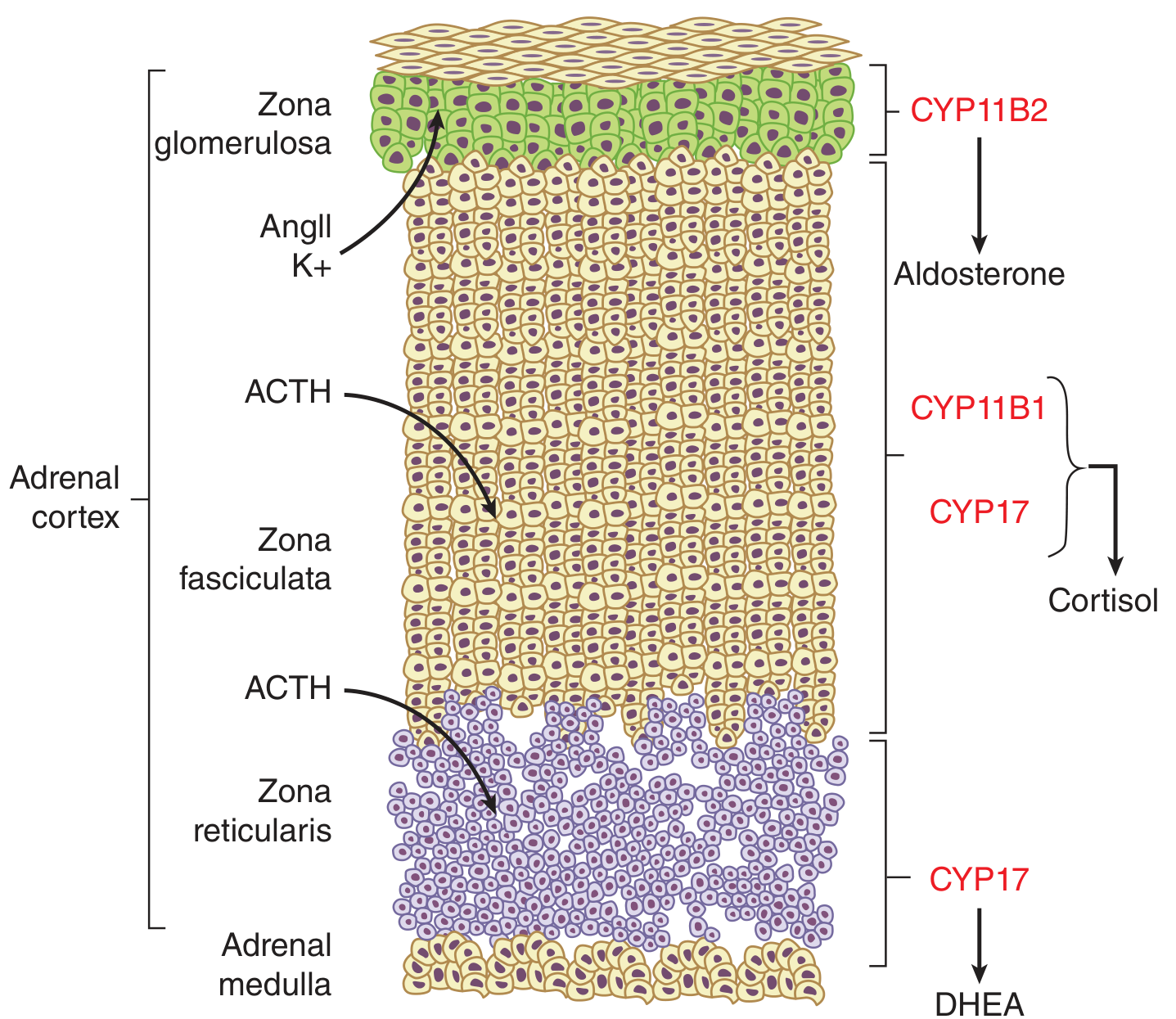
Actions on the Adrenal Cortex
| Zone | Product | Regulator |
|---|---|---|
| Zona glomerulosa | Aldosterone (mineralocorticoid) | Primarily AngII + K+ (ACTH has minor acute effect) |
| Zona fasciculata | Cortisol (glucocorticoid) | Primarily ACTH |
| Zona reticularis | DHEA / DHEAS (androgen precursors) | Primarily ACTH |
Key points:
- Without ACTH stimulation (e.g., hypopituitarism), the zona fasciculata and reticularis undergo atrophy
- Persistently elevated ACTH causes hypertrophy and hyperplasia of these zones (e.g., congenital adrenal hyperplasia)
- "ACTH escape" phenomenon: with prolonged ACTH excess, aldosterone levels initially rise but then return to normal
Regulation of Secretion (HPA Axis)
The HPA axis has three characteristic modes:
- Diurnal rhythm - ACTH peaks in the early morning; circulating cortisol peaks at ~8 AM
- Negative feedback - Cortisol inhibits CRH (at hypothalamus) and POMC expression + corticotroph responsiveness to CRH (at pituitary)
- Stress response - Trauma, hemorrhage, surgery, hypoglycemia, infection, pain, and fear can override negative feedback, sharply raising glucocorticoid levels
Upstream regulation:
- CRH (corticotropin-releasing hormone) from hypothalamus → binds CRH-R on corticotrophs → Gs-cAMP → stimulates both ACTH biosynthesis AND secretion
- Arginine vasopressin (AVP) → binds V1b receptors → Gq-PLC-IP3-Ca²+ → potentiates CRH effects (AVP alone does NOT increase de novo ACTH synthesis)
Pharmaceutical Forms
| Preparation | Details |
|---|---|
| Repository corticotropin injection (Acthar Gel / Cortrophin Gel) | Complex mixture of ACTH analogs (including N25-deamidated porcine ACTH39) + other pituitary peptides. Given IM or SC. Measured in units. |
| Cosyntropin (synthetic ACTH 1-24) | Synthetic peptide - used primarily for diagnostic purposes. IV or IM. |
| Tetracosactide depot | Long-acting synthetic ACTH - available outside the U.S. |
Therapeutic Uses
1. Infantile Spasms (West Syndrome) - PRIMARY indication
- Repository corticotropin injection gel is the mainstay treatment for this rare epileptic disorder of infancy
- Mechanism in this setting is unknown - may be independent of adrenal steroid release (ACTH can control spasms even in adrenally suppressed patients); proposed CNS suppression of CRH may be involved
- Vigabatrin is an alternative, especially in tuberous sclerosis
- Other options: oral prednisolone, methylprednisolone, dexamethasone, valproate, topiramate, clonazepam
- "The mechanism of action of corticotropin and corticosteroids in the treatment of infantile spasms is unknown" (Katzung's Basic and Clinical Pharmacology, 16e)
2. Other Inflammatory/Autoimmune Conditions
- Repository corticotropin injection has been studied in autoimmune rheumatic conditions and nephrotic syndrome
- Has nonglucocorticoid effects via melanocortin receptors (immune cells express MC1R, MC3R, MC4R) that are not fully understood
- Use is limited by high expense and lack of direct comparative trials vs. glucocorticoids
3. Diagnostic Use - ACTH Stimulation Test
- Cosyntropin 0.25 mg (supraphysiological dose) is given IV/IM
- Cortisol is measured at baseline and 30-60 minutes
- A rise in cortisol to >18-20 μg/dL (using standard assays) indicates a normal response (intact adrenal reserve)
- Used to diagnose primary adrenal insufficiency (Addison's disease) and assess adrenal function
- Also used during adrenal venous sampling to distinguish unilateral vs. bilateral aldosterone excess in primary aldosteronism
4. CRH Testing (related diagnostic use)
- Ovine CRH (corticorelin) is used to differentiate pituitary vs. ectopic ACTH production in Cushing's syndrome (pituitary source responds to CRH; ectopic does not)
- Also used after dexamethasone suppression to distinguish pseudo-Cushing states from true Cushing's syndrome
Why ACTH vs. Corticosteroids?
"Except for the treatment of infantile spasms, most proven therapeutic effects of ACTH can be achieved with appropriate doses of corticosteroids. Moreover, therapy with ACTH is less predictable and less convenient than therapy with corticosteroids."
Disadvantages of ACTH over direct corticosteroids:
- ACTH also stimulates mineralocorticoid production (salt/water retention, hypertension)
- Stimulates adrenal androgens (virilization)
- Response is variable depending on adrenal reserve
- Less convenient (requires injection)
- More expensive
Advantage of ACTH:
- Preserves the adrenal axis (does not suppress HPA)
- Possible non-glucocorticoid immunomodulatory effects via melanocortin receptors
- Essential role in infantile spasms
Adverse Effects (from elevated corticosteroid levels)
- Cushing's syndrome (prolonged heavy dosage)
- Sodium and water retention, hypertension
- Hypokalemia
- Virilization (from adrenal androgen stimulation)
- Immunosuppression, increased infection risk
- In children: significant morbidity with repository formulation (weight gain, irritability, hypertension, infections)
Sources:
- Goodman & Gilman's The Pharmacological Basis of Therapeutics, Chapter 50 - ACTH, Adrenocortical Steroids, and their Synthetic Analogs
- Katzung's Basic and Clinical Pharmacology, 16th Edition - Medications Effective for Infantile Spasms
- Firestein & Kelley's Textbook of Rheumatology - Repository Corticotropin Injection
This is a shared conversation. Sign in to Orris to start your own chat.