
Paediatric tracheostomy in detail according to standard ENT textbook
Reading File
Now let me search the medical library for paediatric tracheostomy content in ENT textbooks.
Finding Sources
Finding Sources
Excellent. I have Scott-Brown's (the gold-standard ENT textbook) and Cummings Otolaryngology. Let me now search specifically for paediatric tracheostomy headings and read the relevant sections in parallel.
Finding Sources
Finding Sources
Scott-Brown's Vol 2 block 4 has the paediatric tracheostomy chapter. Let me read this comprehensively in parallel with all relevant sections.
Reading File
Reading File
Excellent content found. Let me continue reading the full paediatric tracheostomy chapter in parallel sections.
Reading File
Reading File
Great detail. Let me continue reading the remaining sections - complications, safety, tubes, and decannulation.
Reading File
Reading File
Excellent content. Let me read the remaining sections on safety, decannulation, and complications.
Reading File
Reading File
Now let me read the decannulation and safety sections.
Reading File
Reading File
Excellent - I now have comprehensive content from Scott-Brown's. Let me also fetch key images to include in the response, and read the decannulation section.
Reading File
Loading Image
I now have comprehensive, detailed content from Scott-Brown's Otorhinolaryngology (the premier ENT textbook). Let me now compile the full detailed answer.
Paediatric Tracheostomy
Source: Scott-Brown's Otorhinolaryngology Head & Neck Surgery, Vol. 2, Chapter 35
Definition
A tracheotomy strictly refers to the creation of a hole into the trachea. A tracheostomy is the fashioning of a permanent or semi-permanent opening (stoma) between the trachea and the skin. This distinction has become clinically important as surgical technique in children's tracheostomies has evolved - modern paediatric practice increasingly aims to create a mature stoma rather than a simple incision held open by the tube alone.
Epidemiology and Changing Indications
There are no significant randomized controlled trials. The majority of publications document individual institutions' series of tracheostomies and their complications. Reports of changing indications from larger children's hospitals may be skewed by changes in medical practice at individual units.
The indications for paediatric tracheostomy have evolved significantly. Until the late 1990s, tracheostomy was considered the mainstay of management for obstructing subglottic haemangioma - now largely replaced by drug treatment (propranolol) or surgical excision. Similarly, the introduction of the cricoid split and single-stage laryngotracheal reconstruction has reduced the need for tracheostomy for extubation failure due to subglottic oedema or stenosis.
Indications
The general indications for tracheostomy in children are:
- To relieve upper airway obstruction
- To prevent complications of prolonged intubation
- To reduce anatomical dead space
- To allow suction toilet of the trachea
In practice, tracheostomies in children are nearly always performed for the first two reasons - upper airway obstruction or to allow/assist mechanical ventilation.
1. Upper Airway Obstruction
The upper airway (from the lips and anterior nares to the carina) may be obstructed at one or more anatomical levels by a range of pathologies:
| Anatomical Site | Example |
|---|---|
| Oropharynx / tongue base | Macroglossia; Treacher Collins / Goldenhar syndrome; Cystic hygroma |
| Nose / nasopharynx | Choanal atresia |
| Supraglottis | Supraglottic cyst |
| Glottis | Vocal cord palsy; physical trauma |
| Subglottis | Subglottic stenosis; subglottic haemangioma |
| Trachea | Tracheomalacia; high tracheal stenosis |
If the obstruction is significant and life-threatening and no other means of relief is appropriate (e.g. nasopharyngeal airway or prong), a tracheostomy must be considered. The increasing availability of paediatric intensive care has allowed surgical procedures involving the airway to be undertaken without a covering tracheostomy using a "single-stage" approach - post-operative airway obstruction risk is managed by a period of intubation and ventilation.
2. Prolonged Intubation
The long-term complications of prolonged endotracheal intubation - particularly ulceration at the level of the glottis and subglottis leading to cicatricial stenosis - are well recognized. The neonatal larynx is softer and more flexible than the adult and, with correct tube sizing and appropriate intensive care, is able to tolerate intubation for relatively longer. There is no clear consensus on maximum safe duration of intubation; premature babies may be intubated for several weeks. Tracheostomy should normally be considered in older children after 2-3 weeks of endotracheal intubation.
3. Long-term and Home Ventilation
An increasing number of children now survive previously lethal conditions with chronic respiratory failure due to the availability of long-term ventilation (hospital or home). In a 2011 UK survey, of 933 home-ventilated children, 206 had tracheostomies. Indications include:
- Congenital central hypoventilation syndrome
- Spinal injury
- Congenital myopathy
- Airway malacia
- Chronic lung disease
4. Tracheal Toilet
Very few children now require tracheostomy purely for toilet of the airway. Children with intractable aspiration may need regular suction, but the presence of a tracheostomy can predispose to aspiration in itself and increase the risk of respiratory tract infection.
Surgical Technique - Specific to Children
Positioning
Under general anaesthesia, the infant is positioned supine on the operating table. Neck extension is achieved with a rolled towel or gel pillow under the shoulders. The neck is fixed in extension and stabilized in the midline using adhesive tape (e.g. Elastoplast) or a horseshoe-shaped head rest.
- Theoretically, extension in infants increases the risk of injury to the great vessels at the root of the anterior neck - in practice, with careful dissection, this is rarely a clinical problem.
- Overextension risks exposing a significant part of the intrathoracic trachea, leading to an incision in the trachea which is too low.
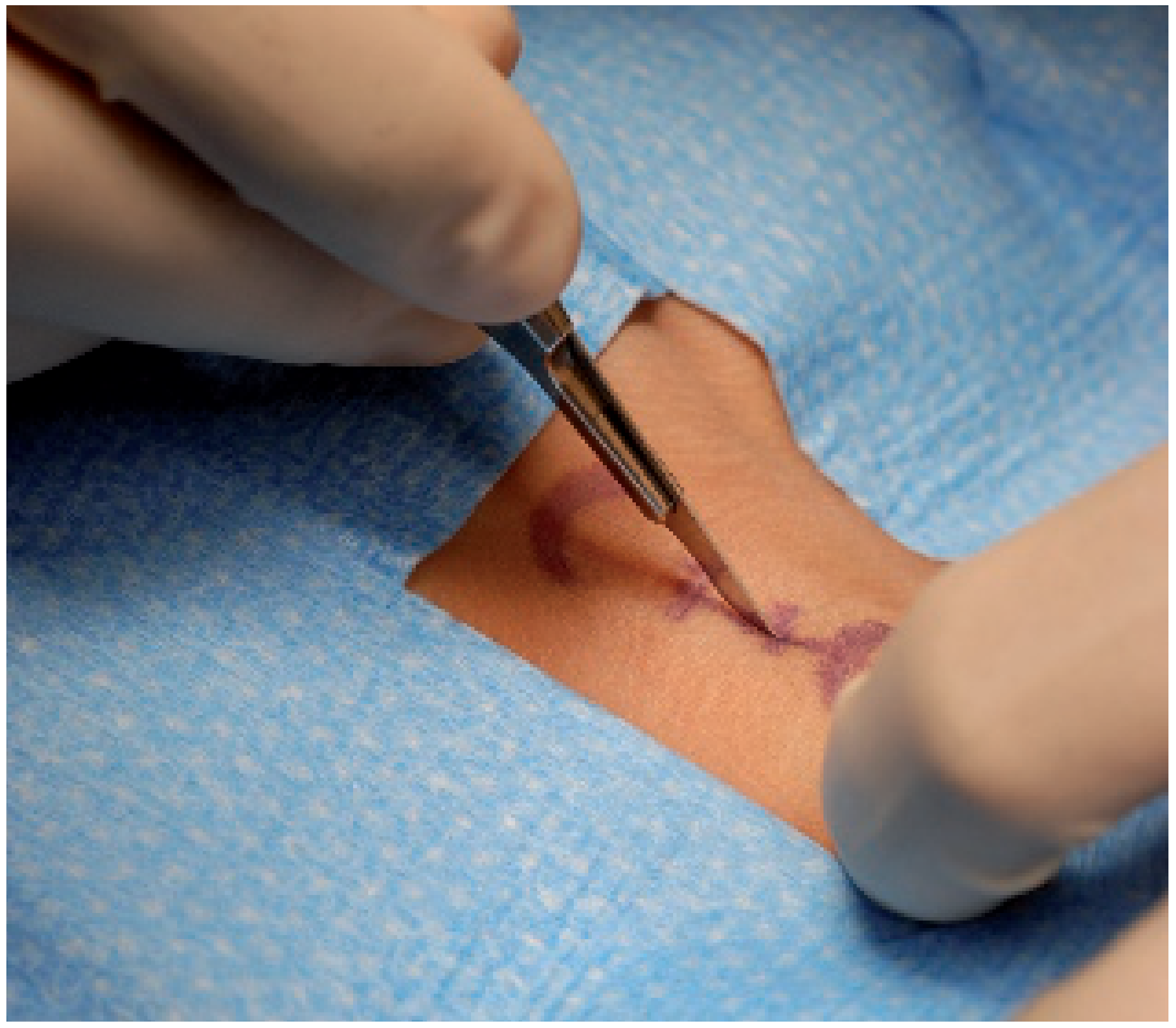
Skin Incision
In adult practice, a horizontal incision is conventional (halfway between the cricoid and sternal notch). In paediatric practice, a vertical skin incision has become standard in most major children's units. The vertical incision has several advantages:
- Keeps dissection in the midline, reducing the tendency to stray from the trachea in a difficult dissection
- Allows easier placement of maturation sutures
- The incision is placed halfway between the cricoid ring and sternal notch
- The skin incision does not need to be much longer than will allow insertion of the selected tube
Removal of Subcutaneous Fat and Maturation Sutures
A disc of subcutaneous fat immediately surrounding the incision is removed, allowing the skin edges to invert slightly to create a stoma lined with healthy squamous epithelium. This effect is increased by suturing the edge of the skin incision to the edge of the tracheal incision using maturation sutures (absorbable, e.g. 4/0 Vicryl Rapide). The resulting opening is more secure, tends to stay open even without the tube in situ, and reduces the risk of a false passage at emergency post-operative tube change.
Stay Sutures
Stay sutures (e.g. 4/0 PROLENE) are placed in the wall of the trachea on either side of the vertical incision and left until the first tube change. In the event of accidental decannulation, upward and lateral traction on these sutures opens the tracheostomy to make tube reinsertion simpler. The sutures are taped to the chest wall (labelled "DO NOT REMOVE") to prevent accidental removal.
Dissection
- Dissection using monopolar or bipolar diathermy is advisable in small children to minimize blood loss
- Dissection should be restricted to the midline to avoid risk to structures in the neck
- In adults and larger children, the thyroid isthmus is traditionally divided and transfixed; in infants, it is usually adequate to divide the isthmus with bipolar diathermy
- The trachea should be palpated regularly throughout the dissection to ensure the direction has not strayed from the midline, given the proximity of the carotid sheath
Tracheal Incision
A vertical incision is made in the midline, usually in tracheal rings 2 and 3 (or 3 and 4). Window incisions and Bjork flaps (an inferiorly based tracheal flap sutured to the skin, or a cruciate incision) have been described to increase stability of the initial tracheostomy tract and improve safety in accidental decannulation. However, animal experiments suggest tracheal flaps may lead to an increased risk of long-term stenosis, and the simple vertical incision is currently favoured by the majority of authors.
Securing Tracheostomy Tubes
Until the tracheostome has epithelialized and matured, the risks of accidental decannulation are most significant. Initially, the tube is fixed with inelastic linen tapes supplied with the tube, tied in a secure knot sufficiently tight to allow one finger to be inserted between the tapes and the neck skin. Tapes should be tightened with the neck flexed (not in the operative extension position). Suturing the flange of the tracheostomy tube to the skin should be avoided in children - infant skin is flexible and thin and does not provide a strong enough anchor.
After 7 days, the first change is undertaken and linen tapes may be changed for a Velcro fastening, allowing easier changing and less skin trauma.
Tracheostomy Tubes
Sizing
Modern tracheostomy tubes are sized by internal diameter (mm) and length (skin flange to tip). Older silver tubes use the French gauge system. The age-appropriate size guide (Great Ormond Street Hospital):
| Age | Internal Diameter (mm) |
|---|---|
| Preterm - 1 month | 3.0 |
| 1-6 months | 3.5 |
| 6-18 months | 4.0 |
| 18 months - 3 years | 4.5 |
| 3-6 years | 5.0 |
| 6-9 years | 5.5 |
| 9-12 years | 6.0 |
| 12-14 years | (adult sizing) |
Smaller tubes become obstructed more easily.
Materials and Types
- PVC (polyvinyl chloride) tubes - traditionally used but more reactive at skin and tracheal surfaces
- Silicone tubes (e.g. Bivona) - more flexible and softer, less reactive, felt to reduce problems both at skin and inside the trachea; the standard for paediatric use
- Silver tubes - no longer commonly used in children; less suitable for small sizes
- Fenestrated tubes - allow some air through the normal upper airway
- Cuffed tubes - rarely required in children as the cricoid ring acts as a natural seal; used when ventilation is required with high airway pressures
The commonly used Bivona and Shiley tubes are recommended by manufacturers to be changed after a maximum of 28 days, though most are changed more frequently on clinical grounds.
Tube Changing
- The first tube change is typically performed at 7 days
- In children who can be easily intubated, the first change is undertaken on the intensive care unit with an intubation trolley and senior ITU medical staff on hand
- If this is uneventful, nursing staff can carry out subsequent changes
- Before discharge home, parents must be taught the tube-changing technique
- The tube needs to be changed before dried secretions start to reduce the lumen
- The old tube should be inspected after removal to determine the degree of contamination, informing the interval until the next change
- Change the tube if: visible dried secretion on external inspection; audible whistle due to obstruction ("if you can hear a tube, you should change it"); suction catheter cannot be passed
Tracheostomy Care
Post-operative Care
Adequate tracheostomy care is critical in the first 2-3 post-operative days. The risk of tube displacement is highest during formation of the stoma tract, as the tract can close very quickly making re-insertion difficult. Inexperienced staff are often reluctant to intervene - hospitals must maintain a high standard of internal training, and many units have specific teams and regular training programmes.
Suction
Immediately after tracheostomy, the change from air warmed and humidified by the upper airway to dry, cold air leads to a rapid increase in airway secretions (this gradually reduces over weeks). Secretions dry on the inside of the tube, gradually reducing the effective lumen. Humidification of inspired air and regular suctioning reduce this tendency.
- Suctioning technique: a suction catheter should be inserted gently to just beyond the end of the tube; suctioning should be applied as the catheter is withdrawn; it should not be forcefully inserted against resistance
- A catheter that cannot be passed to the expected depth suggests tube obstruction or displacement
Humidification
Without the normal upper airway, inspired air is cold and dry. A heat-moisture exchanger (HME) - a device placed at the hub of the tracheostomy tube - provides passive humidification. Active humidification via heated water bath systems may be required in ventilated patients or those with very tenacious secretions.
Tracheostomy Safety Initiatives
The majority of life-threatening tracheostomy-specific complications (tube displacement and blockage) should be avoidable with correct care. The UK National Tracheostomy Safety Project recommendations include:
- An emergency minimum set of equipment should accompany a tracheostomy patient at all times - spare tubes (same size and one size smaller), suction catheters, and dressings
- Bedhead documentation should be displayed at all times providing immediately visible information including tube size and length, and existing upper airway abnormalities
- Emergency treatment algorithms should be provided for attending resuscitation teams
The Global Tracheostomy Collaborative (formed 2012) is a multidisciplinary international organization sharing information and experience to disseminate best practices and improve outcomes.
Complications
Tracheostomy complications are more likely in children than in adults, and more common in children under 2 years of age, particularly preterm infants. Overall complication rates: 25-77%.
The higher complication rate in smaller children reflects:
- The relatively small airway diameter (ease of occlusion by secretions, granuloma or suprastomal collapse)
- Younger tracheostomized children tend to remain tracheostomized for longer periods
Tracheostomy-related mortality in published series since 1980 ranges from 0% to 3.6%. In nearly all cases, the cause of tracheostomy-related death is tube obstruction or accidental decannulation.
Complications by Timing
| Time | Complication |
|---|---|
| General | Tube obstruction; accidental decannulation; general complications of surgery and anaesthesia; death |
| Early post-operative (up to 1 week) | Post-operative haemorrhage; wound edge bleeding; pneumothorax; subcutaneous emphysema; infection; apnoea |
| Late post-operative (after 1 week) | Granulation tissue; bleeding; suprastomal collapse; skin complications; aphonia and speech delay; psychological factors; adverse effects on family |
Granulation Tissue
- Peristomal granulations can generally be controlled with topical steroid/antibiotic preparations; when more severe, removed with bipolar diathermy
- Suprastomal granulations are almost universal (found in 80% of 265 tracheostomies at bronchoscopy in one series). Large suprastomal granulations can affect tube changing and make speaking valve use impossible
- Removal techniques: endoscopic microlaryngeal instruments, microdebrider (Skimmer or Tru-Cut blade), KTP or CO2 laser
- Silver nitrate cautery should be avoided - solution can enter the trachea causing irritation and mucosal injury
- At microlaryngoscopy prior to planned decannulation, all granulation should be removed to maximize airway patency
Suprastomal Collapse
A distinct (though often coexisting) complication from granulation. The anterior tracheal wall immediately superior to the stoma softens and prolapses into the lumen of the subglottic trachea. This can significantly reduce the available lumen and represent a major obstacle to decannulation. Management: KTP laser ablation, or reconstructive surgery with cartilage grafting if collapse is greater than 50%.
Speech and Language
The tracheostomy tube occupies much of the tracheal lumen and directs exhaled air away from the vocal cords. Most children with tracheostomies are therefore aphonic. This has potentially profound effects on speech and language development, particularly if tracheostomized in early childhood.
Speaking valves redirect exhaled air through the normal upper airway to produce voice:
- Rusch speaking valve - open apart from in significant expiration
- Passy-Muir valve - closed apart from in inspiration; encourages use of the normal airway for expiration even in quiet respiration; may be modified for less tolerant children by drilling small holes to allow some expired air to escape
- Speaking valves should be used under supervision and not while the child is asleep
- Speech therapy input is essential
Decannulation
Prerequisites
Decannulation requires:
- Resolution of the underlying indication for tracheostomy
- Endoscopic assessment of the airway (microlaryngoscopy and bronchoscopy)
- Consideration of comorbidities - pulmonary disease, neurological disease, need for further surgery (e.g. mandibular advancement, cleft palate repair - decannulation should be deferred until these are complete)
Endoscopy identifies two main causes of decannulation failure: significant granulation (found in 50/300 tracheostomies in one series) and significant suprastomal collapse (52/300). Vocal cord mobility should also be assessed at endoscopy.
Physiological Considerations
Removal of a tracheostomy leads to a significant change in upper airway physiology:
- Dead space is doubled
- Airway resistance is trebled
With a long-standing tracheostomy, the child may have no memory of mouth and nose breathing, and the new sensation may be distressing ("decannulation panic").
Staged Decannulation (Great Ormond Street Protocol)
To effect physiological changes more gradually:
| Day | Procedure |
|---|---|
| 1 | Admission; downsize tube to 3.0 (or 2.5 in children under 13 months) |
| 2 | Block (cap) tube for 12 hours from 8 a.m.; if successful, continue overnight for a further 12 hours |
| 3 | Decannulate; occlude stoma with adhesive tape and dressing; observe on the ward |
| 4 | Observe off the ward |
| 5 | Discharge |
Leaving the downsized tube in situ allows some respiration if required and prevents the tract from closing should decannulation fail.
Immediate Decannulation
The tracheostomy tube may occupy as much as half of the lumen of the trachea in an infant. If a child can tolerate this degree of obstruction, the post-decannulation airway is likely to be more than sufficient. If the child cannot tolerate capping, it may still be appropriate to simply remove the whole tube and occlude the stoma with a dressing - this must be carried out under direct medical supervision.
Discharge and Home Care
Getting home with a tracheostomy is a complex and time-consuming process. Not all families will have sufficient support or resources. While in hospital, caregivers must be educated in:
- Day-to-day care including tube changing
- Recognition and initial treatment of complications
- Basic life-support training
Generally, two responsible adults must be trained before discharge is possible. Community services (district nursing, community paediatricians) must be arranged. Schools and other institutions involved in the child's care must also receive tracheostomy training.
Best Clinical Practice Summary
- Equipment and personnel to perform emergency tracheostomy should always be available in case attempted intubation fails
- Tracheostomy should normally be considered in older children after 2-3 weeks of endotracheal intubation
- Vertical skin incision is now standard in major children's units
- Maturation sutures reduce the risk of false passage at emergency tube change
- Stay sutures should be placed at the time of tracheostomy and left until the first tube change
- Suturing the tube flange to the skin should be avoided in children
- A minimum emergency equipment set should accompany every tracheostomized patient at all times
- Endoscopy is mandatory before planned decannulation
- Speech therapy input is essential throughout the period of tracheostomy
Scott-Brown's Otorhinolaryngology Head & Neck Surgery, Vol. 2, Chapter 35 (Paediatric Tracheostomy), 8th Edition.
This is a shared conversation. Sign in to Orris to start your own chat.