
What is Homeostasis? Explain its feedback mechanisms 5 marks Question
Reading File
Finding Sources
Finding Sources
Reading File
Reading File
Finding Sources
Searching Images
homeostasis feedback mechanism diagram negative positive feedback loop
Reading File
Reading File
Loading Image
I now have comprehensive information to write a complete 5-mark answer. Here it is:
Homeostasis & Its Feedback Mechanisms
Definition of Homeostasis
Homeostasis is the ability of the body to maintain a stable internal environment despite continuous changes in the external world. The term was coined by Walter Cannon and is derived from the Greek words homoios (similar) and stasis (standing still).
The body carefully controls a seemingly endless list of vital parameters — arterial blood pressure, blood volume, body core temperature, and plasma levels of O₂, glucose, K⁺, Ca²⁺, and H⁺. Homeostasis is not a state of equilibrium (which requires no energy) but a steady state, where the body continuously matches processes that raise and lower a parameter to keep it constant. This requires energy expenditure.
"Homeostasis is the control of a vital parameter." — Medical Physiology (Boron & Boulpaep)
Feedback Mechanisms
A feedback mechanism is one in which some element of the physiological response to a stimulus "feeds back" — either directly or indirectly — to modify the original stimulus. There are two types:
1. Negative Feedback (Most Common)
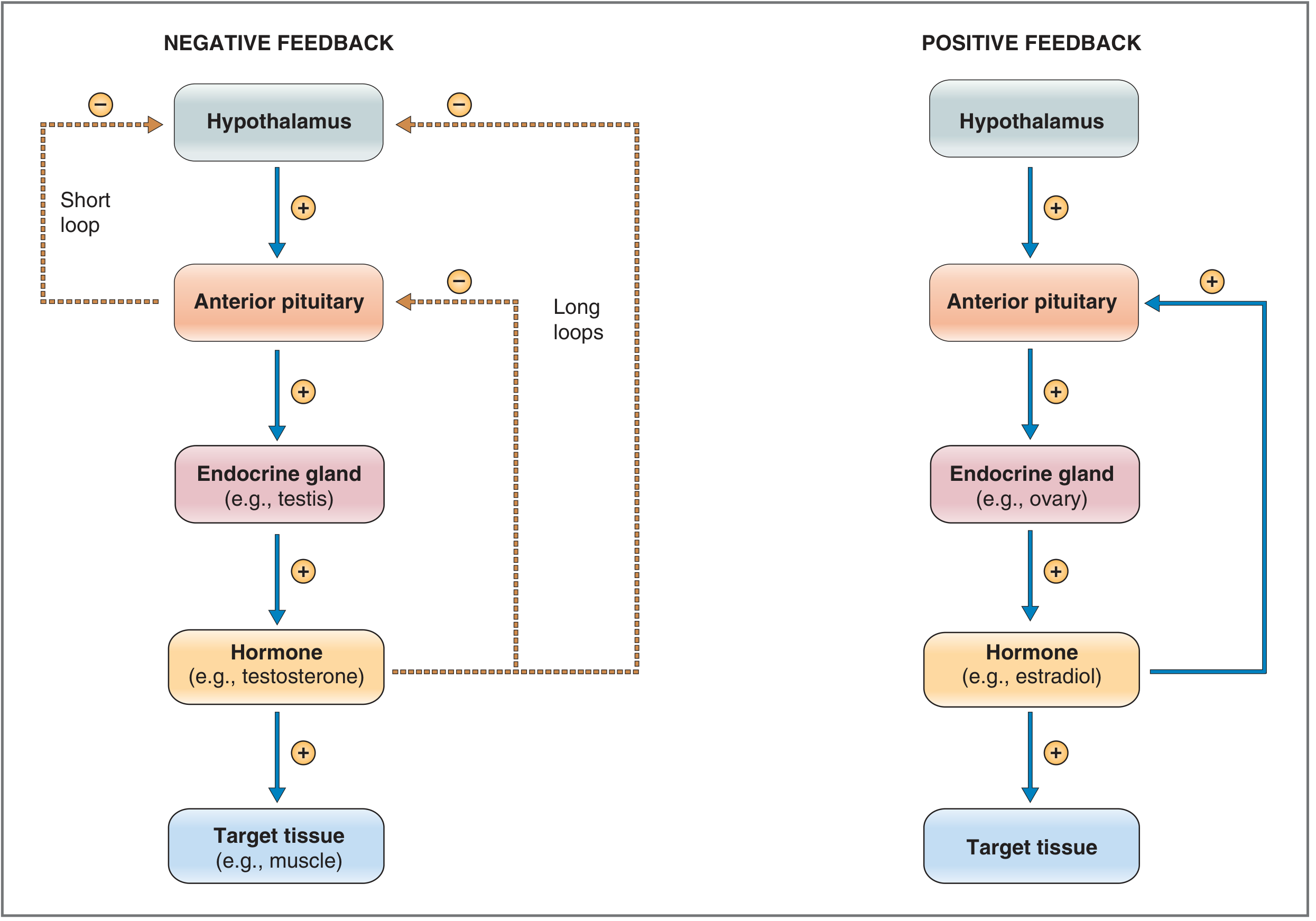
Negative feedback is the most important and common mechanism for maintaining homeostasis. It is self-limiting — when the output of a system reaches the desired level, the feedback signal turns off the original stimulus.
Four essential elements:
| Element | Role |
|---|---|
| Sensor/Receptor | Detects the change in the vital parameter (e.g., thermoreceptors detect temperature change) |
| Control Centre/Set-point | Compares the input signal with the reference (normal) value and generates an error signal |
| Effector | Receives the output signal and acts to counteract the deviation |
| Feedback signal | The corrected output loops back to silence the original stimulus |
Classic Examples:
-
Blood glucose regulation: When blood glucose rises, the pancreas secretes insulin, which acts on liver, muscle, and adipose tissue to lower glucose back to normal. Once glucose is low enough, insulin secretion is turned off.
-
Blood pressure regulation: A fall in arterial blood pressure is detected by baroreceptors, which activate coordinated mechanisms to raise blood pressure. As pressure returns to normal, baroreceptors are no longer stimulated and the response ceases.
-
Body temperature regulation: Thermoreceptors in skin and the hypothalamus detect elevated temperature → the hypothalamus activates sweating and cutaneous vasodilation → heat is dissipated → temperature returns to 37°C → sensors are silenced.
-
HPT axis (Hypothalamus–Pituitary–Thyroid): Thyroid hormones feed back on both the anterior pituitary and hypothalamus to inhibit further TSH/TRH secretion.
- Long-loop feedback — peripheral hormone (e.g., testosterone) feeds back all the way to the hypothalamic-pituitary axis
- Short-loop feedback — anterior pituitary hormone feeds back on the hypothalamus
- Ultrashort-loop feedback — a hypothalamic hormone inhibits its own secretion (e.g., GHRH inhibiting GHRH)
2. Positive Feedback (Uncommon)
Positive feedback is self-augmenting — the output amplifies the original stimulus rather than opposing it. It is rare in biological systems because it does not restore homeostasis; instead, it drives the system toward an explosive endpoint.
Examples:
-
LH surge at ovulation: Rising estrogen (from developing follicle) acts on the anterior pituitary to cause a burst of LH and FSH secretion, triggering ovulation. More LH → more estrogen → more LH — the explosive event is ovulation.
-
Parturition (childbirth/oxytocin): Cervical dilation → posterior pituitary releases oxytocin → uterine contractions intensify → more cervical dilation → more oxytocin. The explosive endpoint is delivery of the fetus.
-
Action potential upstroke: Depolarization opens voltage-gated Na⁺ channels → Na⁺ influx → more depolarization → more Na⁺ entry. This self-reinforcing loop generates the rapid upstroke.
Summary Table
| Feature | Negative Feedback | Positive Feedback |
|---|---|---|
| Direction | Opposes the stimulus | Amplifies the stimulus |
| Effect | Restores homeostasis | Disrupts homeostasis temporarily |
| Frequency | Very common | Rare |
| Nature | Self-limiting | Self-augmenting |
| Examples | Insulin/glucose, BP regulation, thermoregulation | LH surge, oxytocin/parturition, action potential |
Redundancy Principle
The more vital a parameter, the more overlapping systems the body deploys to regulate it. If one feedback loop fails, others compensate — this is why genetic knockouts sometimes fail to produce the expected fatal effects. The result is a milieu intérieur (internal environment) with stable composition.
Sources: Medical Physiology (Boron & Boulpaep); Costanzo Physiology, 7th Ed.; Ganong's Review of Medical Physiology, 26th Ed.
This is a shared conversation. Sign in to Orris to start your own chat.