


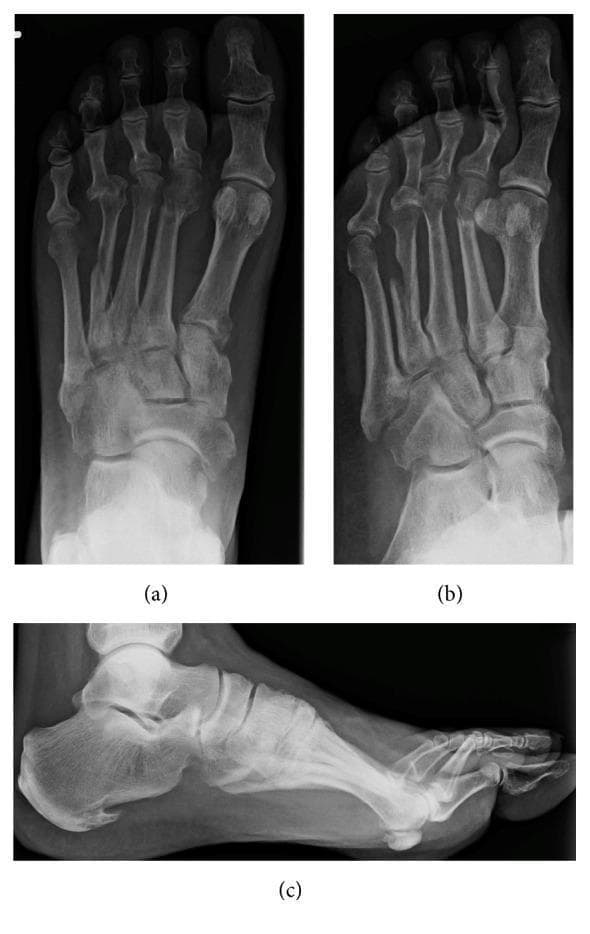
44 female slips and fall stairs with mild pain and swelling 2 hrs ago. Xray image given
foot fracture after fall Ottawa foot rules metatarsal fracture diagnosis management
Bailey and Love's Short Practice of Surgery 28th Edition
Page 526
metatarsal fracture foot X-ray lateral dorsoplantar view
Hugging Face pmc clinical VQA raw
Page 0
X-Ray Analysis — Left Foot (46F, Post-Fall)
Views Provided
- Lateral view (Image 1)
- Dorsoplantar (DP) views (Images 2 & 3)
Radiological Findings
- Bony architecture of the ankle, hindfoot (calcaneus, talus), midfoot, and forefoot appears intact
- No obvious cortical disruption of the calcaneus or talus
- No significant step-off or angulation at the ankle mortise
- Soft tissue swelling may be present (clinically reported)
- All 5 metatarsals are visible; no obvious acute fracture line seen in the metatarsal shafts or necks
- The metatarsal cascade (relative lengths) appears preserved
- Tarsometatarsal (Lisfranc) joints appear congruent — no obvious diastasis between 1st and 2nd metatarsal bases
- Phalangeal bones appear intact
- Key area to scrutinize: The base of the 5th metatarsal — the tuberosity at the lateral border should be assessed for an avulsion fracture (Jones fracture zone), which is a common missed injury in inversion mechanism falls
- The navicular bone cortex appears intact
- No osteolytic or sclerotic lesions suggesting pathological fracture
Impression: No gross acute fracture is definitively visualized on these views. However, subtle fractures (avulsion at 5th MT base, stress fracture, navicular fracture) can be occult on initial plain films.
Clinical Assessment
- Tenderness at the base of the 5th metatarsal ✓ (check)
- Tenderness at the navicular ✓ (check)
- Inability to bear weight for 4 steps
Differential Diagnosis
| Condition | Key Feature |
|---|---|
| 5th MT base avulsion fracture | Inversion mechanism; lateral foot tenderness; may be subtle on DP view |
| Jones fracture | Zone II/III of 5th MT; poor blood supply; important to distinguish |
| Lisfranc injury | Check 1st–2nd MT base gap (>2mm suspicious); can be missed |
| Navicular fracture | Midfoot tenderness; sometimes requires CT |
| Severe ankle sprain (ATFL/CFL) | No fracture but significant ligamentous injury |
| Cuboid fracture ("nutcracker") | Lateral column compression |
Management Recommendations
- Assess Ottawa Rules compliance — if criteria met, X-rays already obtained ✓
- Palpate specifically: base of 5th MT, navicular, Lisfranc point (2nd MT base/medial cuneiform)
- Weight-bearing status assessment
- RICE — Rest, Ice, Compression, Elevation for 24–48 hrs
- NSAIDs — Ibuprofen 400 mg TDS or Diclofenac 50 mg BD for analgesia
- Below-knee compression bandage / walking boot for comfort
- Follow-up X-ray at 10–14 days if pain persists (periosteal reaction becomes visible)
- Consider CT or MRI if high clinical suspicion of navicular stress fracture or Lisfranc injury despite normal X-ray
- Symptomatic treatment — firm-soled shoe or walking boot, weight-bearing as tolerated
- Analgesia; healing typically in 6–8 weeks
- Non-weight-bearing cast for 6–8 weeks OR early surgical fixation (especially in active patients)
- Higher non-union risk
Red Flags to Rule Out
- Lisfranc injury (requires weight-bearing X-rays for definitive assessment — do not miss)
- Any talar dome osteochondral injury (may need MRI)
- Compartment syndrome (unlikely given mild presentation, but monitor for worsening pain/tightness)
What is the two circular landmarks near head of 1st metatarsla
sesamoid bones first metatarsal head anatomy foot X-ray
Bailey and Love's Short Practice of Surgery 28th Edition
Page 589
Sesamoid Bones of the 1st Metatarsal
- Two small, rounded bones embedded within the tendons of the flexor hallucis brevis muscle
- Designated as the medial (tibial) sesamoid and lateral (fibular) sesamoid
- Sit in grooves on the plantar surface of the 1st metatarsal head
- On the dorsoplantar view, they are seen end-on/plantar to the 1st MTP joint, producing the classic two round opacities
- They are part of the normal foot anatomy — present in virtually all individuals
- Act as a pulley for the flexor hallucis brevis tendons
- Absorb weight-bearing stress under the 1st MTP joint (bear ~50% of body weight during push-off)
- Protect the flexor hallucis longus tendon running between them
- In this patient's X-ray, both sesamoids appear intact and in normal position — no fracture, fragmentation, or proximal migration
- Sesamoid fractures (from direct trauma or stress) and sesamoiditis can occur but typically present with plantar 1st MTP tenderness
- Bipartite sesamoid (congenital division into two fragments) is a common normal variant (~10–30% of people), distinguished from fracture by smooth, corticated edges
Does the foot look osteoporotic? Last xray near base of 5th metatarsal.. osteophytes?
osteoporosis foot X-ray radiological signs bone density assessment
Bailey and Love's Short Practice of Surgery 28th Edition
Page 533
osteophytes base 5th metatarsal cuboid joint degenerative changes foot X-ray
Harrison's Principles of Internal Medicine, Twenty First Edition
Page 10398
-
Osteoporotic look?
- On these foot films, I do not see clear severe generalized osteopenia/osteoporosis pattern.
- But plain X-ray is not reliable to diagnose osteoporosis.
- Best test is DEXA (hip/spine ± wrist), not foot X-ray (Bailey & Love, p. 533).
-
Base of 5th metatarsal osteophytes?
- At the tuberosity/base of the 5th metatarsal, I do not see a definite acute fracture.
- There appears to be a small cortical prominence/spur-like irregularity near the 5th metatarsal-cuboid region that could represent mild degenerative enthesopathic/osteophytic change rather than trauma.
- No obvious displaced fragment or clear transverse lucent fracture line in the provided views.
- This looks more like minor chronic degenerative change than a new major bony injury at the 5th base.
- If point tenderness is exactly over the 5th base and pain persists, repeat X-ray in 10-14 days or CT can exclude a subtle occult fracture.