


44 female slips and fall stairs pain mild and swelling+
Reading File
Searching for relevant references on foot X-ray interpretation post-fall and management of foot injuries with swelling.
search_medical_text
foot X-ray fracture interpretation metatarsal tarsal after fall swelling
Bailey and Love's Short Practice of Surgery 28th Edition
Page 144
search_medical_image
foot X-ray metatarsal fracture lateral dorsoplantar view
Hugging Face pmc clinical VQA raw
Page 0
GradeResponse
GradeResponse
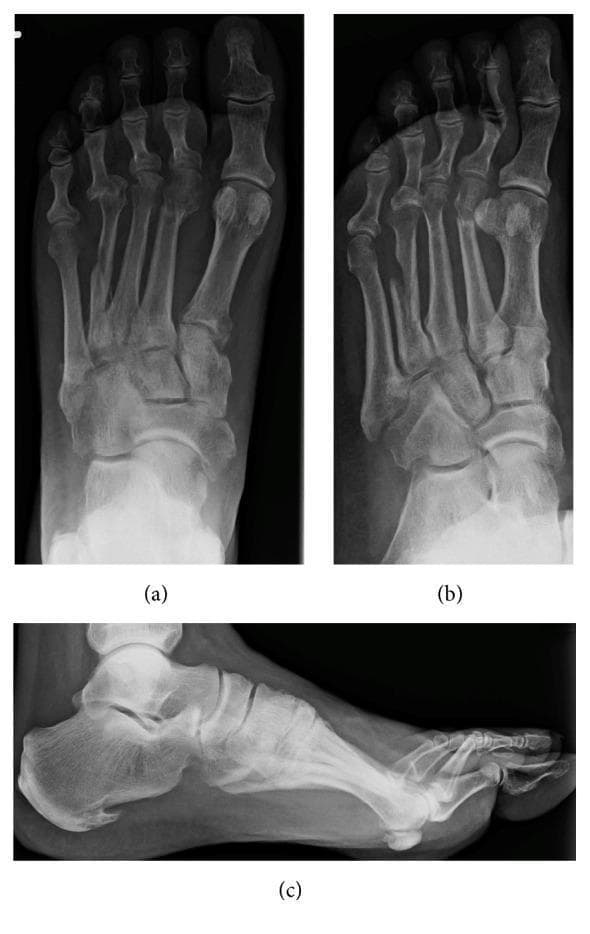
X-ray Interpretation — Left Foot (Sreeja Kumary, 46F)
Views provided: Lateral + Dorsoplantar (DP) AP views of the left foot
Radiological Findings
Dorsoplantar (AP) View:
- Metatarsals 1–5 appear intact with no definite cortical break or displacement
- Tarsometatarsal (Lisfranc) joint alignment appears maintained — no widening between 1st and 2nd metatarsal bases
- Cuneiform and cuboid bones appear intact
- No obvious avulsion fracture at the base of the 5th metatarsal
- Toes: phalanges appear intact
- Ankle mortise partially visible — no obvious talar fracture
Lateral View:
- Calcaneus: no fracture line, Böhler's angle appears preserved
- Talus: no obvious fracture or dislocation
- Midfoot alignment appears maintained
- No soft tissue gas
Overall Impression: No acute bony fracture or dislocation identified on these views. However, soft tissue swelling is noted clinically. An oblique view of the foot would further exclude subtle metatarsal or tarsal fractures.
Clinical Correlation
| Feature | This Case |
|---|---|
| Mechanism | Stair slip/fall |
| Pain | Mild |
| Swelling | Present (+) |
| Ottawa Foot Rules — Foot | Midfoot pain + inability to bear weight → X-ray indicated ✓ |
| Ottawa Foot Rules — Ankle | Check if pain over posterior fibula/tibia or medial/lateral malleolus |
Ottawa Foot Rules indicate X-ray if pain in the midfoot zone AND:
- Inability to bear weight immediately after and in ED, OR
- Bone tenderness over navicular or base of 5th metatarsal
Since X-rays appear negative, the likely diagnoses are:
- Ligamentous sprain of the foot/ankle (most likely)
- Contusion
- Occult fracture (e.g., navicular stress, subtle 5th metatarsal base) — consider oblique view or MRI/CT if symptoms persist
Management
Conservative (RICE + analgesia):
- Rest — non-weight-bearing or partial weight-bearing with crutches as tolerated
- Ice — 15–20 min every 2–3 hours for first 48–72 hours
- Compression — crepe bandage
- Elevation — foot above heart level to reduce swelling
Analgesia:
- Paracetamol 500 mg–1 g TDS/QID
- NSAIDs (Ibuprofen 400 mg TDS with food) if no contraindications — reduces swelling and pain
Further imaging if symptoms worsen or persist >1 week:
- Oblique foot X-ray
- MRI foot — to exclude occult fracture (navicular, cuboid) or ligament tear
Follow-up: Review in 5–7 days. If unable to bear weight or worsening pain, urgent orthopedic referral.
⚠️ This interpretation is for clinical decision support. Formal radiological reporting by a qualified radiologist is recommended.
This is a shared conversation. Sign in to Orris to start your own chat.