
Pathophysiology of pulmonary hypertension full details for md exam answer 10 marks
Reading File
Now let me search the medical library for pulmonary hypertension pathophysiology content in parallel:
Finding Sources
Searching PubMed
"pulmonary hypertension" AND pathophysiology
The Murray & Nadel's Respiratory Medicine textbook has the most dedicated sections. Let me read those in parallel:
Finding Sources
Reading File
Reading File
Let me find the main dedicated pathophysiology chapter on pulmonary hypertension:
Finding Sources
Reading File
Let me search more specifically for the main PAH pathophysiology chapter in Murray & Nadel's:
Finding Sources
Finding Sources
Excellent! Found the key section in Fuster and Hurst's The Heart. Let me read that chapter comprehensively in parallel:
Reading File
Finding Sources
Excellent! Fishman's Pulmonary Diseases and Disorders has the dedicated pathophysiology section. Let me read it comprehensively:
Reading File
Reading File
Let me read more of Fishman's key pathophysiology section and fetch the key diagram:
Reading File
Loading Image
Now let me get more content from Fishman's - the genetic/BMPR2 section and the right heart failure section:
Reading File
Finding Sources
Found Robbins & Cotran pathogenesis section. Let me read it alongside the earlier Fishman's vasoconstriction section:
Reading File
Reading File
Excellent content. Let me get the remaining key sections - the mediators (NO, endothelin, prostacyclin) and the right heart failure consequences:
Reading File
Loading Image
I now have comprehensive material from multiple authoritative textbooks. Let me compile the full, detailed MD exam answer:
Pathophysiology of Pulmonary Hypertension
Definition
Pulmonary hypertension (PH) is defined as a mean pulmonary artery pressure (mPAP) ≥ 25 mmHg at rest, measured by right heart catheterization. Normal mPAP is approximately 14 ± 3 mmHg. Pulmonary vascular resistance (PVR) is the key hemodynamic determinant.
WHO Classification (Etiological Framework)
The underlying cause dictates the pathophysiologic mechanism:
| Group | Category | Mechanism |
|---|---|---|
| 1 | Pulmonary Arterial Hypertension (PAH) | Vasoconstrictive + obliterative |
| 2 | Left heart disease | Passive (postcapillary) |
| 3 | Lung disease / hypoxia | Vasoconstrictive + obliterative |
| 4 | Chronic thromboembolic (CTEPH) | Obstructive |
| 5 | Unclear/multifactorial | Mixed |
Core Pathophysiologic Mechanisms
Regardless of the initial trigger, increased PVR in all forms of PH results from the collective effects of four processes:
- Sustained vasoconstriction
- Vascular remodeling
- In situ thrombosis
- Increased arterial wall stiffness
(Fishman's Pulmonary Diseases and Disorders)
1. Sustained Vasoconstriction
This is driven by a fundamental imbalance between vasoconstrictors and vasodilators at the level of the pulmonary endothelium.
Vasoconstrictors (Upregulated):
Endothelin-1 (ET-1):
- One of the most potent endogenous vasoconstrictors known
- Markedly increased in blood and lung tissue of PAH patients; correlates with disease severity
- Acts on ET-A receptors on pulmonary arterial smooth muscle cells (PASMCs) - causes potent vasoconstriction
- Also mitogenic for PASMCs and fibroblasts (promotes remodeling)
- ET-B receptors on smooth muscle: vasoconstriction + clearance of ET-1
- ET-B receptors on endothelium: paradoxically stimulate NO release (vasodilatory)
Thromboxane A2: Vasoconstrictor and platelet activator, increased in PAH.
Serotonin (5-HT): Acts via 5-HT transporter (5-HTT) to stimulate PASMC proliferation and vasoconstriction.
Angiotensin II: Promotes vasoconstriction and vascular smooth muscle proliferation.
Vasodilators (Downregulated):
Nitric Oxide (NO):
- Synthesized from L-arginine in endothelial cells by eNOS
- Diffuses into PASMCs, activates soluble guanylate cyclase (sGC) → increases cGMP → vasodilation and antiproliferation
- In PAH: eNOS expression and NO production are markedly reduced
- cGMP is also degraded by phosphodiesterase type 5 (PDE-5), which is upregulated in PH
Prostacyclin (PGI2):
- Synthesized from arachidonic acid in endothelial cells via cyclooxygenase
- Acts via IP receptor on PASMCs → increases cAMP → vasodilation and antiproliferation
- PGI2 synthase activity is markedly reduced in PAH
- Thromboxane A2/prostacyclin ratio is shifted toward vasoconstriction
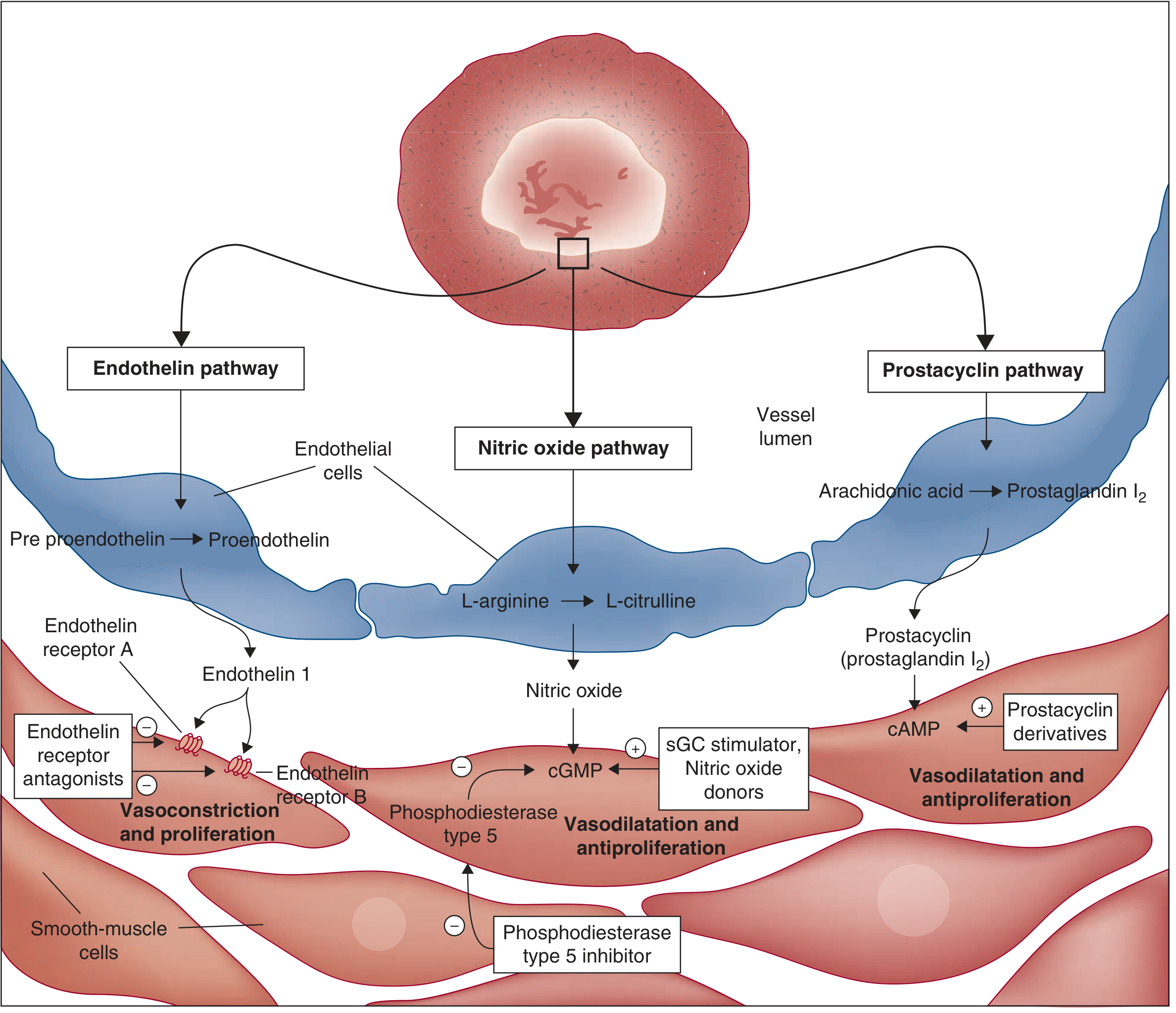
Fuster and Hurst's The Heart, 15th ed. - Three key pathways in PAH pathophysiology
Calcium Dysregulation in PASMCs:
- Rise in cytosolic free Ca²⁺ concentration in PASMCs is a major trigger for vasoconstriction
- Also a key stimulus for PASMC proliferation and migration
- K⁺ channel (Kv) downregulation → membrane depolarization → Ca²⁺ influx via voltage-dependent Ca²⁺ channels (VDCC)
- This represents an intrinsic property of PASMCs in response to hypoxia
Hypoxic Pulmonary Vasoconstriction (HPV):
- An adaptive mechanism to redirect blood from poorly ventilated to well-ventilated areas
- HPV is an intrinsic property of PASMCs (occurs even without endothelium)
- In chronic hypoxia: both sustained vasoconstriction AND structural remodeling occur within weeks
- Disrupted Ca²⁺ homeostasis is the principal mechanism
2. Vascular Remodeling
This is the most important structural change - it leads to irreversible narrowing of the pulmonary vascular bed.
The wall thickness is normally maintained by a balance between proliferation and apoptosis of:
- Fibroblasts
- Pulmonary arterial smooth muscle cells (PASMCs)
- Pulmonary arterial endothelial cells (PAECs)
When this balance tips toward proliferation, progressive wall thickening and luminal obliteration occur.
Structural changes include:
Medial Hypertrophy:
- Increase in number (hyperplasia) and size (hypertrophy) of PASMCs in the media
- Elevated PAP and sustained vasoconstriction perpetuate PASMC hypertrophy in a vicious cycle
- In advanced disease: medial atrophy, fibrosis, and paradoxical thinning with vessel dilation
Muscularization of Normally Non-muscular Vessels:
- Extension of PASMCs into small intra-acinar pulmonary vessels that are normally non-muscularized
- A prominent and early feature of PAH
- Seen in hypoxia-induced PH (indistinguishable histologically from IPAH)
Intimal Proliferation:
- Concentric laminar intimal thickening (onion-skin appearance) causes progressive luminal narrowing
- Results from proliferation of smooth muscle cells, myofibroblasts, and deposition of matrix proteins
Plexiform Lesions (characteristic of severe PAH):
- Aneurysmatic dilatations of small muscular arteries/arterioles
- Contain collections of proliferating endothelial cells, smooth muscle cells, myofibroblasts, and matrix proteins
- Partially or completely occlude the vessel lumen
- Found in IPAH, PAH associated with left-to-right cardiac shunts, HIV, liver cirrhosis, scleroderma
- In IPAH: endothelial cells proliferate in a monoclonal fashion (suggesting neoplastic-like behavior)
- In other PAH forms: polyclonal endothelial cell proliferation
Adventitial Changes:
- Adventitial fibroblast proliferation and increased collagen deposition → reduced arterial wall compliance and increased stiffness
(Fishman's Pulmonary Diseases and Disorders)
3. In Situ Thrombosis
- Monoclonal proliferation of PAECs + PASMC migration + accumulation of inflammatory cells, platelets, and progenitor cells → occlusion of smaller vessels
- Thrombosis occurs without a remote embolic source - reflects a local imbalance of pro- and anticoagulant forces
- Endothelial activation shifts the vessel from anticoagulant to procoagulant state (due to elevated shear stress)
- Decreased prostacyclin (antiplatelet, vasodilatory) and increased thromboxane A2 (proplatelet, vasoconstrictive) further promote thrombosis
- Von Willebrand factor and tissue plasminogen activator (tPA) changes impair fibrinolysis
4. Genetic and Molecular Mechanisms (BMPR2 Pathway)
This is most well-characterized in Group 1 (PAH):
BMPR2 Mutation:
- The first mutation identified in familial PAH
- BMPR2 = Bone Morphogenetic Protein Receptor type 2, a TGF-β receptor superfamily member
- Inactivating germline mutations in BMPR2 found in 75% of familial PAH and 25% of sporadic PAH
- BMPR2 is also downregulated in lungs without BMPR2 mutations (suggesting epigenetic silencing)
- Normal BMPR2 signaling: promotes apoptosis and inhibits proliferation of endothelial cells and VSMCs
- Loss of BMPR2 → haploinsufficiency → dysfunction and uncontrolled proliferation of endothelial cells and VSMCs → pulmonary vascular thickening and occlusion
Two-hit Hypothesis:
- Only 10-20% of BMPR2 mutation carriers develop disease
- A second hit (modifier genes, environmental trigger - e.g., hypoxia, inflammation, drugs, infection) is required
- This explains incomplete penetrance and the variable expressivity of familial PAH
Other genetic mutations (converging on BMPR2 pathway):
- ACVRL1 (activin receptor-like kinase 1) - associated with hereditary hemorrhagic telangiectasia
- ENG (endoglin) - also HHT-related
- SMAD1, SMAD4, SMAD9 - downstream transcription factors in the BMP pathway
- KCNK3 (potassium channel) - Ca²⁺ dysregulation
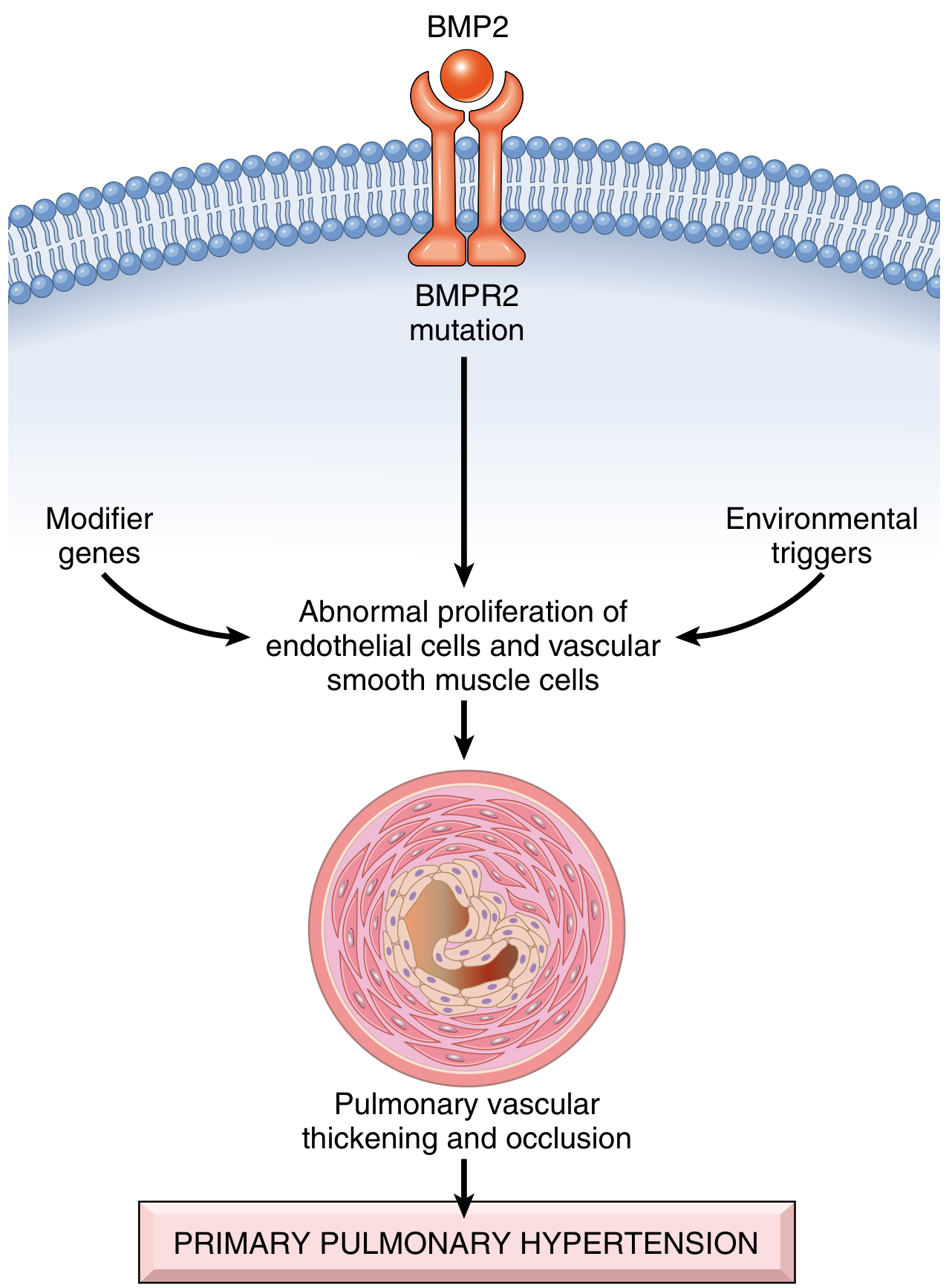
Robbins & Cotran Pathologic Basis of Disease - Pathogenesis of primary (idiopathic) pulmonary hypertension
5. Inflammation and Immune Mechanisms
- Inflammatory cell infiltrates (T and B lymphocytes, macrophages, mast cells, dendritic cells) are found in the plexiform lesions and surrounding vessels
- Elevated circulating cytokines: IL-1β, IL-6, IL-8, TNF-α, MCP-1
- Increased VEGF expression (particularly in plexiform lesions) promotes abnormal angioproliferation
- Growth factors implicated: PDGF, EGF, angiopoietin-1 (overexpressed in IPAH, correlates with severity)
- Regulatory T-cell dysfunction and autoantibodies suggest an autoimmune component
6. Pathogenic Mechanisms by Category (Fishman's Framework)
| Mechanism | Example |
|---|---|
| Passive | Obstruction to pulmonary venous outflow (mitral stenosis, left heart failure) - Group 2 |
| Hyperkinetic | High pulmonary blood flow (left-to-right shunts - VSD, ASD, PDA) - Group 1 |
| Obstructive | Pulmonary thromboembolic disease - Group 4 |
| Obliterative | Parenchymal proliferative disease (IPF, emphysema obliterate capillaries) - Group 3 |
| Vasoconstrictive | Chronic hypoxic vasoconstriction - Group 3 |
| Idiopathic | No discernible cause - Group 1 IPAH |
7. Right Ventricular Consequences (Cor Pulmonale)
The downstream effect of all the above mechanisms:
Right Ventricular Pressure Overload:
- Elevated PVR → elevated mean PAP → increased RV afterload
- RV hypertrophy (concentric) - compensatory, maintains cardiac output
- RV dilation - as compensation fails
- RV failure - the terminal event
Vicious Cycles:
- Elevated RV pressure → decreased coronary perfusion of RV wall → RV ischemia (supply-demand mismatch)
- RV dilation → interventricular septal shift toward LV (D-shaped septum on echo) → decreased LV preload → reduced systemic cardiac output → hypotension → further coronary ischemia
- RV failure → systemic venous hypertension → hepatic congestion, peripheral edema (clinical cor pulmonale)
Chest pain mechanism in PH: Either RV ischemia (inability to meet metabolic demands of hypertrophied RV) or compression of the left main coronary artery by the dilated main pulmonary artery trunk.
8. Group-Specific Pathophysiology Highlights
Group 2 (Left Heart Disease):
- Increased left atrial/PCWP pressure → passive back-transmission through pulmonary veins → pulmonary venous hypertension → reactive precapillary hypertension
- Transmits pulmonary venous pressure → medial hypertrophy of pulmonary arteries
Group 3 (Lung Disease/Hypoxia):
- Two mechanisms: HPV (vasoconstrictive) + parenchymal destruction/fibrosis (obliterative)
- COPD, ILD, sleep apnea all contribute through chronic hypoxemia
Group 4 (CTEPH):
- Acute thrombus → replaced by chronic intravascular scar
- Obstructs proximal vessels → elevated pressure → shunting of flow to remaining open vessels → secondary vascular remodeling of non-obstructed vessels (microvasculopathy)
- Approximately 4% of acute PE patients develop CTEPH
Summary Table: Key Mediators in PAH
| Mediator | Source | Effect | Net Result |
|---|---|---|---|
| Endothelin-1 | Endothelium | ET-A: vasoconstriction + proliferation | Increased PVR |
| Nitric Oxide (↓) | Endothelium via eNOS | Normally: cGMP ↑ → vasodilation | Decreased vasodilation |
| Prostacyclin (↓) | Endothelium via COX | Normally: cAMP ↑ → vasodilation | Decreased vasodilation |
| Thromboxane A2 (↑) | Platelets | Vasoconstriction + platelet aggregation | Thrombosis + ↑ PVR |
| Serotonin | Platelets/endothelium | PASMC proliferation + vasoconstriction | Remodeling |
| PDGF, VEGF | Endothelium | Endothelial/VSMC proliferation | Remodeling |
| Ca²⁺ (cytosolic ↑) | PASMCs | Vasoconstriction + proliferation | Sustained ↑ PVR |
Key Histopathological Findings (Morphology)
All forms of PH share:
- Medial hypertrophy of pulmonary muscular and elastic arteries
- Right ventricular hypertrophy
PAH-specific:
- Plexiform lesions (characteristic but not pathognomonic)
- Concentric laminar intimal proliferation
- In situ thrombosis
- Extension of muscle into normally non-muscular vessels
CTEPH:
- Organizing or recanalized thrombi in proximal and segmental pulmonary arteries
(Robbins & Cotran Pathologic Basis of Disease)
Hemodynamic Definition Recap
PH = mPAP ≥ 25 mmHg at rest (by right heart catheterization)
- Precapillary PH: mPAP ≥ 25, PCWP ≤ 15 mmHg, PVR > 3 Wood units (Groups 1, 3, 4, 5)
- Postcapillary PH: mPAP ≥ 25, PCWP > 15 mmHg (Group 2 - left heart disease)
- Combined pre- and postcapillary PH: mPAP ≥ 25, PCWP > 15, diastolic pressure gradient (DPG) ≥ 7 or PVR > 3
Sources:
- Fishman's Pulmonary Diseases and Disorders - Chapter 72: Pulmonary Vascular Structural and Functional Changes in PH; Pathogenic Mechanisms; Genetic, Cellular, and Molecular Mechanisms of PAH
- Robbins & Cotran Pathologic Basis of Disease - Chapter 15: Pathogenesis of Pulmonary Hypertension
- Fuster and Hurst's The Heart, 15th ed. - Chapter 57: Pathways in the Pathophysiology of PAH
- Recent review: Guignabert C et al. "Pathology and pathobiology of pulmonary hypertension: current insights and future directions." Eur Respir J. 2024 Oct. [PMID: 39209474]
This is a shared conversation. Sign in to Orris to start your own chat.