
Anemia treatment in MHD patients give poster form
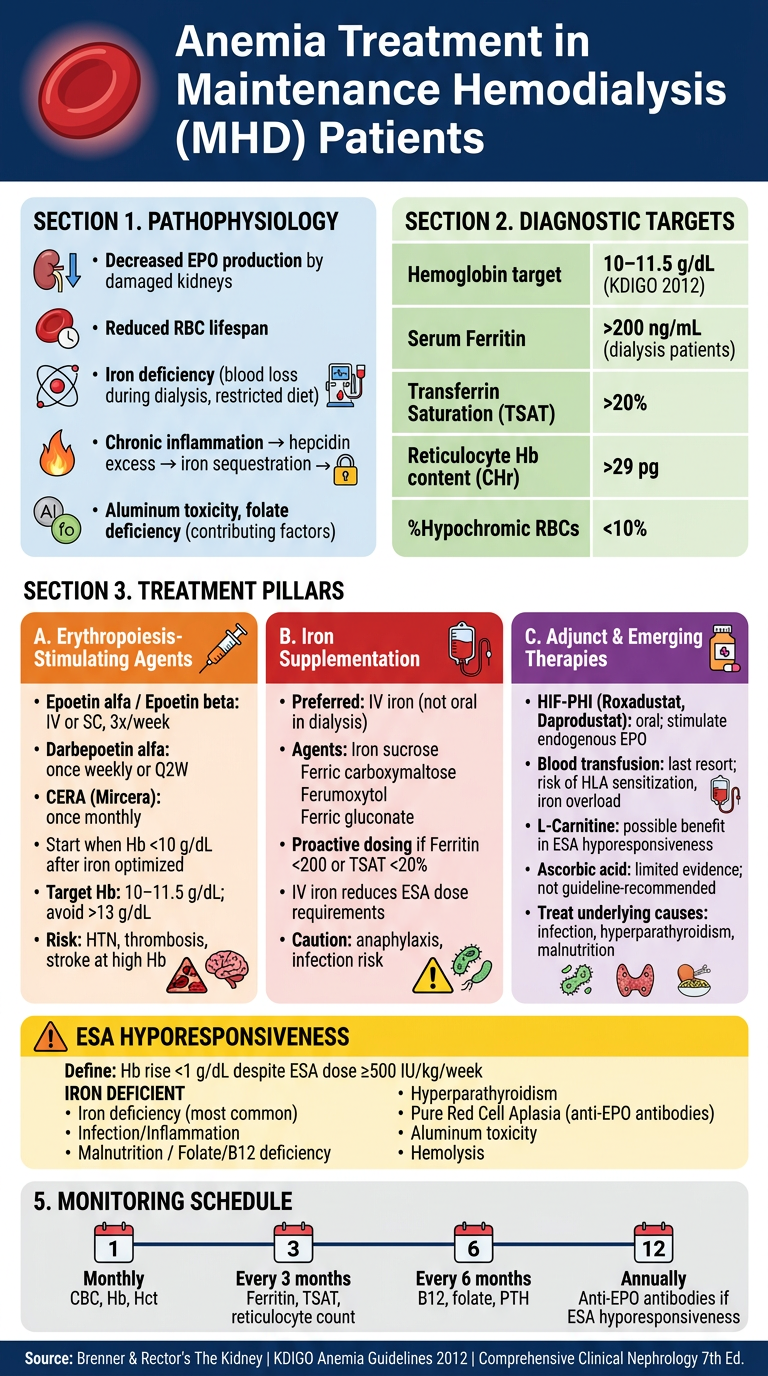
A comprehensive clinical medical poster titled "Anemia Treatment in Maintenance Hemodialysis (MHD) Patients" with the following sections clearly organized in a professional layout: HEADER: "Anemia Treatment in Maintenance Hemodialysis (MHD) Patients" - large bold title on a deep navy blue background with white text, a red blood cell graphic icon SECTION 1 - PATHOPHYSIOLOGY (light blue background): - Decreased EPO production by damaged kidneys - Reduced RBC lifespan - Iron deficiency (blood loss during dialysis, restricted diet) - Chronic inflammation → hepcidin excess → iron sequestration - Aluminum toxicity, folate deficiency (contributing factors) SECTION 2 - DIAGNOSTIC TARGETS (light green background): Table-style layout: - Hemoglobin target: 10–11.5 g/dL (KDIGO 2012) - Serum Ferritin: >200 ng/mL (dialysis patients) - Transferrin Saturation (TSAT): >20% - Reticulocyte Hb content (CHr): >29 pg - %Hypochromic RBCs: <10% SECTION 3 - TREATMENT PILLARS (3 columns with icons): Column A - "Erythropoiesis-Stimulating Agents (ESAs)" (orange header): • Epoetin alfa / Epoetin beta: IV or SC, 3x/week • Darbepoetin alfa: once weekly or Q2W • CERA (Mircera): once monthly • Start when Hb <10 g/dL after iron optimized • Target Hb: 10–11.5 g/dL; avoid >13 g/dL • Risk: HTN, thrombosis, stroke at high Hb Column B - "Iron Supplementation" (red header): • Preferred: IV iron (not oral in dialysis) • Agents: Iron sucrose, Ferric carboxymaltose, Ferumoxytol, Ferric gluconate • Proactive dosing if Ferritin <200 or TSAT <20% • IV iron reduces ESA dose requirements • Caution: anaphylaxis, infection risk Column C - "Adjunct & Emerging Therapies" (purple header): • HIF-PHI (Roxadustat, Daprodustat): oral; stimulate endogenous EPO • Blood transfusion: last resort; risk of HLA sensitization, iron overload • L-Carnitine: possible benefit in ESA hyporesponsiveness • Ascorbic acid: limited evidence; not guideline-recommended • Treat underlying causes: infection, hyperparathyroidism, malnutrition SECTION 4 - ESA HYPORESPONSIVENESS (yellow background, bold warning): Define: Hb rise <1 g/dL despite ESA dose ≥500 IU/kg/week Causes (mnemonic IRON DEFICIENT): - Iron deficiency (most common) - Infection/Inflammation - Malnutrition / Folate/B12 deficiency - Hyperparathyroidism - Pure Red Cell Aplasia (anti-EPO antibodies) - Aluminum toxicity - Hemolysis SECTION 5 - MONITORING SCHEDULE (timeline strip): Monthly: CBC, Hb, Hct | Every 3 months: Ferritin, TSAT, reticulocyte count | Every 6 months: B12, folate, PTH | Annually: Anti-EPO antibodies if ESA hyporesponsiveness FOOTER: Source: Brenner & Rector's The Kidney | KDIGO Anemia Guidelines 2012 | Comprehensive Clinical Nephrology 7th Ed. Clean, professional medical poster style with color-coded sections, icons, and tables. High-quality print-ready design.
Poster Summary
- Primary cause: reduced EPO production by failed kidneys + iron deficiency from dialysis-related blood losses + hepcidin-mediated iron sequestration due to chronic inflammation
| Parameter | Target |
|---|---|
| Hemoglobin | 10–11.5 g/dL |
| Serum Ferritin | >200 ng/mL |
| TSAT | >20% |
| %Hypochromic RBCs | <10% |
-
ESAs — Epoetin alfa/beta (3×/week IV/SC), Darbepoetin alfa (weekly/Q2W), CERA (monthly). Initiate when Hb <10 g/dL after iron replete. Avoid Hb >13 g/dL (↑ CVD/stroke risk).
-
IV Iron — Preferred over oral in dialysis patients. Agents: iron sucrose, ferric carboxymaltose, ferumoxytol, ferric gluconate. IV iron reduces ESA dose requirements significantly.
-
Adjuncts/Emerging — HIF-PHI (Roxadustat, Daprodustat) — oral agents stimulating endogenous EPO; Blood transfusion as last resort (risk: HLA sensitization, iron overload).
Generate a comparison table of ESA agents (epoetin vs darbepoetin vs CERA)
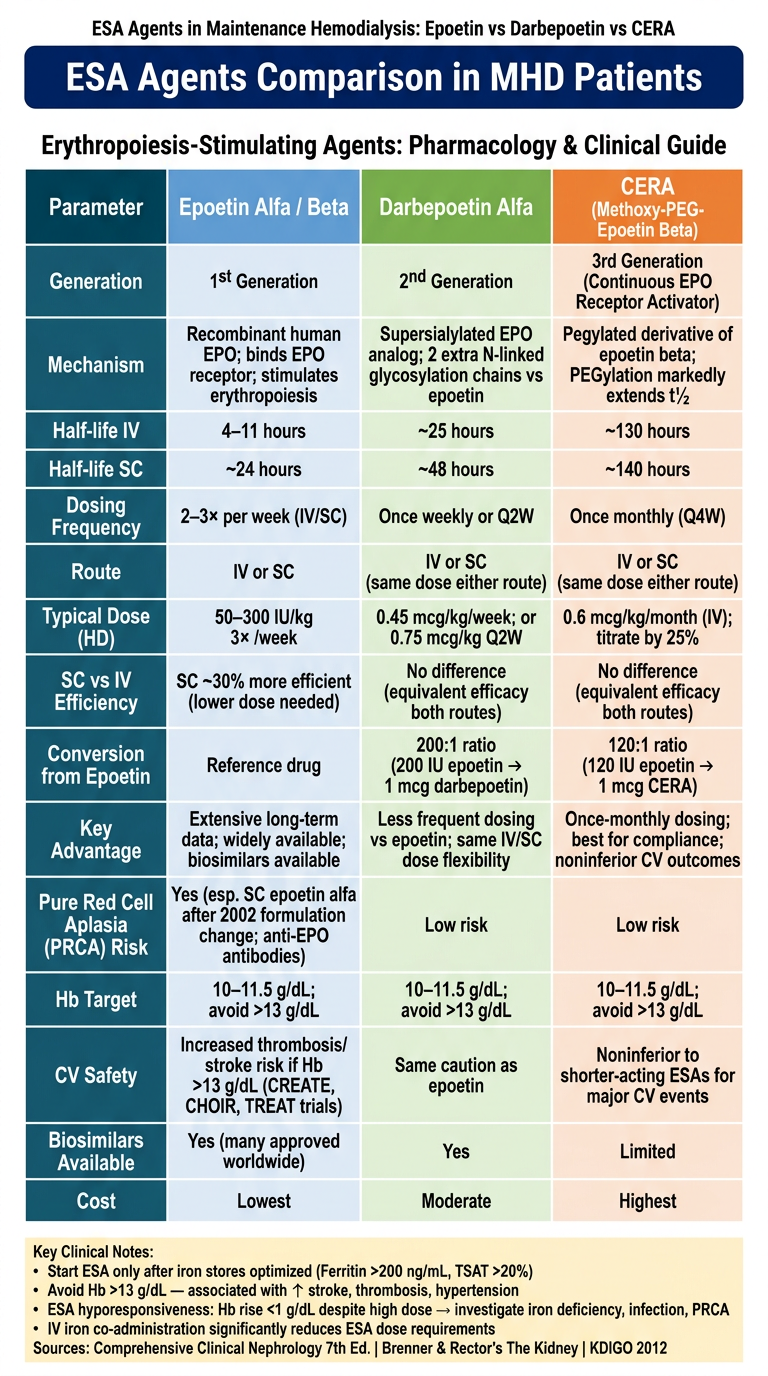
A detailed, professional clinical comparison table poster titled "ESA Agents in Maintenance Hemodialysis: Epoetin vs Darbepoetin vs CERA" on a white background with navy blue header. The poster should have a large comparison table with the following structure: TITLE (navy blue banner, white bold text): "ESA Agents Comparison in MHD Patients" Subtitle: "Erythropoiesis-Stimulating Agents: Pharmacology & Clinical Guide" MAIN TABLE — 4 columns, rows with alternating light gray/white backgrounds, clear bold row headers in dark teal: | Parameter | Epoetin Alfa / Beta | Darbepoetin Alfa | CERA (Methoxy-PEG-Epoetin Beta) | Row 1 — Generation: | 1st Generation | 2nd Generation | 3rd Generation (Continuous EPO Receptor Activator) | Row 2 — Mechanism: | Recombinant human EPO; binds EPO receptor; stimulates erythropoiesis | Supersialylated EPO analog; 2 extra N-linked glycosylation chains vs epoetin | Pegylated derivative of epoetin beta; PEGylation markedly extends t½ | Row 3 — Half-life IV: | 4–11 hours | ~25 hours | ~130 hours | Row 4 — Half-life SC: | ~24 hours | ~48 hours | ~140 hours | Row 5 — Dosing Frequency: | 2–3× per week (IV/SC) | Once weekly or Q2W | Once monthly (Q4W) | Row 6 — Route: | IV or SC | IV or SC (same dose either route) | IV or SC (same dose either route) | Row 7 — Typical Dose (HD): | 50–300 IU/kg 3× /week | 0.45 mcg/kg/week; or 0.75 mcg/kg Q2W | 0.6 mcg/kg/month (IV); titrate by 25% | Row 8 — SC vs IV Efficiency: | SC ~30% more efficient (lower dose needed) | No difference (equivalent efficacy both routes) | No difference (equivalent efficacy both routes) | Row 9 — Conversion from Epoetin: | Reference drug | 200:1 ratio (200 IU epoetin → 1 mcg darbepoetin) | 120:1 ratio (120 IU epoetin → 1 mcg CERA) | Row 10 — Key Advantage: | Extensive long-term data; widely available; biosimilars available | Less frequent dosing vs epoetin; same IV/SC dose flexibility | Once-monthly dosing; best for compliance; noninferior CV outcomes | Row 11 — Pure Red Cell Aplasia (PRCA) Risk: | Yes (esp. SC epoetin alfa after 2002 formulation change; anti-EPO antibodies) | Low risk | Low risk | Row 12 — Hb Target: | 10–11.5 g/dL; avoid >13 g/dL | 10–11.5 g/dL; avoid >13 g/dL | 10–11.5 g/dL; avoid >13 g/dL | Row 13 — CV Safety: | Increased thrombosis/stroke risk if Hb >13 g/dL (CREATE, CHOIR, TREAT trials) | Same caution as epoetin | Noninferior to shorter-acting ESAs for major CV events | Row 14 — Biosimilars Available: | Yes (many approved worldwide) | Yes | Limited | Row 15 — Cost: | Lowest | Moderate | Highest | Below the table, add a footer notes section (light yellow background): "Key Clinical Notes: • Start ESA only after iron stores optimized (Ferritin >200 ng/mL, TSAT >20%) • Avoid Hb >13 g/dL — associated with ↑ stroke, thrombosis, hypertension • ESA hyporesponsiveness: Hb rise <1 g/dL despite high dose → investigate iron deficiency, infection, PRCA • IV iron co-administration significantly reduces ESA dose requirements Sources: Comprehensive Clinical Nephrology 7th Ed. | Brenner & Rector's The Kidney | KDIGO 2012" Design: Clean, professional medical reference table. Column headers in bold navy/teal. Epoetin column = light blue tint, Darbepoetin = light green tint, CERA = light orange tint. High readability, print-quality medical poster format.
ESA Agents at a Glance
| Parameter | Epoetin α/β | Darbepoetin α | CERA |
|---|---|---|---|
| Generation | 1st | 2nd | 3rd |
| Half-life (IV) | 4–11 h | ~25 h | ~130 h |
| Half-life (SC) | ~24 h | ~48 h | ~140 h |
| Dosing | 2–3×/week | Weekly or Q2W | Once monthly |
| SC vs IV dose | SC ~30% more efficient | Same dose both routes | Same dose both routes |
| Conversion ratio | Reference | 200 IU epoetin = 1 mcg | 120 IU epoetin = 1 mcg |
| PRCA risk | Higher (esp. SC epoetin alfa) | Low | Low |
| Cost | Lowest | Moderate | Highest |
| Biosimilars | Many available | Yes | Limited |
- Darbepoetin: 2 extra N-linked glycosylation chains → reduced clearance
- CERA: PEGylation of epoetin beta → dramatically slows clearance