
According to Harrison book of medicine what is the definition of diverticulum
Reading File
Finding Sources
The results don't include Harrison's specifically. Let me search for it directly.
Finding Sources
Finding Sources
I found the key passage. Let me read the full context around that definition.
Reading File
I have the full definition from Harrison's. Here is the answer:
Definition of Diverticulum - Harrison's Principles of Internal Medicine (22nd Edition, 2025)
Harrison's defines a diverticulum in the context of intestinal/colonic disease, distinguishing two types:
"Two types of diverticula occur in the intestine: true and false (or pseudodiverticulum). A true diverticulum is a saclike herniation of the entire bowel wall, whereas a pseudodiverticulum involves only a protrusion of the mucosa and submucosa through the muscularis propria of the colon."
- Harrison's Principles of Internal Medicine, 22E - Chapter 339: Diverticular Disease and Common Anorectal Disorders
Key Points from Harrison's:
| Type | Definition |
|---|---|
| True diverticulum | Saclike herniation of the entire bowel wall (all layers) |
| Pseudodiverticulum (false diverticulum) | Protrusion of only the mucosa and submucosa through the muscularis propria |
The book further notes that the type most commonly seen in the colon is the pseudodiverticulum. These occur at the point where the nutrient artery (vasa recta) penetrates through the muscularis propria, creating a weak point in the colonic wall. They are most commonly found in the sigmoid colon, where high-pressure contractions combined with constipated stool drive herniation at these areas of weakness.
Create a study guide on diverticular disease complications
Give. Example of true and peudo-d iverticulum
A true diverticulum contains all bowel wall layers (mucosa, submucosa, and muscularis), while a pseudodiverticulum herniates only the mucosa and submucosa through the muscle layer. Classic examples include Meckel's diverticulum (true) and colonic diverticula (pseudo).
Searching sources...
Finding Sources
Finding Sources
Reading File
Finding Sources
Loading Image
Finding Sources
Here is a thorough comparison with textbook-sourced examples:
True Diverticulum vs. Pseudodiverticulum - Examples
The Core Distinction
| Feature | True Diverticulum | Pseudodiverticulum (False) |
|---|---|---|
| Wall layers | All three layers - mucosa, submucosa, AND muscularis propria | Mucosa + submucosa only - NO muscular layer |
| Origin | Usually congenital | Usually acquired |
| Mechanism | Full outpouching of the bowel wall | Herniation of inner layers through a defect in the muscle |
Examples of TRUE Diverticula
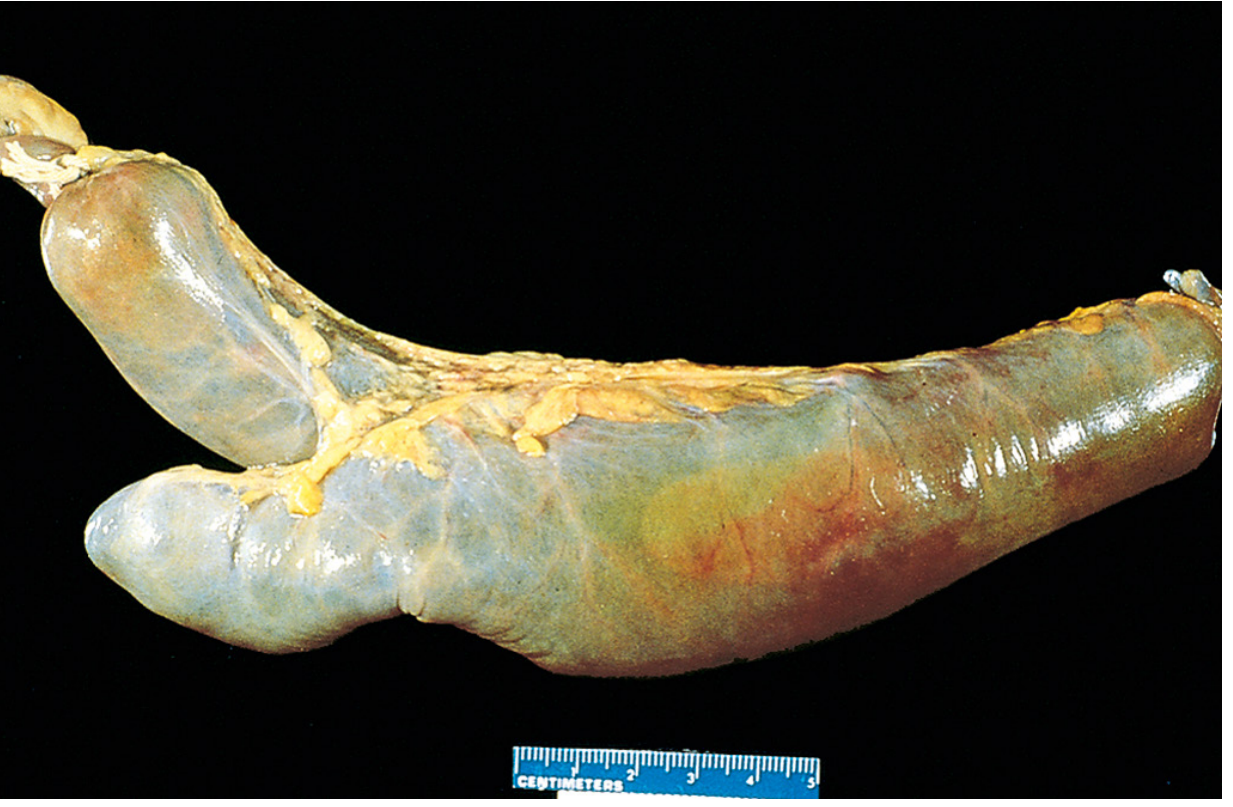
1. Meckel's Diverticulum (most important)
- The most common true diverticulum and the most common congenital GI anomaly
- A remnant of the omphalomesenteric (vitelline) duct that fails to obliterate during weeks 5-7 of gestation
- Located in the ileum, within ~60 cm of the ileocecal valve
- Contains all three intestinal wall layers
- The "Rule of 2s": ~2% of population, ~2 feet from ileocecal valve, ~2 inches long, 2:1 male:female ratio, symptomatic by age 2 in ~4% of cases
- May contain ectopic gastric or pancreatic mucosa, leading to peptic ulceration and GI bleeding
This is a gross pathology image of a Meckel's diverticulum (from Robbins Pathology):
2. Traction Diverticulum of the Esophagus (mid-esophageal)
- A true diverticulum caused by external traction from mediastinal inflammation/lymph nodes pulling all layers outward
- Contains all esophageal wall layers
Examples of PSEUDODIVERTICULA (False Diverticula)
1. Colonic Diverticula (most common overall)
- The most common type of diverticulum encountered clinically
- Occur at points where the vasa recta (nutrient artery) penetrates the muscularis propria, creating a weak spot
- Only mucosa and submucosa herniate through - no muscle layer
- Most common in the sigmoid colon
- The basis of diverticulosis and diverticulitis
- Harrison's 22E: "The type of diverticulum most commonly seen in the colon is the pseudodiverticulum."
2. Zenker's Diverticulum (pharyngo-esophageal)
- A pulsion-type (false) diverticulum at Killian's triangle - the dehiscence between the thyropharyngeus and cricopharyngeus muscles
- Only mucosa and submucosa herniate through the muscular wall
- Caused by increased intraluminal pressure from cricopharyngeal dysfunction
- Common in elderly patients; presents with dysphagia, regurgitation of undigested food, and halitosis
3. Epiphrenic Diverticulum
- False/pulsion diverticulum near the lower esophagus, just above the diaphragm
- Also lacks the full muscular layer
Memory Hook
"TRUE = Total layers (all 3), congenital, ileum (Meckel's)" "PSEUDO = Pushed-through mucosa only, acquired, sigmoid colon"
- Robbins & Cotran Pathologic Basis of Disease - Meckel Diverticulum section
- Harrison's Principles of Internal Medicine, 22E - Chapter 339
- Cummings Otolaryngology - Esophageal Diverticula section
This is a shared conversation. Sign in to Orris to start your own chat.