
Create the most crisp and important points in the way to put in ppt in community medicine ppt on topic obesity
"obesity"[MeSH Terms] AND prevention
WHO obesity fact sheet BMI prevention 2025
Quick answer
Community Medicine PPT: Obesity
Slide 1: Title
- Community Medicine
- Name, class, institution
Slide 2: Definition
- Obesity is abnormal or excessive fat accumulation that impairs health.
- It is a chronic, complex, relapsing disease.
- Usually assessed using Body Mass Index (BMI).
Slide 3: BMI Classification for Adults
| Category | BMI (kg/m²) |
|---|---|
| Underweight | <18.5 |
| Normal | 18.5-24.9 |
| Overweight | 25.0-29.9 |
| Obesity Class I | 30.0-34.9 |
| Obesity Class II | 35.0-39.9 |
| Obesity Class III | ≥40 |
- Overweight: ≥23 kg/m²
- Obesity: ≥25 kg/m²
Slide 4: Magnitude of Problem
- Obesity is rising rapidly in both adults and children.
- It affects high-income, middle-income, and low-income countries.
- India faces a double burden of malnutrition: undernutrition coexists with overweight and obesity.
- Urbanization, sedentary living, and unhealthy diets are key drivers.
Slide 5: Etiology - Multifactorial
- Energy intake exceeds energy expenditure.
- High-calorie, ultra-processed foods and sugary beverages.
- Physical inactivity and increased screen time.
- Genetic predisposition.
- Psychological stress and inadequate sleep.
- Medicines and endocrine disorders in a minority of cases.
- Social, economic, environmental, and commercial determinants.
Slide 6: Risk Factors
- Family history of obesity
- Sedentary lifestyle
- Frequent consumption of fast food
- Large portion sizes
- Alcohol use
- Sleep deprivation
- Childhood obesity
- Low socioeconomic status or obesogenic environment
- Pregnancy-related weight retention
Slide 7: Health Consequences
- Type 2 diabetes mellitus
- Hypertension and cardiovascular disease
- Dyslipidemia
- Stroke
- Obstructive sleep apnea
- Osteoarthritis
- Fatty liver disease
- Infertility and polycystic ovarian syndrome
- Certain cancers
- Depression, stigma, and reduced quality of life
Slide 8: Central Obesity
- Abdominal fat is more harmful than peripheral fat.
- Measured by waist circumference and waist-hip ratio.
- Asian Indian high-risk waist circumference:
- Men: ≥90 cm
- Women: ≥80 cm
- Central obesity strongly predicts diabetes and cardiovascular disease.
Slide 9: Childhood Obesity
- Often tracks into adulthood.
- Leads to early diabetes, hypertension, fatty liver, and psychosocial problems.
- Major causes:
- Energy-dense foods
- Sugary drinks
- Screen time
- Reduced outdoor play
- Unhealthy school food environment
Slide 10: Prevention - Primordial Prevention
- Healthy food environment in homes, schools, and workplaces
- Restrict marketing of unhealthy foods to children
- Front-of-pack food labeling
- Taxation of sugar-sweetened beverages
- Safe parks, cycling paths, and walkable communities
- Promotion of breastfeeding
Slide 11: Primary Prevention
- Balanced, minimally processed diet
- More fruits, vegetables, pulses, whole grains, and nuts
- Limit sugar, salt, saturated fat, and trans-fat
- Avoid sugary beverages and frequent fast food
- At least 150 minutes/week of moderate physical activity for adults
- Regular sleep and stress management
Slide 12: Secondary Prevention
- Regular screening for BMI and waist circumference
- Identify overweight early
- Screen for diabetes, hypertension, dyslipidemia, and fatty liver disease
- Lifestyle counselling and goal-based weight management
- Family-based interventions for children
Slide 13: Tertiary Prevention and Management
- Treat obesity-related complications.
- Diet, physical activity, behavioral therapy, and long-term follow-up.
- Pharmacotherapy may be considered in selected patients.
- Bariatric surgery may be indicated for severe obesity with complications.
- Avoid weight stigma: use respectful, person-first language.
Slide 14: Role of Primary Health Care Team
- Measure BMI and waist circumference routinely.
- Provide nutrition and physical activity counselling.
- Identify high-risk individuals and families.
- Screen for NCDs.
- Refer patients with severe obesity or complications.
- Conduct community awareness activities.
Slide 15: Key Messages
- Obesity is preventable and manageable.
- It is not solely due to lack of willpower.
- Prevention requires action by individuals, families, schools, health systems, communities, and government.
- Early prevention, especially in childhood, gives the greatest benefit.
- A healthy environment makes healthy choices easier.
Slide 16: References
- WHO: Obesity and Overweight Fact Sheet
- Park’s Textbook of Preventive and Social Medicine
- National Programme for Prevention and Control of Non-Communicable Diseases
- Recent systematic reviews on obesity prevention, including PMIDs 39648046, 38763518, and 38763517.
Create the most crisp and important points in the way to put in ppt in community medicine ppt on topic obesity
Obesity: Crisp PPT Points for Community Medicine
Slide 1: Title
Community Medicine Presentation
Slide 2: Definition
- Abnormal or excessive fat accumulation that impairs health.
- A chronic, complex, multifactorial disease.
- Results when energy intake exceeds energy expenditure over time.
Slide 3: Assessment of Obesity
| Category | BMI (kg/m²) |
|---|---|
| Normal | 18.5-24.9 |
| Overweight | 25.0-29.9 |
| Obesity | ≥30 |
- Overweight: ≥23 kg/m²
- Obesity: ≥25 kg/m²
Slide 4: Central Obesity
- Abdominal fat has a higher cardiometabolic risk.
- Assessed by waist circumference.
- Male: ≥90 cm
- Female: ≥80 cm
Slide 5: Magnitude of the Problem
- Obesity is increasing in adults, adolescents, and children.
- Seen in both urban and rural populations.
- India has a double burden of malnutrition:
- Undernutrition
- Overweight and obesity
- Major contributor to non-communicable diseases.
Slide 6: Causes and Risk Factors
- High-calorie, processed foods and sugary drinks
- Physical inactivity and sedentary lifestyle
- Increased screen time
- Genetic predisposition
- Stress and inadequate sleep
- Urbanization and easy availability of fast food
- Family history and childhood obesity
- Drugs and endocrine disorders in some cases
Slide 7: Health Consequences
- Type 2 diabetes mellitus
- Hypertension
- Dyslipidemia
- Coronary artery disease and stroke
- Fatty liver disease
- Obstructive sleep apnea
- Osteoarthritis
- PCOS, infertility, and pregnancy complications
- Certain cancers
- Depression, stigma, and poor quality of life
Slide 8: Childhood Obesity
- Strong predictor of obesity in adulthood.
- Causes early onset diabetes, hypertension, and fatty liver.
- Key causes:
- Unhealthy snacks and sugary beverages
- Screen time
- Reduced outdoor play
- Unhealthy school food environment
Slide 9: Prevention at Individual and Family Level
- Eat a balanced, portion-controlled diet.
- Increase fruits, vegetables, pulses, and whole grains.
- Reduce sugar, salt, saturated fat, and trans-fat.
- Avoid sugary drinks and frequent junk food.
- Regular physical activity:
- Adults: at least 150 minutes/week moderate activity
- Children: at least 60 minutes/day
- Adequate sleep and stress control.
Slide 10: Community-Level Prevention
- Promote healthy school meals.
- Restrict marketing of unhealthy foods to children.
- Nutrition labeling on packaged foods.
- Promote parks, walking tracks, cycling, and sports.
- Health education through schools, workplaces, and media.
- Taxation and regulation of sugar-sweetened beverages.
- Encourage breastfeeding and healthy complementary feeding.
Slide 11: Role of Health Worker / Primary Health Care
- Measure BMI and waist circumference routinely.
- Identify overweight individuals early.
- Screen for diabetes, hypertension, and dyslipidemia.
- Provide diet and physical activity counselling.
- Promote family-based lifestyle modification.
- Refer severe obesity and complications appropriately.
Slide 12: Key Messages
- Obesity is preventable and manageable.
- It is not simply a result of lack of willpower.
- Early prevention is better than treatment.
- Childhood prevention gives lifelong benefits.
- Healthy choices need supportive homes, schools, communities, and policies.
Slide 13: Take-Home Message
Most take content form park book
"obesity"[MeSH Terms] AND prevention
WHO obesity overweight fact sheet body mass index adults 2026
Slide 1: Obesity
- A form of overnutrition
- Important risk factor for non-communicable diseases
Slide 2: Definition
- Abnormal growth of adipose tissue.
- Due to:
- Enlargement of fat cells: hypertrophic obesity
- Increase in number of fat cells: hyperplastic obesity
- Or both.
- Expressed commonly by Body Mass Index (BMI).
Park’s Textbook of Preventive and Social Medicine, p. 447
Slide 3: BMI
| BMI | Classification |
|---|---|
| 18.5-24.9 | Normal |
| 25.0-29.9 | Overweight |
| 30.0-39.9 | Obesity |
| ≥40 | Severe obesity |
- BMI is the most widely used index for assessment of obesity.
Slide 4: Epidemiological Determinants
- Obesity has multiple causation.
- It can occur at any age and generally increases with age.
- Excess weight gain during infancy and childhood predisposes to adult obesity.
- One-third of obese adults may have been obese since childhood.
Park’s Textbook of Preventive and Social Medicine, pp. 448-449
Slide 5: Important Risk Factors
- Age
- Sex: obesity is generally more common in women.
- Genetic factors
- Physical inactivity
- Socio-economic status
- Eating habits:
- Eating between meals
- Sweets and refined foods
- High-fat diet
- Excess calorie intake
Slide 6: Physical Inactivity
- Regular physical activity protects against unhealthy weight gain.
- Sedentary occupation and inactive recreation promote obesity.
- Watching television and reduced exercise contribute to obesity.
- Obesity further reduces activity: a vicious cycle.
Park’s Textbook of Preventive and Social Medicine, p. 449
Slide 7: Central Obesity
- Intra-abdominal fat is more harmful than subcutaneous fat.
- Abdominal obesity is associated with:
- Insulin resistance
- Hyperinsulinaemia
- Dyslipidaemia
- Glucose intolerance
- Hypertension
- Coronary heart disease
- It is a key component of metabolic syndrome.
Park’s Textbook of Preventive and Social Medicine, p. 450
Slide 8: Assessment of Obesity
- Body weight
- Weight-for-height
- Body Mass Index
- Skinfold thickness
- Waist circumference / waist-hip ratio
- Accurate assessment needs measurements and reference standards.
Slide 9: Hazards of Obesity
- Increased morbidity and mortality.
- Diabetes mellitus
- Hypertension
- Coronary heart disease
- Stroke
- Gallbladder disease
- Osteoarthritis
- Respiratory problems
- Increased risk of certain cancers
- Psychosocial problems
Park’s Textbook of Preventive and Social Medicine, pp. 451 onward
Slide 10: Prevention
Individual level
- Avoid excessive calorie intake.
- Balanced diet with adequate fruits, vegetables, and fibre.
- Limit refined foods, sweets, fats, and frequent snacking.
- Regular physical activity.
- Maintain ideal body weight.
Community level
- Health education regarding healthy diet and exercise.
- Promotion of physical activity in schools and workplaces.
- Encourage healthy food habits from childhood.
- Prevent sedentary lifestyle.
Slide 11: Key Community Medicine Message
- Obesity is a preventable nutritional disorder.
- Early-life prevention is important.
- Lifestyle modification is the main preventive strategy.
- Prevention of obesity helps prevent diabetes, hypertension, and coronary heart disease.
Slide 12: Conclusion
Reference slide
- Park’s Textbook of Preventive and Social Medicine, chapter on Nutrition and Health, section “Obesity,” pp. 447-451.
Add Park-based speaker notes for each slide
site:who.int obesity overweight fact sheet BMI definition
Park-Based Speaker Notes for Obesity PPT
Slide 1: Obesity - A Public Health Problem
“Obesity is an important nutritional and public health problem. It is associated with increased morbidity and mortality, mainly due to diabetes, hypertension, and coronary heart disease. In community medicine, obesity is important because it is largely preventable through healthy diet and physical activity.”
Park’s Textbook of Preventive and Social Medicine, p. 447
Slide 2: Definition
“Park defines obesity as abnormal growth of adipose tissue. It can result from enlargement of fat cells, called hypertrophic obesity; increase in the number of fat cells, called hyperplastic obesity; or a combination of both. Although overweight usually occurs due to obesity, it may also occur because of increased muscle mass or fluid retention.”
Park’s Textbook of Preventive and Social Medicine, p. 447
Slide 3: BMI
“Body mass index, or BMI, is calculated by dividing weight in kilograms by the square of height in metres. It is the most commonly used practical index for classifying overweight and obesity in adults. BMI is useful in population surveys, screening, and monitoring nutritional status.”
Park’s Textbook of Preventive and Social Medicine, section ‘Use of BMI to classify obesity,’ p. 449
Slide 4: Epidemiological Determinants
“The aetiology of obesity is complex and multifactorial. Obesity can occur at any age, but it generally increases with age. Excessive weight gain during infancy predisposes to obesity in later life. Park notes that about one-third of obese adults may have been obese since childhood.”
Park’s Textbook of Preventive and Social Medicine, pp. 448-449
Slide 5: Risk Factors
“The major determinants described in Park include age, sex, genetic factors, physical inactivity, socio-economic status, and eating habits. Eating between meals, preference for sweets, refined foods, and fats, along with excessive energy intake, increase the risk. These factors interact rather than acting independently.”
Slide 6: Physical Inactivity
“Regular physical activity protects against unhealthy weight gain. Sedentary occupation, television viewing, and inactive recreation promote obesity. Reduced energy expenditure is an important factor in obesity. A vicious cycle can develop because obesity restricts activity, and reduced activity further increases obesity.”
Park’s Textbook of Preventive and Social Medicine, p. 449
Slide 7: Central Obesity
“Central or abdominal obesity is more dangerous than peripheral fat accumulation. Intra-abdominal fat is closely linked to insulin resistance and metabolic syndrome. This includes hyperinsulinaemia, dyslipidaemia, glucose intolerance, and hypertension, which increase the risk of coronary heart disease.”
Park’s Textbook of Preventive and Social Medicine, p. 450
Slide 8: Assessment of Obesity
“Obesity is characterized by an increase in fatty mass. Though it may be clinically obvious, accurate assessment requires objective measurement and reference standards. Common methods include body weight, weight-for-height, BMI, skinfold thickness, and measures of central fat distribution such as waist circumference and waist-hip ratio.”
Park’s Textbook of Preventive and Social Medicine, p. 450
Slide 9: Hazards of Obesity
“Obesity increases both morbidity and mortality. Its most important consequences are diabetes mellitus, hypertension, and coronary heart disease. It may also contribute to other problems such as osteoarthritis, respiratory disease, gallbladder disease, and psychosocial difficulties. Thus, obesity is a major modifiable risk factor for non-communicable diseases.”
Park’s Textbook of Preventive and Social Medicine, section ‘Hazards of obesity,’ pp. 451 onward
Slide 10: Prevention
“Prevention should focus on avoiding positive energy balance. Dietary advice should emphasize avoiding excess calories, refined foods, fats, sweets, and frequent snacking. Regular physical activity is essential. Since eating patterns are established early in life, health education and healthy habits should begin in childhood.”
Park’s Textbook of Preventive and Social Medicine, pp. 448-449
Slide 11: Community Medicine Approach
“Obesity prevention is not only an individual responsibility. Community-level measures should promote healthy diets, physical activity, and awareness regarding complications of obesity. Schools, families, workplaces, and health workers all have a role. Early detection of overweight and counselling can prevent progression to obesity and related NCDs.”
Based on Park’s prevention-oriented approach to nutrition and NCD risk factors.
Slide 12: Conclusion
“To conclude, obesity is a multifactorial nutritional disorder with serious health consequences. It should be prevented early, especially during childhood. A balanced diet, regular physical activity, and supportive community environments are the cornerstone of prevention.”
Reference for final slide
Section: Obesity, Chapter on Nutrition and Health, pp. 447-451.
Make it more attractive by adding images
obesity body mass index BMI classification infographic adult overweight obesity
abdominal central obesity waist circumference metabolic syndrome diagram
healthy diet physical activity obesity prevention children community health illustration
"obesity"[MeSH Terms] AND prevention
WHO obesity fact sheet BMI physical activity prevention
Suggested Attractive Image Layout
Slide 1: Title - Obesity
- Use a full-width background image or right-side image showing healthy lifestyle versus sedentary lifestyle.
- Add subtitle: “A major preventable risk factor for NCDs”

Slide 2: Definition
- Add two small labelled boxes:
- Hypertrophic obesity: increased fat-cell size
- Hyperplastic obesity: increased fat-cell number
- Keep the definition in a highlighted text box.
Slide 3: BMI Classification
- Green: Normal
- Yellow: Overweight
- Orange/red: Obesity
Normal → Overweight → Obesity → Severe obesitySlide 4: Determinants / Risk Factors
- 👶 Age/childhood obesity
- 🧬 Genetics
- 🛋 Physical inactivity
- 🍟 Unhealthy eating
- 💼 Socio-economic factors
- ♀ Sex/pregnancy-related weight gain
Slide 5: Eating Habits and Physical Inactivity
| Promotes obesity | Prevents obesity |
|---|---|
| Fast food, sweets, refined food | Fruits, vegetables, balanced meals |
| Screen time, sedentary work | Walking, cycling, sports |

Slide 6: Physical Inactivity - Vicious Cycle

Slide 7: Central Obesity
- Highlight the abdominal region in orange/red.
- Add arrows to: insulin resistance, hypertension, dyslipidaemia, diabetes, and CHD.
“Central obesity is more harmful than peripheral obesity.”
Slide 8: Assessment of Obesity
- Weighing scale - Body weight
- Height scale - Height
- Calculator - BMI
- Measuring tape around waist - Waist circumference
BMI = Weight (kg) / Height² (m²)
Slide 9: Hazards of Obesity
- Brain: Stroke
- Heart: Hypertension, CHD
- Liver: Fatty liver
- Pancreas: Diabetes
- Joints: Osteoarthritis
- Airways: Sleep apnea
Slide 10: Prevention
- Half plate: vegetables and fruits
- One-quarter: whole grains
- One-quarter: pulses/protein foods
- Add water bottle, walking shoes, and sleep icon.
- Balanced diet
- Avoid excess calories
- Regular exercise
- Reduce sedentary time
- Healthy habits from childhood
Slide 11: Community Medicine Approach

Slide 12: Conclusion
- Image of a family walking, cycling, or eating a healthy meal.
- Large message:
“Healthy diet + Regular activity + Early prevention = Healthier community”
Quick Presentation Design Rules
- Use maximum 4-5 bullets per slide.
- Use images on 6-7 slides only, not every slide.
- Use the same font throughout: Aptos, Calibri, or Poppins.
- Use dark blue for titles, green for prevention, and orange/red only for risks.
- Keep speaker notes unchanged and cite Park’s Textbook of Preventive and Social Medicine, pp. 447-451 in the references slide.
- The WHO visuals support the prevention messages, while the core definition, determinants, assessment, central obesity, and hazards remain Park-based. The WHO obesity overview also supports the standard BMI framing.
Create a funny image related to the content and particulate Tamil Nadu style in it
A lighthearted, respectful cartoon for a community medicine presentation about preventing obesity, set in Tamil Nadu. A cheerful Tamil family in everyday traditional and modern clothing at a Chennai-style street corner, choosing a banana leaf healthy meal with vegetables, millet dosa and fruit while playfully walking past an oversized tempting plate of fried snacks and sugary soda. A friendly local doctor holding a BMI chart and a grandmother encouraging everyone to walk. Include recognizable but subtle Tamil Nadu details: kolam at the doorstep, coconut trees, a temple gopuram in the distant background, Tamil-style tea stall signage without readable text. Warm, humorous, educational tone, no body shaming, no caricature of obesity, landscape 16:9 composition with clear empty space on the left for a presentation title.
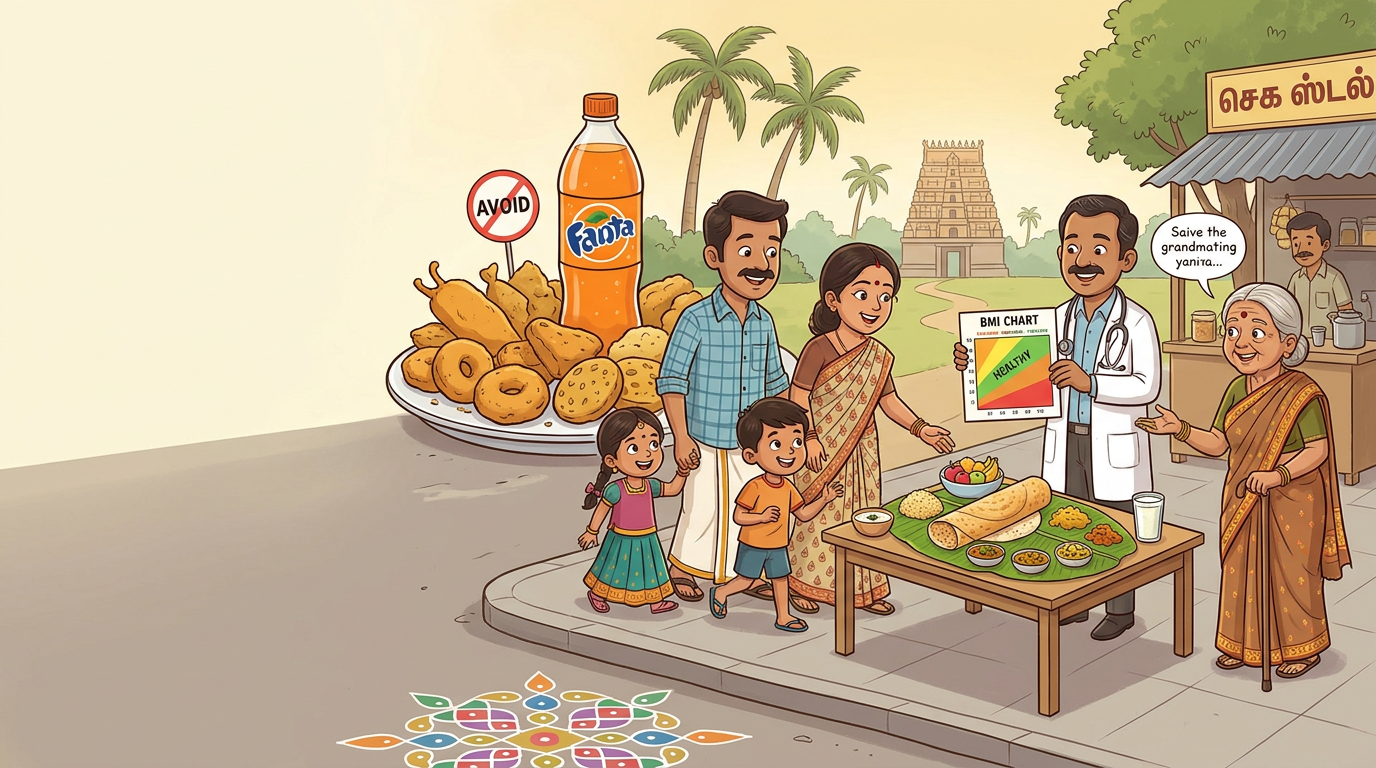
Eat in moderation, walk every day!
Create a full PPT with these Tamil Nadu-style visuals
WHO obesity overweight fact sheet BMI health risks prevention
"obesity"[MeSH Terms] AND prevention
Landscape 16:9 humorous but respectful educational Tamil Nadu cartoon for a community medicine obesity presentation. A Tamil family near a kolam-decorated Chennai home chooses a banana-leaf meal of vegetables, sambar, millet dosa and fruit, while a playful oversized plate of bajji, chips and soda tries to tempt them from the side. A friendly local doctor holds a BMI chart. Temple gopuram, coconut trees, and a cycle in background. No readable text. No body shaming. Clear space on left for slide title.
Landscape 16:9 Tamil Nadu-style educational cartoon infographic about obesity risk factors. A central neutral human silhouette surrounded by simple illustrated icons: genetics DNA, television and sofa, sugary snacks, busy desk job, sleep moon, and family. Subtle Tamil Nadu setting with kolam pattern borders and distant temple gopuram. Respectful public health style, no readable text, clean empty areas for labels.
Landscape 16:9 Tamil Nadu-style educational cartoon showing a cheerful family doing morning walking and cycling along a Chennai marina-style promenade, with fruits, vegetables, water bottle and healthy banana-leaf meal nearby. A grandmother in saree, adults and children included, temple gopuram and coconut trees far background. Warm funny community-health mood, no readable text, leave clear space for presentation title.
Landscape 16:9 clear Tamil Nadu-style health education cartoon for obesity assessment. A friendly community health nurse measures waist circumference over clothing with a tape, another adult stands on a weighing scale, height chart beside them, and a simple BMI calculator board with blank screen. Respectful neutral body shapes, no shaming. Kolam border, Tamil Nadu primary health centre and coconut trees in background. No readable text, clean composition with empty left space for labels.
Landscape 16:9 Tamil Nadu-style health education cartoon about health effects of obesity. A central neutral person with subtle red arrows to simple icons for heart, blood pressure cuff, blood glucose droplet, liver and knee joint, all displayed as friendly medical symbols. Community clinic, small temple gopuram and kolam in background. Respectful, non-stigmatizing, no readable text, leave clear top space for title.
~/
mkdir -p "/tmp/workspace/obesity-tn-ppt/assets" "/tmp/workspace/obesity-tn-ppt/src" "/tmp/workspace/obesity-tn-ppt/output" && python "/tmp/skills/shared/scripts/fetch_images.py" "https://cdn.orris.care/image-gen/79b237dd1f044bb8b23164559d07d222.png" "https://cdn.orris.care/image-gen/c1cbdecff3b24c369476d1aec1154c22.png" "https://cdn.orris.care/image-gen/c6b393973a9b4edab83138563237b977.png" "https://cdn.orris.care/image-gen/a8e30e9605944512b2f39d0f17b5aea7.png" "https://cdn.orris.care/image-gen/6dfffecc50c44e5c9dedba6a095ebdf8.png"
SESSION INTENT
SUMMARY
- User initially requested crisp PPT-ready points on obesity for Community Medicine.
- Content was refined to be primarily Park’s Textbook of Preventive and Social Medicine based.
- A 12-slide structure was established:
- Obesity: A Public Health Problem
- Definition
- BMI
- Epidemiological Determinants
- Risk Factors
- Physical Inactivity
- Central Obesity
- Assessment of Obesity
- Hazards of Obesity
- Prevention
- Community Medicine Approach
- Conclusion / References
- Park-based content and previously drafted speaker notes:
- Definition: abnormal growth of adipose tissue due to enlargement of fat-cell size (hypertrophic obesity), increase in fat-cell number (hyperplastic obesity), or both. Overweight can also result from abnormal muscle development/fluid retention.
- BMI: weight (kg)/height² (m²); widely used practical index for classification.
- Determinants: age, sex, genetics, physical inactivity, socioeconomic status, and eating habits.
- Obesity may occur at any age, generally increases with age; excessive weight gain in infancy predisposes later obesity; about one-third of obese adults may have been obese since childhood.
- Physical inactivity, sedentary work, television/inactive recreation promote obesity; obesity and reduced activity form a vicious cycle.
- Eating habits: frequent eating between meals, sweets, refined foods, fats, and excess energy intake.
- Central/intra-abdominal obesity is linked to insulin resistance and metabolic syndrome: hyperinsulinaemia, dyslipidaemia, glucose intolerance, hypertension, and CHD.
- Assessment includes body weight, weight-for-height, BMI, skinfold thickness, waist circumference, and waist–hip ratio.
- Hazards: increased morbidity/mortality, diabetes mellitus, hypertension, CHD, stroke, gallbladder disease, osteoarthritis, respiratory problems, cancers, psychosocial problems.
- Prevention: avoid excess caloric intake; balanced diet; reduce refined foods/sweets/fats/snacking; regular activity; promote healthy habits from childhood; community health education and school/workplace activity.
- Suggested citation for final deck: Park’s Textbook of Preventive and Social Medicine, section “Obesity,” chapter Nutrition and Health, pp. 447–451 (available library edition ISBN 9789382219163).
- Park source file available at:
/textbooks/9789382219163/9789382219163_block6.md- Key lines:
- Definition: 1882–1884
- Epidemiological determinants: 1983 onward
- Physical inactivity: 2009 onward
- Eating habits: 2021 onward
- Central obesity: 2089–2111
- Assessment: 2118 onward
- Hazards: 2210 onward
- Existing detailed speaker notes were previously drafted slide-by-slide. Preserve their wording/ideas in deck notes:
- Slide 1: obesity is nutritional/public-health problem associated with diabetes, hypertension, CHD; preventable with diet/activity.
- Slide 2: Park’s definition and hypertrophic/hyperplastic forms.
- Slide 3: BMI calculation and uses in population surveys/screening.
- Slide 4: multifactorial etiology, age, infancy/childhood tracking.
- Slide 5: Park determinants and interaction.
- Slide 6: physical activity protection and vicious cycle.
- Slide 7: central obesity/metabolic syndrome/CHD.
- Slide 8: objective measures and reference standards.
- Slide 9: morbidity/mortality and major complications.
- Slide 10: prevention via energy balance and early healthy habits.
- Slide 11: schools/families/workplaces/health workers/community role.
- Slide 12: early prevention, diet, activity, supportive environments.
- WHO material was gathered only as supplementary/current support:
- WHO defines overweight/obesity as abnormal/excessive fat accumulation posing health risk.
- In adults BMI >25 is overweight and >30 obesity.
- WHO notes higher-than-optimal BMI caused an estimated 3.7 million NCD deaths in 2021.
- Use Park as the core source; WHO can appear in supplementary references if desired.
- PubMed supplementary references found:
- Imad et al. 2025, umbrella review, PMID 39648046, DOI 10.1111/obr.13878.
- Cochrane child obesity prevention reviews 2024: PMID 38763518 and PMID 38763517.
- User requested a funny image with a Tamil Nadu style. It should remain respectful and non-stigmatizing, with no body shaming/caricature.
- Recommended deck design:
- 16:9 landscape.
- Consistent dark blue titles, green prevention elements, orange/red only for risks.
- Tamil Nadu aesthetic using subtle kolam borders, temple gopuram, coconut trees, banana-leaf food, Chennai promenade/community details.
- Use illustrations on key slides; do not overcrowd all slides.
- Concise content: max 4–5 bullets/slide.
- Include a final Tamil caption: “சாப்பாடு அளவோடு, நடைப்பயிற்சி தினமோடு!” (“Eat in moderation, walk every day!”).
ARTIFACTS
Source materials accessed
- Park textbook record confirmed:
Park's Textbook of Preventive and Social Medicine- ISBN:
9789382219163 - Community Medicine speciality
- Relevant content:
/textbooks/9789382219163/9789382219163_block6.md
- No PPTX file has yet been created or saved.
- Todo list was created:
- Gather Park-based content and prepare Tamil Nadu-style visual assets — in progress
- Create a polished PPTX with speaker notes and citations — pending
- Verify slide content, notes, and output file — pending
Generated Tamil Nadu-style visuals
- Earlier generated funny respectful obesity-prevention cartoon:
https://cdn.orris.care/image-gen/7b0d3183dfd649a882f07855fa2be66c.png- Tamil family, healthy banana-leaf meal, temptation of fried snacks/soda, local doctor, kolam, temple gopuram.
- Title/healthy-food Tamil Nadu cartoon:
https://cdn.orris.care/image-gen/79b237dd1f044bb8b23164559d07d222.png- Family near kolam-decorated Chennai home, banana-leaf healthy food, tempting fried snacks/soda, doctor with BMI chart.
- Tamil Nadu risk-factor cartoon infographic:
https://cdn.orris.care/image-gen/c1cbdecff3b24c369476d1aec1154c22.png- Central human silhouette with DNA, TV/sofa, snacks, desk job, sleep, family; kolam/temple setting.
- Tamil Nadu physical-activity/prevention cartoon:
https://cdn.orris.care/image-gen/c6b393973a9b4edab83138563237b977.png- Family walking/cycling on Chennai marina-style promenade, healthy food, water bottle, grandmother in saree, children, coconut trees/gopuram.
Optional WHO visual URLs found
- Healthy diet graphic:
https://www.who.int/images/default-source/infographics/5-keys-to-a-healthy-diet.tmb-549v.jpg?Culture=en&sfvrsn=a3c1bac1_2
- Physical-activity graphic:
https://cdn.who.int/media/images/librariesprovider2/default-album/infographic--make-physical-activity-a-part-of-daily-life-during-all-stages-of-life.tmb-479v.jpg?sfvrsn=5dbde6e2_3
- Obesity visual:
https://www.who.int/images/default-source/wpro/health-topic/obesity-and-overweight/obesity2.tmb-549v.jpg?Culture=en&sfvrsn=4794fe5_1
- Use the generated Tamil Nadu visuals preferentially to meet the user’s requested style.
NEXT STEPS
- Create the actual
.pptxfile from scratch using the PPTX skill andpython-pptx. - Read the full PPTX creation guidance (
/tmp/skills/pptx/python-pptx.md) before generating. - Build a polished 12-slide 16:9 deck with:
- concise Park-based bullets,
- speaker notes for every slide,
- the Tamil Nadu-style generated visuals embedded,
- simple diagrams/icons for BMI, vicious cycle, central obesity, assessment, hazards, and community action,
- Park and optional WHO/PubMed references on final slide.
- Download/embed URL images using the mandated helper script:
python /tmp/skills/shared/scripts/fetch_images.py "<url>"- Do not write custom image download code.
- Add presenter notes, likely requiring PPTX XML/note-slide handling if
python-pptxlacks direct support; inspect PPTX skill guidance. - Verify the resulting deck:
- extract text with
python-pptx, - inspect that all 12 slides are present,
- confirm notes/citations/embedded visuals,
- render or inspect slides for overflow/layout issues.
- extract text with
- Save to an accessible output path and provide the user a direct download link.