
Sulphonamide pharmacology
Reading File
Reading File
Searching the Web
sulfonamides pharmacology mechanism spectrum resistance adverse effects contraindications
Searching PubMed
sulfonamides pharmacology
Reading File
Finding Sources
Finding Sources
Finding Sources
Reading File
Reading File
Finding Sources
Finding Sources
Reading File
Reading File
Reading Web Page
https://www.merckmanuals.com/professional/infectious-disease…
Reading File
Sulfonamides (Sulfa drugs)
Examples: sulfamethoxazole, sulfadiazine, sulfisoxazole, sulfacetamide, silver sulfadiazine, mafenide. They are now mainly used in combination with trimethoprim as co-trimoxazole or TMP-SMX.
Mechanism of action
Sulfonamides are structural analogues of para-aminobenzoic acid (PABA). They competitively inhibit bacterial dihydropteroate synthase, blocking the conversion of PABA into dihydrofolate. This prevents tetrahydrofolate formation, impairing purine and thymidine synthesis and hence DNA production.
Humans are spared because human cells use preformed dietary folate rather than synthesizing it from PABA.
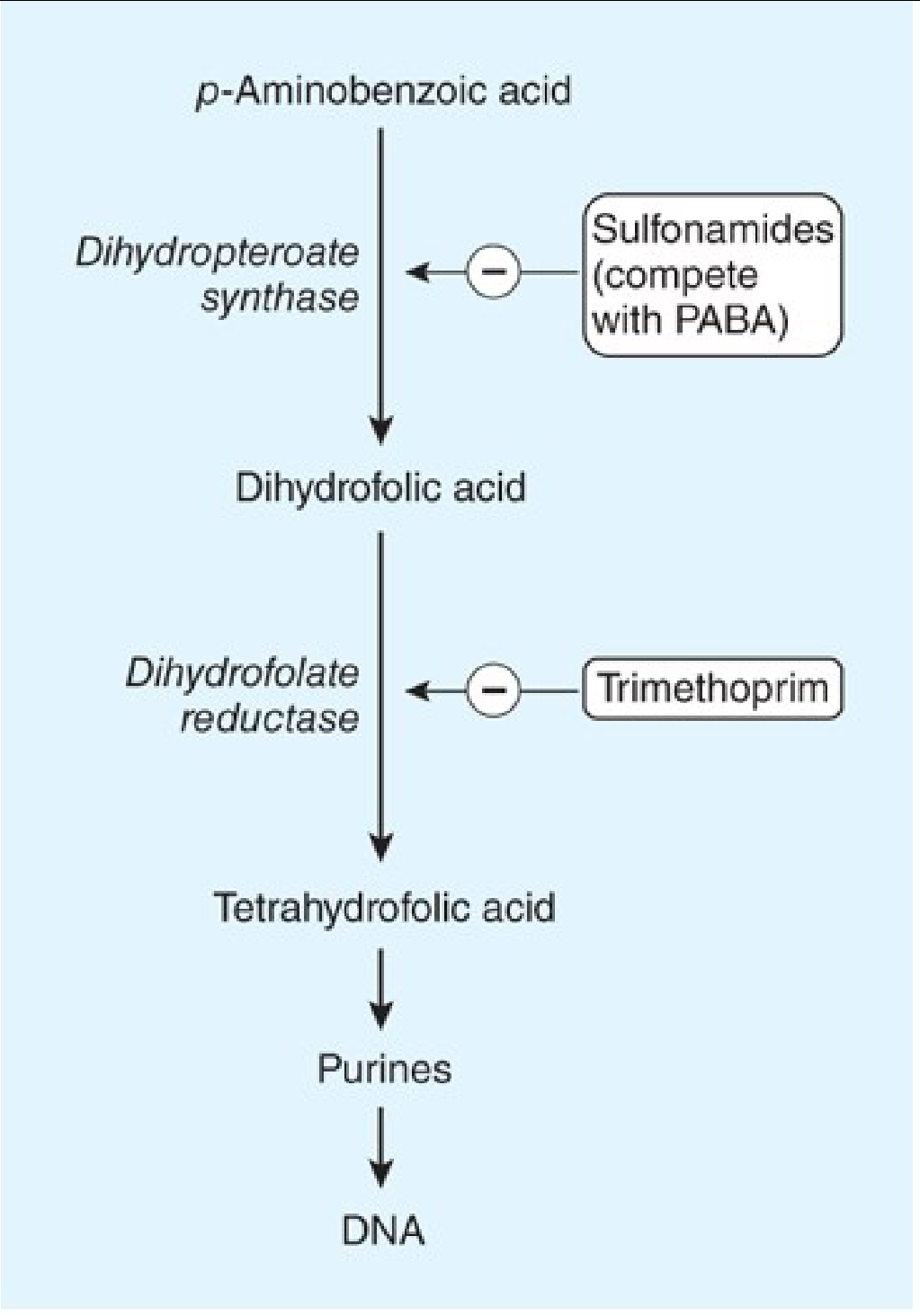
- Sulfonamides alone are usually bacteriostatic.
- With trimethoprim, which blocks the next enzyme, dihydrofolate reductase, they produce sequential folate-pathway blockade and synergistic antimicrobial action.
Katzung's Basic and Clinical Pharmacology, 16th ed., p. 1299.
Antibacterial spectrum
Activity can include susceptible:
- Enterobacteriaceae: E. coli, Klebsiella, Enterobacter
- Haemophilus influenzae
- Some Staphylococcus and Streptococcus
- Nocardia
- Chlamydia trachomatis
- Some protozoa
Poor or absent activity against:
- Pseudomonas aeruginosa: intrinsically resistant
- Anaerobes: poor activity
- Rickettsiae: may paradoxically have enhanced growth with sulfonamides
Katzung's Basic and Clinical Pharmacology, 16th ed., p. 1299.
Resistance
Resistance is widespread and usually cross-resistance applies within the sulfonamide class. Mechanisms:
- Increased bacterial PABA production
- Altered dihydropteroate synthase with reduced drug affinity, often plasmid-mediated
- Reduced permeability or increased efflux
- Bypass by using exogenous folate
Pharmacokinetics
- Most are well absorbed orally and widely distributed, including into CSF, placenta, and fetal tissues.
- They undergo hepatic acetylation/conjugation and are mainly excreted by the kidneys.
- Dose adjustment is needed in significant renal impairment.
- They are relatively less soluble in acidic urine. Acetylated metabolites may precipitate and cause crystalluria.
Katzung's Basic and Clinical Pharmacology, 16th ed., pp. 1299-1300.
Major clinical uses
| Drug or combination | Common use |
|---|---|
| TMP-SMX | Susceptible UTI, Pneumocystis jirovecii treatment/prophylaxis, nocardiosis, some community-acquired MRSA skin infections, selected GI infections |
| Sulfadiazine + pyrimethamine | Toxoplasmosis |
| Sulfadoxine + pyrimethamine | Malaria in selected settings |
| Silver sulfadiazine / mafenide | Topical management of burn wounds |
| Sulfasalazine | Inflammatory bowel disease and inflammatory arthritis, chiefly through its 5-aminosalicylate component |
| Sulfacetamide | Topical ophthalmic infections |
Do not use sulfonamides for group A streptococcal pharyngitis because they do not reliably eradicate the organism, as summarized in the Merck Manual review.
Adverse effects
Remember: “Sulfa = skin, sun, stones, suppression, serum bilirubin.”
- Hypersensitivity: rash, urticaria, fever, photosensitivity, vasculitis, serum sickness, Stevens-Johnson syndrome or toxic epidermal necrolysis
- Renal: crystalluria, hematuria, obstruction, interstitial nephritis
- Hematologic: hemolysis in G6PD deficiency, leukopenia, thrombocytopenia, agranulocytosis, aplastic anemia
- Neonatal kernicterus: displacement of bilirubin from albumin
- Hepatitis, GI upset, headache
- Can precipitate or worsen porphyria; rarely hypothyroidism or lupus-like phenomena
For crystalluria, ensure hydration; urinary alkalinization reduces precipitation risk. Lippincott Illustrated Reviews: Pharmacology, pp. 1032-1034.
Contraindications and precautions
Avoid or use only with specialist advice in:
- Previous serious sulfonamide hypersensitivity
- Pregnancy near term
- Infants younger than 2 months except specific specialist-directed situations
- Breastfeeding of premature, jaundiced, ill, or G6PD-deficient infants
- Severe renal or hepatic impairment
- G6PD deficiency
- Porphyria
Near-term fetal and neonatal exposure can raise unconjugated bilirubin and increase kernicterus risk, as outlined by the Merck Manual.
Key interactions
- Warfarin: sulfamethoxazole inhibits CYP2C9 and may substantially increase INR and bleeding risk.
- Phenytoin: increased phenytoin concentrations can occur.
- TMP-SMX adds trimethoprim-related risks: hyperkalemia, especially with ACE inhibitors, ARBs, spironolactone, or renal dysfunction; and increased methotrexate toxicity.
One-line exam summary
Sulfonamides are PABA analogues that competitively inhibit dihydropteroate synthase, producing bacteriostasis by blocking bacterial folate synthesis; resistance is common, and important toxicities include hypersensitivity, crystalluria, G6PD-related hemolysis, marrow suppression, and kernicterus.
This is a shared conversation. Sign in to Orris to start your own chat.