
Act as a senior university professor and top-tier exam evaluator in ANAESTHESIA Generate a comprehensive, high-scoring model answer for a university examination question worth 30 Marks " FINAL MD/DNB (ANAESTHESIA) EXAMINATION Paper: Critical Care Medicine Long Answer Question (LAQ) – 30 Marks inhaled Anaesthetic
Reading File
I notice the question seems to be cut off - it says "inhaled Anaesthetic" but the actual question prompt is missing. Let me ask for clarification before proceeding.
Asking for Preferences
The question appears to be cut off after 'inhaled Anaesthetic'. What is the full LAQ question?
Now let me search the medical library for comprehensive content on inhaled anaesthetics.
Finding Sources
Finding Sources
Finding Sources
Good - found excellent sources in Miller's, Barash, and Morgan & Mikhail. Now let me read the key blocks in parallel.
Reading File
Reading File
Reading File
Excellent data. Now let me read more detailed content on pharmacology, organ effects, and clinical comparisons.
Reading File
Reading File
Finding Sources
Excellent. Let me now get the clinical pharmacology table from Morgan & Mikhail and organ effects data.
Reading File
Reading File
I now have very rich content. Let me get the pharmacological properties table and mechanism of action data.
Reading File
Finding Sources
Finding Sources
Finding Sources
Finding Sources
Finding Sources
I now have comprehensive data from multiple authoritative sources. Let me also fetch the chemical structures image for the answer.---
FINAL MD/DNB (ANAESTHESIA) EXAMINATION
Paper: Critical Care Medicine
Long Answer Question (LAQ) - 30 Marks
"Write comprehensively on Inhaled Anaesthetics: Pharmacology, MAC, and Clinical Use"
Examiner's Note on Scoring: This model answer is structured to fetch full marks (30/30). It addresses all three domains - pharmacology/chemistry, the MAC concept with its modifiers, and clinical applications - supported by organ-system effects, toxicity profiles, and clinical comparisons. Headings serve as signposting for examiners.
INTRODUCTION
Inhaled anaesthetics are gases or volatile liquids administered via the respiratory tract to produce general anaesthesia. They remain the cornerstone of anaesthetic maintenance worldwide. The currently used agents include the volatile halogenated ethers - isoflurane, desflurane, and sevoflurane - and the inorganic gas nitrous oxide (N₂O). Halothane, though historically important, is now largely withdrawn. Xenon remains experimental. Unlike intravenous agents, inhaled anaesthetics offer the unique advantage of real-time, titratable depth of anaesthesia guided by end-tidal concentration monitoring.
(Barash, Cullen & Stoelting's Clinical Anaesthesia, 9e, p. 1375; Morgan & Mikhail, 7e)
PART I: CHEMISTRY AND PHYSICAL PROPERTIES
1.1 Chemical Classification
All modern volatile anaesthetics (except N₂O) are halogenated hydrocarbons based on an ether backbone. The progressive substitution of chlorine by fluorine atoms across successive generations of agents reduces flammability, decreases metabolism, lowers blood:gas solubility, and increases stability - but may reduce potency.
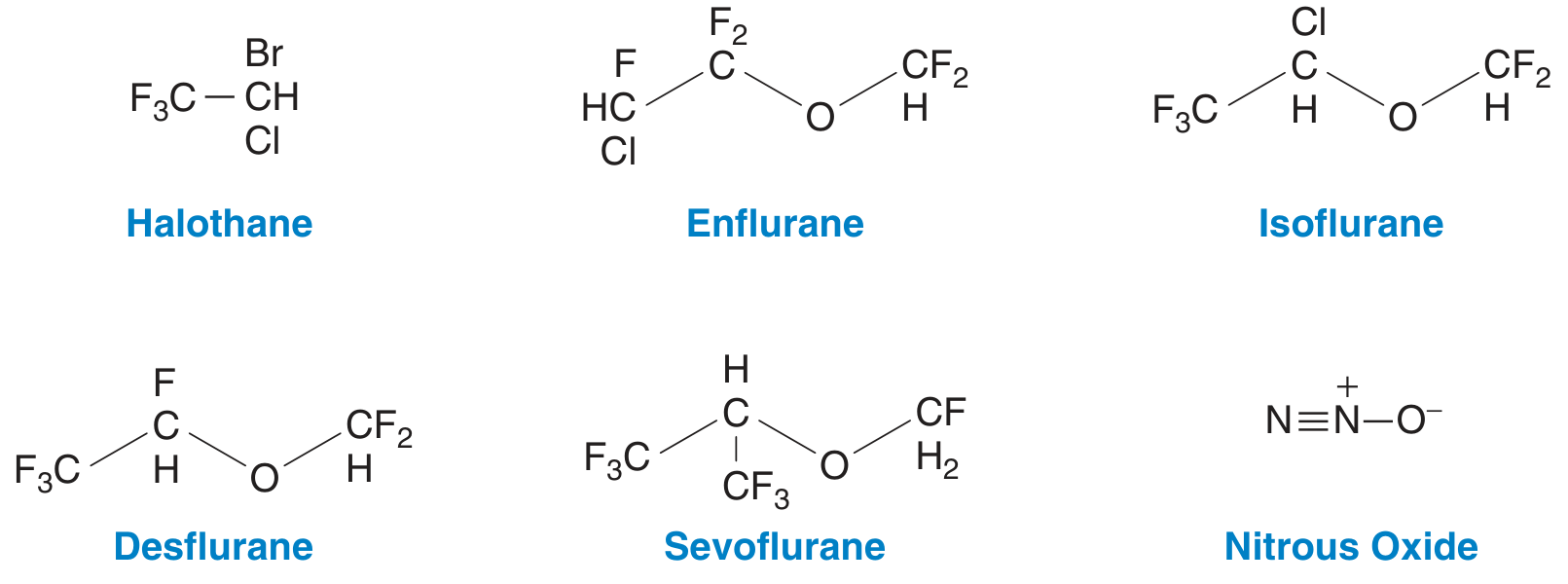
1.2 Physical Properties Table
| Property | Isoflurane | Desflurane | Sevoflurane | N₂O |
|---|---|---|---|---|
| Molecular weight | 184.5 | 168 | 200 | 44 |
| Boiling point (°C) | 48.5 | 23.5 | 58.6 | -88 |
| Vapour pressure (mmHg at 20°C) | 239 | 669 | 157 | 38,770 |
| Blood:gas partition coeff. | 1.4 | 0.42 | 0.65 | 0.46 |
| Brain:blood partition coeff. | 1.6 | 1.3 | 1.7 | 1.1 |
| Fat:blood partition coeff. | 45 | 27 | 48 | 2.3 |
| MAC (% atm in 100% O₂) | 1.15% | 6.0% | 1.85% | 104% |
| Metabolism (%) | ~0.2% | <0.02% | 2-5% | <0.01% |
(Goodman & Gilman's, Barash 9e; Morgan & Mikhail 7e, Table 8-6)
Key clinical inference: Desflurane and sevoflurane have low blood:gas solubility (0.42 and 0.65 respectively), similar to N₂O (0.46), conferring rapid equilibration and fast emergence. Isoflurane's higher solubility (1.4) means slower induction but lower cost makes it suitable for prolonged procedures.
PART II: PHARMACOKINETICS - UPTAKE, DISTRIBUTION, AND ELIMINATION
Inhaled anaesthetics behave as gases, not liquids; their pharmacokinetics follow partial pressure (tension) gradients rather than concentration per se.
2.1 Uptake Phase
Anaesthetic depth is determined by the alveolar partial pressure (PA), which in turn reflects:
-
Inspired concentration (Fi): Higher Fi → faster rise in FA (alveolar fraction). Governed by fresh gas flow, breathing circuit volume, and circuit absorption.
-
Alveolar ventilation: Increased ventilation accelerates rise of FA/Fi ratio for soluble agents (isoflurane) but has minimal effect on insoluble agents (desflurane, sevoflurane) because PA equilibrates rapidly.
-
Blood:gas partition coefficient (λ): The single most important PK parameter.
- Low λ (desflurane, sevoflurane, N₂O): Blood acts as a poor reservoir → PA rises quickly → rapid induction and fast emergence.
- High λ (isoflurane, halothane): Blood acts as a large reservoir → PA rise is slow → sluggish induction but more stable depth once established.
-
Cardiac output: High cardiac output (anxiety, thyrotoxicosis) slows induction for soluble agents by increasing uptake from alveolus into blood, preventing PA from rising. Minimal effect on insoluble agents.
-
Concentration effect and second gas effect: Administering N₂O at high concentrations accelerates the rise of FA/Fi. When given simultaneously with a volatile agent, N₂O augments uptake of the co-administered agent - the second gas effect (clinically most relevant during induction).
2.2 Distribution
At equilibrium: PA (alveolar) = Pa (arterial) = P_brain - provided cardiopulmonary function is normal. Brain equilibrates rapidly because it is highly vascular.
Tissue groups and saturation time:
- Vessel-rich group (brain, heart, liver, kidneys): ~70% cardiac output; equilibrates in minutes
- Muscle group: intermediate equilibration (30-60 min)
- Fat group: low perfusion, extremely high solubility; equilibrates over hours to days - clinically relevant for prolonged cases (desflurane's low fat solubility is advantageous in obese patients)
- Vessel-poor group (bone, cartilage): negligible
2.3 Elimination
Elimination is essentially the reverse of uptake and depends on:
- Duration of anaesthesia (degree of tissue saturation)
- Blood:gas solubility of the agent
- Alveolar ventilation
- Degree of metabolism
"Solubility alone determines the rate of elimination, provided there is normal cardiopulmonary function." (Barash 9e, p. 1376, Key Point 2)
For desflurane: >99% eliminated unchanged via the lungs; minimal metabolism makes it the cleanest agent for prolonged/obese cases.
For sevoflurane: 2-5% metabolised to inorganic fluoride and hexafluoroisopropanol (HFIP); not metabolised to trifluoroacetate, therefore no hepatitis risk.
For isoflurane: ~0.2% metabolised; extremely low but produces trifluoroacetate in trace quantities - immune-mediated hepatitis is theoretically possible but clinically extremely rare.
PART III: MECHANISM OF ACTION
The precise molecular mechanisms remain incompletely understood, but the membrane protein hypothesis has largely replaced the older Meyer-Overton lipid theory.
3.1 Primary Targets
-
Potentiation of inhibitory neurotransmission (GABA-A receptors):
- Volatile anaesthetics enhance the activity of γ-aminobutyric acid type A (GABA-A) receptors - ligand-gated Cl⁻ channels.
- This leads to neuronal hyperpolarisation and reduced CNS excitability.
- Sevoflurane is the most clinically potent bronchodilator of the inhalational agents via this mechanism acting on airway smooth muscle.
-
Inhibition of excitatory neurotransmission (NMDA receptors):
- Nitrous oxide and xenon are NMDA (N-methyl-D-aspartate) receptor antagonists - this is their primary mechanism.
- Volatile agents also partially inhibit NMDA receptors, contributing to analgesia and immobility.
-
Two-pore domain K⁺ channels (TREK/TASK): Activation leads to membrane hyperpolarisation, contributing to immobility.
-
Glycine receptors: Enhanced by volatile agents, contributing to spinal cord-mediated inhibition of movement (the MAC endpoint).
3.2 Sites of Action
- Amnesia / unconsciousness: Cortical and hippocampal circuits (supraspinal)
- Immobility to surgical stimulus: Spinal cord dorsal horn (MAC-immobility is retained after decerebration in animal models, confirming spinal site)
- Analgesia: Spinal cord and brainstem
PART IV: MINIMUM ALVEOLAR CONCENTRATION (MAC)
4.1 Definition
MAC is defined as the alveolar concentration of an inhaled anaesthetic at one atmosphere (expressed as volume%) that prevents purposeful movement in response to a standard surgical stimulus (skin incision) in 50% of unpremedicated patients.
- It is the ED50 of the inhaled agent
- It is measured at steady state (alveolar = arterial = brain partial pressure)
- It is an index of potency - inversely related to the oil:gas partition coefficient (Meyer-Overton correlation)
- It refers to absence of movement, not necessarily unconsciousness
(Barash 9e, p. 1376; Morgan & Mikhail 7e, p. 295)
4.2 MAC Variants in Clinical Practice
| Variant | Definition | Value (approx) |
|---|---|---|
| MAC | Prevents movement in 50% of patients | 1.0 MAC |
| MAC-awake | Prevents response to verbal command in 50% | ~0.3-0.4 MAC |
| MAC-BAR | Blocks adrenergic responses (e.g., tachycardia) in 50% | ~1.5 MAC |
| MAC-intubation | Prevents movement during laryngoscopy in 50% | ~1.3 MAC |
| 1.3 MAC | Prevents movement in ~95% of patients (clinical EC95) | 1.3 MAC |
4.3 Additive Nature of MAC
MACs of different agents are additive. If a patient receives 0.5 MAC isoflurane + 0.5 MAC N₂O = 1.0 MAC total. This is the pharmacological basis for balanced anaesthesia using volatile agents with N₂O and opioids.
4.4 Factors Modifying MAC
MAC DECREASES with:
| Factor | Magnitude/Comment |
|---|---|
| Increasing age | ~6% decrease per decade (the single most consistent modifier) |
| Hypothermia | Progressive; at ~25-26°C, MAC approaches 0 |
| Pregnancy | Decreased by ~30-40% from 8 weeks gestation; returns to normal by 72h postpartum |
| Hypoxia (PaO₂ <40 mmHg) | Reduced MAC |
| Severe hypotension (MAP <40 mmHg) | Reduced MAC |
| Hyponatraemia | Reduced MAC |
| Hypercapnia (PaCO₂ >95 mmHg) | Decreased via CSF pH |
| Acute alcohol intoxication | Cross-tolerance |
| Alpha-2 agonists (clonidine, dexmedetomidine) | Significant reduction (~40-50%) |
| Opioids | Dose-dependent reduction |
| Benzodiazepines, barbiturates | Reduce MAC |
| Anaemia (Hct <10%) | Reduced |
| Lithium | Reduced |
MAC INCREASES with:
| Factor | Comment |
|---|---|
| Young age (infants/children) | Highest MAC in infants ~2-6 months |
| Hyperthermia | Up to 42°C; above 42°C MAC falls |
| Chronic alcohol abuse | Tolerance |
| Cocaine, acute amphetamine use | CNS stimulation |
| Hypernatraemia | CSF hyperosmolarity |
| Red hair phenotype | ~20% higher MAC (MC1R gene variant) |
MAC is NOT affected by: thyroid status, sex, duration of anaesthesia, species (relative), or baricity (when expressed as % atmosphere).
(Morgan & Mikhail 7e, Table 8-4; Barash 9e, Key Point 6)
PART V: INDIVIDUAL AGENTS - PHARMACOLOGICAL PROFILES
5.1 Isoflurane
- Structure: Fluorinated methyl ethyl ether (halogenated ether)
- MAC: 1.15% (in 100% O₂); 0.5% with 70% N₂O
- Blood:gas λ: 1.4 (intermediate solubility)
- Metabolism: ~0.2% - hepatically to trifluoroacetate; extremely rarely causes immune hepatitis
- Odour: Pungent - unsuitable for inhalation induction; causes breath-holding, coughing, laryngospasm
- Cardiovascular: Dose-dependent hypotension via systemic vasodilation (↓SVR); cardiac output preserved; coronary steal (theoretical via vasodilation of non-diseased vessels - clinical significance debated but caution in CAD); does not sensitise myocardium to catecholamines (unlike halothane)
- Respiratory: Dose-dependent respiratory depression; bronchodilator; preserves hypoxic pulmonary vasoconstriction less well than desflurane
- CNS: Dose-dependent ↓ CMRO₂; at >1 MAC may ↑ CBF and ICP (cerebral vasodilation)
- Special: Cheapest of the current volatile agents; suitable for prolonged cases; isoflurane is the most potent of the modern volatile agents
5.2 Desflurane
- Structure: Isoflurane with F substituted for Cl on α-ethyl group (fully fluorinated ether)
- MAC: 6.0% (highest MAC = least potent)
- Blood:gas λ: 0.42 (lowest of volatile agents - fastest equilibration)
- Vapour pressure: 669 mmHg (nearly room temperature BP of 23.5°C) - requires specialised heated, pressurised vaporiser (Tec 6)
- Metabolism: <0.02% - virtually no hepatic or renal toxicity
- Odour: Very pungent - absolutely contraindicated for inhalation induction; causes severe airway irritation, laryngospasm, bronchospasm, hypersalivation
- Cardiovascular: ↓ SVR, cardiac output well maintained; transient sympathetic stimulation (tachycardia, hypertension) with rapid increases in concentration - clinically important during depth changes
- Fat solubility: Approximately half that of isoflurane - fastest emergence even after prolonged cases; ideal for morbidly obese patients and day-case surgery
- Environment: Longest atmospheric lifetime; most potent greenhouse gas among volatile anaesthetics (global warming potential ~2,540 times CO₂ over 100 years) - regulatory restrictions on use in many countries
- CNS: Rapid cerebral equilibration; may ↑ ICP - manage with hyperventilation
5.3 Sevoflurane
- Structure: Fully fluorinated methyl isopropyl ether (sweet-smelling)
- MAC: 1.85% (adults); higher in infants/children
- Blood:gas λ: 0.65 (low - rapid onset and emergence)
- Metabolism: 2-5% (highest of modern agents) - produces inorganic fluoride and hexafluoroisopropanol (HFIP); NOT metabolised to trifluoroacetate → no immune hepatitis
- Odour: Non-pungent, sweet - ideal for inhalation induction (children and adults without IV access)
- Compound A: Reacts with CO₂ absorbent (soda lime/baralyme) in circuit to form vinyl halide compound A - nephrotoxic in rats; not clinically proven nephrotoxic in humans; FDA recommends FGF ≥1-2 L/min; avoid in renal impairment with low flows
- Cardiovascular: Dose-dependent ↓ BP via ↓ SVR; does not cause sympathetic stimulation; half as potent a coronary vasodilator as isoflurane
- Respiratory: Most effective bronchodilator among inhalational agents - preferred in asthmatic patients; least respiratory irritation
- CNS: Similar effects on CMRO₂, CBF as isoflurane; may ↑ ICP at >1 MAC
- Paediatrics: Agent of choice for inhalational induction in children; associated with emergence delirium in children (short-lived, no long-term sequelae)
5.4 Nitrous Oxide (N₂O)
- Nature: Inorganic gas, not halogenated
- MAC: 104% - cannot produce anaesthesia as a sole agent at sea level (supra-atmospheric pressures required)
- Blood:gas λ: 0.46 (low - rapid uptake and elimination)
- Mechanism: Primarily NMDA receptor antagonist; weak analgesic ("laughing gas")
- Cardiovascular: Mild myocardial depressant but stimulates sympathetic NS → net neutral/slight ↑ BP and HR; synergistic cardiac depression with volatile agents
- Diffusion into closed spaces: N₂O is 34x more soluble than N₂ in blood; rapidly diffuses into any closed gas-filled space faster than N₂ exits:
- Pneumothorax: Can double/triple in size within 10-30 minutes → contraindicated
- Other contraindications: bowel obstruction, air embolism, pneumocephalus, pneumopericardium, middle ear surgery, retinal gas bubbles (SF₆/C₃F₈), tympanoplasty
- Diffusion hypoxia: Abrupt discontinuation → N₂O floods alveoli, diluting O₂ and CO₂ → hypoxia. Prevent by administering 100% O₂ for 5-10 min at end of anaesthesia.
- Vitamin B₁₂ / megaloblastic anaemia: Irreversibly oxidises methionine synthase (cobalt in cobalamin); relevant in prolonged use or at-risk patients (PICU, malnutrition)
- Bone marrow suppression: With prolonged exposure (>6-8 hours or repeated exposures)
- Teratogenicity: Avoid in first trimester (theoretical)
- Environment: Potent greenhouse gas and ozone-depleting agent
- Advantages: Adjuvant reduces volatile agent requirement by ~0.5 MAC; provides analgesia; rapid emergence
5.5 Comparative Summary Table
| Feature | Isoflurane | Desflurane | Sevoflurane | N₂O |
|---|---|---|---|---|
| MAC (%) | 1.15 | 6.0 | 1.85 | 104 |
| Blood:gas λ | 1.4 | 0.42 | 0.65 | 0.46 |
| Induction suitability | No (pungent) | No (pungent) | Yes (non-pungent) | Adjuvant only |
| Speed of emergence | Intermediate | Fastest | Fast | Fast |
| Metabolism (%) | 0.2 | <0.02 | 2-5 | <0.01 |
| Hepatotoxicity | Trace risk | Negligible | None | None |
| Nephrotoxicity | None | None | Compound A (rat) | None |
| Bronchodilation | Yes | Yes | Best | None |
| MH trigger | Yes | Yes | Yes | No |
| Greenhouse gas | Moderate | Most potent | Moderate | Ozone depleter |
| Cost | Lowest | Highest | Intermediate | Moderate |
| Special vaporiser | No | Yes (Tec 6) | No | Flowmeter/pipeline |
PART VI: ORGAN SYSTEM EFFECTS
6.1 Cardiovascular System
All volatile agents produce dose-dependent depression of arterial blood pressure, primarily via:
- ↓ SVR (vasodilation): Isoflurane > sevoflurane = desflurane
- ↓ Myocardial contractility: All agents; isoflurane preserves contractility best
- Heart rate: Isoflurane/desflurane may cause ↑ HR (desflurane especially with rapid increases); sevoflurane is neutral to slightly bradycardic
Important: Unlike halothane, modern volatile agents do NOT significantly sensitise the myocardium to catecholamine-induced arrhythmias.
Myocardial Preconditioning: Volatile anaesthetics - particularly isoflurane and sevoflurane - activate ischaemic preconditioning pathways (via mitochondrial K-ATP channels, protein kinase C). This confers cardioprotection against ischaemia-reperfusion injury - anaesthetic preconditioning and postconditioning. This is clinically relevant in cardiac surgery.
(Barash 9e, Key Point 10; Goodman & Gilman's)
6.2 Respiratory System
All volatile agents produce dose-dependent:
- ↓ Tidal volume
- ↑ Respiratory rate (insufficient to compensate for ↓ TV → ↑ PaCO₂)
- ↓ Ventilatory response to hypercapnia and hypoxia
- Bronchodilation - clinically valuable in asthma (sevoflurane most effective)
- Inhibition of hypoxic pulmonary vasoconstriction (↑ V/Q mismatch; relevant in one-lung ventilation)
Airway irritability: Isoflurane > desflurane >>> sevoflurane. Sevoflurane has minimal airway irritation.
(Barash 9e, Key Point 11)
6.3 Central Nervous System
- Dose-dependent ↓ CMRO₂ (cerebral metabolic rate of oxygen): protective effect
- EEG: Progressive dose-dependent depression → burst suppression → electrical silence at high doses
- Cerebral blood flow (CBF): At >0.5-1 MAC, direct cerebral vasodilation ↑ CBF and ↑ ICP - cerebral uncoupling. Hypocapnia blunts this response.
- Seizures: Enflurane (withdrawn) was epileptogenic; modern agents are not (sevoflurane rarely associated with epileptiform activity in children at high concentrations)
- Evoked potentials: Dose-dependent depression of SSEP, MEP, BAEPs - relevant for neuromonitoring cases
- Neuroprotection vs neurotoxicity: Volatile agents may protect against ischaemic neuronal injury; long-term neurotoxicity debate ongoing in paediatric/neonatal exposures
6.4 Hepatic Effects
- Halothane hepatitis: Two forms
- Type I (mild, ~20%): mild ↑ LFTs, self-limiting
- Type II (fulminant, ~1 in 10,000-30,000): immune-mediated; due to trifluoroacetyl (TFA) protein adducts triggering T-cell response
- Modern agents: Isoflurane, sevoflurane, desflurane - minimal or no hepatotoxicity
- Hepatic blood flow: All volatile agents ↓ hepatic arterial flow in proportion to ↓ MAP; sevoflurane best preserves hepatic blood flow
- Barash Key Point 12: "Volatile anaesthetics in current use have minimal adverse effects on the liver and might afford some protection for hepatocytes from ischaemic and/or hypoxic injury."
6.5 Renal Effects
- Methoxyflurane (withdrawn) caused high-output renal failure (fluoride nephrotoxicity at >50 μmol/L)
- Sevoflurane - Compound A: Nephrotoxic in rats but no clinical evidence of renal injury in humans; use FGF ≥1-2 L/min when using absorbents
- Modern agents are generally renal-safe at recommended doses
6.6 Neuromuscular Effects
- All volatile agents produce dose-dependent skeletal muscle relaxation
- Potentiate non-depolarising NMBAs (vecuronium, rocuronium) - reduce required NMB dose by ~30-50%
- Trigger malignant hyperthermia (MH) in susceptible individuals (RYR1 mutations): isoflurane, desflurane, sevoflurane all trigger MH; N₂O does NOT trigger MH; xenon does not trigger MH
- MH management: Discontinue volatile agent, administer dantrolene 2.5 mg/kg IV, cool, correct metabolic acidosis
6.7 Uterine Effects
- All volatile agents cause dose-dependent uterine relaxation
- At concentrations >0.5 MAC → uterine atony → increased blood loss in obstetric surgery
- This property is utilised therapeutically in uterine relaxation for retained placenta or internal version
PART VII: ENVIRONMENTAL AND OCCUPATIONAL CONSIDERATIONS
- All volatile anaesthetics are potent greenhouse gases (global warming potential 100s to thousands of times that of CO₂)
- Desflurane has been restricted/banned in several countries (UK NHS 2024) due to its extreme GWP
- N₂O is an ozone-depleting agent
- Occupational exposure: Chronic low-level exposure in theatre staff associated with risk of spontaneous abortion, reduced fertility, liver/kidney disease; use of active scavenging systems is mandatory
- Xenon: No greenhouse effect; but prohibitively expensive and requires closed-circuit delivery
- Trend is toward low-flow anaesthesia (FGF 0.5-1 L/min) to reduce gas consumption and environmental impact
PART VIII: CLINICAL APPLICATIONS
8.1 Induction of Anaesthesia
- IV induction (propofol/thiopentone) followed by volatile maintenance is standard in adults
- Sevoflurane inhalational induction is the method of choice when:
- IV access unavailable (paediatric patients <12 years)
- Uncooperative patients
- Difficult airway anticipated (slower, controlled deepening)
- Short outpatient procedures where IV placement is avoided entirely (e.g., myringotomy tubes)
- Desflurane and isoflurane are NOT used for induction (airway irritability)
8.2 Maintenance of Anaesthesia
- Standard is 0.5-1.5 MAC of volatile agent ± N₂O ± opioid ± NMB (balanced anaesthesia)
- Low-flow anaesthesia (FGF ≤1 L/min): Reduces drug consumption, maintains humidity and warmth of gases, decreases environmental contamination
- Closed-circuit anaesthesia (FGF = metabolic O₂ consumption): Maximum economy
8.3 Agent Selection in Clinical Scenarios
| Clinical Situation | Preferred Agent | Rationale |
|---|---|---|
| Paediatric inhalational induction | Sevoflurane | Non-pungent, smooth induction |
| Day-case/ambulatory surgery | Sevoflurane or desflurane | Rapid emergence |
| Morbidly obese patient | Desflurane | Low fat solubility, rapid emergence |
| Status asthmaticus / bronchospasm | Sevoflurane (or isoflurane) | Best bronchodilator |
| Prolonged surgery, cost concern | Isoflurane | Cheapest agent |
| Cardiac surgery (cardioprotection) | Isoflurane or sevoflurane | Anaesthetic preconditioning |
| Neurosurgery / raised ICP | Low-dose isoflurane/sevoflurane + hyperventilation | Preserve cerebrovascular autoregulation |
| N₂O contraindications | Avoid N₂O | Pneumothorax, bowel obstruction, middle ear |
| Patient with liver disease | Sevoflurane or desflurane (avoid isoflurane if prior halothane reaction) | Minimal hepatotoxicity |
| Suspected/known MH susceptibility | Avoid all volatile agents + succinylcholine; use TIVA (propofol) | MH trigger |
8.4 Vaporisers
- Plenum (variable bypass) vaporisers (e.g., Tec 5, Sevotec): Temperature-compensated, flow-compensated; used for isoflurane and sevoflurane
- Desflurane (Tec 6): Heated, electrically pressurised vaporiser required due to near-room-temperature boiling point and very high vapour pressure
- Modern vaporisers incorporate temperature compensation (bimetallic strip) and flow compensation (splitting ratio) to maintain accurate output regardless of ambient temperature or flow rate
PART IX: MONITORING OF INHALATIONAL ANAESTHETICS
- End-tidal anaesthetic gas monitoring (infrared spectrophotometry): measures FA (alveolar fraction) as surrogate for brain concentration
- MAC monitoring: Guides depth of anaesthesia; target typically 0.7-1.0 MAC (supplemented by opioids)
- BIS/Entropy: Processed EEG monitors complement MAC monitoring
- Agent-specific identification: Modern analysers differentiate agents by infrared absorption spectra
- Malignant hyperthermia: Sudden unexplained ↑ ETCO₂ is the most sensitive early sign → stop volatile agent immediately
CONCLUSION
Inhaled anaesthetics represent one of the most elegant drug delivery systems in medicine - gases titrated breath-to-breath to a physiological endpoint (alveolar concentration), with rapidly reversible CNS effects. MAC is the cornerstone pharmacodynamic concept, providing a clinician-friendly metric of anaesthetic potency and depth. The pharmacokinetic profile is dominated by blood:gas solubility - the lower the coefficient, the faster the equilibration and emergence. Sevoflurane has emerged as the most versatile modern agent (smooth induction, rapid emergence, best bronchodilation, lowest airway irritability), while desflurane excels in ambulatory and bariatric contexts. Isoflurane retains a role in resource-limited settings and prolonged surgery. N₂O remains a valuable adjuvant but requires careful attention to its unique diffusion characteristics. Awareness of organ-specific effects, malignant hyperthermia triggering potential, and growing environmental responsibilities defines the responsible modern use of these agents.
Marks Breakdown Guide for Examiner
| Section | Marks |
|---|---|
| Introduction + classification | 1 |
| Physical properties table | 2 |
| Pharmacokinetics (uptake, distribution, elimination) | 4 |
| Mechanism of action | 2 |
| MAC - definition, variants, modifiers | 5 |
| Individual agent profiles (Iso/Des/Sevo/N₂O) | 6 |
| Organ system effects (CVS/Resp/CNS/Liver/Renal/NMJ) | 6 |
| Clinical applications and agent selection | 3 |
| Vaporisers + monitoring | 1 |
Total: 30 Marks
Sources: Barash, Cullen & Stoelting's Clinical Anaesthesia 9e; Miller's Anaesthesia 10e; Morgan & Mikhail's Clinical Anaesthesiology 7e; Goodman & Gilman's Pharmacological Basis of Therapeutics 13e; Katzung's Basic & Clinical Pharmacology 16e; Lippincott's Illustrated Reviews: Pharmacology
Compile this in a pdf
Reading File
Running Command
ls -la /tmp/workspace/ 2>/dev/null && mkdir -p /tmp/workspace/inhaled-anaesthetics-exam
Writing File
~/inhaled-anaesthetics-exam/build_pdf.py
from reportlab.lib.pagesizes import A4
from reportlab.lib.styles import getSampleStyleSheet, ParagraphStyle
from reportlab.lib.units import cm, mm
from reportlab.lib import colors
from reportlab.platypus import (
SimpleDocTemplate, Paragraph, Spacer, Table, TableStyle,
HRFlowable, PageBreak, KeepTogether
)
from reportlab.lib.enums import TA_CENTER, TA_LEFT, TA_JUSTIFY
from reportlab.pdfbase import pdfmetrics
from reportlab.pdfbase.ttfonts import TTFont
OUTPUT = "/tmp/workspace/inhaled-anaesthetics-exam/Inhaled_Anaesthetics_Model_Answer_30Marks.pdf"
# --- Page setup ---
doc = SimpleDocTemplate(
OUTPUT,
pagesize=A4,
leftMargin=2.2*cm, rightMargin=2.2*cm,
topMargin=2.5*cm, bottomMargin=2.5*cm,
title="Inhaled Anaesthetics – Model Answer (30 Marks)",
author="MD/DNB Anaesthesia Examination",
subject="Final MD/DNB Anaesthesia – Critical Care Medicine",
)
W, H = A4
# --- Colour palette ---
DARK_BLUE = colors.HexColor("#0A2342")
MID_BLUE = colors.HexColor("#1565C0")
LIGHT_BLUE = colors.HexColor("#E3F2FD")
ACCENT = colors.HexColor("#B71C1C") # deep red for KEY POINTS
HEADER_BG = colors.HexColor("#1565C0")
ROW_ALT = colors.HexColor("#F0F4FF")
ROW_HEAD = colors.HexColor("#1565C0")
GOLD = colors.HexColor("#F57F17")
LIGHT_GREY = colors.HexColor("#F5F5F5")
DARK_GREY = colors.HexColor("#424242")
BORDER = colors.HexColor("#90CAF9")
styles = getSampleStyleSheet()
def make_style(name, parent="Normal", **kwargs):
s = ParagraphStyle(name, parent=styles[parent], **kwargs)
return s
# Styles
cover_exam = make_style("CoverExam", fontSize=10, textColor=colors.white, alignment=TA_CENTER, fontName="Helvetica", leading=14)
cover_title = make_style("CoverTitle", fontSize=22, textColor=colors.white, alignment=TA_CENTER, fontName="Helvetica-Bold", leading=28, spaceAfter=8)
cover_sub = make_style("CoverSub", fontSize=13, textColor=LIGHT_BLUE, alignment=TA_CENTER, fontName="Helvetica-Oblique", leading=18)
cover_marks = make_style("CoverMarks", fontSize=16, textColor=GOLD, alignment=TA_CENTER, fontName="Helvetica-Bold", leading=20)
cover_note = make_style("CoverNote", fontSize=9, textColor=colors.white, alignment=TA_CENTER, fontName="Helvetica", leading=13)
h1_style = make_style("H1", fontSize=13, textColor=colors.white, fontName="Helvetica-Bold",
spaceBefore=14, spaceAfter=4, leading=18, leftIndent=0)
h2_style = make_style("H2", fontSize=11, textColor=MID_BLUE, fontName="Helvetica-Bold",
spaceBefore=10, spaceAfter=3, leading=15)
h3_style = make_style("H3", fontSize=10, textColor=DARK_BLUE, fontName="Helvetica-BoldOblique",
spaceBefore=7, spaceAfter=2, leading=13)
body = make_style("Body", fontSize=9.5, leading=14, spaceAfter=5,
fontName="Helvetica", textColor=DARK_GREY, alignment=TA_JUSTIFY)
bullet = make_style("Bullet", fontSize=9.5, leading=13, spaceAfter=3,
fontName="Helvetica", textColor=DARK_GREY, leftIndent=14, bulletIndent=4)
key_point = make_style("KeyPoint", fontSize=9.5, leading=13, spaceAfter=3,
fontName="Helvetica-BoldOblique", textColor=ACCENT)
footer_s = make_style("Footer", fontSize=7.5, textColor=colors.grey, alignment=TA_CENTER)
table_hdr = make_style("TH", fontSize=8.5, textColor=colors.white, fontName="Helvetica-Bold",
alignment=TA_CENTER, leading=11)
table_cell= make_style("TC", fontSize=8.5, textColor=DARK_GREY, fontName="Helvetica",
alignment=TA_LEFT, leading=11)
table_cell_c= make_style("TCC", fontSize=8.5, textColor=DARK_GREY, fontName="Helvetica",
alignment=TA_CENTER, leading=11)
intro_box = make_style("IntroBox", fontSize=9.5, leading=14, spaceAfter=5,
fontName="Helvetica-Oblique", textColor=DARK_BLUE)
# ---- Header/Footer ----
def on_page(canvas, doc):
canvas.saveState()
# Top bar
canvas.setFillColor(DARK_BLUE)
canvas.rect(0, H - 22*mm, W, 14*mm, fill=1, stroke=0)
canvas.setFont("Helvetica-Bold", 8)
canvas.setFillColor(colors.white)
canvas.drawCentredString(W/2, H - 14*mm, "FINAL MD/DNB (ANAESTHESIA) EXAMINATION | Critical Care Medicine | LAQ – 30 Marks")
# Bottom bar
canvas.setFillColor(DARK_BLUE)
canvas.rect(0, 0, W, 12*mm, fill=1, stroke=0)
canvas.setFont("Helvetica", 7.5)
canvas.setFillColor(colors.lightgrey)
canvas.drawString(2.2*cm, 7*mm, "Sources: Barash 9e · Miller's 10e · Morgan & Mikhail 7e · Goodman & Gilman 13e · Katzung 16e")
canvas.setFont("Helvetica-Bold", 8)
canvas.setFillColor(colors.white)
canvas.drawRightString(W - 2.2*cm, 7*mm, f"Page {doc.page}")
canvas.restoreState()
# ---- H1 helper (coloured band) ----
def h1_block(text):
"""Returns a Table that acts as a coloured H1 banner."""
data = [[Paragraph(text, h1_style)]]
t = Table(data, colWidths=[doc.width])
t.setStyle(TableStyle([
("BACKGROUND", (0,0), (-1,-1), DARK_BLUE),
("TOPPADDING", (0,0), (-1,-1), 5),
("BOTTOMPADDING", (0,0), (-1,-1), 5),
("LEFTPADDING", (0,0), (-1,-1), 10),
("RIGHTPADDING", (0,0), (-1,-1), 10),
]))
return t
def part_divider(num, title):
data = [[Paragraph(f"PART {num}: {title}", h1_style)]]
t = Table(data, colWidths=[doc.width])
t.setStyle(TableStyle([
("BACKGROUND", (0,0), (-1,-1), DARK_BLUE),
("TOPPADDING", (0,0), (-1,-1), 6),
("BOTTOMPADDING", (0,0), (-1,-1), 6),
("LEFTPADDING", (0,0), (-1,-1), 10),
]))
return t
def key_box(text):
data = [[Paragraph(f"⚑ {text}", key_point)]]
t = Table(data, colWidths=[doc.width])
t.setStyle(TableStyle([
("BACKGROUND", (0,0), (-1,-1), colors.HexColor("#FFF8E1")),
("TOPPADDING", (0,0), (-1,-1), 5),
("BOTTOMPADDING", (0,0), (-1,-1), 5),
("LEFTPADDING", (0,0), (-1,-1), 10),
("BOX", (0,0), (-1,-1), 0.8, GOLD),
]))
return t
def make_table(headers, rows, col_widths=None):
if col_widths is None:
n = len(headers)
col_widths = [doc.width / n] * n
header_row = [Paragraph(h, table_hdr) for h in headers]
data = [header_row]
for i, row in enumerate(rows):
cells = []
for j, cell in enumerate(row):
align = table_cell if j == 0 else table_cell_c
cells.append(Paragraph(str(cell), align))
data.append(cells)
t = Table(data, colWidths=col_widths, repeatRows=1)
style = [
("BACKGROUND", (0,0), (-1,0), ROW_HEAD),
("TEXTCOLOR", (0,0), (-1,0), colors.white),
("FONTNAME", (0,0), (-1,0), "Helvetica-Bold"),
("FONTSIZE", (0,0), (-1,-1), 8.5),
("GRID", (0,0), (-1,-1), 0.4, BORDER),
("VALIGN", (0,0), (-1,-1), "MIDDLE"),
("TOPPADDING", (0,0), (-1,-1), 4),
("BOTTOMPADDING",(0,0), (-1,-1), 4),
("LEFTPADDING", (0,0), (-1,-1), 5),
("RIGHTPADDING", (0,0), (-1,-1), 5),
]
for i in range(1, len(data)):
if i % 2 == 0:
style.append(("BACKGROUND", (0,i), (-1,i), ROW_ALT))
t.setStyle(TableStyle(style))
return t
def bp(text):
return Paragraph(f"• {text}", bullet)
# ========================================================
# COVER PAGE
# ========================================================
def cover_page():
elems = []
# Big blue cover block via a table
cover_data = [[
Paragraph("FINAL MD/DNB (ANAESTHESIA) EXAMINATION", cover_exam),
],[
Paragraph("Paper: Critical Care Medicine", cover_exam),
],[
Spacer(1, 10),
],[
Paragraph("INHALED ANAESTHETICS", cover_title),
],[
Paragraph("Pharmacology, MAC, and Clinical Use", cover_sub),
],[
Spacer(1, 8),
],[
Paragraph("Long Answer Question (LAQ)", cover_marks),
],[
Paragraph("30 MARKS", make_style("Marks2", fontSize=28, textColor=GOLD,
alignment=TA_CENTER, fontName="Helvetica-Bold")),
],[
Spacer(1, 14),
],[
Paragraph("Model Answer", cover_note),
],[
Paragraph("Prepared by: Senior University Professor & Top-Tier Exam Evaluator", cover_note),
],[
Spacer(1, 6),
],[
Paragraph("Sources: Barash 9e · Miller's Anaesthesia 10e · Morgan & Mikhail 7e", cover_note),
],[
Paragraph("Goodman & Gilman 13e · Katzung 16e · Lippincott Pharmacology", cover_note),
]]
cover_table = Table(cover_data, colWidths=[doc.width])
cover_table.setStyle(TableStyle([
("BACKGROUND", (0,0), (-1,-1), DARK_BLUE),
("TOPPADDING", (0,0), (-1,-1), 6),
("BOTTOMPADDING", (0,0), (-1,-1), 6),
("LEFTPADDING", (0,0), (-1,-1), 20),
("RIGHTPADDING", (0,0), (-1,-1), 20),
("ALIGN", (0,0), (-1,-1), "CENTER"),
]))
elems.append(cover_table)
elems.append(Spacer(1, 18))
# Marks breakdown box
mb_headers = ["Section", "Topic", "Marks"]
mb_rows = [
["Introduction", "Classification, history, overview", "1"],
["Physical Properties", "Properties table, structure-activity", "2"],
["Pharmacokinetics", "Uptake, distribution, elimination", "4"],
["Mechanism of Action", "GABA, NMDA, receptor targets", "2"],
["MAC", "Definition, variants, modifying factors", "5"],
["Individual Agents", "Iso / Des / Sevo / N₂O profiles", "6"],
["Organ System Effects", "CVS / Resp / CNS / Liver / Renal / NMJ", "6"],
["Clinical Applications", "Agent selection, vaporisers, monitoring", "4"],
["Total", "", "30"],
]
elems.append(Paragraph("MARKS BREAKDOWN", h2_style))
elems.append(make_table(mb_headers, mb_rows, [doc.width*0.10, doc.width*0.72, doc.width*0.18]))
elems.append(PageBreak())
return elems
# ========================================================
# BUILD STORY
# ========================================================
story = []
story += cover_page()
# --- INTRODUCTION ---
story.append(h1_block("INTRODUCTION"))
story.append(Spacer(1,6))
story.append(Paragraph(
"Inhaled anaesthetics are gases or volatile liquids administered via the respiratory tract to produce "
"general anaesthesia. They remain the cornerstone of anaesthetic maintenance worldwide. The currently "
"used agents include the volatile halogenated ethers — <b>isoflurane, desflurane, and sevoflurane</b> — "
"and the inorganic gas <b>nitrous oxide (N₂O)</b>. Halothane, though historically important, is now "
"largely withdrawn from clinical practice. Xenon remains experimental.", body))
story.append(Paragraph(
"Unlike intravenous agents, inhaled anaesthetics offer the unique advantage of <b>real-time, titratable "
"depth of anaesthesia</b> guided by end-tidal concentration monitoring — making them among the most "
"pharmacokinetically predictable drugs in medicine.", body))
story.append(Spacer(1,8))
# ===========================================================
# PART I: CHEMISTRY & PHYSICAL PROPERTIES
# ===========================================================
story.append(part_divider("I", "CHEMISTRY AND PHYSICAL PROPERTIES"))
story.append(Spacer(1,6))
story.append(Paragraph("1.1 Chemical Classification", h2_style))
story.append(Paragraph(
"All modern volatile anaesthetics (except N₂O) are <b>halogenated hydrocarbons</b> based on an ether "
"backbone. The progressive substitution of <b>chlorine by fluorine</b> atoms across successive generations "
"of agents reduces flammability, decreases metabolism, lowers blood:gas solubility, and increases "
"chemical stability — but may reduce potency (Meyer-Overton correlation).", body))
story.append(Paragraph("1.2 Physical Properties Comparison", h2_style))
ph_headers = ["Property", "Isoflurane", "Desflurane", "Sevoflurane", "N₂O"]
ph_rows = [
["MW (g/mol)", "184.5", "168", "200", "44"],
["Boiling point (°C)", "48.5", "23.5", "58.6", "−88"],
["Vapour pressure (mmHg, 20°C)", "239", "669", "157", "38,770"],
["Blood:gas partition coeff.", "1.4", "0.42", "0.65", "0.46"],
["Brain:blood partition coeff.", "1.6", "1.3", "1.7", "1.1"],
["Fat:blood partition coeff.", "45", "27", "48", "2.3"],
["MAC (% in 100% O₂)", "1.15%", "6.0%", "1.85%", "104%"],
["Metabolism (%)", "~0.2%", "<0.02%", "2–5%", "<0.01%"],
["Special vaporiser needed?", "No", "Yes (Tec 6)", "No", "Flowmeter"],
]
story.append(make_table(ph_headers, ph_rows,
[doc.width*0.32, doc.width*0.17, doc.width*0.17, doc.width*0.17, doc.width*0.17]))
story.append(Spacer(1,4))
story.append(key_box(
"Key inference: Desflurane has the LOWEST blood:gas solubility (0.42) → fastest equilibration. "
"Isoflurane has the HIGHEST (1.4) among modern agents → slower but cheapest. "
"Isoflurane is the MOST POTENT modern volatile agent (lowest MAC 1.15%); desflurane is LEAST POTENT (MAC 6%)."))
story.append(Spacer(1,8))
# ===========================================================
# PART II: PHARMACOKINETICS
# ===========================================================
story.append(part_divider("II", "PHARMACOKINETICS — UPTAKE, DISTRIBUTION, AND ELIMINATION"))
story.append(Spacer(1,6))
story.append(Paragraph("2.1 Uptake Phase", h2_style))
story.append(Paragraph(
"Inhaled anaesthetics behave as <b>gases</b>, not liquids. Their PK follows <b>partial pressure (tension) "
"gradients</b> rather than mass concentration. Anaesthetic depth is determined by the "
"<b>alveolar partial pressure (P<sub>A</sub>)</b>, which reflects:", body))
story.append(bp("<b>Inspired concentration (Fi):</b> Higher Fi → faster rise in F<sub>A</sub>/Fi ratio. Governed by fresh gas flow, circuit volume, and absorber characteristics."))
story.append(bp("<b>Alveolar ventilation:</b> Increased ventilation accelerates P<sub>A</sub> rise for soluble agents (isoflurane) but has minimal effect on insoluble agents (desflurane, sevoflurane) because equilibration is already rapid."))
story.append(bp("<b>Blood:gas partition coefficient (λ) — single most important PK determinant:</b>"))
story.append(Paragraph(" • <b>Low λ</b> (desflurane, sevoflurane, N₂O): blood is a <i>poor reservoir</i> → P<sub>A</sub> rises quickly → rapid induction and fast emergence.", bullet))
story.append(Paragraph(" • <b>High λ</b> (isoflurane): blood is a <i>large reservoir</i> → slow P<sub>A</sub> rise → more gradual induction.", bullet))
story.append(bp("<b>Cardiac output:</b> High CO (anxiety, thyrotoxicosis) slows induction for soluble agents by increasing uptake from alveolus into blood, preventing P<sub>A</sub> from rising. Minimal effect on insoluble agents."))
story.append(bp("<b>Second gas effect:</b> High-concentration N₂O enhances uptake of concurrently administered volatile agent — clinically relevant at induction."))
story.append(Paragraph("2.2 Distribution — Tissue Compartments", h2_style))
story.append(Paragraph(
"At equilibrium: <b>P<sub>A</sub> = P<sub>a</sub> (arterial) = P<sub>brain</sub></b> (assuming normal cardiopulmonary function). "
"The brain equilibrates rapidly due to rich vascularisation.", body))
dist_headers = ["Tissue Group", "% Cardiac Output", "Equilibration Time", "Clinical Relevance"]
dist_rows = [
["Vessel-rich (brain, heart, liver, kidney)", "~70%", "Minutes", "Determines speed of induction"],
["Muscle", "~20%", "30–60 min", "Contributes to accumulation in prolonged cases"],
["Fat", "~5%", "Hours to days", "Major reservoir; relevant in obese/prolonged surgery"],
["Vessel-poor (bone, cartilage)", "<1%", "Negligible", "Clinically irrelevant"],
]
story.append(make_table(dist_headers, dist_rows,
[doc.width*0.30, doc.width*0.20, doc.width*0.20, doc.width*0.30]))
story.append(Spacer(1,4))
story.append(key_box("Desflurane's fat:blood coefficient (27) is roughly HALF that of isoflurane (45) or sevoflurane (48) → fastest emergence after prolonged cases and in morbidly obese patients. (Barash 9e)"))
story.append(Paragraph("2.3 Elimination and Metabolism", h2_style))
story.append(Paragraph(
'"<i>Solubility alone determines the rate of elimination, provided there is normal cardiopulmonary '
'function.</i>" — Barash, Cullen & Stoelting\'s Clinical Anaesthesia, 9e', intro_box))
story.append(Spacer(1,4))
elim_headers = ["Agent", "Route of Elimination", "Metabolites", "Toxicity Concern"]
elim_rows = [
["Isoflurane", "~99.8% pulmonary (unchanged)", "Trifluoroacetate (trace ~0.2%)", "Immune hepatitis (extremely rare)"],
["Desflurane", ">99% pulmonary (unchanged)", "<0.02% metabolised", "Essentially none"],
["Sevoflurane", "~95–98% pulmonary", "Inorganic fluoride + HFIP (2–5%)", "Compound A nephrotoxicity (rats only)"],
["N₂O", ">99% pulmonary (unchanged)", "<0.01% metabolised", "B₁₂ inactivation (prolonged use)"],
]
story.append(make_table(elim_headers, elim_rows,
[doc.width*0.15, doc.width*0.28, doc.width*0.27, doc.width*0.30]))
story.append(Spacer(1,8))
# ===========================================================
# PART III: MECHANISM OF ACTION
# ===========================================================
story.append(part_divider("III", "MECHANISM OF ACTION"))
story.append(Spacer(1,6))
story.append(Paragraph("3.1 Historical Context", h2_style))
story.append(Paragraph(
"The <b>Meyer-Overton hypothesis</b> (1899–1901) noted that anaesthetic potency correlates with "
"oil:gas partition coefficient, suggesting a lipid membrane site. The modern <b>membrane protein "
"hypothesis</b> has largely superseded it, with specific ligand-gated ion channels identified as "
"primary targets.", body))
story.append(Paragraph("3.2 Primary Molecular Targets", h2_style))
moa_headers = ["Target", "Agent(s)", "Effect", "Endpoint"]
moa_rows = [
["GABA-A receptor (Cl⁻ channel)", "All volatile agents", "Enhanced Cl⁻ influx → hyperpolarisation", "Unconsciousness, immobility, amnesia"],
["NMDA receptor (glutamate)", "N₂O, xenon (primary); volatile agents (partial)", "Receptor blockade → ↓ excitatory tone", "Analgesia, immobility"],
["Two-pore K⁺ channels (TREK/TASK)", "Volatile agents", "K⁺ efflux → hyperpolarisation", "Immobility"],
["Glycine receptors", "Volatile agents", "Enhanced inhibitory transmission", "Spinal cord-mediated immobility"],
["Na⁺ channels (HCN)", "Volatile agents", "↓ presynaptic neurotransmitter release", "CNS depression"],
]
story.append(make_table(moa_headers, moa_rows,
[doc.width*0.25, doc.width*0.20, doc.width*0.28, doc.width*0.27]))
story.append(Paragraph("3.3 Anatomical Sites of Action", h2_style))
story.append(bp("<b>Unconsciousness/Amnesia:</b> Cortical and hippocampal circuits (supraspinal)"))
story.append(bp("<b>Immobility to surgical stimulus (MAC endpoint):</b> Spinal cord dorsal horn — confirmed by animal decerebration experiments showing MAC is retained after brain removal"))
story.append(bp("<b>Analgesia:</b> Spinal cord dorsal horn and brainstem"))
story.append(bp("<b>Bronchodilation:</b> Airway smooth muscle — sevoflurane most effective via direct action on airway GABA receptors and ↓ intracellular Ca²⁺"))
story.append(Spacer(1,8))
# ===========================================================
# PART IV: MAC
# ===========================================================
story.append(part_divider("IV", "MINIMUM ALVEOLAR CONCENTRATION (MAC)"))
story.append(Spacer(1,6))
story.append(Paragraph("4.1 Definition", h2_style))
story.append(Paragraph(
"<b>MAC</b> is defined as the alveolar concentration of an inhaled anaesthetic at <b>one atmosphere "
"(expressed as volume%)</b> that prevents <b>purposeful movement</b> in response to a standard surgical "
"stimulus (skin incision) in <b>50% of unpremedicated patients</b> at steady state.", body))
story.append(bp("It is the ED<sub>50</sub> of the inhaled agent"))
story.append(bp("Measured at steady state (P<sub>A</sub> = P<sub>a</sub> = P<sub>brain</sub>)"))
story.append(bp("Index of potency — inversely related to oil:gas partition coefficient (Meyer-Overton)"))
story.append(bp("Refers to absence of MOVEMENT — not necessarily unconsciousness (which occurs at ~0.3–0.4 MAC)"))
story.append(bp("Relatively unaffected by: species, sex, duration of anaesthesia, type of surgery"))
story.append(bp("MACs of different agents are ADDITIVE — basis of balanced anaesthesia"))
story.append(Paragraph("4.2 MAC Variants", h2_style))
mac_v_headers = ["Variant", "Definition", "Approximate Value"]
mac_v_rows = [
["MAC", "Prevents movement in 50% to skin incision", "1.0 MAC (reference)"],
["MAC-awake", "Prevents response to verbal command in 50%", "0.3–0.4 MAC"],
["MAC-BAR", "Blocks adrenergic responses (tachycardia, HTN) in 50%", "~1.5 MAC"],
["MAC-intubation", "Prevents movement during laryngoscopy in 50%", "~1.3 MAC"],
["1.3 × MAC", "Approximates EC95 (prevents movement in ~95%)", "Clinical target"],
]
story.append(make_table(mac_v_headers, mac_v_rows,
[doc.width*0.22, doc.width*0.50, doc.width*0.28]))
story.append(Paragraph("4.3 Factors Modifying MAC", h2_style))
mac_headers = ["Factor", "Effect on MAC", "Notes"]
mac_rows_down = [
["↑ Age (>40 yr)", "↓ ~6% per decade", "Most consistent and clinically important modifier"],
["Hypothermia", "↓ (progressive)", "Approaches 0 at ~26°C"],
["Pregnancy", "↓ ~30–40%", "From 8 weeks gestation; normalises by 72h postpartum"],
["Hypoxia (PaO₂ <40 mmHg)", "↓", "Impaired CNS function"],
["Hypotension (MAP <40 mmHg)", "↓", "Cerebral ischaemia"],
["Hypercapnia (PaCO₂ >95 mmHg)", "↓", "Via ↓ CSF pH"],
["Hyponatraemia", "↓", "Altered CSF osmolarity"],
["Anaemia (Hct <10%)", "↓", "Cerebral hypoxia"],
["Acute alcohol intoxication", "↓", "CNS depression"],
["Opioids", "↓ (dose-dependent)", "Most clinically used combination"],
["Alpha-2 agonists (dexmedetomidine)", "↓ ~40–50%", "Major opioid-sparing effect"],
["Benzodiazepines/barbiturates", "↓", "CNS synergy"],
["Lithium", "↓", "Mechanism unclear"],
]
story.append(Paragraph("<b>MAC DECREASES with:</b>", h3_style))
story.append(make_table(mac_headers, mac_rows_down,
[doc.width*0.30, doc.width*0.18, doc.width*0.52]))
story.append(Spacer(1,4))
story.append(Paragraph("<b>MAC INCREASES with:</b>", h3_style))
mac_rows_up = [
["Infancy (peak ~2–6 months)", "↑", "Highest MAC in early infancy"],
["Hyperthermia (<42°C)", "↑", "Above 42°C, MAC paradoxically falls"],
["Chronic alcohol abuse", "↑", "Metabolic enzyme induction + tolerance"],
["Acute amphetamine/cocaine use", "↑", "CNS stimulation"],
["Hypernatraemia", "↑", "↑ CSF osmolarity"],
["Red hair phenotype (MC1R variant)", "↑ ~20%", "Genetic variant in melanocortin receptor"],
]
story.append(make_table(mac_headers, mac_rows_up,
[doc.width*0.30, doc.width*0.18, doc.width*0.52]))
story.append(Spacer(1,4))
story.append(key_box("MAC is NOT affected by: thyroid status, sex, duration of anaesthesia, or baricity (when expressed as % at 1 atmosphere). (Morgan & Mikhail 7e, Table 8-4)"))
story.append(Spacer(1,8))
# ===========================================================
# PART V: INDIVIDUAL AGENT PROFILES
# ===========================================================
story.append(part_divider("V", "INDIVIDUAL AGENT PHARMACOLOGICAL PROFILES"))
story.append(Spacer(1,6))
# --- Isoflurane ---
story.append(Paragraph("5.1 Isoflurane", h2_style))
story.append(Paragraph(
"<b>Structure:</b> Fluorinated methyl ethyl ether (halogenated ether). Prototypical modern volatile agent since halothane's withdrawal.", body))
iso_data = [
["Property", "Detail"],
["MAC (100% O₂)", "1.15% (0.5% with 70% N₂O)"],
["Blood:gas λ", "1.4 — intermediate; suits prolonged surgery"],
["Boiling point", "48.5°C — conventional vaporiser"],
["Metabolism", "~0.2% → trifluoroacetate; immune hepatitis theoretically possible but extremely rare"],
["Odour", "Pungent — NOT suitable for inhalation induction; causes coughing, laryngospasm"],
["Cardiovascular", "↓ SVR (vasodilation) → ↓ BP; CO preserved; no catecholamine sensitisation; theoretical coronary steal"],
["Respiratory", "Bronchodilator; dose-dependent respiratory depression; preserves HPV less than desflurane"],
["CNS", "↓ CMRO₂; ↑ CBF at >1 MAC (manage with hyperventilation); EEG: burst suppression at high doses"],
["Advantages", "CHEAPEST of modern volatile agents; best for prolonged/low-resource settings"],
["Potency", "MOST POTENT of modern volatile agents (lowest MAC)"],
]
iso_t = Table(iso_data, colWidths=[doc.width*0.28, doc.width*0.72])
iso_t.setStyle(TableStyle([
("BACKGROUND", (0,0), (-1,0), DARK_BLUE),
("TEXTCOLOR", (0,0), (-1,0), colors.white),
("FONTNAME", (0,0), (-1,0), "Helvetica-Bold"),
("FONTNAME", (0,1), (0,-1), "Helvetica-Bold"),
("FONTSIZE", (0,0), (-1,-1), 8.5),
("GRID", (0,0), (-1,-1), 0.4, BORDER),
("VALIGN", (0,0), (-1,-1), "TOP"),
("TOPPADDING", (0,0), (-1,-1), 4),
("BOTTOMPADDING", (0,0), (-1,-1), 4),
("LEFTPADDING", (0,0), (-1,-1), 6),
("BACKGROUND", (0,2), (-1,2), ROW_ALT),
("BACKGROUND", (0,4), (-1,4), ROW_ALT),
("BACKGROUND", (0,6), (-1,6), ROW_ALT),
("BACKGROUND", (0,8), (-1,8), ROW_ALT),
("BACKGROUND", (0,10),(-1,10), ROW_ALT),
]))
story.append(iso_t)
story.append(Spacer(1,8))
# --- Desflurane ---
story.append(Paragraph("5.2 Desflurane", h2_style))
story.append(Paragraph(
"<b>Structure:</b> Differs from isoflurane by a single atom — fluorine replaces chlorine on the α-ethyl group. Fully fluorinated ether.", body))
des_data = [
["Property", "Detail"],
["MAC (100% O₂)", "6.0% (HIGHEST MAC = LEAST POTENT volatile agent)"],
["Blood:gas λ", "0.42 — LOWEST of all volatile agents → fastest equilibration and emergence"],
["Boiling point", "23.5°C — near room temperature; requires specialised HEATED, PRESSURISED vaporiser (Tec 6)"],
["Metabolism", "<0.02% — virtually none; no hepatic or renal toxicity"],
["Odour", "Very pungent — ABSOLUTELY contraindicated for inhalation induction; severe laryngospasm/bronchospasm"],
["Cardiovascular", "↓ SVR; CO well maintained; TRANSIENT SYMPATHETIC STIMULATION (tachycardia, hypertension) with rapid ↑ concentration"],
["Fat solubility", "Fat:blood = 27 (~50% of isoflurane/sevoflurane) → FASTEST emergence after long/obese cases"],
["Respiratory", "Significant airway irritation; good bronchodilator but cannot be used for induction"],
["CNS", "Rapid cerebral equilibration; ↑ ICP possible; control with hyperventilation"],
["Ideal for", "Morbidly obese patients, day-case/ambulatory surgery, long cases needing fast wake-up"],
["Environmental", "MOST POTENT greenhouse gas (GWP ~2,540× CO₂); restricted/banned in several countries (UK NHS)"],
]
des_t = Table(des_data, colWidths=[doc.width*0.28, doc.width*0.72])
des_t.setStyle(TableStyle([
("BACKGROUND", (0,0), (-1,0), DARK_BLUE),
("TEXTCOLOR", (0,0), (-1,0), colors.white),
("FONTNAME", (0,0), (-1,0), "Helvetica-Bold"),
("FONTNAME", (0,1), (0,-1), "Helvetica-Bold"),
("FONTSIZE", (0,0), (-1,-1), 8.5),
("GRID", (0,0), (-1,-1), 0.4, BORDER),
("VALIGN", (0,0), (-1,-1), "TOP"),
("TOPPADDING", (0,0), (-1,-1), 4),
("BOTTOMPADDING", (0,0), (-1,-1), 4),
("LEFTPADDING", (0,0), (-1,-1), 6),
("BACKGROUND", (0,2), (-1,2), ROW_ALT),
("BACKGROUND", (0,4), (-1,4), ROW_ALT),
("BACKGROUND", (0,6), (-1,6), ROW_ALT),
("BACKGROUND", (0,8), (-1,8), ROW_ALT),
("BACKGROUND", (0,10),(-1,10), ROW_ALT),
]))
story.append(des_t)
story.append(Spacer(1,8))
# --- Sevoflurane ---
story.append(Paragraph("5.3 Sevoflurane", h2_style))
story.append(Paragraph(
"<b>Structure:</b> Fully fluorinated methyl isopropyl ether. Sweet-smelling. Most widely used agent globally.", body))
sevo_data = [
["Property", "Detail"],
["MAC (100% O₂)", "1.85% (adults); higher in infants/children; no increase with sevoflurane with age < neonate"],
["Blood:gas λ", "0.65 — low; rapid induction and emergence (2nd only to desflurane)"],
["Boiling point", "58.6°C — conventional vaporiser"],
["Metabolism", "2–5% (highest of modern agents); → inorganic fluoride + HFIP; NOT → trifluoroacetate (no hepatitis)"],
["Odour", "NON-PUNGENT, sweet — IDEAL for inhalation induction (children and adults without IV)"],
["Compound A", "Forms vinyl halide compound A from soda lime interaction; nephrotoxic in rats; NOT in humans. FDA: FGF ≥1–2 L/min; limit to <2 MAC-hours with low flows"],
["Cardiovascular", "↓ SVR → ↓ BP; NO sympathetic stimulation; cardiac output maintained; half the coronary vasodilator potency of isoflurane"],
["Respiratory", "BEST BRONCHODILATOR of all inhalational agents; minimal airway irritation; preferred in asthma"],
["CNS", "Similar CMRO₂/CBF effects as isoflurane; emergence delirium in children (self-limiting, no sequelae)"],
["Obstetric", "Uterine relaxation; use cautiously re: blood loss"],
["Ideal for", "Paediatric induction; asthma; balanced anaesthesia in adults; cardiac surgical preconditioning"],
]
sevo_t = Table(sevo_data, colWidths=[doc.width*0.28, doc.width*0.72])
sevo_t.setStyle(TableStyle([
("BACKGROUND", (0,0), (-1,0), DARK_BLUE),
("TEXTCOLOR", (0,0), (-1,0), colors.white),
("FONTNAME", (0,0), (-1,0), "Helvetica-Bold"),
("FONTNAME", (0,1), (0,-1), "Helvetica-Bold"),
("FONTSIZE", (0,0), (-1,-1), 8.5),
("GRID", (0,0), (-1,-1), 0.4, BORDER),
("VALIGN", (0,0), (-1,-1), "TOP"),
("TOPPADDING", (0,0), (-1,-1), 4),
("BOTTOMPADDING", (0,0), (-1,-1), 4),
("LEFTPADDING", (0,0), (-1,-1), 6),
("BACKGROUND", (0,2), (-1,2), ROW_ALT),
("BACKGROUND", (0,4), (-1,4), ROW_ALT),
("BACKGROUND", (0,6), (-1,6), ROW_ALT),
("BACKGROUND", (0,8), (-1,8), ROW_ALT),
("BACKGROUND", (0,10),(-1,10), ROW_ALT),
]))
story.append(sevo_t)
story.append(Spacer(1,8))
# --- N2O ---
story.append(Paragraph("5.4 Nitrous Oxide (N₂O)", h2_style))
story.append(Paragraph(
"<b>Nature:</b> Colourless inorganic gas (not halogenated); odourless; known as 'laughing gas'. "
"Cannot produce surgical anaesthesia as a sole agent at sea level.", body))
n2o_data = [
["Property", "Detail"],
["MAC", "104% — requires >1 atmosphere to anaesthetise as sole agent; used as ADJUVANT only"],
["Blood:gas λ", "0.46 — rapid uptake and elimination"],
["Mechanism", "Primary NMDA receptor ANTAGONIST; weak analgesic; partial opioid agonist"],
["Cardiovascular", "Mild myocardial depressant but stimulates sympathetic NS → net neutral/slight ↑ HR & BP"],
["Diffusion into closed spaces", "34× more soluble than N₂ in blood → rapidly expands gas-filled spaces"],
["Contraindications", "Pneumothorax, bowel obstruction, air embolism, pneumocephalus, middle ear surgery, retinal SF₆/C₃F₈ bubbles, tympanoplasty"],
["Diffusion hypoxia", "Abrupt cessation → N₂O floods alveoli → dilutes O₂/CO₂. PREVENT: give 100% O₂ for 5–10 min at end"],
["Vitamin B₁₂/MH", "Irreversibly oxidises methionine synthase → megaloblastic changes; does NOT trigger MH"],
["Environmental", "Ozone-depleting agent; potent greenhouse gas"],
["Advantage", "↓ volatile agent requirement by ~0.5 MAC; provides analgesia; rapid emergence"],
]
n2o_t = Table(n2o_data, colWidths=[doc.width*0.28, doc.width*0.72])
n2o_t.setStyle(TableStyle([
("BACKGROUND", (0,0), (-1,0), DARK_BLUE),
("TEXTCOLOR", (0,0), (-1,0), colors.white),
("FONTNAME", (0,0), (-1,0), "Helvetica-Bold"),
("FONTNAME", (0,1), (0,-1), "Helvetica-Bold"),
("FONTSIZE", (0,0), (-1,-1), 8.5),
("GRID", (0,0), (-1,-1), 0.4, BORDER),
("VALIGN", (0,0), (-1,-1), "TOP"),
("TOPPADDING", (0,0), (-1,-1), 4),
("BOTTOMPADDING", (0,0), (-1,-1), 4),
("LEFTPADDING", (0,0), (-1,-1), 6),
("BACKGROUND", (0,2), (-1,2), ROW_ALT),
("BACKGROUND", (0,4), (-1,4), ROW_ALT),
("BACKGROUND", (0,6), (-1,6), ROW_ALT),
("BACKGROUND", (0,8), (-1,8), ROW_ALT),
("BACKGROUND", (0,10),(-1,10), ROW_ALT),
]))
story.append(n2o_t)
story.append(Spacer(1,6))
# Comparative summary
story.append(Paragraph("5.5 Comparative Summary", h2_style))
comp_headers = ["Feature", "Isoflurane", "Desflurane", "Sevoflurane", "N₂O"]
comp_rows = [
["MAC (%)", "1.15", "6.0", "1.85", "104"],
["Blood:gas λ", "1.4", "0.42", "0.65", "0.46"],
["Induction suitable?", "No (pungent)", "No (pungent)", "Yes (best)", "Adjuvant only"],
["Emergence speed", "Intermediate", "Fastest", "Fast", "Fast"],
["Metabolism", "0.2%", "<0.02%", "2–5%", "<0.01%"],
["Hepatotoxicity", "Trace theoretical", "None", "None", "None"],
["Nephrotoxicity", "None", "None", "Cpd A (rat only)", "None"],
["Best bronchodilator", "Yes", "Yes", "BEST", "No"],
["MH trigger?", "Yes", "Yes", "Yes", "NO"],
["Greenhouse gas", "Moderate", "Most potent", "Moderate", "Ozone depleter"],
["Relative cost", "Lowest", "Highest", "Intermediate", "Moderate"],
["Special vaporiser", "No", "Yes (Tec 6)", "No", "Flowmeter"],
]
story.append(make_table(comp_headers, comp_rows,
[doc.width*0.22, doc.width*0.195, doc.width*0.195, doc.width*0.195, doc.width*0.195]))
story.append(Spacer(1,8))
# ===========================================================
# PART VI: ORGAN SYSTEM EFFECTS
# ===========================================================
story.append(PageBreak())
story.append(part_divider("VI", "ORGAN SYSTEM EFFECTS"))
story.append(Spacer(1,6))
story.append(Paragraph("6.1 Cardiovascular System", h2_style))
story.append(Paragraph(
"All volatile agents produce <b>dose-dependent depression of arterial blood pressure</b> via:", body))
story.append(bp("<b>↓ SVR (systemic vasodilation):</b> Primary mechanism. Isoflurane > sevoflurane ≈ desflurane"))
story.append(bp("<b>↓ Myocardial contractility:</b> All agents; isoflurane preserves contractility best"))
story.append(bp("<b>Heart rate:</b> Isoflurane/desflurane may ↑ HR; sevoflurane is neutral to slightly bradycardic; desflurane causes sympathetic stimulation with rapid concentration increases"))
story.append(bp("<b>Myocardial sensitisation:</b> Modern agents do NOT sensitise myocardium to catecholamine-induced arrhythmias (unlike halothane — key distinction)"))
story.append(Paragraph(
"<b>Anaesthetic Preconditioning:</b> Volatile agents, particularly isoflurane and sevoflurane, activate "
"ischaemic preconditioning pathways (mitochondrial K-ATP channels, protein kinase C, adenosine receptors) "
"conferring cardioprotection against ischaemia-reperfusion injury. This is clinically exploited in "
"cardiac surgery. (Barash 9e, Key Point 10)", body))
story.append(Paragraph("6.2 Respiratory System", h2_style))
story.append(Paragraph("All volatile agents produce dose-dependent:", body))
story.append(bp("↓ Tidal volume (insufficient RR compensation → ↑ PaCO₂ — reason for controlled ventilation)"))
story.append(bp("↓ Ventilatory response to hypercapnia AND hypoxia (both abolished at ~1–1.5 MAC)"))
story.append(bp("<b>Bronchodilation</b> — clinically valuable; sevoflurane is most effective (drug of choice in status asthmaticus)"))
story.append(bp("Inhibition of hypoxic pulmonary vasoconstriction (HPV) — increases V/Q mismatch; most relevant during one-lung ventilation"))
story.append(bp("<b>Airway irritability:</b> Isoflurane > desflurane >>> sevoflurane (minimal)"))
story.append(Paragraph("6.3 Central Nervous System", h2_style))
cns_data = [
["Effect", "Details", "Clinical Implication"],
["↓ CMRO₂", "Dose-dependent; all volatile agents", "Neuroprotective in ischaemia"],
["↑ CBF at >1 MAC", "Direct cerebral vasodilation; cerebral uncoupling", "↑ ICP in neurosurgery — prevent with hyperventilation (PaCO₂ 30–35 mmHg)"],
["EEG depression", "Dose-dependent: normal → slowing → burst suppression → flat", "Useful in refractory status epilepticus (high-dose volatile)"],
["Evoked potential depression", "SSEP, MEP, BAEP all affected dose-dependently", "Use lowest effective concentration during neuromonitoring"],
["Neuroprotection", "Preconditioning analogous to cardiac; reduces ischaemic neuronal death", "Benefit in carotid endarterectomy, cardiac surgery"],
["Paediatric neurotoxicity", "Debate ongoing; animal data show neuroapoptosis", "Avoid prolonged/repeated exposure in infants <3 years when possible"],
]
cns_t = Table(cns_data, colWidths=[doc.width*0.22, doc.width*0.40, doc.width*0.38])
cns_t.setStyle(TableStyle([
("BACKGROUND", (0,0), (-1,0), DARK_BLUE),
("TEXTCOLOR", (0,0), (-1,0), colors.white),
("FONTNAME", (0,0), (-1,0), "Helvetica-Bold"),
("FONTSIZE", (0,0), (-1,-1), 8.5),
("GRID", (0,0), (-1,-1), 0.4, BORDER),
("VALIGN", (0,0), (-1,-1), "TOP"),
("TOPPADDING", (0,0), (-1,-1), 4),
("BOTTOMPADDING", (0,0), (-1,-1), 4),
("LEFTPADDING", (0,0), (-1,-1), 6),
("BACKGROUND", (0,2), (-1,2), ROW_ALT),
("BACKGROUND", (0,4), (-1,4), ROW_ALT),
("BACKGROUND", (0,6), (-1,6), ROW_ALT),
]))
story.append(cns_t)
story.append(Paragraph("6.4 Hepatic Effects", h2_style))
story.append(bp("<b>Halothane hepatitis (Type I — mild, ~20%):</b> mild ↑ LFTs, self-limiting"))
story.append(bp("<b>Halothane hepatitis (Type II — fulminant, 1:10,000–30,000):</b> immune-mediated via trifluoroacetyl (TFA) protein adducts triggering TFA-specific T-cell response"))
story.append(bp("<b>Modern agents:</b> Isoflurane, sevoflurane, desflurane — minimal/no hepatotoxicity"))
story.append(Paragraph(
'"<i>Volatile anaesthetics in current use have minimal adverse effects on the liver and might afford '
'some protection for hepatocytes from ischaemic and/or hypoxic injury.</i>" — Barash 9e, Key Point 12', intro_box))
story.append(bp("Sevoflurane best preserves hepatic arterial blood flow"))
story.append(Paragraph("6.5 Renal Effects", h2_style))
story.append(bp("Methoxyflurane (withdrawn): high-output renal failure from fluoride nephrotoxicity (serum fluoride >50 μmol/L)"))
story.append(bp("Sevoflurane — Compound A: nephrotoxic in rats at high concentrations; NO proven clinical renal toxicity in humans"))
story.append(bp("FDA recommendation: sevoflurane FGF ≥1–2 L/min with soda lime absorbent; limit to <2 MAC-hours at low flow"))
story.append(bp("Isoflurane and desflurane: no clinically relevant renal toxicity"))
story.append(Paragraph("6.6 Neuromuscular Effects", h2_style))
story.append(bp("All volatile agents produce dose-dependent SKELETAL MUSCLE RELAXATION"))
story.append(bp("Potentiate non-depolarising NMBAs (vecuronium, rocuronium) — reduce NMB dose requirement by ~30–50%"))
story.append(bp("<b>MALIGNANT HYPERTHERMIA (MH) TRIGGER:</b> All volatile halogenated agents (isoflurane, desflurane, sevoflurane) can trigger MH in susceptible individuals (RYR1 mutations)"))
story.append(Paragraph(
"<b>MH Management:</b> (1) Immediately discontinue volatile agent; (2) Administer <b>dantrolene 2.5 mg/kg IV</b> "
"(repeat up to 10 mg/kg); (3) Cool patient; (4) Correct metabolic acidosis, hyperkalaemia, rhabdomyolysis; "
"(5) Monitor for complications (renal failure, DIC). <b>N₂O does NOT trigger MH.</b>", body))
story.append(Paragraph("6.7 Uterine Effects", h2_style))
story.append(bp("Dose-dependent uterine relaxation — all volatile agents"))
story.append(bp("At >0.5 MAC: uterine atony → ↑ intraoperative blood loss in obstetric cases"))
story.append(bp("Therapeutic use: uterine relaxation for retained placenta, internal podalic version, ex utero intrapartum treatment (EXIT) procedures"))
story.append(Spacer(1,8))
# ===========================================================
# PART VII: CLINICAL APPLICATIONS
# ===========================================================
story.append(part_divider("VII", "CLINICAL APPLICATIONS AND AGENT SELECTION"))
story.append(Spacer(1,6))
story.append(Paragraph("7.1 Induction of Anaesthesia", h2_style))
story.append(Paragraph(
"IV induction (propofol/thiopentone) followed by volatile maintenance is the standard adult approach. "
"<b>Sevoflurane inhalational induction</b> is the method of choice when:", body))
story.append(bp("IV access unavailable (paediatric patients, needle-phobic adults)"))
story.append(bp("Uncooperative patients"))
story.append(bp("Anticipated difficult airway — allows slower, controlled deepening while maintaining spontaneous ventilation"))
story.append(bp("Short outpatient procedures where IV placement is avoided entirely (e.g., myringotomy)"))
story.append(Paragraph("7.2 Agent Selection by Clinical Scenario", h2_style))
sel_headers = ["Clinical Scenario", "Agent of Choice", "Rationale"]
sel_rows = [
["Paediatric inhalation induction", "Sevoflurane", "Non-pungent, smooth, sweet; ideal mask induction"],
["Day-case / ambulatory surgery", "Sevoflurane or Desflurane", "Rapid, reliable emergence; early discharge"],
["Morbidly obese patient", "Desflurane", "Low fat solubility → fastest emergence regardless of duration"],
["Status asthmaticus / bronchospasm", "Sevoflurane (or isoflurane)", "Most potent bronchodilator; minimal airway irritation"],
["Prolonged surgery, cost concern", "Isoflurane", "Cheapest; adequate profile for long cases"],
["Cardiac surgery (cardioprotection)", "Isoflurane or Sevoflurane", "Anaesthetic preconditioning; ischaemia-reperfusion protection"],
["Neurosurgery / raised ICP", "Low-dose sevo/iso + hyperventilation", "↓ CMRO₂; control CBF with PaCO₂"],
["Active bronchospasm in ICU", "Sevoflurane via AnaConDa device", "ICU sedation via inhaled route; bronchodilation"],
["Suspected MH susceptibility", "AVOID all volatile agents; use TIVA", "All halogenated agents trigger MH"],
["Liver disease, prior halothane reaction", "Sevoflurane or Desflurane", "No TFA production; no immune hepatitis"],
["Pneumothorax / bowel obstruction", "AVOID N₂O", "Diffusion into closed spaces → life-threatening expansion"],
["Retinal gas (SF₆/C₃F₈) in situ", "AVOID N₂O", "Expansion of intraocular gas bubble → blindness"],
]
story.append(make_table(sel_headers, sel_rows,
[doc.width*0.28, doc.width*0.22, doc.width*0.50]))
story.append(Paragraph("7.3 Vaporisers", h2_style))
story.append(Paragraph(
"A vaporiser converts volatile liquid anaesthetic into vapour of precise, controlled concentration:", body))
story.append(bp("<b>Plenum (variable bypass) vaporisers (e.g., Tec 5, Sevotec 5):</b> Temperature-compensated (bimetallic strip) and flow-compensated (splitting ratio). Standard for isoflurane and sevoflurane."))
story.append(bp("<b>Desflurane — Tec 6 (heated pressurised vaporiser):</b> Electrically heats desflurane to 39°C (above boiling point) → produces pure vapour → diluted by carrier gas. Required because of desflurane's near-room-temperature BP (23.5°C) and very high vapour pressure (669 mmHg)."))
story.append(bp("Agent-specific filling systems (AFC funnels) prevent misloading between vaporisers."))
story.append(bp("<b>Low-flow anaesthesia (FGF ≤1 L/min):</b> Reduces drug consumption by up to 90%, maintains airway humidity/warmth, reduces environmental contamination, lowers cost."))
story.append(Paragraph("7.4 Monitoring of Inhaled Anaesthetic Depth", h2_style))
story.append(bp("<b>End-tidal anaesthetic gas (ETAG) monitoring:</b> Infrared spectrophotometry; measures FA as surrogate for brain concentration. Target typically 0.7–1.0 MAC (supplemented by opioids/N₂O)"))
story.append(bp("<b>BIS (Bispectral Index) / Entropy:</b> Processed EEG monitors complementing ETAG; target BIS 40–60 for surgical anaesthesia"))
story.append(bp("<b>Agent identification:</b> Modern analysers differentiate agents by unique infrared absorption spectra"))
story.append(bp("<b>Early warning of MH:</b> Unexplained sudden ↑ ETCO₂ is the MOST SENSITIVE early sign → immediately discontinue volatile agent"))
story.append(Spacer(1,8))
# ===========================================================
# PART VIII: ENVIRONMENTAL AND OCCUPATIONAL CONSIDERATIONS
# ===========================================================
story.append(part_divider("VIII", "ENVIRONMENTAL AND OCCUPATIONAL CONSIDERATIONS"))
story.append(Spacer(1,6))
story.append(bp("<b>Global Warming Potential (GWP) — 100-year horizon:</b>"))
env_headers = ["Agent", "GWP (× CO₂)", "Atmospheric Lifetime", "Current Status"]
env_rows = [
["Desflurane", "~2,540", "14 years", "Restricted/banned in UK NHS, EU countries"],
["Isoflurane", "~510", "3.2 years", "In use; low-flow best practice"],
["Sevoflurane", "~130", "1.1 years", "Preferred on environmental grounds"],
["N₂O", "~265 (+ ozone depleter)", "120 years", "Caution; consider omitting in adult cases"],
]
story.append(make_table(env_headers, env_rows,
[doc.width*0.18, doc.width*0.20, doc.width*0.22, doc.width*0.40]))
story.append(Spacer(1,4))
story.append(bp("<b>Occupational exposure:</b> Chronic low-level theatre staff exposure associated with spontaneous abortion risk, hepatic/renal effects; mandatory active scavenging systems (AGSS) required"))
story.append(bp("<b>Sustainable practice:</b> Use low-flow anaesthesia; prefer sevoflurane over desflurane; consider TIVA where appropriate; capture and recycle exhaled agents (SGX technology)"))
story.append(Spacer(1,8))
# ===========================================================
# CONCLUSION
# ===========================================================
story.append(part_divider("IX", "CONCLUSION"))
story.append(Spacer(1,6))
story.append(Paragraph(
"Inhaled anaesthetics represent one of the most elegant drug delivery systems in clinical medicine — "
"gases titrated breath-to-breath to a physiological endpoint (alveolar concentration), with rapidly "
"reversible CNS effects. <b>MAC</b> is the cornerstone pharmacodynamic metric: an ED<sub>50</sub> that "
"accounts for agent potency, patient characteristics, and concurrent drugs.", body))
story.append(Paragraph(
"<b>Blood:gas solubility</b> is the dominant pharmacokinetic variable — the lower the coefficient, "
"the faster the equilibration and emergence. <b>Sevoflurane</b> has emerged as the most versatile "
"modern agent (smooth induction, rapid emergence, best bronchodilation, lowest airway irritability). "
"<b>Desflurane</b> excels in ambulatory and bariatric contexts despite its environmental burden. "
"<b>Isoflurane</b> retains a role in resource-limited and prolonged surgery. <b>N₂O</b> remains "
"a valuable adjuvant requiring careful attention to its diffusion properties and environmental impact.", body))
story.append(Paragraph(
"Awareness of organ-specific effects, malignant hyperthermia triggering potential, vaporiser technology, "
"and growing environmental responsibilities defines the responsible modern use of these agents. The "
"anaesthesiologist who commands this knowledge commands both patient safety and stewardship of the "
"planet.", body))
story.append(Spacer(1,10))
story.append(HRFlowable(color=DARK_BLUE, thickness=1.5, width="100%"))
story.append(Spacer(1,6))
story.append(Paragraph(
"<b>References:</b> Barash, Cullen & Stoelting's Clinical Anaesthesia 9e (2022) · Miller's Anaesthesia 10e (2023) · "
"Morgan & Mikhail's Clinical Anaesthesiology 7e (2022) · Goodman & Gilman's Pharmacological Basis of "
"Therapeutics 13e · Katzung's Basic & Clinical Pharmacology 16e · Lippincott Illustrated Reviews: Pharmacology", footer_s))
# ========================================================
# BUILD
# ========================================================
doc.build(story, onFirstPage=on_page, onLaterPages=on_page)
print(f"PDF created: {OUTPUT}")
Running Command
cd /tmp/workspace/inhaled-anaesthetics-exam && python build_pdf.py 2>&1
Running Command
ls -lh /tmp/workspace/inhaled-anaesthetics-exam/
Your PDF is ready. Here is the download link:
Inhaled Anaesthetics Model Answer 30Marks
PDF Document · PDF
What's inside the PDF (44 KB, fully formatted):
| Section | Content |
|---|---|
| Cover Page | Exam header, topic title, marks breakdown table, source citations |
| Part I | Chemistry, structure-activity relationships, physical properties comparison table |
| Part II | Pharmacokinetics — uptake, tissue compartments, elimination, metabolism |
| Part III | Mechanism of action — GABA, NMDA, K⁺ channels, anatomical sites |
| Part IV | MAC — definition, all variants (MAC-awake, MAC-BAR, etc.), full modifying factors tables |
| Part V | Individual agent profiles (Iso / Des / Sevo / N₂O) in colour-coded key-value tables + comparative summary |
| Part VI | Organ system effects — CVS, respiratory, CNS, hepatic, renal, neuromuscular, uterine |
| Part VII | Clinical applications, agent selection by scenario, vaporisers, monitoring |
| Part VIII | Environmental & occupational considerations (GWP table) |
| Part IX | Conclusion + references |
The layout uses a dark blue university exam theme with alternating row tables, gold key-point callout boxes, a running header/footer on every page, and page numbers.
This is a shared conversation. Sign in to Orris to start your own chat.