Genu Valgum | Genu Varum | Genu Recurvatum
Comprehensive Guide: Biomechanics · Types · Anatomy · Diagnosis · Ortho & Physio Management
SECTION 1 — ANATOMY & NORMAL ALIGNMENT
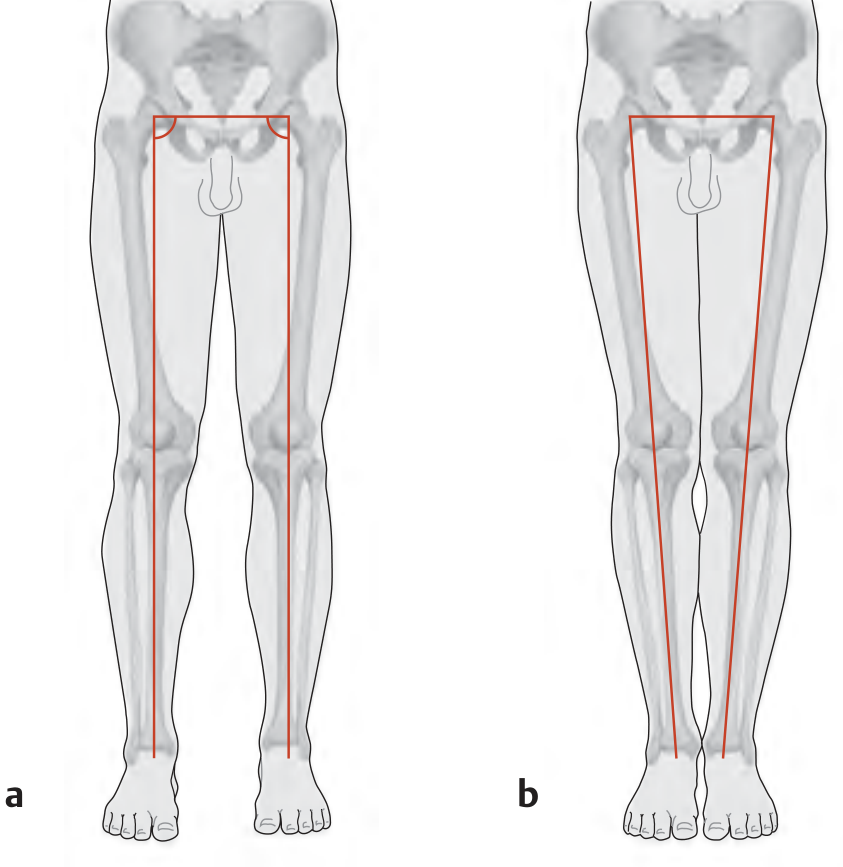
Key Anatomical Axes
| Axis | Definition | Normal Value |
|---|
| Mechanical axis (Mikulicz line) | Line from center of femoral head → intercondylar eminence → center of ankle mortise | Passes through center of knee |
| Anatomic tibiofemoral (femorotibial) angle | Angle between long axes of femur and tibia | 174° laterally open (≈ 6° valgus is physiologic) |
| Anatomic-mechanical axis divergence | Femoral anatomic axis diverges from mechanical axis | ~6° |
The anatomic and mechanical axes coincide in the tibia but diverge by 6° in the femur — hence normal weight-bearing alignment is a slight physiological valgus.
(THIEME Atlas of General Anatomy, p. 431)
Relevant Anatomical Structures at the Knee
- Medial compartment: Medial femoral condyle, medial tibial plateau, medial meniscus, MCL, pes anserinus
- Lateral compartment: Lateral femoral condyle, lateral tibial plateau, lateral meniscus, LCL, IT band, biceps femoris, popliteus
- Sagittal stabilizers: ACL (prevents anterior tibial translation), PCL (prevents posterior translation), posterior capsule, popliteus
- Extensor mechanism: Quadriceps, patellar tendon, patella (transmits force across the joint)
- Neurovascular: Popliteal artery & vein, tibial nerve, common peroneal nerve — all at risk in severe deformities
SECTION 2 — GENU VARUM (Bow Legs)
Definition
The knee center is lateral to the mechanical axis → tibia points medially → medial-open deformity in the coronal plane.
Types / Classification
| Type | Age/Setting | Key Feature |
|---|
| Physiologic genu varum | <2 years | Up to 20° normal in 1st year of life; spontaneous correction |
| Infantile Blount disease (Tibia vara) | 0–4 years | Pathologic medial physeal failure; obesity + early walking |
| Adolescent Blount disease | 8–15 years | Medial physis widening; less severe; often unilateral |
| Metabolic/Nutritional | Any age | Rickets, renal osteodystrophy (bilateral) |
| Developmental/Traumatic | Any | Osteogenesis imperfecta, osteochondroma, physeal injury |
| Degenerative | Adult | Secondary to medial compartment OA |
Blount Disease (most important pathologic cause):
- Radiographic sign: Drennan metaphyseal-diaphyseal angle >16° = abnormal
- Langenskiöld classification (I–VI): progressive metaphyseal-epiphyseal changes
- Associated with internal tibial torsion and obesity
Biomechanics of Genu Varum
"In genu varum, the center of the knee joint is lateral to the mechanical axis... the medial joint complex is subjected to abnormal pressure, while the lateral joint structures (LCL, IT tract, biceps femoris) are subjected to abnormal tension."
— THIEME Atlas of General Anatomy, p. 431
| Structure | Effect |
|---|
| Medial compartment (cartilage, meniscus) | Compression overload → OA |
| Lateral structures (LCL, IT band, biceps) | Tension overload → stretching |
| Lateral foot border | Increased stress → fallen arch |
| Hip abductors | Compensatory overactivation |
| ACL/PCL | Altered loading patterns |
Gait changes: Lateral thrust at the knee during stance phase; compensatory contralateral pelvic drop.
SECTION 3 — GENU VALGUM (Knock Knees)
Definition
The knee center is medial to the mechanical axis → tibia points laterally → lateral-open deformity.
Types / Classification
| Type | Setting | Features |
|---|
| Physiologic genu valgum | Ages 3–5 years | Up to 10–15° normal; peak valgus at age 3–4 years |
| Pathologic (structural) | >10 years | Persists beyond physiologic phase |
| Metabolic | Any | Renal osteodystrophy (most common bilateral cause), rickets |
| Traumatic | Any | Lateral physeal damage (stimulates overgrowth), fractures |
| Tumoral | Any | Osteochondromas stimulating asymmetric growth |
| Neuromuscular | CP, polio | Quadriceps and hip abductor imbalance |
| Post-TKA | Surgical | Component malposition, soft tissue imbalance |
Surgical threshold in children: >10 cm intermalleolar distance OR >15° valgus angulation in children >10 years.
Biomechanics of Genu Valgum
| Structure | Effect |
|---|
| Lateral compartment (cartilage, meniscus) | Compression overload → lateral OA |
| Medial structures (MCL, medial capsule) | Tension overload → stretching, instability |
| Patella | Lateral maltracking → patellar instability/subluxation |
| IT band | Tight, contributes to lateral pull |
| Medial knee pain | From MCL stress |
Gait changes: Medial knee thrust during stance; toe-out gait; excessive foot pronation; risk of patellar dislocation.
Clinical measurement:
- Intermalleolar distance >5 cm with knees touching = abnormal
- Normal: when feet together, both medial malleoli and both knees should touch simultaneously
(THIEME Atlas of General Anatomy, p. 431)
SECTION 4 — GENU RECURVATUM (Hyperextension Deformity)
Definition
A sagittal plane deformity where the knee hyperextends beyond neutral (0°) — the tibia and femur form a posteriorly-open angle. International convention: recurvation (sagittal) vs. antecurvation. (THIEME Atlas, p. 46)
Normal knee extension = 0°. Genu recurvatum = hyperextension typically >5°, up to 15–20° in severe cases.
Types / Classification
| Type | Cause |
|---|
| Congenital | Intrauterine positioning, joint hyperlaxity |
| Acquired — ligamentous | PCL laxity, posterolateral corner (PLC) insufficiency, ACL laxity |
| Acquired — neuromuscular | Quadriceps weakness (polio, CP, muscular dystrophy) — recurvatum as a compensatory mechanism to stabilize the knee in stance |
| Acquired — bony | Malunited proximal tibial fracture, posterior tibial slope deficiency, physeal injury |
| Post-TKA | Excessive posterior tibial slope, PCL over-resection, soft tissue imbalance |
| Hypermobility syndromes | EDS, Marfan syndrome — generalized ligamentous laxity |
Biomechanics of Genu Recurvatum
Normal knee stance:
Knee in ~5° flexion → quadriceps active → stable

Recurvatum:
Knee hyperextends → weight-bearing line passes ANTERIOR to knee axis
→ Posterior capsule and PCL must resist hyperextension passively
→ Quadriceps mechanism becomes inefficient (shortened moment arm)
→ Over time: posterior capsule stretches further → deformity worsens
| Structure | Effect |
|---|
| Posterior capsule | Primary passive restraint → progressively stretches |
| PCL | Abnormal tensile stress |
| ACL | Impingement risk at full hyperextension |
| Popliteal neurovascular bundle | Stretching risk |
| Quadriceps | Inefficient leverage; may be the cause (weakness) or the result |
| Ankle/foot | Compensatory equinus or calcaneus deformity |
Neuromuscular recurvatum mechanism: In polio or CP with weak quadriceps, the patient hyperextends the knee to move the ground reaction force anterior to the knee axis — this passively stabilizes the knee without muscle activity. This is an adaptive strategy but causes progressive posterior capsular and ligamentous stretching.
SECTION 5 — DEVELOPMENTAL (PHYSIOLOGICAL) PROGRESSION
| Age | Normal Alignment |
|---|
| Birth – 1 year | Up to 20° genu varum (physiological) |
| 1.5 – 2 years | Transition to neutral |
| 2 – 4 years | Up to 10–15° genu valgum (physiological) |
| 5–7 years | Return toward adult valgus (5–7°) |
| Adult | 5–7° physiologic valgus (females slightly more) |
(Miller's Review of Orthopaedics 9th Ed, p. 278; THIEME Atlas, p. 431)
SECTION 6 — DIAGNOSTIC CRITERIA
Clinical Assessment
History:
- Age of onset, rate of progression
- Family history, nutritional history (rickets)
- Pain location, gait complaints, functional limitations
- Prior trauma, infections, surgeries
Physical Examination:
| Test | Genu Varum | Genu Valgum | Recurvatum |
|---|
| Standing alignment | Intercondylar gap | Intermalleolar gap | Hyperextension angle |
| Intercondylar distance | >3 cm = abnormal | — | — |
| Intermalleolar distance | — | >5 cm = abnormal | — |
| Tibiofemoral angle | >10° varus | >10° valgus (post age 7) | Measured in sagittal plane |
| Recurvatum test | — | — | Patient lies supine; lift leg by ankle — knee sags into extension |
| Thrust test | Lateral thrust during gait | Medial thrust | — |
| Rotational profile | Tibial torsion (Blount) | Femoral anteversion | — |
| Ligament laxity | Dial test, Varus stress | MCL stress, Lachman | PCL, PLC assessment |
Radiological Assessment
| Modality | Measurement | Normal |
|---|
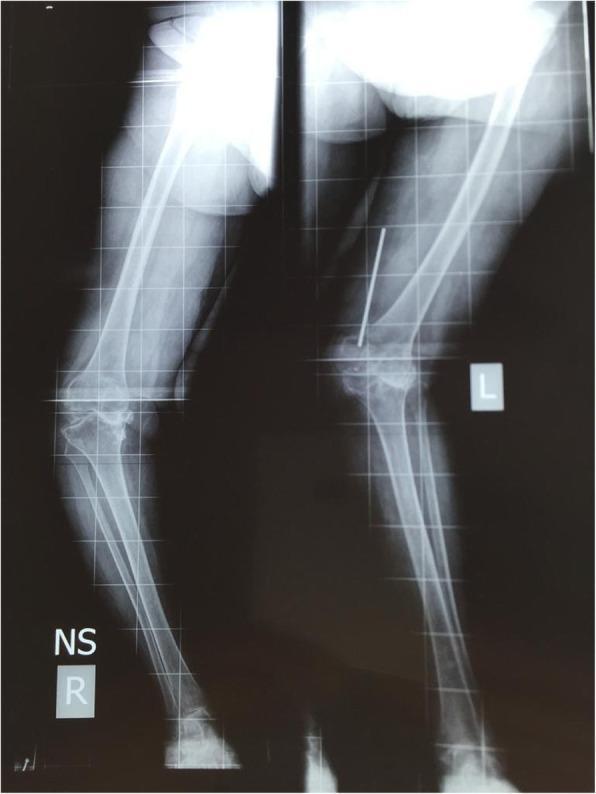
| Long-leg standing X-ray (scanogram) | Mechanical axis deviation (MAD) | <10 mm medial to knee center |
| Tibiofemoral angle | Anatomic angle | 174° (6° valgus) |
| Medial proximal tibial angle (MPTA) | Tibial contribution | 87° ± 3° |
| Lateral distal femoral angle (LDFA) | Femoral contribution | 88° ± 3° |
| Posterior tibial slope | Sagittal plane | 7–10° |
| Drennan angle | Metaphyseal-diaphyseal angle | <11° normal; >16° = Blount |
| EOS biplanar imaging | Full 3D alignment | Gold standard for complex deformity |
Valgus/Varus classification by degree:
- Mild: 5–10°
- Moderate: 10–20°
- Severe: >20°
SECTION 7 — ROLE OF ORTHOPAEDICS
Genu Varum
| Stage/Severity | Intervention |
|---|
| Physiologic (<2 yrs) | Observation only |
| Blount Stage I–II (<3 yrs) | Knee-ankle-foot orthosis (KAFO) bracing |
| Blount Stage II (>3 yrs) / Stage III | Proximal tibial-fibular osteotomy (overcorrect to valgus — because medial physeal abnormality persists) |
| Stages IV–VI | Complex multi-stage procedures; epiphysiolysis for V–VI |
| Adolescent Blount | Medial tibial hemiepiphysiodesis (guided growth) or osteotomy |
| Adult OA-related | High tibial osteotomy (HTO) — realigns mechanical axis; delays/avoids TKA |
Genu Valgum
| Severity | Intervention |
|---|
| Physiologic | Observation |
| Pathologic (growing child, <Skeleton closure) | Lateral hemiepiphysiodesis (stapling or 8-plate guided growth) — based on Heueter-Volkmann law |
| Pathologic (skeletally mature) | Distal femoral osteotomy (DFO) or proximal tibial osteotomy |
| Associated patellar instability | MPFL reconstruction + DFO |
| Post-TKA | Component revision, soft tissue balancing |
| Conservative cutoff (surgical indication) | >10 cm intermalleolar distance OR >15° in children >10 years (Miller's, p. 278) |
Genu Recurvatum
| Cause | Intervention |
|---|
| Ligamentous (PCL/PLC laxity) | PCL/PLC reconstruction + posterior capsular plication |
| Bony (tibial malunion/slope deficiency) | Tibial osteotomy (increase posterior slope) |
| Neuromuscular | AFO/KAFO bracing ± posterior capsular plication |
| Severe progressive | Ilizarov external fixation with gradual correction |
| Post-TKA recurvatum | Revision with modified tibial slope insert |
Ilizarov technique: Used when significant deformity + limb length discrepancy coexist — allows simultaneous deformity correction and lengthening. (Miller's, p. 278)
SECTION 8 — ROLE OF PHYSIOTHERAPY
General Physiotherapy Goals Across All Three Deformities
- Correct/compensate alignment through muscle rebalancing
- Reduce pain (manual therapy, electrotherapy)
- Improve function and gait pattern
- Post-operative rehabilitation (peri- and post-surgical)
- Prevent progression in mild/physiological cases
Physiotherapy for Genu Varum
| Impairment | Physio Intervention |
|---|
| Tight IT band / lateral structures | IT band stretching, foam rolling |
| Weak hip abductors (medial knee collapse in varum paradox) | Hip abductor strengthening (side-lying raises, clamshell, resistance band) |
| Medial compartment overload | Lateral wedge insole (shifts load laterally) |
| Gait lateral thrust | Gait retraining, biofeedback |
| Post-HTO rehabilitation | Progressive weight-bearing, quad strengthening, proprioception |
| Bracing | KAFO in Blount; valgus unloader brace in adult OA-varum |
Physiotherapy for Genu Valgum
| Impairment | Physio Intervention |
|---|
| Weak hip external rotators & abductors | ER strengthening (clamshells, prone ER), glute med exercises |
| Tight IT band + TFL | Lateral hip and IT band stretching |
| Weak VMO (patellar instability) | VMO-targeted quad sets, terminal knee extension (TKE) |
| Foot pronation | Arch support, intrinsic foot strengthening |
| Patellar maltracking | Patellar taping (McConnell technique), VMO strengthening |
| Medial wedge insole | Shifts load medially in lateral compartment OA |
| Post-DFO rehabilitation | Staged weight-bearing, proprioception, progressive strengthening |
Physiotherapy for Genu Recurvatum
| Impairment | Physio Intervention |
|---|
| Quadriceps weakness | Progressive quad strengthening — SLR, short-arc quad (SAQ), TKE |
| Posterior capsule laxity | Avoid end-range hyperextension; functional range training |
| Proprioception deficit | Balance training, single-leg stance, perturbation training |
| Hamstring tightness (paradoxical) | Hamstring stretching (if tight) — careful; hamstrings also protect against recurvatum |
| Neuromuscular recurvatum | AFO (posterior leaf spring or solid AFO) controls hyperextension in swing + stance; combined with quadriceps strengthening |
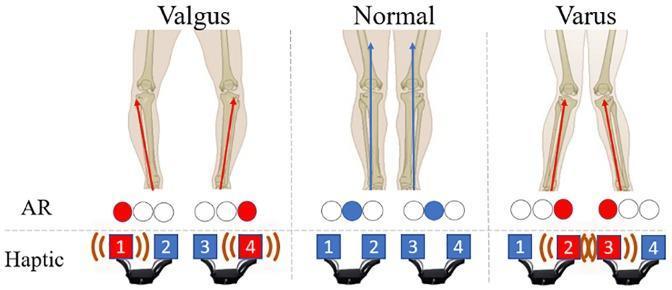
| Gait retraining | Teach slight knee flexion at heel strike; biofeedback, AR-assisted gait training |
| Post-surgery | Controlled weight bearing, avoid hyperextension positioning |
SECTION 9 — QUICK COMPARISON TABLE
| Feature | Genu Varum | Genu Valgum | Genu Recurvatum |
|---|
| Plane | Coronal | Coronal | Sagittal |
| Direction | Medial deviation (bow) | Lateral deviation (knock) | Hyperextension |
| Mechanical axis | Lateral to knee | Medial to knee | Anterior to knee (sagittal) |
| Overloaded compartment | Medial | Lateral | Posterior capsule, PCL |
| Stretched structures | LCL, IT band | MCL | Posterior capsule, PCL |
| Associated OA | Medial compartment | Lateral compartment | PF compartment, PCL stress |
| Clinical measure | Intercondylar distance >3 cm | Intermalleolar distance >5 cm | Hyperextension angle >5° |
| Radiology | MPTA <84°, MAD medial | LDFA >93°, MAD lateral | Posterior tibial slope <5° |
| Ortho surgery | HTO, osteotomy | DFO, hemiepiphysiodesis | Osteotomy, PCL/PLC recon |
| Physio focus | Hip abductors, lateral wedge insole | VMO, hip ER, medial taping | Quad strength, AFO, proprioception |
Sources
- Miller's Review of Orthopaedics, 9th Ed, pp. 278–279 (Genu varum, Blount disease, Genu valgum)
- THIEME Atlas of General Anatomy and Musculoskeletal System, pp. 46, 431 (Axis deviation, Mikulicz line, Physiologic alignment)
- Physical Therapist Management of Total Knee Arthroplasty, p. 17
- Bailey & Love's Short Practice of Surgery, 28th Ed, p. 512
- Grainger & Allison's Diagnostic Radiology (Radiological assessment of limb alignment)This comprehensive guide covers all three knee deformities. Here's a quick orientation to the content:
What's covered:
- Anatomy — Mechanical axis (Mikulicz line), femorotibial angle (normal 174°/6° valgus), key structures of each compartment
- Types — Physiologic vs pathologic, Blount disease (infantile + adolescent), metabolic, traumatic, neuromuscular, degenerative, post-surgical
- Biomechanics — For each deformity: which compartment is overloaded, which structures are stretched, gait deviations
- Developmental timeline — When varum/valgum is physiologic vs pathologic by age
- Diagnostic criteria — Clinical tests (intercondylar/intermalleolar distance, recurvatum test, thrust test) + radiological (MAD, MPTA, LDFA, Drennan angle, tibial slope)
- Orthopaedic role — Observation → bracing → hemiepiphysiodesis → osteotomy (HTO/DFO) → reconstruction → Ilizarov, stratified by severity and skeletal maturity
- Physiotherapy role — Muscle rebalancing targets, specific exercises, orthoses, gait retraining, and post-op rehab for each condition