
Brachial plexus
Reading File
The brachial plexus is the network of nerves (C5-T1) that supplies the upper limb. Let me pull comprehensive textbook content on this topic.
Searching sources...
Finding Sources
Searching the Web
brachial plexus anatomy roots trunks divisions cords branches
Reading File
Reading File
Reading File
Reading File
Reading File
Finding Sources
Reading File
Finding Sources
Loading Image
Reading File
Loading Image
Finding Sources
Finding Sources
Finding Sources
Reading File
Reading File
Reading File
Now I have comprehensive information to provide a thorough answer. Let me compile everything.
Brachial Plexus
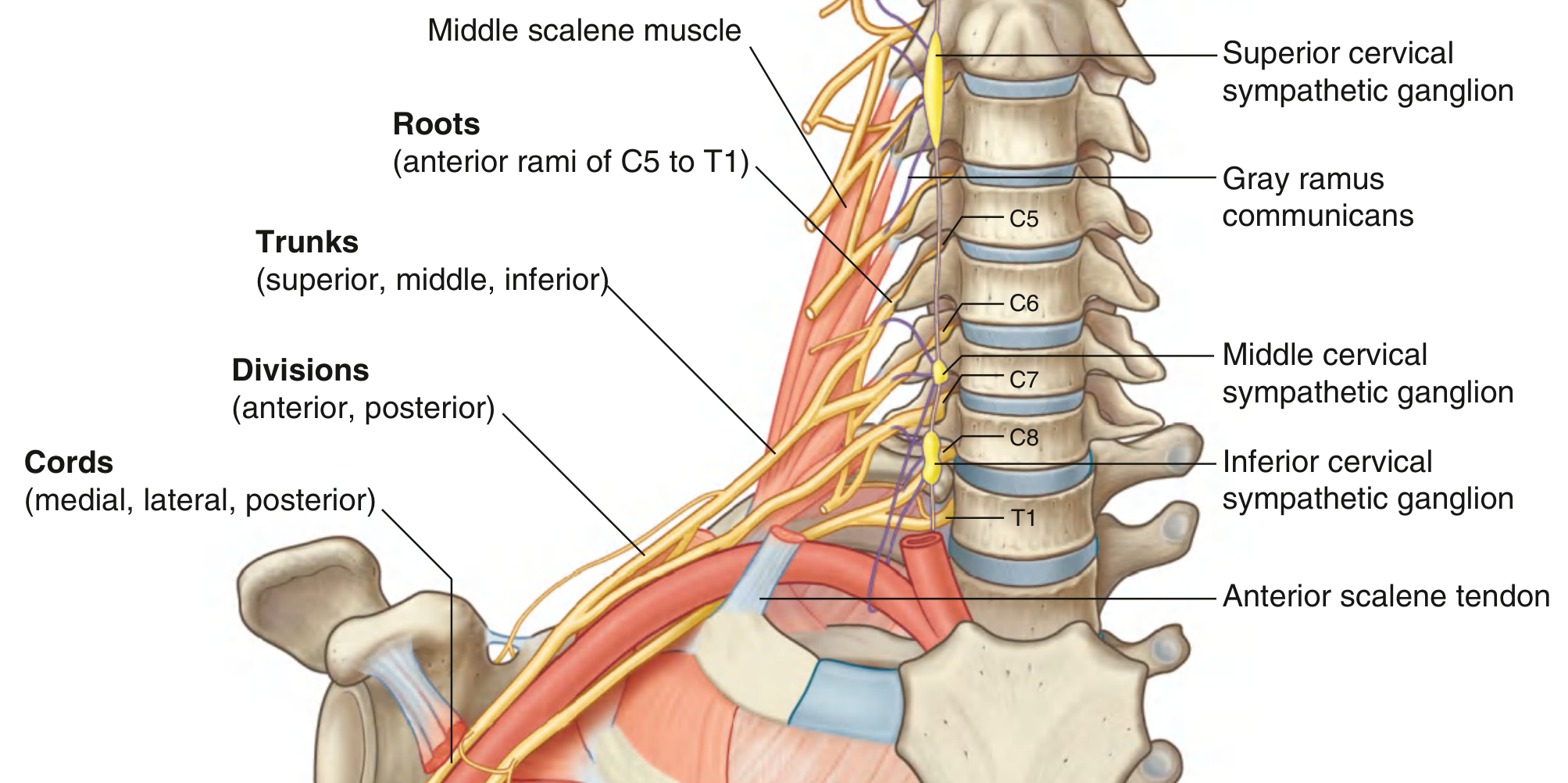
Overview
The brachial plexus is a somatic nerve plexus formed by the anterior rami of C5-C8 and most of T1. It originates in the neck, passes laterally and inferiorly over rib I, and enters the axilla. It supplies all motor and sensory innervation to the upper limb (except the uppermost arm, which receives cutaneous supply from C3/C4).
The mnemonic "Real Teenagers Drink Cold Beer" summarizes the sequential parts:
Roots → Trunks → Divisions → Cords → Branches
Anatomy: Layer by Layer
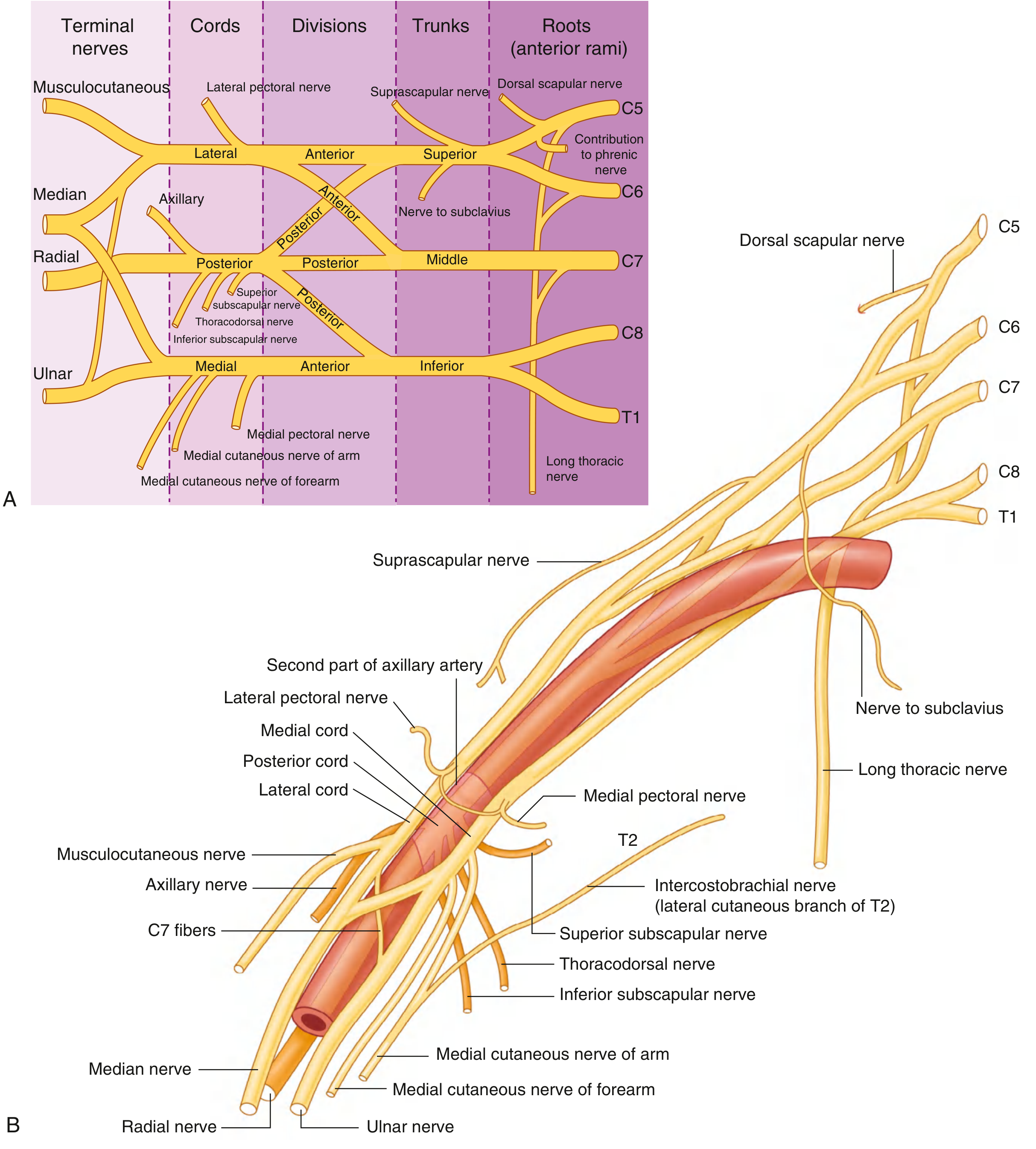
1. Roots (C5-T1)
- The anterior rami of C5-T1 form the roots
- They pass between the anterior and middle scalene muscles (interscalene space)
- Receive gray rami communicantes from the sympathetic trunk (postganglionic sympathetic fibers)
- Branches off the roots:
- Dorsal scapular nerve (C5) - rhomboid major & minor
- Long thoracic nerve (C5-C7) - serratus anterior
- Contribution to phrenic nerve (C5)
2. Trunks (3 trunks)
| Trunk | Formed by | Position |
|---|---|---|
| Superior (upper) | C5 + C6 | Superior |
| Middle | C7 alone | Middle |
| Inferior (lower) | C8 + T1 | On rib I, posterior to subclavian artery |
Branches off the superior trunk only:
- Suprascapular nerve (C5, C6) - supraspinatus, infraspinatus
- Nerve to subclavius (C5, C6) - subclavius
3. Divisions
- Each trunk splits into an anterior and a posterior division (6 divisions total)
- No peripheral nerves arise directly from divisions
- Anterior divisions - give rise to nerves of the anterior (flexor) compartments
- Posterior divisions - give rise to nerves of the posterior (extensor) compartments
4. Cords
Named by position relative to the second part of the axillary artery:
| Cord | Formed from | Roots | Position |
|---|---|---|---|
| Lateral | Anterior divisions of superior + middle trunks | C5-C7 | Lateral to axillary artery |
| Medial | Anterior division of inferior trunk | C8, T1 | Medial to axillary artery |
| Posterior | All 3 posterior divisions | C5-T1 | Posterior to axillary artery |
Branches
From the Lateral Cord (C5-C7)
- Lateral pectoral nerve - pectoralis major & minor
- Musculocutaneous nerve - biceps, brachialis, coracobrachialis; sensory to lateral forearm
- Lateral root of median nerve
From the Medial Cord (C8, T1)
- Medial pectoral nerve - pectoralis major & minor
- Medial cutaneous nerve of arm - medial distal arm
- Medial cutaneous nerve of forearm - medial forearm
- Ulnar nerve (C8, T1)
- Medial root of median nerve
The median nerve is formed by the union of the lateral and medial roots, creating the classic "M" shape over the axillary artery with the musculocutaneous and ulnar nerves.
From the Posterior Cord (C5-T1)
- Superior subscapular nerve (C5, C6) - subscapularis (upper)
- Thoracodorsal nerve (C6-C8) - latissimus dorsi
- Inferior subscapular nerve (C5, C6) - subscapularis (lower), teres major
- Axillary nerve (C5, C6) - deltoid, teres minor; sensory to upper lateral arm
- Radial nerve (C5-T1) - all posterior compartment muscles of arm and forearm
Clinical Correlates
Erb-Duchenne Palsy (Upper Brachial Plexus Injury)
- Roots injured: C5, C6 (superior trunk)
- Cause: Forceful widening of the angle between the neck and shoulder (shoulder dystocia in neonates, motorcycle accidents in adults)
- Muscles affected: Deltoid, biceps, brachialis, brachioradialis, supinator
- Posture: Arm internally rotated, extended at elbow, pronated forearm - the classic "policeman receiving a tip" (waiter's tip) deformity
- Sensory loss: Lateral arm and upper lateral forearm
- Prognosis: Best prognosis; >90% of neonatal cases resolve without intervention
Klumpke's Palsy (Lower Brachial Plexus Injury)
- Roots injured: C8, T1 (inferior trunk)
- Cause: Forceful hyperabduction (e.g., grasping overhead during a fall, breech delivery with arms above head)
- Muscles affected: Intrinsic hand muscles (interossei, lumbricals, thenar, hypothenar)
- Posture: Claw hand (combined median and ulnar intrinsic muscle paralysis)
- Sensory loss: Medial forearm, hand, and inner 1.5 fingers (C8, T1)
- Horner syndrome: Ptosis, miosis (pupil constriction), enophthalmos, anhidrosis - due to damage to sympathetic fibers from T1
Total (Complete) Brachial Plexus Palsy (C5-T1)
- Worst prognosis
- Complete paralysis and anesthesia of the upper limb (except upper medial arm, supplied by T2 intercostobrachial nerve)
Pancoast Tumor
- Apical lung cancer that invades the inferior trunk (C8, T1), causing Klumpke-like palsy plus Horner syndrome
Thoracic Outlet Syndrome
- Compression of the medial, lateral, and posterior cords between the first rib and clavicle (or under pectoralis minor)
Key Memory Aids
| Cord | Mnemonic | Branches |
|---|---|---|
| Lateral cord | Lateral cord gives LateM (Lateral pectoral, musculocutaneous, Median lateral root) | |
| Medial cord | Medial cord gives Medical Men Might Miss (Medial pectoral, Medial cut. arm, Medial cut. forearm, Median medial root, Ulnar) | |
| Posterior cord | STAR (Superior subscapular, Thoracodorsal, Axillary, Radial) + inferior subscapular |
Sources: Gray's Anatomy for Students, p. 858-866; S Das Manual on Clinical Surgery 13th Ed., p. 140; Miller's Review of Orthopaedics 9th Ed., p. 260; Neuroanatomy through Clinical Cases 3rd Ed., p. 395
This is a shared conversation. Sign in to Orris to start your own chat.