

Screenshot_20260620-061057.png
Explain trophoboastic tumour with gross and microscopy
Reading File
Searching sources...
Finding Sources
Finding Sources
Reading File
Reading File
Reading File
Reading File
Good - I have rich content from Robbins. Let me now fetch the key images and read the choriocarcinoma / PSTT sections more fully.
Loading Image
Loading Image
Reading File
Loading Image
Reading File
Loading Image
Loading Image
Loading Image
I now have all the content and images needed for a thorough answer. Let me compile everything.
Gestational Trophoblastic Disease (GTD) - Trophoblastic Tumours
GTD encompasses a spectrum of tumours and tumour-like conditions characterised by proliferation of placental (trophoblastic) tissue. All elaborate human chorionic gonadotropin (hCG) to varying degrees. The major entities are:
- Hydatidiform Mole (Complete and Partial)
- Invasive Mole
- Choriocarcinoma
- Placental Site Trophoblastic Tumour (PSTT)
- Epithelioid Trophoblastic Tumour (ETT)
1. HYDATIDIFORM MOLE
Etiology / Genetics
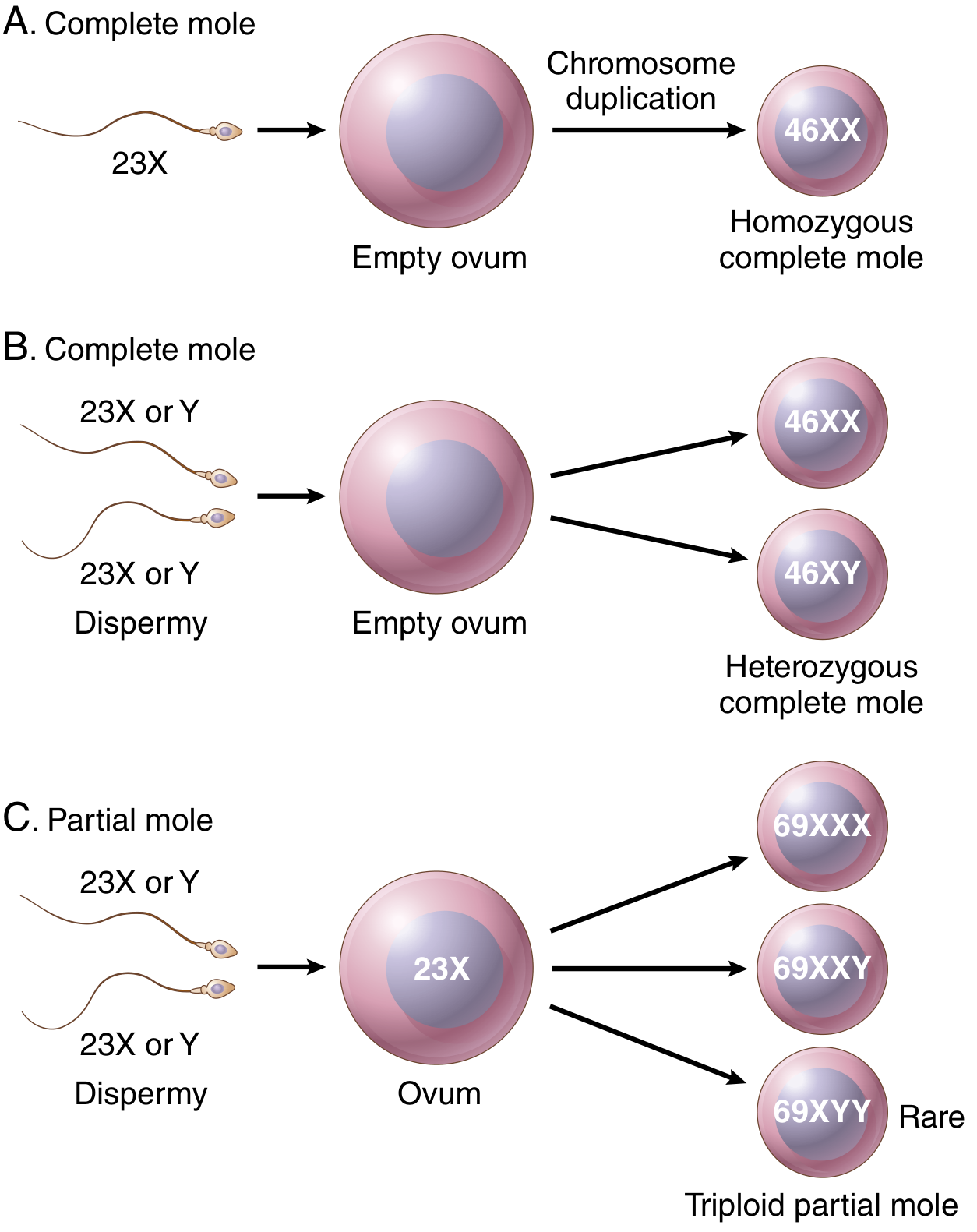
Both types result from fertilisation with an excess of paternal genetic material.
| Feature | Complete Mole | Partial Mole |
|---|---|---|
| Karyotype | Diploid (46,XX or 46,XY) | Triploid (69,XXY) |
| Embryo/fetus | Absent | May be present (growth restricted, anomalies) |
| Villous edema | All villi | Some villi |
| Trophoblast proliferation | Diffuse, circumferential | Focal, slight |
| Serum hCG | Greatly elevated | Less elevated |
| Risk of choriocarcinoma | 2.5% | Rare |
- Incidence: 1 in 1000-2000 pregnancies in the US; twice as common in Southeast Asia
- Risk is higher at extremes of reproductive life (teenagers and women 40-50 years)
Complete Mole - Pathogenesis
- 90%: fertilisation of an "empty" egg (no maternal chromosomes) by a single sperm that undergoes chromosome duplication (monospermic androgenesis) → 46,XX
- 10%: dispermy (two sperm fertilise an empty egg) → 46,XX or 46,XY
- No embryonic development is possible
Partial Mole - Pathogenesis
- An egg with intact maternal chromosomes is fertilised by two sperm → triploid karyotype (69,XXY most commonly)
- Fetal development may occur but with lethal central nervous system and skeletal abnormalities (syndactyly)
GROSS MORPHOLOGY - Hydatidiform Mole
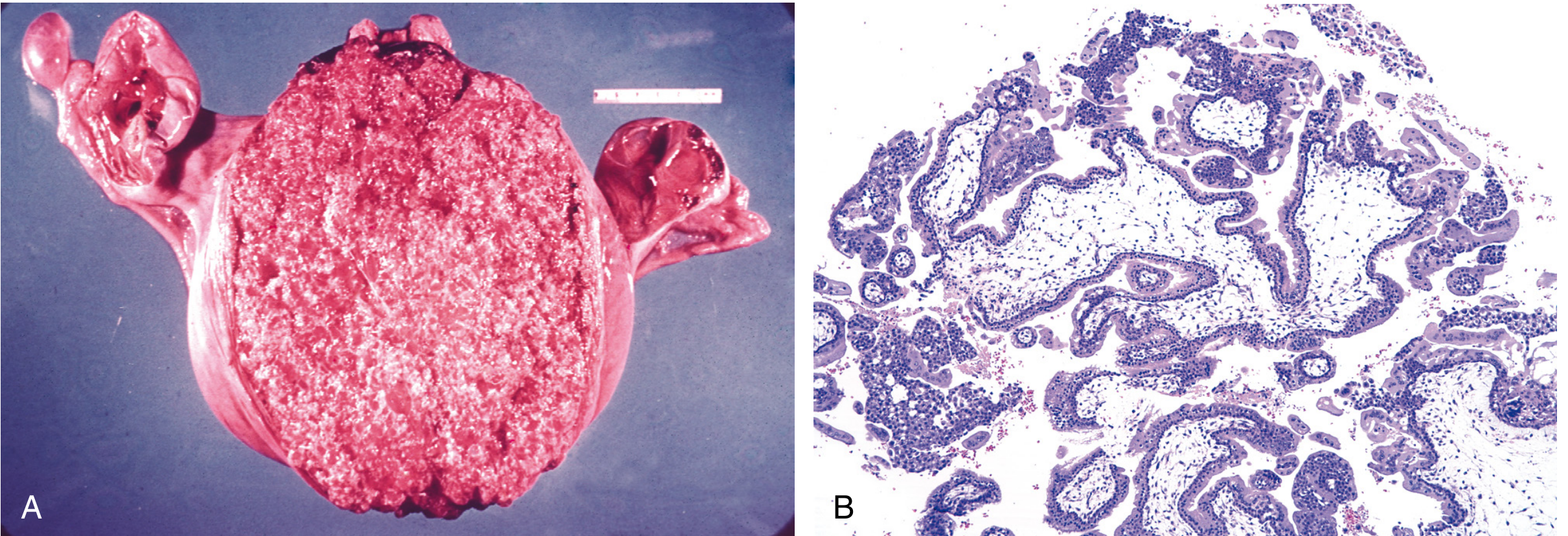
- The complete mole appears as a delicate, friable mass of thin-walled, translucent, cystic, grape-like structures - swollen oedematous (hydropic) villi that distend the uterus
- The partial mole shows only focal villous swelling; the rest of the villi appear normal
MICROSCOPY - Hydatidiform Mole
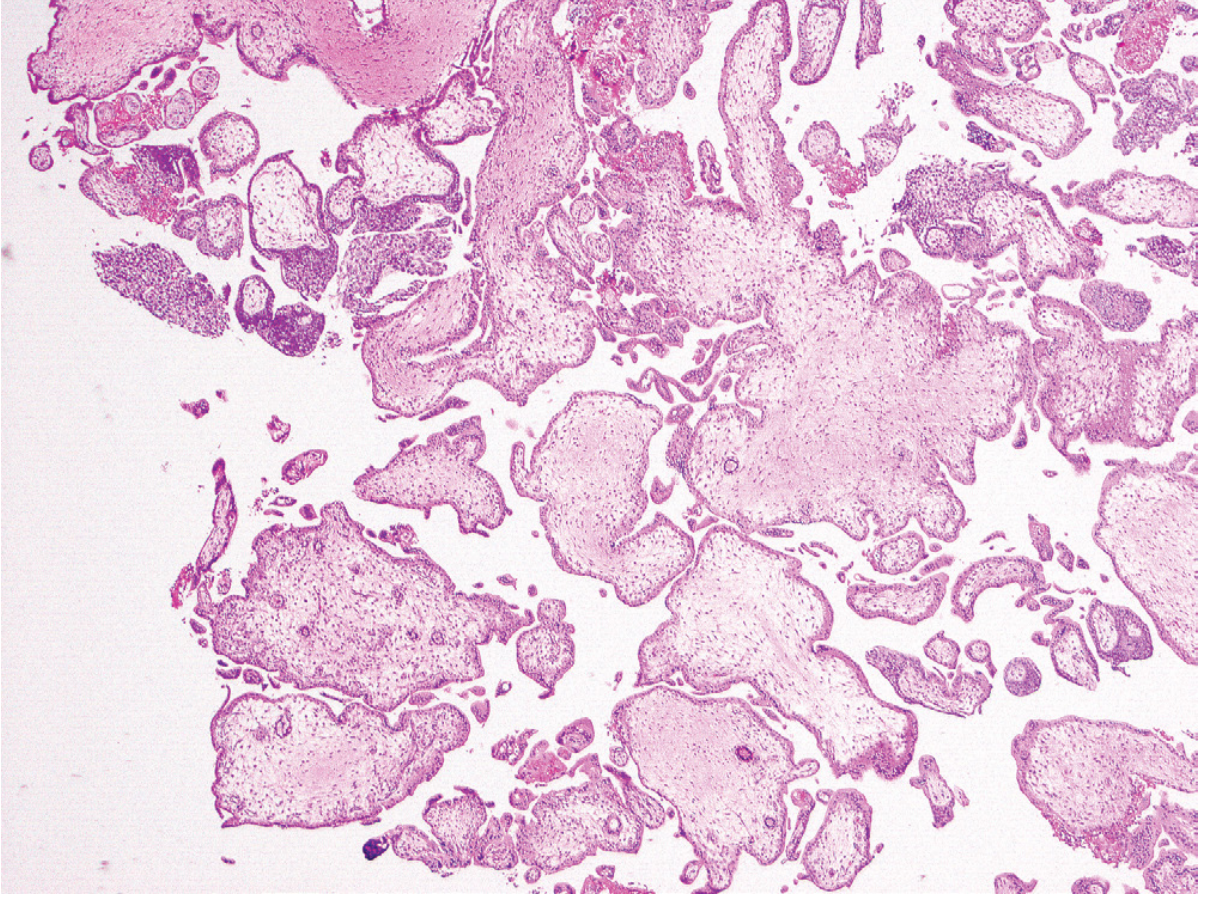
Complete mole (microscopy):
- All or most villi are affected
- Chorionic villi are enlarged, smooth, and oval with central cavitation (cisterns)
- Covered by circumferential biphasic trophoblast proliferation (both cytotrophoblast and syncytiotrophoblast)
- Loose, oedematous stroma; fetal blood vessels typically absent
Partial mole (microscopy):
- Only some villi are enlarged; others are normal
- Trophoblast proliferation is focal and slight
- Irregular villous outlines; "scalloped" contour of villi
- Fetal/embryonic elements may be present
2. INVASIVE MOLE
Gross
- Infiltrative lesion that penetrates and sometimes perforates the uterine wall
- Haemorrhagic areas in the myometrium; hydropic villi visible within the muscle wall
Microscopy
- Hydropic chorionic villi lined by proliferating cytotrophoblast and syncytiotrophoblast invade the myometrium
- Villi may invade parametrial tissue and blood vessels; can embolise to lungs and brain (~5% of complete moles)
Clinical features
- Vaginal bleeding, irregular uterine enlargement, persistently elevated serum hCG after evacuation
3. CHORIOCARCINOMA
A malignant neoplasm of trophoblastic cells arising from a previously normal or abnormal pregnancy.
Incidence: 1 in 20,000-30,000 pregnancies
Antecedents: 50% arise from complete hydatidiform mole; 25% follow spontaneous abortions; ~22% follow normal pregnancies; remainder from ectopic pregnancies
GROSS MORPHOLOGY
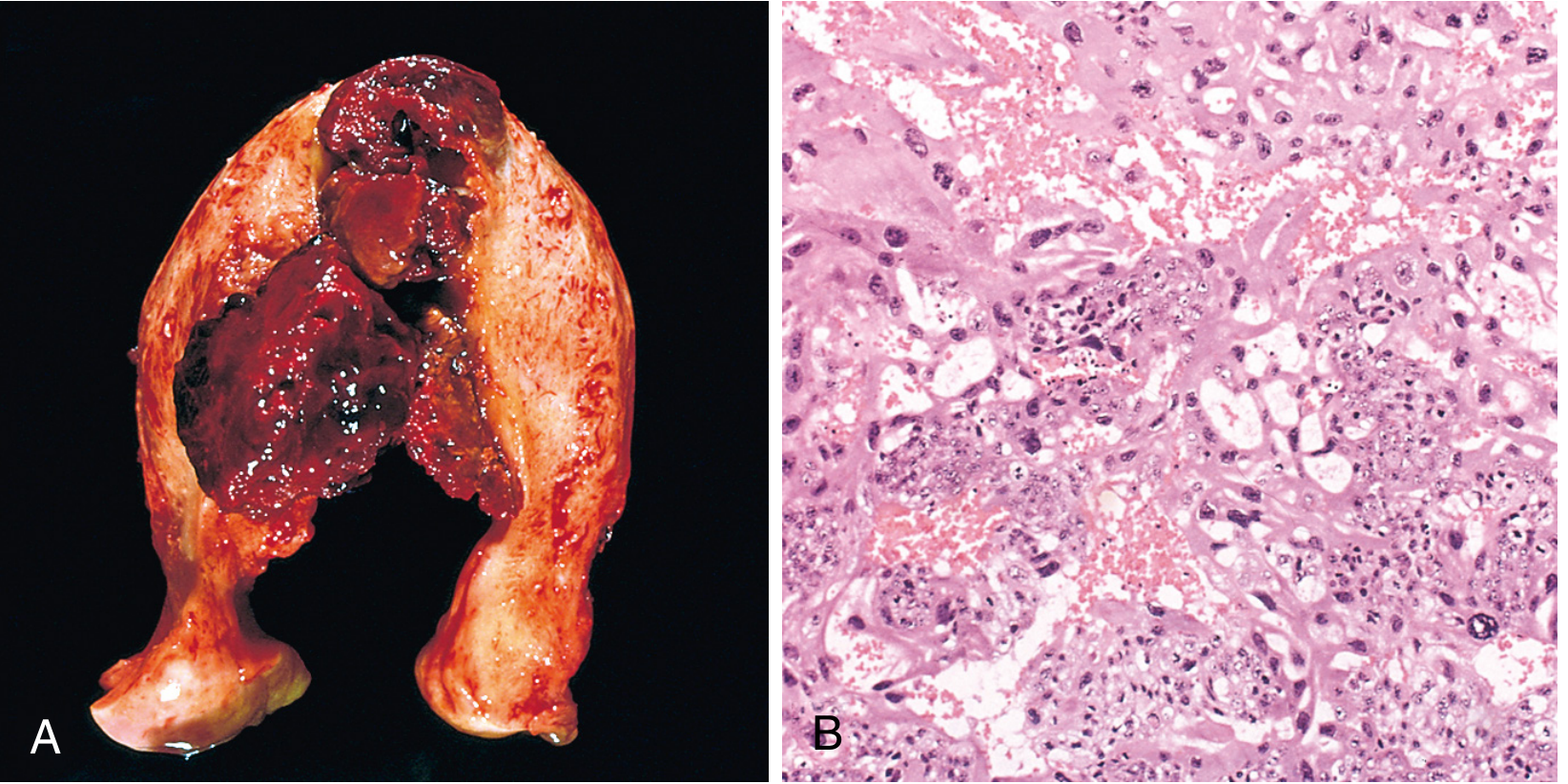
- Soft, fleshy, yellow-white tumour with large pale areas of necrosis and extensive haemorrhage
- Invades the myometrium and may extend to the uterine serosa and adjacent structures
- Bulky, destructive, haemorrhagic mass
MICROSCOPY
- Proliferating syncytiotrophoblasts and cytotrophoblasts arranged in sheets and columns
- Chorionic villi are ABSENT - this is the key distinguishing feature
- Abundant mitoses, sometimes abnormal
- Tumour invades the myometrium and penetrates blood vessels
- Extensive areas of necrosis and haemorrhage surrounding viable tumour at the periphery
Metastases
- Hematogenous spread is characteristic
- Lungs (50%), vagina (30-40%), brain, liver, bone, kidney - in descending frequency
- hCG is typically very elevated
Prognosis
- Despite widespread metastases, responds extremely well to chemotherapy (methotrexate ± actinomycin D)
- Near 100% remission rate; most patients can have normal subsequent pregnancies
4. PLACENTAL SITE TROPHOBLASTIC TUMOUR (PSTT)
Gross
- Uterine mass; may follow normal pregnancy (50%), spontaneous abortion, or hydatidiform mole
- Presents with abnormal uterine bleeding or amenorrhea; moderately elevated hCG (much lower than choriocarcinoma)
MICROSCOPY
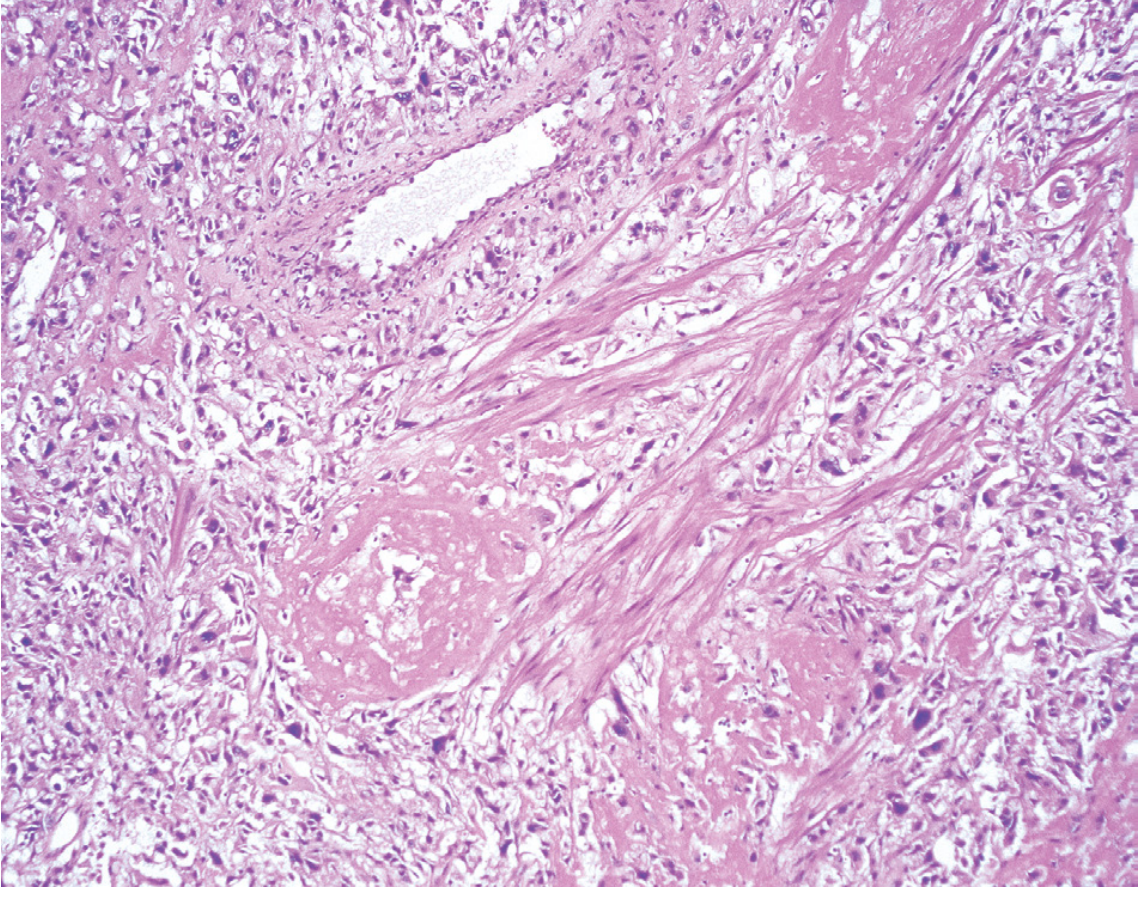
- Composed of polygonal mononuclear or binucleated extravillous trophoblasts with abundant cytoplasm
- Invades without local destruction or haemorrhage (unlike choriocarcinoma)
- Shows tropism for maternal vessels
- No biphasic pattern (no syncytiotrophoblast sheets); no villi
Prognosis
- Localised disease: good prognosis with surgical removal alone
- 10-15% die of disseminated disease
5. EPITHELIOID TROPHOBLASTIC TUMOUR (ETT)
Gross / Clinical
- Most commonly presents following pregnancy with amenorrhea, sometimes a palpable mass
- Most are intrauterine or cervical; extrauterine tumours also occur
MICROSCOPY
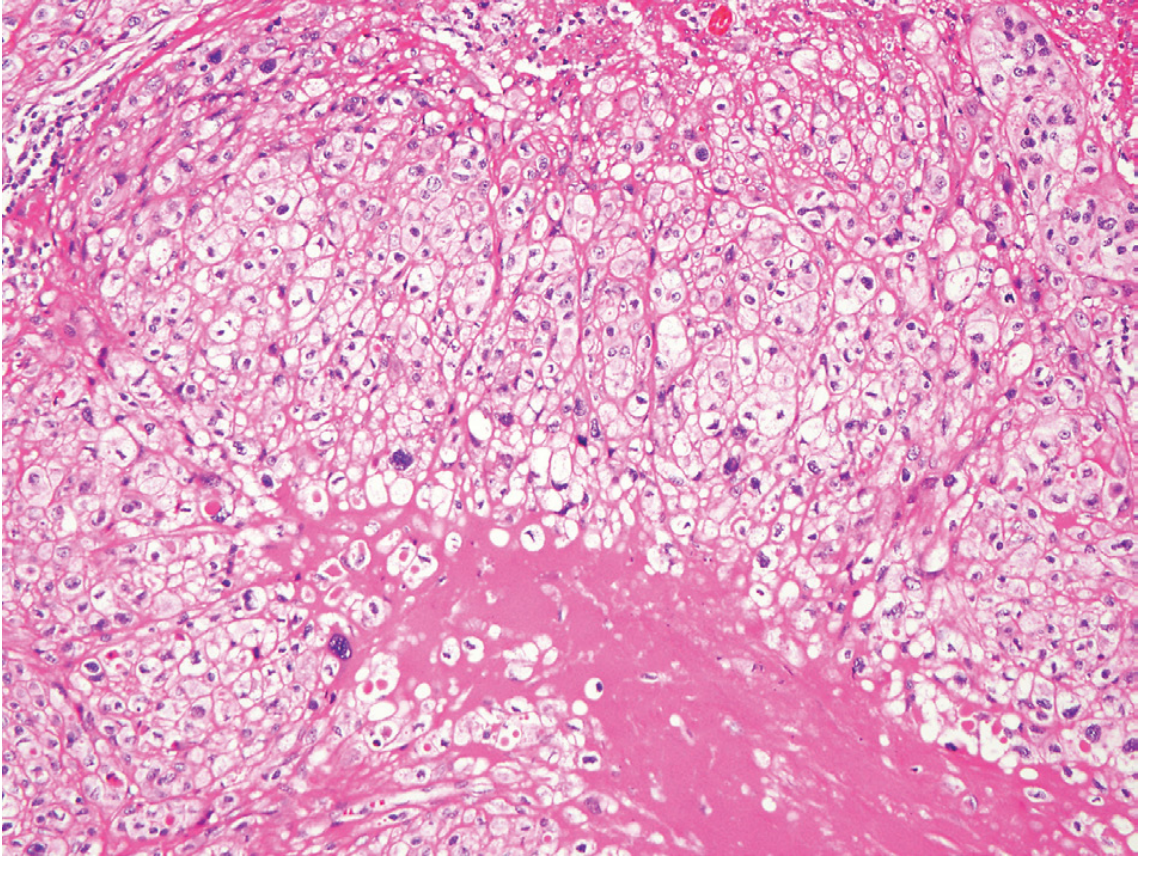
- Sheets of mononuclear trophoblast cells with abundant clear cytoplasm
- Characteristic pink hyaline material within the tumour
- Lacks the overt invasive/destructive features of PSTT
- Metastasises most commonly to lungs and bone
- ~10-15% of patients with metastatic disease eventually succumb
Summary Table
| Entity | Key Gross | Key Microscopy | hCG | Malignant potential |
|---|---|---|---|---|
| Complete Mole | Grape-like villi, distended uterus | All villi enlarged, cisterns, circumferential trophoblast hyperplasia | Very high | 2.5% → choriocarcinoma |
| Partial Mole | Focal villous swelling | Focal villi enlarged, scalloped outline, some normal villi | Moderately elevated | Low |
| Invasive Mole | Hydropic villi in myometrium | Villi + trophoblast invading muscle | Elevated | Local/metastatic |
| Choriocarcinoma | Haemorrhagic, necrotic uterine mass | Cyto + syncytiotrophoblast, NO villi, marked mitoses | Very high | High - but chemo-curable |
| PSTT | Uterine mass, no haemorrhage | Mononuclear extravillous trophoblasts, splits muscle fibres | Mildly elevated | 10-15% mortality |
| ETT | Intrauterine/cervical mass | Mononuclear cells, clear cytoplasm, hyaline material | Mildly elevated | 10-15% mortality |
Sources: Robbins, Cotran & Kumar - Pathologic Basis of Disease; Robbins & Kumar Basic Pathology (10th Ed.)
This is a shared conversation. Sign in to Orris to start your own chat.