
Describe the step and energetic ofbeta oxidation of palmitic
Reading File
Beta oxidation of palmitic acid (a 16-carbon saturated fatty acid) involves 7 cycles of the spiral, producing acetyl-CoA, NADH, and FADH2. The net ATP yield is around 106 ATP. Let me pull the full details from the medical library now.
Searching sources...
Finding Sources
Finding Sources
Finding Sources
Finding Sources
The Lippincott Biochemistry entry looks ideal. Let me read it along with the Ganong section.
Reading File
Reading File
Now let me read the detailed steps from Lippincott (the core beta-oxidation steps and energetics):
Reading File
Now let me get the four reaction steps in detail:
Reading File
Now let me fetch the key diagrams:
Loading Image
Loading Image
Excellent - I now have everything needed for a thorough answer with diagrams.
Beta-Oxidation of Palmitic Acid: Steps and Energetics
Palmitic acid (C16:0) is a 16-carbon saturated fatty acid and the most common fatty acid in the body. Its complete oxidation proceeds through activation, mitochondrial transport, 7 cycles of beta-oxidation, and entry of the products into the TCA cycle.
Phase 1 - Activation (Cytosol)
Palmitate is first converted to palmitoyl-CoA in the cytosol by long-chain fatty acyl-CoA synthetase (thiokinase) on the outer mitochondrial membrane:
Palmitate + CoA + ATP → Palmitoyl-CoA + AMP + PPi
The pyrophosphate (PPi) is immediately hydrolyzed by pyrophosphatase, making the reaction irreversible. This step costs 2 ATP equivalents (ATP → AMP + PPi).
Phase 2 - Transport into Mitochondria (Carnitine Shuttle)
The inner mitochondrial membrane is impermeable to CoA. Long-chain acyl groups are ferried across by the carnitine shuttle:
- CPT-I (carnitine palmitoyltransferase I, outer membrane): transfers the acyl group from CoA to carnitine, forming acylcarnitine. This is the rate-limiting step, inhibited by malonyl-CoA (fatty acid synthesis signal).
- Carnitine-acylcarnitine translocase: moves acylcarnitine into the matrix in exchange for free carnitine.
- CPT-II (inner membrane): transfers acyl group from carnitine back to CoA in the matrix, regenerating palmitoyl-CoA inside the mitochondrion.
Phase 3 - The Four Reactions of Each Beta-Oxidation Cycle
Each turn of the spiral shortens the acyl chain by 2 carbons and produces 1 acetyl-CoA, 1 FADH2, and 1 NADH.
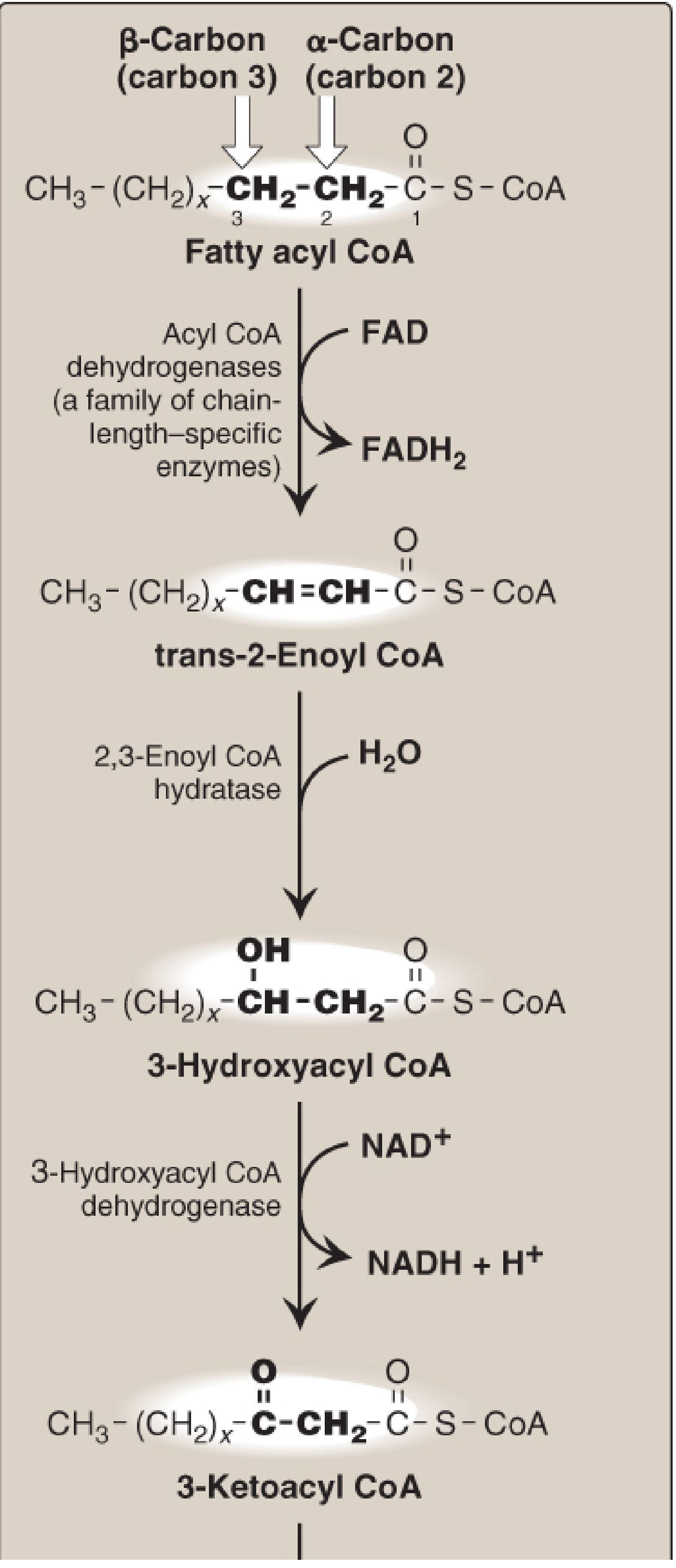
| Step | Reaction | Enzyme | Product |
|---|---|---|---|
| 1. Oxidation | Acyl-CoA → trans-2-Enoyl-CoA | Acyl-CoA dehydrogenase (FAD-linked) | FADH2 |
| 2. Hydration | trans-2-Enoyl-CoA + H2O → L-3-Hydroxyacyl-CoA | 2,3-Enoyl-CoA hydratase | -- |
| 3. Oxidation | L-3-Hydroxyacyl-CoA → 3-Ketoacyl-CoA | L-3-Hydroxyacyl-CoA dehydrogenase (NAD+-linked) | NADH |
| 4. Thiolysis | 3-Ketoacyl-CoA + CoA → Acyl-CoA (2C shorter) + Acetyl-CoA | β-Ketothiolase (thiolase) | Acetyl-CoA |
The shortened acyl-CoA then re-enters the cycle.
Phase 4 - Number of Cycles for Palmitate
Palmitate has 16 carbons. Each cycle cleaves off 2 carbons:
- 7 cycles are needed to fully degrade palmitoyl-CoA
- This produces 8 acetyl-CoA, 7 NADH, and 7 FADH2
Energetics: ATP Yield
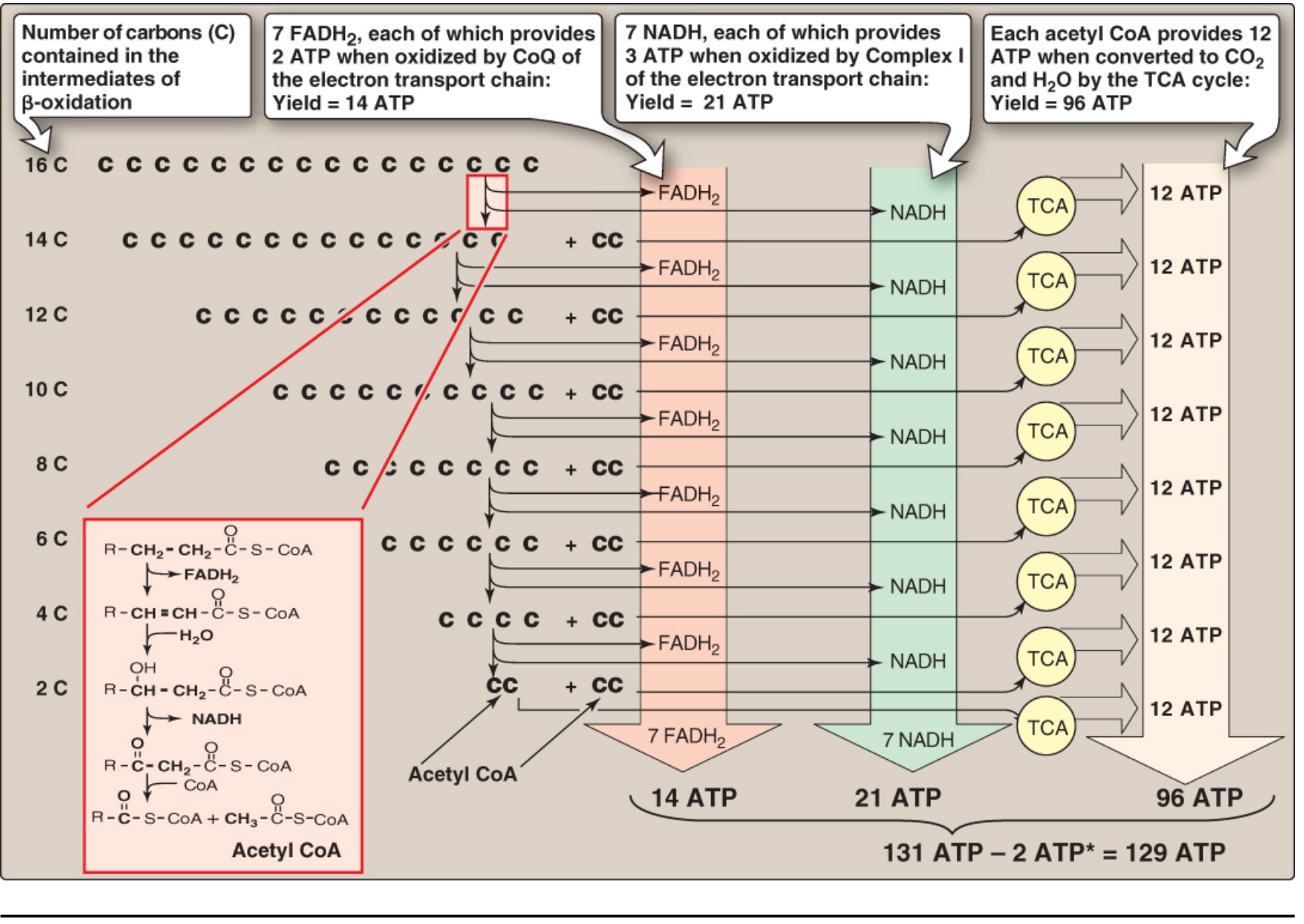
| Source | Number | ATP per molecule | Subtotal |
|---|---|---|---|
| FADH2 (from beta-oxidation) | 7 | 1.5 (via CoQ/Complex II) | ~14 ATP |
| NADH (from beta-oxidation) | 7 | 2.5 (via Complex I) | ~17.5 ATP |
| Acetyl-CoA (via TCA cycle) | 8 | 10 each | ~80 ATP |
Note: The diagram above uses slightly older values (2 ATP per FADH2 = 14, 3 ATP per NADH = 21, 12 ATP per acetyl-CoA = 96, total = 131 ATP gross). Modern P/O ratios give ~129 net by a different calculation, but the classic biochemistry course value is:
Gross ATP = 131
Minus activation cost = -2 ATP
Net ATP from palmitate = 129 ATP
Summary Table
| Parameter | Value |
|---|---|
| Starting material | Palmitoyl-CoA (16C) |
| Number of beta-oxidation cycles | 7 |
| Acetyl-CoA produced | 8 |
| FADH2 produced | 7 |
| NADH produced | 7 |
| ATP from FADH2 | 14 |
| ATP from NADH | 21 |
| ATP from 8 acetyl-CoA (TCA) | 96 |
| Gross ATP | 131 |
| Cost of activation | -2 |
| Net ATP | 129 |
Key Regulatory Points
- CPT-I is the rate-limiting step; malonyl-CoA (the first committed intermediate of fatty acid synthesis) inhibits it - this prevents futile cycling between synthesis and degradation.
- The acetyl-CoA/CoA ratio regulates thiolase: high ratio slows degradation.
- Insulin (fed state) promotes fatty acid synthesis, raising malonyl-CoA and inhibiting beta-oxidation. Glucagon/low insulin (fasted state) promotes beta-oxidation.
Sources: Lippincott's Illustrated Reviews: Biochemistry, 8th ed. (Figs. 16.17, 16.18); Ganong's Review of Medical Physiology, 26th ed.
This is a shared conversation. Sign in to Orris to start your own chat.