
Give brief notes about zinc uses, mechanism , indications , treatment and complications from all the standard textbooks available and recent advances in India, as this is for my ppt presentation
zinc supplementation therapy
zinc deficiency treatment recent advances India 2024 2025
zinc deficiency acrodermatitis enteropathica skin rash perioral
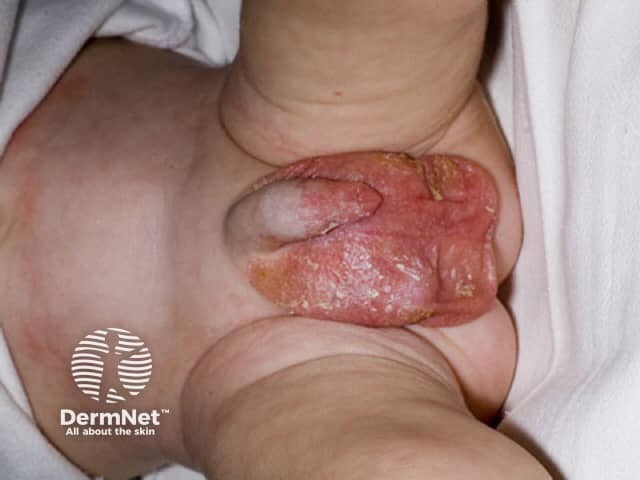
Clinical photograph of an infant displaying periorificial dermatitis associated with acrodermatitis enteropathica (zinc deficiency). This frontal close‑up captures the perioral and periorificial skin with erythematous, scaly plaques, crusting, and fissuring at the oral commissures and surrounding lips. The involved skin is inflamed with a rough, desquamative surface and mild edema; epidermal scaling may be greasy or flaky. Distribution is predominantly periorificial, a pattern typical of zinc‑deficiency dermatitis, though acral involvement may occur in some cases. The image illustrates a classic mucocutaneous eruption seen in congenital/genetic AAC (SLC39A4) or acquired zinc deficiency, and may accompany accompanying symptoms such as diarrhea, irritability, and alopecia in certain patients. Pathophysiology centers on impaired zinc transport and keratinocyte dysfunction, leading to compromised barrier integrity and inflammatory ceruminous changes at skin junctions. Clinically, the finding supports a diagnosis of zinc deficiency dermatitis; zinc level and alkaline phosphatase testing can confirm, and rapid improvement after zinc supplementation is characteristic. Differential diagnoses include seborrheic dermatitis, atopic dermatitis, contact dermatitis, and candidiasis. This image is valuable for education, aiding recognition, differential diagnosis, and monitoring therapeutic response in pediatric dermatology and nutrition clinics. This resource supports clinical documentation and searchable educational annotation.
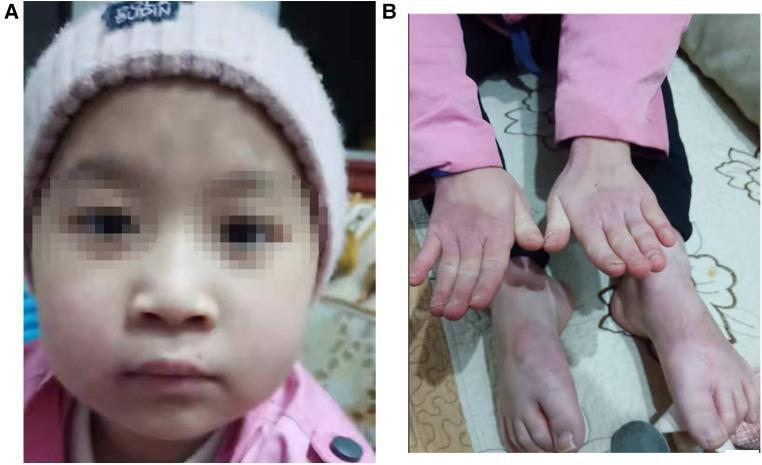
Two clinical photographs (A and B) illustrating the physical manifestations of acrodermatitis enteropathica (AE) in a pediatric patient following treatment initiation. Image A displays a front-facing view of the child's face, specifically highlighting the perioral region. Although pixelated for privacy, a distinct erythematous (red) rash is visible surrounding the mouth, characteristic of the perioral distribution seen in zinc deficiency disorders. Image B shows the patient's hands and feet, demonstrating the acromelic distribution of the disease. Erythematous, pink-to-red inflammatory patches are visible on the dorsal surfaces of the hands and feet. The visual evidence supports the classic triad of AE: dermatitis (perioral and acral), alopecia (partially obscured by a hat), and historical diarrhea, though these images focus on the post-treatment dermatological resolution. The clinical significance of these photos lies in documenting the characteristic distribution of lesions in SLC39A4-related zinc malabsorption and the subsequent cutaneous improvement after zinc supplementation.
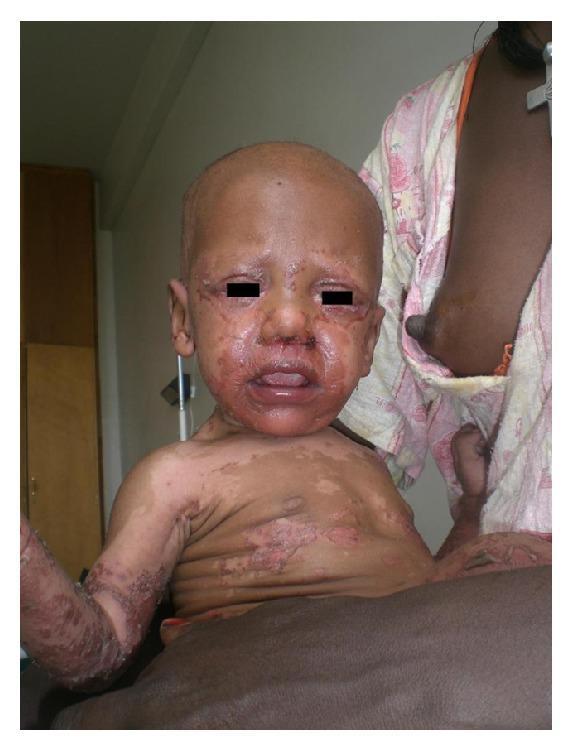
This clinical photograph displays a pediatric patient with an extensive, severe presentation of acrodermatitis enteropathica. The image illustrates a characteristic periorificial distribution of skin lesions, with dense involvement of the perioral, perinasal, and periocular regions. The morphology of these lesions includes confluent, well-defined erythematous plaques accompanied by erosions and thick brown crusting, indicative of disease progression or secondary bacterial superinfection. Beyond the facial involvement, the photograph demonstrates widespread, symmetrical distribution across the trunk and upper extremities, particularly affecting the chest and arms. The patient also exhibits diffuse alopecia, a common systemic finding associated with zinc deficiency. This visual serves as an educational reference for identifying the classic triad of acrodermatitis enteropathica: periorificial dermatitis, diarrhea (implied clinically), and alopecia. It is highly relevant for pediatric dermatology and nutritional medicine specialties, showcasing the advanced cutaneous manifestations of hereditary or acquired zinc malabsorption.
ZINC - Comprehensive PPT Notes
SLIDE 1: Overview & Biochemistry
- Second most abundant trace element in the body after iron (total body content: 2-2.5 g)
- Present in ALL metabolically active tissues; ~55% in muscle, ~30% in bone
- Prostate, semen, and retina have exceptionally high local concentrations
- Acts as a "master hormone" in relation to cell division and growth
- Atomic number 30; Zn²⁺ ion has a stable, filled 3d electron shell - NO redox reactions possible; minimal ROS risk
- ~3,000 zinc-containing metalloproteins in the human body
- Most are transcription factors and DNA/RNA-binding proteins containing "zinc finger" domains
- Zinc fingers: Zn²⁺ stabilizes polypeptide loop via coordination with 2 cysteine + 2 histidine residues
- Confer sequence-specific polynucleotide binding
SLIDE 2: Mechanisms / Functions
- Carbonic anhydrase II
- Carboxypeptidase A
- Alkaline phosphatase (↓ ALP = early marker of Zn deficiency)
- Alcohol dehydrogenase
- Superoxide dismutase (cytosolic form)
- Adenosine deaminase, phospholipase C, leucine aminopeptidase
- Exploits Lewis acid properties: stabilizes negatively charged intermediates, polarizes carbonyl groups, enhances nucleophilicity of water
- Zinc transporter families: ZnT (9 members, zinc exporters) and ZIP (Zrt/Irt-like proteins, zinc importers)
- ZNT1 exports zinc from enterocytes; expression rises with zinc supplementation
- Metallothionein (MT): intracellular metal-binding protein, binds up to 7 zinc molecules; regulates zinc storage and buffering
- Regulates lipid, protein, and nucleic acid synthesis and degradation
- Required for T-cell, neutrophil, and natural killer (NK) cell function
- Zinc deficiency impairs cell-mediated immunity
- Role in wound healing (formation and cross-linking of collagen)
- Night vision (mobilizes hepatic retinol stores; Zn deficiency → nyctalopia)
- Taste sensation (hypogeusia in deficiency)
- Spermatogenesis / gonadal function
SLIDE 3: Dietary Sources & Absorption
- Shellfish (esp. oysters) > Red meat > Fish > Eggs > Dairy
- Legumes, wheat germ, whole bran (moderate, but reduced by milling)
- Fruits, refined carbohydrates - very little zinc
- Adults: ~12-15 mg/day (RDA); higher in pregnancy and lactation
- US median intake: men ~14 mg/day, women ~9 mg/day
- Net intestinal absorption: 20-50% of dietary content (variable)
- At normal intake (12 mg/day): ~26% absorbed; at very low intake (0.23 mg/day): up to 100% (adaptive upregulation)
- Two uptake processes in intestinal BBM: (1) active saturable carrier-mediated (dominates at normal/low intake); (2) nonsaturable diffusive (higher intake)
- Phytates (cereal grains, legumes, nuts) - MAJOR inhibitor
- Dietary fiber, oxalates, calcium (competitive inhibition)
- Excess dietary iron and copper
- Drugs: penicillamine, sodium valproate, ethambutol
- Animal protein (amino acids and small peptides facilitate enterocyte uptake)
- Zinc-binding ligand in human breast milk
- Absorbed Zn → portal circulation → liver (incorporation into metalloenzymes)
- Plasma Zn: ~80% bound to albumin, ~20% to α₂-macroglobulin and transferrin; <1% ultrafilterable (free)
- Normal plasma Zn: 80-120 μg/dL (12-18 μmol/L)
- Primarily fecal (via pancreatic and intestinal secretions)
- Urinary: ~0.5 mg/day normally; markedly increases in catabolic illness (skeletal muscle release)
SLIDE 4: Zinc Deficiency - Causes & Risk Groups
- Acrodermatitis Enteropathica (AE): Autosomal recessive; mutations in SLC39A4 gene encoding ZIP4 transporter; presents on weaning from breast milk
- Diets high in phytate (cereal-based diets) - endemic in parts of the Middle East, North Africa, rural India
- Anorexia nervosa, food faddism, alcoholism (poor intake + increased urinary excretion)
- Inflammatory bowel disease (Crohn's disease, UC)
- Cystic fibrosis
- Short bowel syndrome / GI surgery
- Graft-versus-host disease
- Cholestatic liver disease
- Nephrotic syndrome (urinary zinc loss)
- Extensive cutaneous burns or generalized exfoliative dermatoses
- Excessive sweating
- Alcoholism (renal excretion)
- Catabolic states: surgery, trauma, sepsis, malignancy
- Prolonged total parenteral nutrition (TPN) without adequate zinc
- Penicillamine therapy in Wilson's disease
- Ornithine transcarbamylase deficiency
- Premature infants (inadequate stores, high requirement)
- Exclusively breastfed infants (breast milk Zn falls after 1-2 months)
- Pregnant and lactating women
- Elderly (reduced energy and dietary intake)
- HIV/AIDS patients
- Diabetes mellitus, sickle cell disease, cirrhosis
SLIDE 5: Clinical Features (Indications for Testing/Treatment)
- Periorificial + acral dermatitis
- Diarrhea
- Alopecia (diffuse)
- Distribution: perioral, perigenital, perianal, perinasal, acral (hands/feet), flexures
- Morphology: vesiculobullous, pustular (often flaccid → crusting), eczematous/psoriasiform plaques
- Nail dystrophy: thinning, longitudinal ridges
- Angular cheilitis, stomatitis
- Poor wound healing
- Burning mouth syndrome (low serum Zn found in many patients)
- Children: growth retardation, stunting, hypogonadism, dwarfism (especially in severe chronic deficiency)
- Neurological: irritability, emotional lability, depression, cognitive impairment
- Impaired taste (hypogeusia) and smell
- Night blindness (nyctalopia)
- Increased susceptibility to infections (impaired cell-mediated immunity)
- Hypogonadism in males (in severe deficiency)
- Ocular involvement in some cases
- Vacuolation of keratinocytes in upper stratum malpighii (stratum spinosum)
- Confluent vacuolation → subcorneal bulla formation
- Identical histology in both inherited and acquired zinc deficiency
SLIDE 6: Diagnosis & Laboratory
- Diagnosis: serum zinc <12 μmol/L (<70 μg/dL); values 5-10% higher in serum vs. plasma
- Normal range: 80-120 μg/dL (Tietz)
- Caution: levels fall transiently with acute illness/surgery/stress, hypoalbuminemia (zinc redistribution, not true deficiency)
- Pregnancy and OCP use may depress serum Zn levels
- Serum alkaline phosphatase (ALP): Low ALP in a zinc-dependent enzyme - helpful when Zn level is borderline/normal
- Hair zinc: Long-term status indicator
- Erythrocyte zinc: Long-term assessment (RBC Zn ~10× plasma levels)
- 24-hour urinary zinc: Elevated in renal wasting conditions; decreased in dietary deficiency
- Clinical response to zinc supplementation (classic approach, especially when serum Zn is borderline)
SLIDE 7: Treatment
| Indication | Dose |
|---|---|
| Acquired zinc deficiency (adult) | 60 mg elemental zinc twice daily (Harrison's) |
| Genetic AE (children) | 3 mg/kg/day elemental zinc, lifelong |
| Acquired AE (children) | 1-2 mg/kg/day (50 mg elemental zinc per 220 mg zinc sulfate tablet); can stop once diet corrected |
| Diarrhea in children ≥6 months (WHO/Harrison's) | 20 mg/day until recovery |
| Common cold (Zinc gluconate lozenges) | 13 mg elemental zinc every 2 hours while awake (evidence conflicting; Cochrane 2024) |
- Zinc sulfate (most common; oral)
- Zinc gluconate (lozenges, syrups)
- Zinc acetate
- Injectable zinc (for TPN; shortage has been reported causing deficiency in premature infants)
- Address underlying cause in acquired cases (malabsorption, diet modification)
- Monitor copper levels during prolonged high-dose zinc supplementation
- Dietary modification: increase meat, shellfish, legumes, whole grains; reduce phytate-heavy diets
SLIDE 8: Complications / Toxicity
- Nausea and vomiting (most common)
- Fever
- Zinc fume fever (occupational - welders): fever, respiratory distress, excessive salivation, sweating, headache
- Dose range causing toxicity: 150-450 mg/day
- Copper deficiency - most important complication (competitive inhibition of common divalent cation transporter)
- Leads to hypochromic anemia (refractory to iron), neurological deficits
- Seen with zinc-based denture adhesives (excess use), high-dose supplements
- Immunosuppression - paradoxically, excess zinc depresses immune function
- Anosmia - irreversible; from intranasal zinc preparations (avoid completely)
- Iron deficiency anemia (competitive inhibition)
SLIDE 9: Recent Advances & India-Specific Context
- Zinc deficiency is widespread in India due to predominantly cereal/phytate-rich diets
- Soil zinc deficiency in Indian agricultural land is well documented; zinc fertilizer demand in India was 285,000 tonnes (projected to rise to 347,000 tonnes by 2035) - directly affects food chain zinc content (Frontiers in Soil Science, 2024)
- ICMR (2020) has published updated Dietary Reference Values for zinc for Indians
- Zinc deficiency commonly coexists with iron deficiency in Indian children and women
- Zinc & Pediatric Diarrhea (Meta-analysis, PMID 39641338, 2024): Systematic review and meta-analysis confirms zinc supplementation significantly reduces duration and severity of acute and persistent watery diarrhea in children - continues to support WHO ORS + Zinc protocol
- Zinc & Common Cold (Cochrane, PMID 38719213, 2024): Zinc (lozenges/syrup) may reduce duration of common cold symptoms; evidence for prevention remains uncertain
- Zinc & Pediatric GI Disease (PMID 37836377, 2023): Systematic review validates therapeutic role of zinc in pediatric IBD, celiac disease, short bowel syndrome
- Zinc deficiency after bariatric surgery (Indian Journal of Surgery, 2025): Risk increases progressively at 6 months, 1 year, 2 years post-surgery; serum Zn drops ~9.4% at 1 year post-sleeve gastrectomy - routine post-bariatric zinc monitoring now recommended
- Zinc fingers in gene therapy: Research into engineered zinc-finger nucleases as sequence-specific gene editing tools (pre-CRISPR technology, still under development; Harper's Biochemistry 32E)
- Neonatal zinc deficiency alerts: CDC-reported shortage of injectable zinc causing deficiency dermatitis in cholestatic premature infants - highlights need for robust zinc supplementation protocols in NICUs
- Zinc as an immunomodulator in COVID-19 and respiratory infections
- Zinc biofortification of staple crops (wheat, rice) as a public health strategy in India
- Zinc-chelating peptides from marine sources (sea cucumber) being explored as novel high-bioavailability supplements
- Role of zinc in telomere maintenance and healthy aging - Zn deficiency linked to increased short telomeres and premature cellular apoptosis
SLIDE 10: Clinical Image - Acrodermatitis Enteropathica
Quick Reference Summary Table
| Parameter | Key Point |
|---|---|
| Body content | 2-2.5 g total; 2nd most abundant trace element |
| Metalloenzymes | >200 (alkaline phosphatase, carbonic anhydrase, alcohol dehydrogenase, etc.) |
| Plasma level | 80-120 μg/dL (normal) |
| Deficiency threshold | <70 μg/dL (<12 μmol/L) |
| Classic inherited deficiency | Acrodermatitis enteropathica (SLC39A4/ZIP4 mutation) |
| Classic triad | Dermatitis + Diarrhea + Alopecia |
| Treatment - adults | 60 mg elemental zinc BID oral |
| Treatment - genetic AE | 3 mg/kg/day, lifelong |
| Treatment - child diarrhea | 20 mg/day (WHO protocol) |
| Toxicity concern | Copper deficiency (>150 mg/day chronic) |
| India burden | Phytate-rich diet + zinc-poor soil = widespread subclinical deficiency |
- Harrison's Principles of Internal Medicine 22E (2025) - Chapter 344
- Andrews' Diseases of the Skin - Clinical Dermatology (Chapter 22)
- Fitzpatrick's Dermatology Vol 1&2
- Dermatology 2-Volume Set 5E (Bolognia)
- Tietz Textbook of Laboratory Medicine 7E (Chapter 39)
- Sleisenger & Fordtran's Gastrointestinal and Liver Disease
- Yamada's Textbook of Gastroenterology 7E
- Harper's Illustrated Biochemistry 32E (Chapter 10)
- Henry's Clinical Diagnosis and Management by Laboratory Methods
- Recent PubMed: PMIDs 39641338, 38719213, 37836377
- Indian Journal of Surgery 2025 (post-bariatric zinc deficiency)