
Describe IMNCI case management process using acute respiratory infection as example according to park
Reading File
Now let me search the library for IMNCI content in Park's textbook.
Finding Sources
Finding Sources
Reading File
Reading File
Reading File
Reading File
Now let me get the detailed IMNCI case management process and the ARI-specific section from Park's:
Finding Sources
Reading File
Finding Sources
Finding Sources
Finding Sources
Finding Sources
Excellent! The key content is in block3. Let me now read the detailed ARI/IMNCI case management content:
Reading File
Reading File
Reading File
Reading File
Reading File
Reading File
I now have comprehensive content from Park's textbook. Let me also fetch the key IMNCI flowchart image:
Loading Image
I now have all the content needed for a comprehensive answer. Let me compile the full response.
IMNCI Case Management Process - According to Park's Textbook of Preventive and Social Medicine
Background: What is IMNCI?
The Integrated Management of Neonatal and Childhood Illness (IMNCI) is the Indian adaptation of the WHO/UNICEF's IMCI strategy. It is renamed "IMNCI" because India extended the programme to include the first 7 days of life. It is the central pillar of child health interventions under the RCH-II/NRHM strategy.
Key highlights of the Indian adaptation:
- Inclusion of 0-7 days age group in the programme
- Incorporates national guidelines on malaria, anaemia, vitamin-A supplementation and immunization
- Training of health personnel begins with sick young infants up to 2 months
- Almost equal proportion of training time for sick young infant and sick child
- Is skill-based
The strategy has three main components:
- Improvement in case-management skills of health staff through locally adapted IMNCI guidelines
- Improvements in the health system for effective management of childhood illness
- Improvements in family and community practices
The Integrated Case Management Process
The case management process is illustrated in Fig. 13 of Park's:
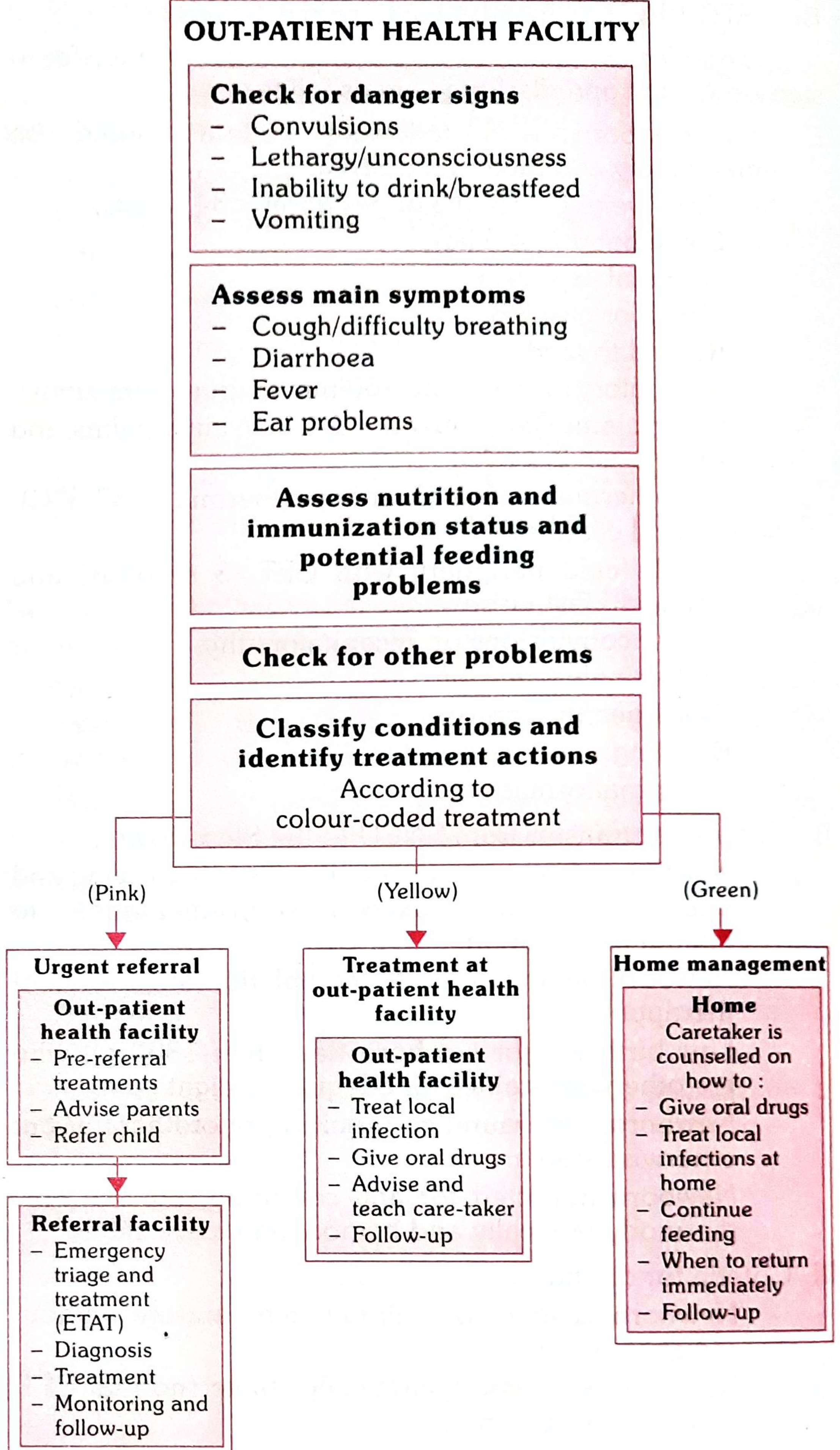
The complete IMNCI case management process involves the following six steps (Park's, Ch. 8):
Step A: ASSESS
Check for danger signs first, then ask about common conditions, examine the child, and check nutrition and immunization status.
General danger signs (any one = Very Severe Disease):
- Not able to drink or breastfeed
- Convulsions
- Abnormally sleepy or difficult to wake
- Vomiting everything
Step B: CLASSIFY (Colour-coded triage)
Each illness is classified using a 3-colour system:
| Colour | Meaning | Action |
|---|---|---|
| Pink | Urgent pre-referral treatment needed | Refer urgently to hospital |
| Yellow | Specific medical treatment needed | Treat at outpatient health facility |
| Green | Simple home management | Counsel caretaker, home care |
Step C: TREAT
After classifying, identify specific treatments. Give first dose of drugs in the clinic. If referral is needed, give pre-referral treatment before transfer.
Step D: COUNSEL
Teach the caretaker how to give oral drugs, how to feed and give fluids during illness, and how to treat local infections at home. Advise when to return immediately and schedule a follow-up date.
Step E: ASSESS FEEDING & NUTRITIONAL STATUS
Assess breast-feeding practices, counsel to solve feeding problems, and counsel the mother about her own health.
Step F: FOLLOW-UP
When the child is brought back as requested, give follow-up care and reassess for new problems.
ARI as an Example of the Case Management Process
ARI (cough or difficult breathing) is one of the five core IMCI conditions. The process unfolds as follows:
STEP 1 - History Taking
- Age of the child
- Duration of cough
- Ability to drink (in child 2 months to 5 years); stopped feeding well (in child < 2 months)
- History of measles, fever, convulsions
- Excessive drowsiness or difficulty to wake
- Irregular breathing or periods of apnoea
STEP 2 - Physical Examination (Assess)
Look and listen for:
(1) COUNT BREATHS IN ONE MINUTE - Fast breathing thresholds:
| Age | Fast Breathing |
|---|---|
| < 2 months | ≥ 60 breaths/minute |
| 2 months to < 12 months | ≥ 50 breaths/minute |
| 12 months to < 5 years | ≥ 40 breaths/minute |
Note: In young infants, repeat the count if ≥ 60/minute, as their breathing is often erratic.
(2) LOOK FOR CHEST INDRAWING - Lower chest wall goes IN when child breathes in. Indicates greater effort to breathe. In young infants, mild chest indrawing is normal due to soft chest wall bones.
(3) LOOK AND LISTEN FOR STRIDOR - Harsh noise on breathing IN; caused by narrowing of larynx, trachea or epiglottis (croup).
(4) LOOK FOR WHEEZE - Soft whistling noise on breathing OUT; caused by narrowing of lower air passages. If recurrent wheezing (> 1 episode in past year), classify as recurrent wheeze.
(5) Assess level of consciousness - Abnormally sleepy or difficult to wake
(6) Feel for fever or low body temperature
STEP 3 - Classify (for child 2 months to 5 years)
TABLE 3 - Management of Pneumonia (2 months to 5 years):
| Signs | Classification | Treatment |
|---|---|---|
| Chest indrawing (first episode) | SEVERE PNEUMONIA (Pink) | Refer URGENTLY; first dose antibiotic; treat fever/wheeze if present |
| Fast breathing, NO chest indrawing | PNEUMONIA - not severe (Yellow) | Home care + oral antibiotic; treat fever/wheeze; return in 2 days |
| No chest indrawing AND no fast breathing | NO PNEUMONIA: Cough or Cold (Green) | Home care; treat fever/wheeze; if cough > 30 days, refer for assessment |
For Very Severe Disease (any danger sign present):
| Signs | Classification | Treatment |
|---|---|---|
| Unable to drink, convulsions, abnormally sleepy, stridor in calm child, or severe malnutrition | VERY SEVERE DISEASE (Pink) | Refer URGENTLY; first dose antibiotic; treat fever; treat wheeze |
STEP 4 - Classify (for young infant < 2 months)
In young infants, fast breathing cut-off is ≥ 60 breaths/minute. Any pneumonia in a young infant is considered severe and requires immediate hospital referral.
TABLE 4 - Classification for young infant:
| Signs | Classification |
|---|---|
| Fast breathing (≥ 60/min) | SEVERE PNEUMONIA |
| No fast breathing (< 60/min) | NO PNEUMONIA |
Severe signs in young infants include: convulsions/abnormally sleepy, stridor when calm, severe chest indrawing, grunting, poor feeding, cyanosis.
STEP 5 - Treat
(A) Pneumonia in child 2 months to 5 years:
- First-line: Oral Amoxicillin or Co-trimoxazole for 5 days (home treatment)
- If condition worsens or does not improve after 48 hours: switch to IM injections of cloxacillin and gentamycin
(B) Severe pneumonia (2 months to 5 years):
- Urgent referral to hospital
- Pre-referral: first dose of antibiotic
(C) Pneumonia in young infant < 2 months:
- Must be hospitalized
- Co-trimoxazole may be started before referring
- In hospital: IM Benzyl Penicillin OR Ampicillin AND Gentamycin as per Table 7
| Antibiotic | Dose | Age < 7 days | Age 7 days to 2 months |
|---|---|---|---|
| Inj. Benzyl Penicillin OR | 50,000 IU/kg/dose | 12 hourly | 6 hourly |
| Inj. Ampicillin AND | 50 mg/kg/dose | 12 hourly | 8 hourly |
| Inj. Gentamycin | 2.5 mg/kg/dose | 12 hourly | 8 hourly |
(D) No Pneumonia (AURI - Cough or Cold):
- Antibiotics NOT recommended (majority viral; increase resistance; no clinical benefit)
- Symptomatic treatment and home care only
- Counsel the mother on home care
STEP 6 - Reassessment (Follow-Up) at 2 Days
For a child on oral antibiotics for pneumonia:
| Assessment | Signs | Action |
|---|---|---|
| Worse | Unable to drink, chest indrawing, other danger signs | Refer URGENTLY |
| The same | No improvement | Change antibiotic OR refer |
| Improving | Breathing slower, less fever, eating better | Finish 5 days of antibiotic |
STEP 7 - Counsel (Home Care for ARI)
- Continue breast-feeding and fluids
- Soothe the throat with a safe remedy (e.g. honey in water or warm tea for children ≥ 1 year)
- Clear the nose if it interferes with feeding
- Do NOT give: anti-histamines, decongestants, cough suppressants
- When to return immediately: if child becomes unable to drink, breathing worsens, develops fast breathing, or is not improving after 2 days
Summary: Why ARI Illustrates IMNCI Well
ARI demonstrates the IMNCI logic perfectly because:
- The same presenting complaint (cough/breathing difficulty) can range from a simple cold (Green) to severe life-threatening pneumonia (Pink), requiring very different actions
- The same symptoms in different age groups (< 2 months vs 2 months to 5 years) are classified differently
- Overlapping conditions (wheezing, fever, malnutrition) are addressed simultaneously - the hallmark of the integrated approach
- The colour-coded system guides a first-level health worker to make rational, standardized treatment decisions without requiring advanced diagnostics
Source: Park's Textbook of Preventive and Social Medicine, Chapter 11 (ARI) and Chapter 8 (IMNCI/IMCI)
Give me this in the form of flow chart pdf
Your credits are exhausted. You can purchase a top-up or subscribe to a plan to continue using Orris. If you're already subscribed, your daily credits will reset tomorrow.
This is a shared conversation. Sign in to Orris to start your own chat.