
Management of severe painful nodulocystic acne
I'll read the medical library skill first, then research this topic in parallel.
Reading File
Now I'll search the library and PubMed in parallel.
Finding Sources
Finding Sources
Searching PubMed
"nodulocystic acne" OR "severe acne" AND isotretinoin management
Let me search with broader terms to find relevant textbook sections.
Finding Sources
Searching PubMed
"acne vulgaris"[MeSH Terms] AND isotretinoin[MeSH Terms]
Excellent - I found great sources. Now let me read the most relevant textbook sections in parallel.
Reading File
Reading File
Finding Sources
Reading Article
PMID: 38300170
Now let me read the key sections from Harrison's and the Dermatology textbook for detailed management info.
Reading File
Reading File
Reading File
Let me read a bit more from Harrison's for the management details, and the Dermatology textbook for isotretinoin section on nodulocystic acne.
Reading File
Reading File
Reading File
Now let me get more details on monitoring, side effects, special considerations, and intralesional corticosteroids.
Finding Sources
Finding Sources
Finding Sources
Reading File
I now have comprehensive data from multiple authoritative sources. Let me fetch a relevant clinical image and compose the full answer.
Loading Image
I now have comprehensive information from multiple authoritative textbooks and the 2024 JAAD guidelines. Here is the full, structured answer:
Management of Severe Painful Nodulocystic Acne
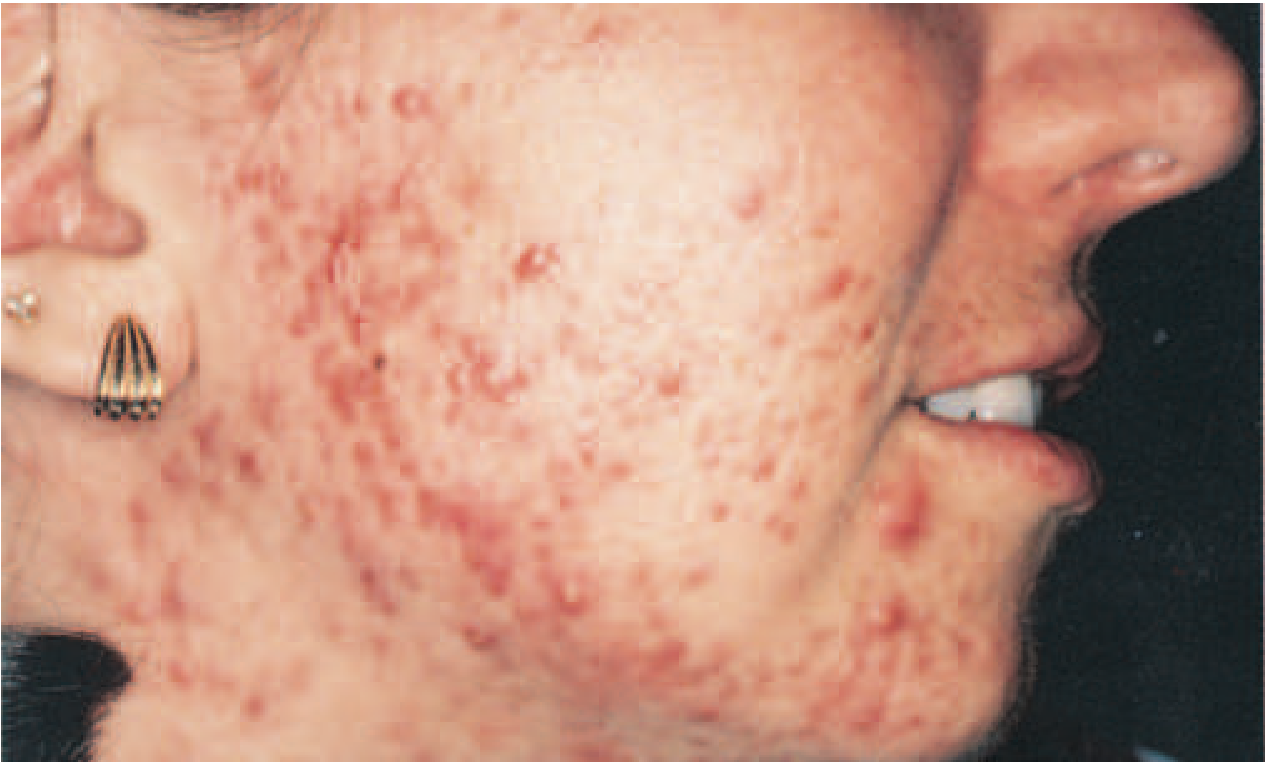
Pathophysiology (Brief)
Nodulocystic acne represents the most severe end of the acne spectrum. Four key factors converge:
- Follicular hyperkeratosis causing microcomedone formation
- Androgen-driven sebum hypersecretion
- Proliferation of Cutibacterium acnes within the comedone
- Rupture of the cyst wall triggering a foreign-body inflammatory reaction in the dermis, producing deep, painful nodules and cysts
Graded Management Approach
Step 1: Systemic Antibiotics + Topical Combination (While Preparing for Isotretinoin)
While isotretinoin is being arranged (or as a bridge for moderate-severe cases), use:
| Agent | Dose | Notes |
|---|---|---|
| Doxycycline | 100 mg BD or low-dose extended release | Anti-inflammatory independent of antibacterial effect |
| Minocycline | 100 mg BD | Alternative; risk of autoimmune side effects with prolonged use |
| Benzoyl peroxide (topical 2.5-5%) | Apply daily | Prevents C. acnes resistance; used alongside all topical antibiotics |
| Topical retinoid (tretinoin/adapalene) | Applied to entire face nightly | Normalizes follicular keratinization |
| Topical clindamycin | Applied BD | Always combine with BP to prevent resistance |
Systemic antibiotics should not be used as monotherapy, and their duration should be limited to reduce resistance. Reassess at 3 months.
Step 2: Oral Isotretinoin - The Cornerstone of Treatment
Oral isotretinoin (13-cis-retinoic acid) is the first-line treatment for severe nodulocystic acne and the only medication that targets all four pathogenic factors simultaneously - sebum production, comedogenesis, C. acnes colonization, and inflammation. It is FDA-approved since 1982 specifically for severe, nodulocystic acne refractory to oral antibiotics.
Dosing Protocol
| Phase | Dose | Rationale |
|---|---|---|
| Month 1 (initiation) | 0.25-0.5 mg/kg/day | Reduces initial flare risk; allows adjustment to side effects |
| Months 2 onwards | 0.5-1 mg/kg/day (with fatty meal) | Standard therapeutic dose |
| Target cumulative dose | 120-150 mg/kg | Minimizes relapse risk; minimal extra benefit beyond 150 mg/kg |
- One formulation (lidose-isotretinoin) can be taken without food.
- Approximately 95% of patients achieve a good clinical response after 20 weeks.
- About one-third require a second course for persistent or relapsed disease.
Predicting Relapse Risk
Higher relapse risk: male sex, young age, short treatment duration, low cumulative dose, closed comedonal/microcystic acne, PCOS. In women with PCOS-associated refractory acne, rule out hyperandrogenemia (ovarian/adrenal source) before attributing treatment failure to inadequate dosing.
Step 3: Adjunctive Measures for Painful Nodules/Cysts
Intralesional triamcinolone acetonide (2-5 mg/mL, ~0.1 mL per lesion) provides rapid relief of pain and swelling in individual large, inflamed nodules and cysts. This is highly effective for acute painful lesions while systemic therapy takes effect (isotretinoin has a 1-3 month lag before onset). Larger cysts may need incision and drainage prior to injection.
- Risks: hypopigmentation (especially in darker skin tones), dermal atrophy, telangiectasia.
Step 4: Hormonal Therapy (Women)
| Agent | Use |
|---|---|
| Combined oral contraceptives (COCs) | Several are FDA-approved for acne; address androgenic drive |
| Spironolactone | Safe, effective, durable antiandrogen for women; increasingly first-line in adult female acne |
| Clascoterone cream (topical antiandrogen) | FDA-approved; blocks androgen receptor at the follicle |
Spironolactone is particularly valuable in women whose acne fails antibiotics or who need a non-teratogenic alternative to isotretinoin. A 2025 meta-analysis (PMID: 39912292) confirmed spironolactone is effective for moderate-to-severe acne in adult women.
Step 5: Managing Acne Fulminans (Most Severe Complication)
Acne fulminans is the most extreme presentation - sudden onset, ulcerating, hemorrhagic nodulo-cystic acne with systemic features (fever, arthralgia, leukocytosis). It can also be triggered iatrogenically by isotretinoin initiation.
Treatment: Oral isotretinoin + low-dose oral corticosteroid (e.g., prednisolone 0.5 mg/kg/day) to suppress the intense inflammatory cascade before isotretinoin is introduced at low dose.
Isotretinoin: Monitoring and Safety
Pre-treatment (Mandatory)
- Pregnancy tests: Two negative tests before starting (US iPLEDGE program requirement)
- Fasting lipid panel and liver function tests (LFTs)
- Enrolment in iPLEDGE (US) or equivalent national pregnancy risk management program
Ongoing Monitoring
| Parameter | Frequency |
|---|---|
| Pregnancy test | Monthly (all women of childbearing potential) |
| Fasting lipids (TG, cholesterol) | Monthly for first 2 months, then as indicated |
| LFTs | Monthly for first 2 months |
| Creatine kinase (athletes) | If symptomatic myalgia |
Common Dose-Dependent Side Effects
- Mucocutaneous: Cheilitis (nearly universal), xerosis, dry eyes/nasal mucosa, skin fragility - manage with emollients and lip balm
- Musculoskeletal: Myalgias, low back pain
- Metabolic: Hypertriglyceridaemia (~20-50%), mild transaminase elevation
- Ocular: Decreased night vision, dry eyes - ophthalmology if severe
Contraindications
- Pregnancy (Category X teratogen - causes craniofacial, cardiac, CNS defects)
- Effective contraception mandatory: 1 month before, during, and 1 month after therapy
- Hypervitaminosis A or concurrent tetracycline use (pseudotumor cerebri risk)
Debunked Associations
Meta-analyses show no established causal association between isotretinoin and depression/suicide, and no association with inflammatory bowel disease. - Dermatology 2-Volume Set 5e, p. 731
Maintenance After Isotretinoin
Topical retinoid ± benzoyl peroxide following completion reduces recurrence rate. Note that associated scarring and sinus tracts do not respond to isotretinoin - these require surgical modalities.
Surgical/Procedural Options
| Procedure | Indication |
|---|---|
| Intralesional triamcinolone (2-5 mg/mL) | Acute painful nodules/cysts |
| Incision and drainage | Large fluctuant cysts before injection |
| Comedo extraction | Persistent open/closed comedones (not inflamed) |
| Chemical peels (glycolic/salicylic acid) | Adjunct for comedonal component |
| Photodynamic therapy (5-ALA + blue/red light) | Adjunct for inflammatory acne |
| 1450-nm diode laser | Sebaceous gland targeting |
| Dermabrasion / laser resurfacing | Post-inflammatory scarring |
2024 JAAD Guidelines Summary
The 2024 American Academy of Dermatology Guidelines (Reynolds et al., PMID: 38300170) - the most current evidence-based guidelines - make these strong recommendations:
- Benzoyl peroxide, topical retinoids, topical antibiotics, oral doxycycline for mild-moderate acne
- Oral isotretinoin strongly recommended for acne that is severe, causing psychosocial burden or scarring, or failing standard oral/topical therapy
- Limit systemic antibiotic duration; always combine with BP to prevent resistance
- Intralesional corticosteroid for larger individual lesions (Good Practice Statement)
Note: An erratum to these guidelines was published (PMID: 41999378) - minor corrections only, recommendations unchanged.
Sources
- Harrison's Principles of Internal Medicine 22E (2025), p. 434
- Dermatology 2-Volume Set 5e (Bolognia), pp. 729-732
- Swanson's Family Medicine Review, p. 285
- Reynolds RV et al. "Guidelines of care for the management of acne vulgaris." J Am Acad Dermatol 2024 May. PMID: 38300170
- Kow CS et al. "Spironolactone for moderate to severe acne in adult women." Australas J Dermatol 2025 May. PMID: 39912292
What about use of lasers for nodulocystic acne
Searching sources...
Finding Sources
Searching PubMed
"acne vulgaris"[MeSH Terms] AND "laser therapy"[MeSH Terms]
Good leads. Now let me read the key textbook sections and PubMed abstracts in parallel.
Reading File
Reading File
Reading Article
PMID: 40167813
Reading Article
PMID: 38845186
Reading Article
PMID: 39509291
Excellent data. Let me get more detail from the Dermatology textbook on sebaceous gland targeting and PDT, plus check the Goodman & Gilman pharmacology section.
Reading File
Finding Sources
Reading File
I now have comprehensive, well-sourced information. Here is the complete answer:
Laser and Light-Based Therapy for Nodulocystic Acne
Important Context First
Lasers and light-based devices occupy a adjunctive or second-line role in nodulocystic acne - they are not a replacement for oral isotretinoin. As Fitzpatrick's Dermatology notes: "although lasers are beginning to find a role in the treatment of acne, the authors consider them inferior to traditional medical treatments." However, they are valuable as:
- Adjuncts alongside isotretinoin (with superior combined outcomes vs isotretinoin alone)
- Alternatives when isotretinoin is contraindicated (e.g., pregnancy, refusal, psychiatric contraindications)
- Bridge therapy while isotretinoin takes effect (1-3 month lag period)
- Treatment of residual active disease, post-inflammatory erythema, and scarring
Mechanisms of Action: How Lasers Target Acne
There are three main mechanisms by which laser/light therapies work:
| Mechanism | Target | Modalities |
|---|---|---|
| Photoactivation of bacterial porphyrins | C. acnes endogenous porphyrins absorb blue light (415 nm), generating singlet oxygen that kills bacteria | Blue light, PDT (ALA-PDT) |
| Thermal sebaceous gland damage | Selective photothermolysis of lipid-rich sebaceous glands reduces sebum output | 1450-nm diode, 1320-nm Nd:YAG, 1726-nm laser |
| Anti-inflammatory / vascular targeting | Subpurpuric fluences of vascular lasers heat perivascular tissue, stimulate procollagen, reduce inflammation | PDL (585 nm), KTP (532 nm), Nd:YAG (1064 nm) |
Laser/Light Modalities: Efficacy Data
1. Photodynamic Therapy (PDT) with ALA - Best Evidence for Active Nodulocystic Acne
PDT provides the most consistent improvement among all light-based acne treatments.
How it works:
- Topical 5-aminolevulinic acid (ALA) is applied to the skin 1 hour before light exposure
- ALA is selectively taken up by the pilosebaceous unit and metabolized to protoporphyrin IX
- Activated light source (PDL, IPL, or broadband red light) generates singlet oxygen species
- This damages sebaceous glands and kills C. acnes
Efficacy:
- Red light-PDT: 85.5% ± 5.4% lesion reduction (outperforms IPL-PDT at 75.5% ± 8.1%)
- Multiple studies show maintained clinical improvement for up to 20 weeks
Light sources used with ALA:
- Pulsed-dye laser (PDL)
- Intense Pulsed Light (IPL)
- Broadband red light
Downside: Significant photosensitivity for 24-48h after treatment; post-treatment erythema and stinging are common.
2. Vascular Lasers - Active Inflammatory Lesion Reduction
A 2025 systematic review (PMID: 40167813) of 32 studies (1,520 patients, 2010-2024) evaluated IPL, PDL, and Nd:YAG:
| Device | Wavelength | Lesion Reduction | Notes |
|---|---|---|---|
| Pulsed Dye Laser (PDL) | 585-595 nm | Up to 82.5% | Sub-purpuric fluences; single treatment lasts ~12 weeks; stimulates procollagen |
| PDL + Nd:YAG combination | 585 + 1064 nm | Up to 83.5% | Best combined vascular approach |
| IPL (Intense Pulsed Light) | 400-1200 nm | 42-62% | Broadband; less targeted than PDL; multiple treatments |
| KTP laser | 532 nm | ~36% lesion decrease | Twice weekly x2 weeks; reduces sebum production at 1 month |
| Nd:YAG | 1064 nm | Slightly superior to IPL | Deeper penetration; safe in darker skin tones (Fitzpatrick III-VI) |
Adverse effects across vascular lasers are generally mild and transient - erythema, pain, and occasional purpura. Severe effects are rare.
3. Non-Ablative Infrared Lasers - Sebaceous Gland Targeting
These work by delivering thermal energy deep enough to damage sebaceous glands while cryogen spray protects the epidermis.
| Laser | Mechanism | Efficacy |
|---|---|---|
| 1450-nm diode (Smoothbeam) | Thermal necrosis of sebaceous gland | 14/15 patients had significant inflammatory lesion reduction lasting 6 months in pilot study; painful with only gradual improvement |
| 1320-nm Nd:YAG | Thermal sebaceous damage | Demonstrated acne improvement; multiple treatments needed |
| 1540-nm erbium glass | Thermal sebaceous damage | Improvement shown; multiple sessions required |
| 1726-nm laser | Highly specific for lipid absorption | 40-80% clearance of inflammatory acne for up to 2 years; FDA-approved in US and Europe for mild-to-severe acne - most promising newer modality |
Important caveat: Non-ablative infrared treatments tend to be painful and show only gradual modest improvement per session, limiting practicality as standalone options.
4. Blue Light / Blue-Red Light Combination
- Narrowband enhanced blue light (407-420 nm, e.g., ClearLight device) is FDA-approved for moderate inflammatory acne
- Activates C. acnes porphyrins without exogenous photosensitizer
- Protocol: twice weekly, 15-minute sessions (face); 45 minutes for face, chest, and back
- 80% of patients had 60% lesion reduction at 4 weeks in a multicenter study
- Gradual return of lesions over 3-6 months - not durable enough for severe nodulocystic disease as monotherapy
- Red light (deeper penetration, more anti-inflammatory) combined with blue light gives the best light-only results
5. Photopneumatic Therapy (Isolaz)
- Combines suction (unplugs the follicular infundibulum) + broadband pulsed light (400-1200 nm)
- Light activates C. acnes porphyrins
- Results are modest and temporary; best for inflammatory lesions
- Post-treatment erythema/purpura possible
Lasers Combined with Isotretinoin: Does It Help?
Traditionally, a 6-month gap between isotretinoin and energy-based procedures was recommended over concerns about delayed wound healing and keloid formation. This recommendation has now been challenged.
A 2025 meta-analysis (PMID: 39509291) of 6 RCTs (285 patients) found:
- Isotretinoin + laser/light > isotretinoin alone for clinical improvement and acne lesion reduction
- No significant increase in adverse events (dryness, hyperpigmentation, scarring) vs isotretinoin alone
- Notable treatment-related discomfort remains a consideration
A 2024 systematic review (PMID: 38845186) (16 studies including 6 RCTs) confirmed:
- PDL, non-ablative fractional laser (NAFL), fractional microneedle radiofrequency (FMRF), and IPL are safe and effective in combination with isotretinoin
- "The current evidence does not justify delaying the use of energy-based devices for patients who have recently undergone or are currently receiving isotretinoin treatment"
Laser Treatment of Acne Scars (Post-Nodulocystic)
Nodulocystic acne commonly leaves atrophic scars and sinus tracts that do not respond to isotretinoin. Lasers are the primary tool here:
| Modality | Use Case | Efficacy |
|---|---|---|
| Fractional photothermolysis (1550 nm, Fraxel) | Atrophic acne scars | 50-75% improvement in majority; 2-6 treatments monthly; safe in Fitzpatrick III-V |
| Ablative CO2 laser / Fractional CO2 | Deep atrophic scars | High efficacy; more downtime; caution in darker skin types (PIH risk) |
| Pulsed-dye laser (PDL) | Post-inflammatory erythema; hypertrophic scars | Improves persistent redness and early raised scars |
| Radiofrequency microneedling (FMRF) | Atrophic scars | Effective; minimal downtime; safe in all skin types |
Practical Recommendations
| Situation | Preferred Laser/Light Approach |
|---|---|
| Active nodulocystic acne + isotretinoin not tolerated | ALA-PDT (best evidence) or PDL/Nd:YAG combination |
| Active acne as bridge while isotretinoin starts | Intralesional triamcinolone for individual nodules + blue-red light or IPL |
| Adjunct to ongoing isotretinoin | PDL, NAFL, or FMRF - do not delay for the 6-month rule |
| Mild-moderate inflammatory acne (not severe nodulocystic) | Blue-red light, IPL, or 1450-nm diode |
| Post-nodulocystic scarring | Fractional CO2, 1550-nm fractional laser, or RF microneedling |
| Darker skin types (Fitzpatrick IV-VI) | Nd:YAG (1064 nm), fractional photothermolysis, FMRF - avoid ablative CO2 |
Cost and practicality remain the main barriers - multiple sessions are needed, insurance typically does not cover these procedures, and pain during treatment (especially infrared devices) is significant.
Sources
- Fitzpatrick's Dermatology, pp. 1439-1440
- Dermatology 2-Volume Set 5e (Bolognia), pp. 769-772
- Pfenninger and Fowler's Procedures for Primary Care 3e, pp. 1439-1440
- Jafarzadeh A et al. "Systematic review of vascular lasers for inflammatory active acne vulgaris." Lasers Med Sci 2025. PMID: 40167813
- Xu Y et al. "Energy-based devices plus isotretinoin for acne and acne scars." J Cosmet Dermatol 2024. PMID: 38845186
- He SX et al. "Isotretinoin combined laser/light vs isotretinoin alone: meta-analysis." J Cosmet Dermatol 2025. PMID: 39509291
This is a shared conversation. Sign in to Orris to start your own chat.