
Nerve Conduction: Explain why myelinated neurons conduct nerve impulses faster (saltatory conduction).
Reading File
Now let me search the medical library for relevant content on saltatory conduction and myelinated neurons.
Finding Sources
Finding Sources
Excellent sources found. Now let me read the key sections in parallel.
Reading File
Reading File
Reading File
Now let me fetch the key diagrams and read the Neuroscience textbook's analogy section, plus get the Ganong's section on conduction velocity comparisons.
Loading Image
Loading Image
Reading File
I now have everything needed for a thorough, well-illustrated answer. Let me compose the full response.
Saltatory Conduction: Why Myelinated Neurons Conduct Faster
1. The Problem: Speed vs. Space
In unmyelinated axons, an action potential propagates by sequential depolarization of every patch of membrane along the axon - each point triggers the next in a continuous, slow wave. The fastest unmyelinated fibers (like the squid giant axon, 1,000 µm wide) reach only ~25 m/sec. To achieve that speed without myelin requires enormous axon diameter. The human brain simply cannot afford 1,000-µm-thick axons everywhere - your head would be far too large. Vertebrates solved this with myelin.
2. The Myelin Sheath: Structure
Myelin is a lipid-rich insulating wrapping deposited around the axon by Schwann cells (peripheral nervous system) or oligodendrocytes (central nervous system). A Schwann cell spirals its membrane around the axon many times, creating 100+ concentric layers of the lipid sphingomyelin. This increases membrane resistance and decreases membrane capacitance dramatically - ion flow through the myelinated membrane is reduced approximately 5,000-fold compared to bare axon membrane.
The myelin sheath is not continuous. Short gaps (~1-2 µm) called nodes of Ranvier interrupt the sheath every 0.2-2.0 mm. The internodal segments between nodes can be up to 1,000 times longer than a node.
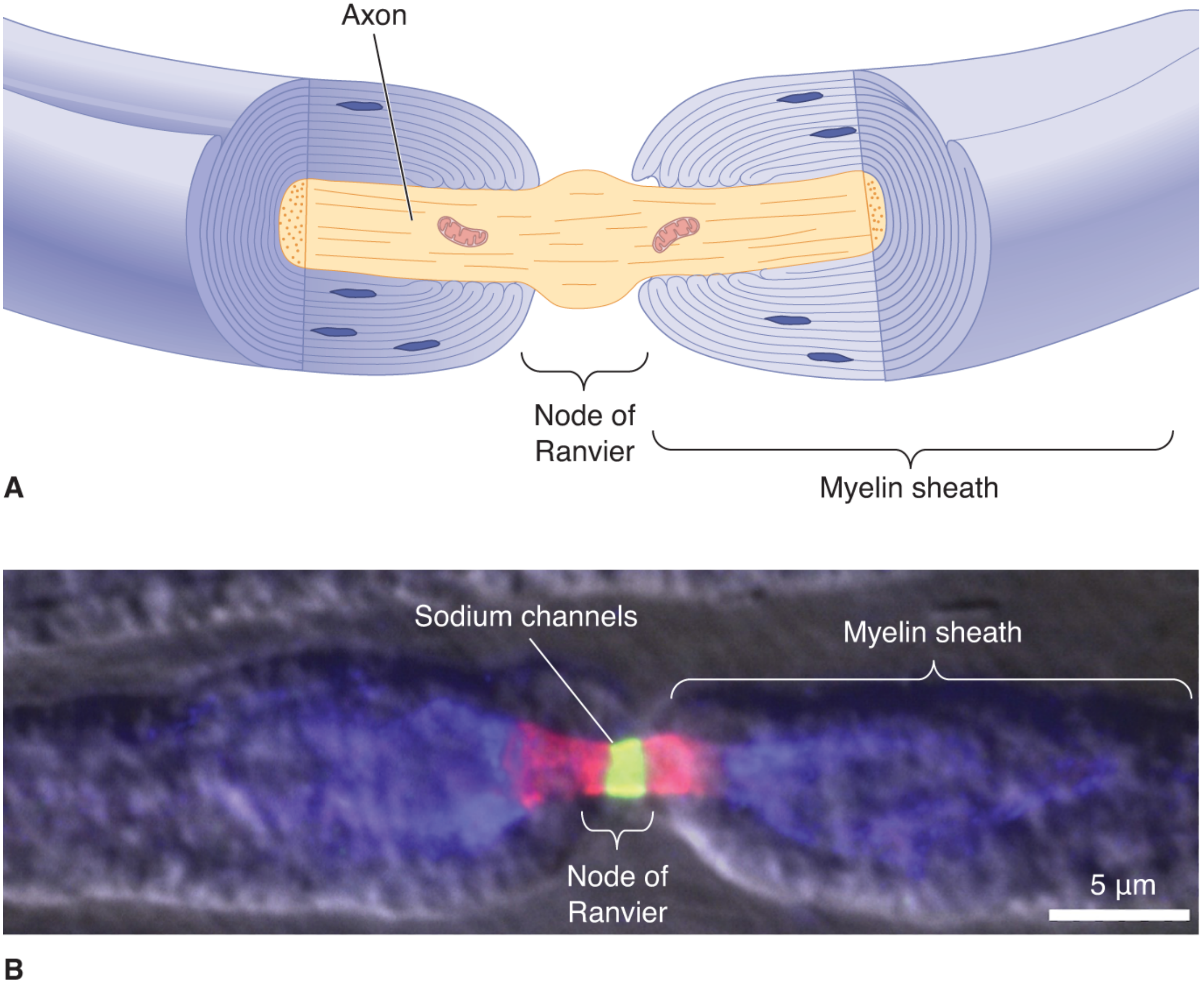
Figure from Neuroscience: Exploring the Brain - (A) the node of Ranvier and myelin sheath anatomy, (B) fluorescence showing voltage-gated Na⁺ channels (green) densely concentrated at the node.
3. The Key Mechanism: Nodes of Ranvier and Ion Channel Distribution
Because the myelin insulates the internode so effectively, voltage-gated Na⁺ channels are densely packed only at the nodes of Ranvier - they are essentially absent under the myelin. When an action potential fires at one node:
- Na⁺ rushes inward at that node, reversing local membrane potential.
- The resulting depolarization spreads passively as local-circuit current - positive charges flow down the axoplasm inside and return through the extracellular fluid outside, completing the circuit.
- Because myelin raises membrane resistance and lowers capacitance along the internode, this passive current spreads very efficiently and rapidly down the inside of the axon to the next node (up to 2 mm away), barely losing charge to the insulated internode.
- When enough current arrives at the next node, it depolarizes that node past threshold, firing a new action potential there.
- The signal then "leaps" to the next node, and so on.
This is saltatory conduction (from Latin saltare, "to jump") - the action potential appears to jump from node to node, skipping the myelinated internodes entirely.
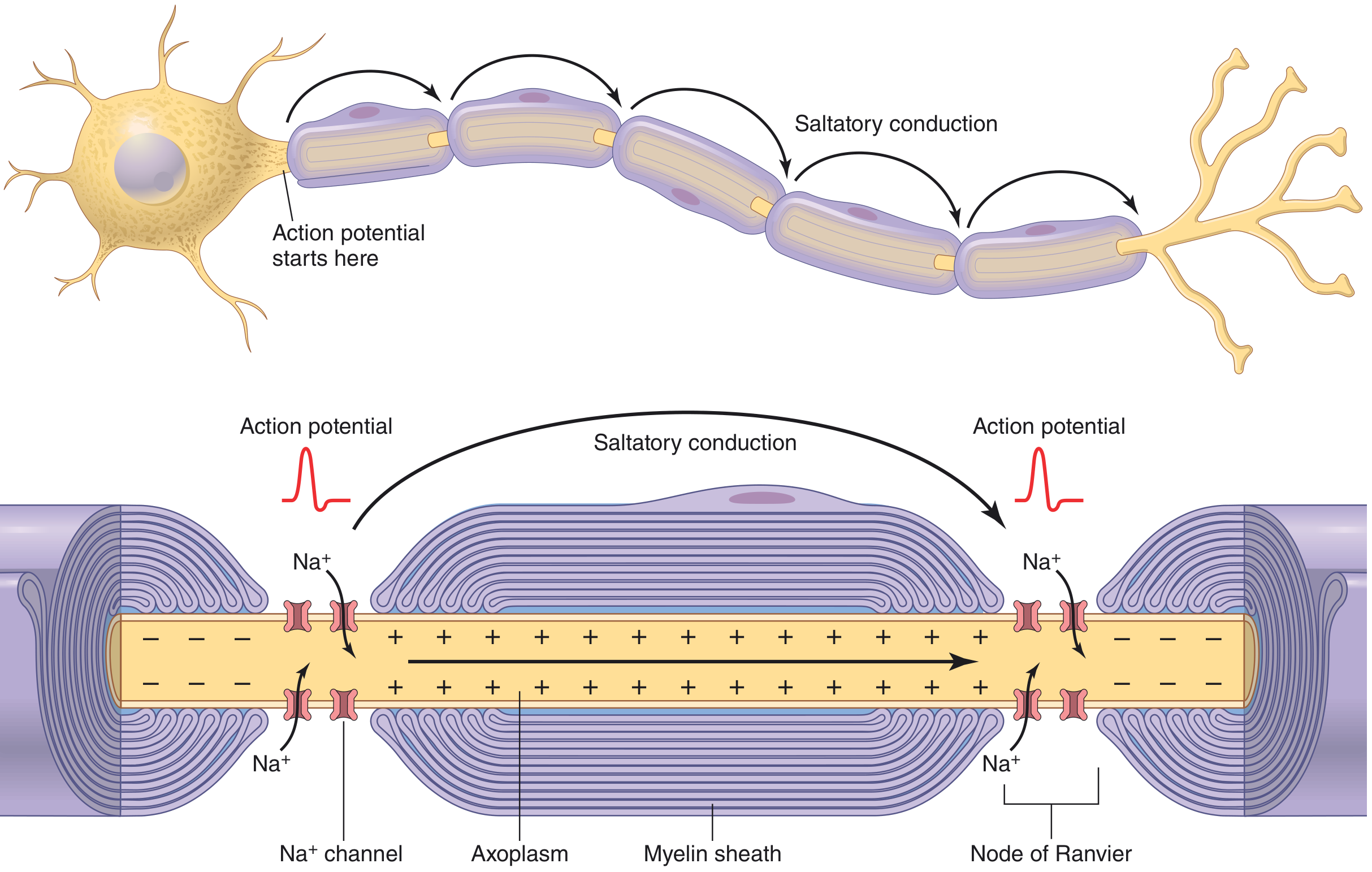
Figure 5.17 from Guyton & Hall - Saltatory conduction. Action potentials fire only at nodes (Na⁺ channels visible), while passive current flows rapidly along the axoplasm through the internode.
4. Why This Is Faster - The Biophysics
Three electrical properties explain the speed increase:
| Property | Unmyelinated axon | Myelinated internode | Effect |
|---|---|---|---|
| Membrane resistance (r_m) | Low (leaky) | Very high (insulated) | Current travels farther without leaking |
| Membrane capacitance (c_m) | High | Very low | Less charge needed to depolarize next section |
| Length constant (λ) | Short | Long | Passive current spreads over much greater distances |
The length constant (λ = √(r_m / r_i)) is dramatically longer in myelinated fibers because r_m is so high. This means the passive depolarizing current from one node reaches the next node with sufficient amplitude to trigger an action potential, even across a 1-2 mm gap.
In unmyelinated fibers, the same current would dissipate too quickly - it can only activate adjacent membrane fractions of a millimeter away.
The "skipping" behavior means much less time is spent firing successive action potentials at every membrane patch. The actual firing only happens at nodes (roughly every 1-2 mm), so the effective conduction velocity is far greater.
5. The Walking vs. Skipping Analogy
A helpful analogy from Neuroscience: Exploring the Brain:
"Action potential conduction without myelin is like walking down a sidewalk heel-to-toe, using every inch. Conduction with myelin is like skipping - you cover far more ground per step."
6. Speed Numbers: Myelinated vs. Unmyelinated
| Fiber type | Diameter | Myelination | Velocity |
|---|---|---|---|
| Aα (motor, proprioception) | 12-20 µm | Heavy | 70-120 m/sec |
| Aβ (touch, pressure) | 6-12 µm | Yes | 30-70 m/sec |
| Aδ (fast pain, temperature) | 1-5 µm | Thin | 5-30 m/sec |
| C (slow pain, autonomic) | 0.2-1.5 µm | None | 0.5-2 m/sec |
In myelinated fibers, conduction velocity is linearly proportional to axon diameter. Unmyelinated fibers scale as the square root of diameter - far less efficient. Myelination increases transmission velocity 5- to 50-fold compared to an unmyelinated fiber of the same diameter. - Guyton & Hall Textbook of Medical Physiology
7. The Metabolic Bonus
Saltatory conduction also conserves metabolic energy. Because ions cross the membrane only at nodes (not along the entire axon length), far fewer Na⁺ and K⁺ ions move per impulse - roughly 100 times less ion exchange than continuous conduction. The Na⁺/K⁺-ATPase pump needs to do much less work to restore ion gradients after each action potential. - Guyton & Hall; Kandel, Principles of Neural Science
8. Clinical Relevance: What Happens When Myelin is Lost
In multiple sclerosis, the immune system attacks CNS myelin. In Guillain-Barré syndrome, PNS myelin is targeted. When the internode loses insulation:
- Membrane resistance falls, membrane capacitance rises
- The length constant shortens
- Passive current no longer bridges the gap to the next node
- Action potential conduction slows dramatically or fails completely
This explains the weakness, sensory loss, and coordination deficits seen in demyelinating diseases - as described in Kandel's Principles of Neural Science.
Summary in one sentence: Myelin insulates the axon between nodes of Ranvier, which concentrates voltage-gated Na⁺ channels at the nodes, forces passive current to travel long distances efficiently through the low-resistance axoplasm, and triggers action potentials only at nodes - making the signal "leap" from node to node at speeds up to 120 m/sec instead of creeping millimeter by millimeter.
Sources:
- Neuroscience: Exploring the Brain, 5th Ed. (Bear, Connors, Paradiso) - [Myelin and Saltatory Conduction section]
- Guyton & Hall Textbook of Medical Physiology - [Special Characteristics of Signal Transmission in Myelinated Fibers]
- Principles of Neural Science, 6th Ed. (Kandel et al.) - [Passive Membrane Properties and Axon Diameter]
This is a shared conversation. Sign in to Orris to start your own chat.