
Explain structure of nephron
Reading File
Finding Sources
Finding Sources
Reading File
Reading File
Loading Image
Reading File
Reading File
Loading Image
Reading File
Reading File
I now have comprehensive content to write a detailed, well-illustrated answer on nephron structure. Here is the full explanation:
Structure of the Nephron
The nephron is the functional unit of the kidney. Each human kidney contains approximately 900,000 to 1 million nephrons (range: ~200,000 to >2.5 million), and each nephron is capable of independently forming urine. A nephron consists of two main parts: the renal corpuscle and the renal tubule.
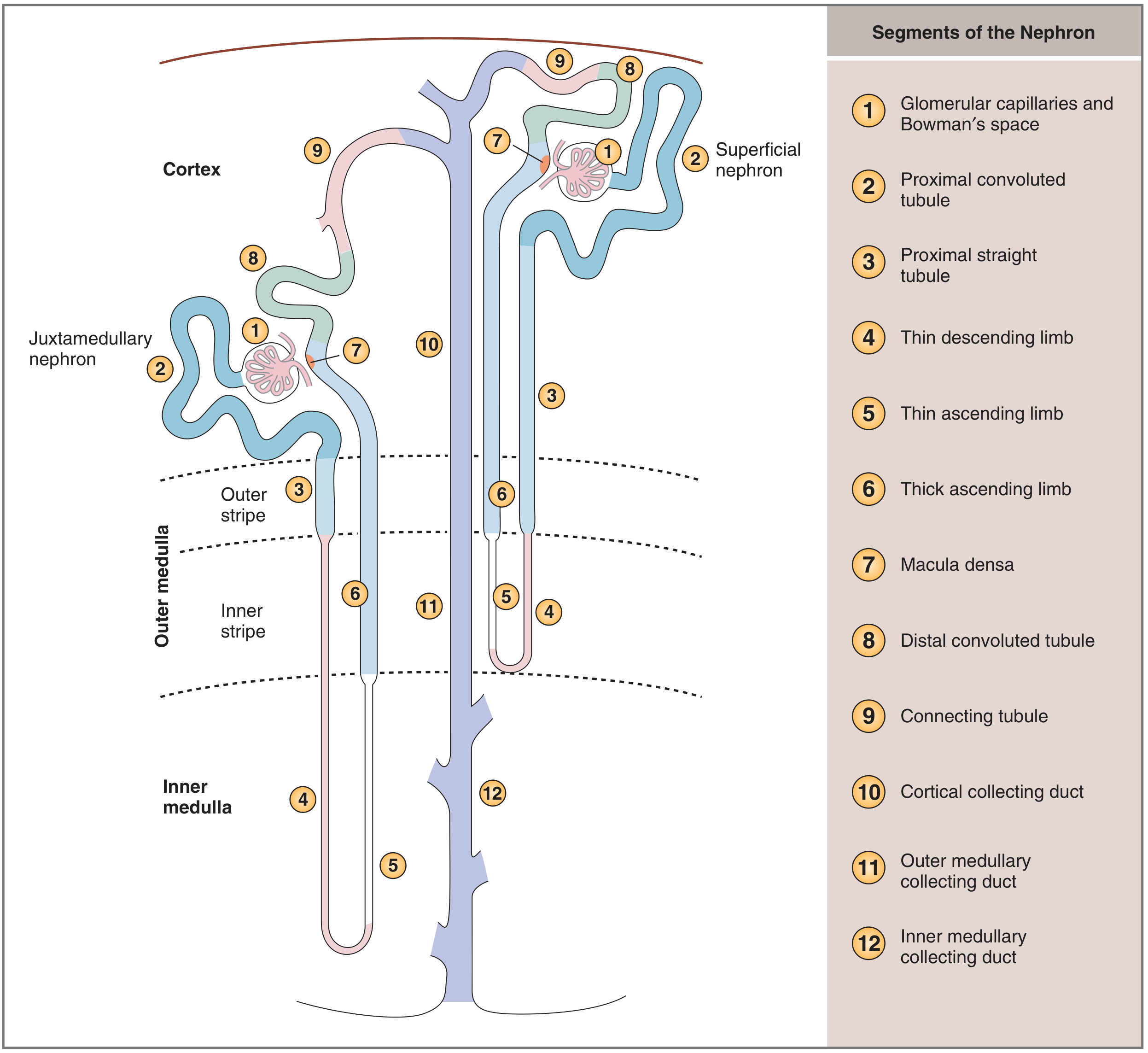
1. Renal Corpuscle
The renal corpuscle (also called the Malpighian corpuscle) consists of the glomerulus + Bowman's capsule. It is located entirely within the cortex.
Glomerulus
- A tuft of fenestrated capillaries arising from an afferent arteriole and drained by an efferent arteriole.
- Average diameter ~200 µm in humans.
- Contains three main cell types:
- Fenestrated endothelial cells - line the capillary lumen, with pores 70-100 nm in diameter; allow passage of water and small solutes but retain blood cells.
- Mesangial cells - lie in the central region between capillary loops; provide structural support and can contract to regulate filtration surface area.
- Podocytes (visceral epithelial cells) - large, terminally differentiated cells that wrap foot processes around the capillaries. Adjacent foot processes are bridged by the filtration slit diaphragm, a key component of the filtration barrier.
Glomerular Filtration Barrier
Three layers must be crossed for filtration:
- Fenestrated capillary endothelium
- Glomerular basement membrane (GBM) - contains lamina rara interna, lamina densa, and lamina rara externa; rich in negatively charged heparan sulfate, which repels albumin.
- Filtration slit diaphragm (between podocyte foot processes)
Bowman's Capsule
- A double-walled cup surrounding the glomerulus.
- The parietal layer (flat epithelium) lines the outer wall.
- The visceral layer (podocytes) covers the capillaries.
- Bowman's space (urinary space) lies between these two layers and collects the glomerular filtrate.
- At the vascular pole, afferent and efferent arterioles enter/exit. At the urinary pole, Bowman's space is continuous with the proximal tubule.
2. Renal Tubule
From Bowman's space, the filtrate passes sequentially through the following segments:
Proximal Tubule
Divided into two parts:
- Proximal Convoluted Tubule (PCT) - located in the cortex; highly convoluted. Cells have an extensive brush border (microvilli) on the luminal surface, massively increasing surface area for reabsorption. Rich in mitochondria. Reabsorbs ~65-70% of filtered Na⁺, water, glucose (entirely), amino acids, HCO₃⁻, phosphate, and uric acid.
- Proximal Straight Tubule (PST / pars recta) - descends into the outer stripe of the outer medulla.
Loop of Henle
A hairpin-shaped structure with three segments:
| Segment | Location | Permeability |
|---|---|---|
| Thin descending limb | Descends into medulla (inner stripe / inner medulla in long loops) | Highly permeable to water; impermeable to solutes |
| Thin ascending limb | Only in long-looped (juxtamedullary) nephrons; inner medulla | Impermeable to water; permeable to NaCl (passive) |
| Thick ascending limb (TAL) | Ascends through inner stripe → outer stripe → cortex | Impermeable to water; actively reabsorbs NaCl via Na⁺-K⁺-2Cl⁻ cotransporter (NKCC2) |
The TAL is sometimes called the "diluting segment" because it reabsorbs NaCl without water, making the tubular fluid hypotonic.
Macula Densa
- A cluster of specialized cells at the end of the TAL, where it contacts the glomerular arterioles.
- Senses NaCl concentration in tubular fluid.
- Part of the juxtaglomerular apparatus (JGA), which regulates renin release and GFR via tubuloglomerular feedback.
Distal Convoluted Tubule (DCT)
- Located in the cortex; relatively short.
- Continues active NaCl reabsorption via the NCC (Na⁺-Cl⁻ cotransporter); site of action of thiazide diuretics.
- Responds to aldosterone (increases Na⁺ reabsorption) and parathyroid hormone (increases Ca²⁺ reabsorption).
- Impermeable to water in the absence of ADH.
Connecting Tubule (CNT)
- Bridges the DCT and collecting duct.
- Derived from metanephric blastema (same as nephron).
- Contains principal cells and intercalated cells.
3. Collecting Duct System
Technically not part of the nephron (derives from the ureteric bud, a separate embryonic origin), but functionally inseparable. Multiple nephrons drain into a single collecting duct.
| Segment | Location | Function |
|---|---|---|
| Cortical Collecting Duct (CCD) | Cortex | Aldosterone-regulated Na⁺ reabsorption; K⁺ and H⁺ secretion |
| Outer Medullary Collecting Duct (OMCD) | Outer medulla | H⁺ secretion; acid-base regulation |
| Inner Medullary Collecting Duct (IMCD) | Inner medulla → papilla | ADH-regulated water reabsorption via aquaporin-2; urea recycling; final urine concentration |
Collecting ducts contain two cell types:
- Principal cells - respond to ADH and aldosterone; reabsorb Na⁺, water; secrete K⁺.
- Intercalated cells (A and B types) - regulate acid-base balance via H⁺-ATPase and Cl⁻/HCO₃⁻ exchangers.
4. Two Types of Nephrons
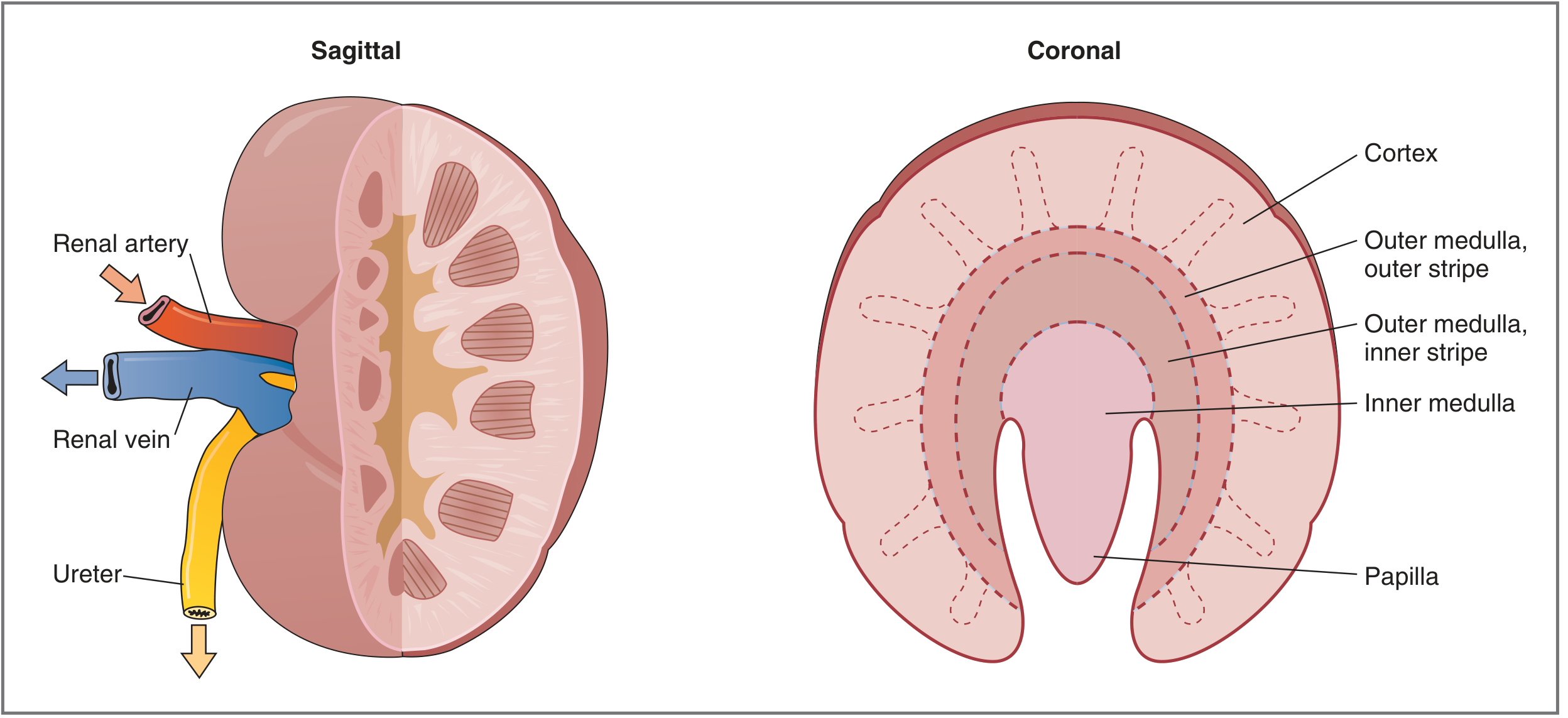
| Feature | Cortical (Superficial) Nephrons | Juxtamedullary Nephrons |
|---|---|---|
| Glomerulus location | Outer cortex | Near corticomedullary border |
| Glomerular size | Smaller | Larger (higher GFR) |
| Loop of Henle | Short - descends only to outer medulla | Long - descends deep into inner medulla/papilla |
| Blood supply | Peritubular capillaries | Peritubular capillaries + vasa recta |
| Function | General filtration/reabsorption | Essential for urine concentration |
The vasa recta are long hairpin-shaped capillaries that run alongside the long loops of Henle in juxtamedullary nephrons. They act as countercurrent exchangers, preserving the medullary osmotic gradient needed for concentrated urine production.
5. Renal Vasculature of the Nephron
Renal artery → Interlobar arteries → Arcuate arteries → Cortical radial (interlobular) arteries → Afferent arteriole → Glomerular capillaries → Efferent arteriole → Peritubular capillaries (± vasa recta) → Small veins → Renal vein.
The kidney is unique in having two capillary beds in series (portal-like arrangement), which allows independent regulation of filtration pressure (glomerular) and reabsorption (peritubular).
Summary of Nephron Segments and Locations
| Segment | Zone |
|---|---|
| Glomerulus + Bowman's capsule | Cortex |
| PCT | Cortex |
| PST (pars recta) | Cortex → outer stripe of outer medulla |
| Thin descending limb | Outer medulla inner stripe → inner medulla |
| Thin ascending limb | Inner medulla (long-looped only) |
| Thick ascending limb | Inner stripe → outer stripe → cortex |
| Macula densa | Cortex (at JGA) |
| DCT | Cortex |
| Connecting tubule | Cortex |
| Cortical collecting duct | Cortex |
| Outer medullary collecting duct | Outer medulla |
| Inner medullary collecting duct | Inner medulla → papilla |
Sources:
- Costanzo Physiology, 7th Edition, pp. 251-252
- Brenner and Rector's The Kidney, 2-Volume Set, pp. 83-90
In detail structure and function of heart
Reading File
Finding Sources
Finding Sources
Finding Sources
Finding Sources
Finding Sources
Reading File
Reading File
Reading File
Reading File
Reading File
Loading Image
Reading File
Reading File
Reading File
Reading File
Loading Image
Reading File
Reading File
Reading File
The full detailed answer is above. Here is a quick summary of what was covered:
The answer covers all major aspects of heart structure and function across 10 sections:
- Position and orientation - apex, base, surfaces, mediastinal location
- Pericardium and wall layers - fibrous/serous pericardium, endocardium, myocardium, epicardium
- Four chambers - right atrium (crista terminalis, fossa ovalis), right ventricle (trabeculae, papillary muscles, moderator band), left atrium (pulmonary veins), left ventricle (thick wall, interventricular septum)
- Four valves - tricuspid, mitral (AV valves with chordae tendineae), pulmonary, aortic (semilunar valves; coronary arteries arise from aortic sinuses)
- Cardiac muscle histology - striated, intercalated discs, gap junctions, functional syncytium
- Conduction system - SA node → AV node (delay) → Bundle of His → right/left bundle branches → Purkinje fibers (4 m/sec)
- Action potential phases (0-4) with ionic basis - the plateau (Phase 2) explained and its importance
- Coronary circulation - RCA, LAD, LCx territories; diastolic filling
- Autonomic innervation - sympathetic (β1, ↑rate/force) vs. parasympathetic (vagus, ↓rate)
- Cardiac output and function - dual pump, ~5 L/min at rest, key differences from skeletal muscle
This is a shared conversation. Sign in to Orris to start your own chat.