
ECG
Asking for Preferences
What would you like to know about ECG?
The user wants a comprehensive ECG guide covering all aspects. Let me read the medical library skill first, then pull content in parallel.
Reading File
Now let me search the library for comprehensive ECG content in parallel:
Finding Sources
Finding Sources
Finding Sources
Finding Sources
Finding Sources
Good. Let me now read the key ECG sections in parallel:
Reading File
Reading File
Finding Sources
Let me read the detailed ECG interpretation content and also fetch the Harrison's ECG section:
Reading File
Reading File
Excellent - I now have rich content from Medical Physiology and Harrison's. Let me fetch the ECG diagram images and also get the Tintinalli's STEMI ECG section:
Loading Image
Reading File
I now have rich, comprehensive content from multiple authoritative sources. Let me compile the full ECG guide.
Comprehensive ECG Guide
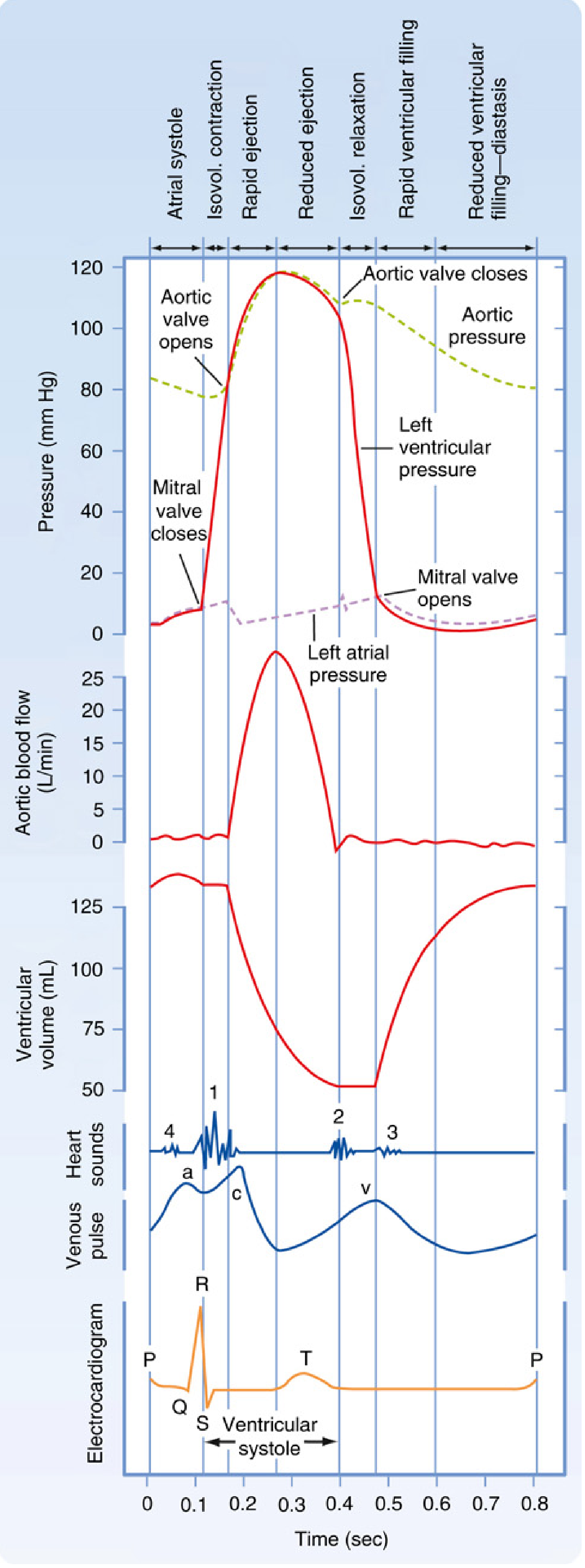
The ECG in relation to the full cardiac cycle - Miller's Anesthesia, 10e
1. What is an ECG?
An ECG (electrocardiogram) measures differences in electrical potential generated by the heart at body surface electrodes. It gives direct information about rate, rhythm, and the time-dependent electrical vector of the heart. It also reveals the origin and conduction of the cardiac action potential through different regions of the heart.
- Medical Physiology (Boron & Boulpaep), p. 730
- Miller's Anesthesia, 10e, p. 1364
2. ECG Paper & Calibration
| Parameter | Small box (1 mm) | Large box (5 mm) |
|---|---|---|
| Time | 0.04 s | 0.2 s |
| Voltage | 0.1 mV | 0.5 mV |
| 5 large boxes | = | 1.0 second |
3. The Waveforms - What Each Represents
| Wave / Interval | Electrical Event | Key Facts |
|---|---|---|
| P wave | Atrial depolarization | SA node fires → spreads to both atria; normal duration <120 ms |
| PR interval | AV node conduction delay | Normal 120-200 ms; represents delay before ventricular activation |
| QRS complex | Ventricular depolarization | Normal <120 ms; Purkinje → ventricular myocardium |
| ST segment | Early ventricular repolarization (plateau phase) | Should be isoelectric; deviation = ischemia/injury |
| T wave | Ventricular repolarization | Usually upright except aVR, V1 |
| QT interval | Total ventricular action potential duration | Shortens with faster heart rate |
The AV node creates a deliberate slowing of conduction - this is the PR interval - allowing atria to finish contracting before the ventricles begin. From the distal His bundle, impulses travel through the right and left bundle branches into the Purkinje system, then to individual ventricular cardiomyocytes.
- Miller's Anesthesia, 10e, p. 1364
4. The 12 Leads - What They Look At
Limb leads (frontal plane):
- I, II, III - bipolar limb leads
- aVR, aVL, aVF - augmented unipolar limb leads
Precordial leads (horizontal plane):
- V1-V2 - right ventricle / septal
- V3-V4 - anterior wall
- V5-V6 - lateral wall
- II, III, aVF - inferior wall
- I, aVL - high lateral wall
5. How to Read an ECG - Systematic Approach
Use a consistent sequence every time:
Step 1: Rate
- Quick method: Count large boxes between two R waves. Rate = 300 ÷ (number of large boxes)
- 1 box = 300 bpm, 2 = 150, 3 = 100, 4 = 75, 5 = 60, 6 = 50
- Precise method: R-R interval (seconds) → Rate = 60 ÷ R-R interval
Step 2: Rhythm
Ask three questions:
- Where is the pacemaker? (Is there a P wave before every QRS?)
- What is the conduction path? (Is PR normal? Is QRS narrow or wide?)
- Is the rhythm regular?
Normal sinus rhythm: Regular rate 60-100 bpm, upright P in II, P:QRS = 1:1, normal PR (120-200 ms), narrow QRS (<120 ms).
Step 3: Axis (Frontal Plane)
Normal QRS axis: -30° to +90°
| Axis | Meaning |
|---|---|
| -30° to +90° | Normal |
| More negative than -30° | Left axis deviation (LAD) |
| More positive than +110° | Right axis deviation (RAD) |
Quick method: If QRS is positive in both Lead I and aVF → normal axis. If positive in I, negative in aVF → LAD. If negative in I, positive in aVF → RAD.
Step 4: P Wave
- Present? Upright in II? One per QRS? Duration <120 ms?
Step 5: PR Interval
- Normal: 120-200 ms (3-5 small boxes)
- Short: WPW or junctional rhythm
- Prolonged: AV block
Step 6: QRS Complex
- Duration <120 ms = normal (narrow)
- 110-120 ms = incomplete bundle branch block
- ≥120 ms = complete bundle branch block or ventricular rhythm
Step 7: ST Segment & T Wave
- Elevation or depression?
- T wave morphology: upright, inverted, peaked?
Step 8: QT Interval
- Corrected QT (QTc) = QT ÷ √(R-R interval)
- Normal QTc: <440 ms (men), <460 ms (women)
6. Common Arrhythmias
| Arrhythmia | Key ECG Features |
|---|---|
| Sinus tachycardia | Rate >100, normal P waves, regular, normal QRS |
| Sinus bradycardia | Rate <60, otherwise normal |
| Sinus arrhythmia | Rate varies with breathing (normal variant) |
| Atrial fibrillation (AF) | Absent P waves, irregularly irregular R-R, fibrillatory baseline |
| Atrial flutter | Sawtooth flutter waves at ~300/min, often 2:1 block (ventricular rate ~150) |
| SVT (AVNRT/AVRT) | Regular narrow complex tachycardia, P waves hidden or retrograde |
| Ventricular tachycardia (VT) | Wide complex (>120 ms), rate >100, AV dissociation |
| Ventricular fibrillation (VF) | Chaotic, no organized complexes - cardiac arrest |
| 1st degree AV block | PR >200 ms, all P waves conduct |
| 2nd degree (Mobitz I) | Progressive PR lengthening → dropped QRS (Wenckebach) |
| 2nd degree (Mobitz II) | Fixed PR, intermittent dropped QRS without warning - more serious |
| 3rd degree (complete) AV block | P waves and QRS completely dissociated, escape rhythm |
| LBBB | Wide QRS ≥120 ms, broad notched R in I/V5/V6, no septal q waves |
| RBBB | Wide QRS ≥120 ms, rSR' in V1 ("rabbit ears"), wide S in I/V6 |
| WPW | Short PR (<120 ms), delta wave (slurred QRS upstroke), wide QRS |
Conduction abnormalities are the first major category of arrhythmias. They can result from ischemia, fibrosis, infection, electrolyte imbalance, or drug toxicity.
- Medical Physiology, p. 731
7. Ischemia and Infarction
Ischemia lowers the resting membrane potential and shortens the action potential duration, creating a voltage gradient between normal and ischemic zones - these "currents of injury" appear as ST deviation.
STEMI (ST-Elevation MI)
| Territory | Leads with ST Elevation | Likely Vessel |
|---|---|---|
| Anterior | V1-V4 | LAD |
| Lateral | I, aVL, V5-V6 | LCx |
| Inferior | II, III, aVF | RCA (or LCx) |
| Posterior | Reciprocal ST depression V1-V3 (mirror) | RCA/LCx |
| Right ventricle | ST elevation in right-sided leads (V3R/V4R) | RCA proximal |
Hyperacute T waves are the earliest sign of acute MI - tall, peaked, symmetric T waves preceding ST elevation.
Evolutionary changes of STEMI:
- Hyperacute T waves (minutes)
- ST elevation (minutes to hours)
- Q wave formation (hours to days)
- T wave inversion (hours to days)
- Q waves may persist permanently
NSTEMI / Unstable Angina
-
ST depression and/or T wave inversions without ST elevation
-
Biomarkers (troponin) elevated in NSTEMI, normal in unstable angina
-
Subendocardial ischemia: ST depression in precordial leads + ST elevation in aVR
-
Harrison's Principles of Internal Medicine 22e, p. 1398-1400
8. Hypertrophy Patterns
Left Ventricular Hypertrophy (LVH)
- Tall left precordial R waves + deep right precordial S waves
- Sokolov-Lyon criterion: SV1 + (RV5 or RV6) >35 mm
- Cornell criterion: RaVL >20 mm (women), >28 mm (men)
- Repolarization abnormality: ST depression + T wave inversion in I, aVL, V5-V6 ("strain pattern")
- LVH increases risk of cardiovascular morbidity, mortality, and sudden cardiac death
Right Ventricular Hypertrophy (RVH)
- Right axis deviation
- Tall R in V1 (R >S in V1)
- T wave inversions in right precordial leads
Pulmonary Embolism (Acute Cor Pulmonale)
-
Sinus tachycardia (most common)
-
S1Q3T3 pattern: S wave in I, Q wave in III, T wave inversion in III
-
Right axis deviation, RBBB pattern, ST-T changes V1-V4
-
Harrison's Principles of Internal Medicine 22e, p. 1363-1368
9. Bundle Branch Blocks
| Feature | RBBB | LBBB |
|---|---|---|
| QRS duration | ≥120 ms | ≥120 ms |
| V1 | rSR' ("rabbit ears") | Broad QS or rS |
| V6 | Wide slurred S | Broad tall R, no q |
| Axis | Normal or RAD | Normal or LAD |
| Clinical significance | Often benign; RV conduction delay | Always abnormal; structural disease |
LBBB note: New LBBB in the context of chest pain should be treated as STEMI equivalent. LBBB also makes ST analysis unreliable - use Sgarbossa criteria if needed.
Fascicular Blocks
-
Left anterior fascicular block (LAFB): QRS axis more negative than -45° - most common cause of marked LAD
-
Left posterior fascicular block (LPFB): QRS axis >+110° to +120° - rare isolated finding, must exclude other causes of RAD
-
Harrison's Principles of Internal Medicine 22e, p. 1371-1393
10. Other Important ECG Patterns
| Pattern | Key Finding | Association |
|---|---|---|
| Long QT | QTc >440-460 ms | Drug effect, hypokalemia, hypomagnesemia, congenital (LQTS); risk of Torsades de Pointes |
| Short QT | QTc <340 ms | Short QT syndrome; hypercalcemia |
| Brugada pattern | Coved ST elevation + RBBB morphology in V1-V2 | Sudden cardiac death risk, especially in young Asian males |
| Delta wave (WPW) | Short PR + slurred QRS onset | Accessory pathway; risk of rapid AF degenerating to VF |
| Peaked T waves | Tall symmetric T waves | Hyperkalemia (earliest sign) |
| PR depression | Diffuse in multiple leads | Pericarditis (also with saddle-shaped ST elevation) |
| Electrical alternans | Beat-to-beat QRS axis alternation | Cardiac tamponade |
| Low voltage | QRS <5 mm in limb leads, <10 mm precordial | Pericardial effusion, emphysema, obesity, hypothyroidism |
11. Electrolyte Effects on ECG
| Electrolyte | Change | ECG Findings |
|---|---|---|
| Hyperkalemia | K+ rises | Peaked T → flat P → wide QRS → sine wave → VF |
| Hypokalemia | K+ falls | Flat T, prominent U wave, ST depression, long QU |
| Hypercalcemia | Ca2+ rises | Short QT |
| Hypocalcemia | Ca2+ falls | Long QT (prolonged ST segment) |
| Hypomagnesemia | Mg2+ falls | Long QT, Torsades risk |
12. Quick Clinical Practice Framework
When you pick up an ECG, run through: Rate - Rhythm - Axis - P waves - PR - QRS - ST/T - QT
Ask yourself:
- Is this a sinus rhythm?
- Is the rate normal, fast, or slow?
- Are complexes narrow or wide?
- Is there ST deviation?
- Are there any high-risk features (e.g. VT, complete heart block, STEMI, long QT)?
Sources:
- Medical Physiology (Boron & Boulpaep), pp. 710-735
- Miller's Anesthesia, 10e, pp. 1364-1368
- Harrison's Principles of Internal Medicine 22e, pp. 1362-1400
- Tintinalli's Emergency Medicine, Chapter 49
This is a shared conversation. Sign in to Orris to start your own chat.