
Lactate synthesis and increase basic information with CKD PATIENT
Reading File
Now let me search the medical library and PubMed in parallel for lactate synthesis and CKD.
Finding Sources
Finding Sources
Searching PubMed
lactate metabolism chronic kidney disease
Good results. Now let me read the key textbook sections in parallel - especially the Brenner and Rector Kidney section on renal gluconeogenesis/lactate, the Harrison's section on lactic acidosis, and the Frameworks for Internal Medicine section on the mechanism.
Reading File
Reading File
Reading File
Reading Article
PMID: 40207870
Excellent - rich content retrieved. Let me read more of the Brenner & Rector lactate handling section and the Harrison's lactic acidosis section for full detail.
Reading File
Reading File
Finding Sources
Let me read the key lactate handling section from Brenner & Rector that contains the detailed content on renal lactate handling and the metabolic cost section.
Reading File
Reading File
Now let me get the Comprehensive Clinical Nephrology content on acidosis in CKD and a web search for the latest info on lactate in CKD.
Finding Sources
Searching the Web
lactate synthesis increase CKD chronic kidney disease pathophysiology 2024 2025
I now have comprehensive material. Let me also fetch the key image from Brenner & Rector showing lactate utilization along the nephron, and read the CKD metabolic acidosis treatment section quickly.
Loading Image
Reading File
I now have comprehensive information to write a complete, detailed answer. Let me compile everything.
Lactate: Synthesis, Metabolism, and Elevated Levels in CKD Patients
1. Basic Lactate Biochemistry - Where Does Lactate Come From?
Synthesis Pathway
Lactate is produced from pyruvate via the enzyme lactate dehydrogenase (LDH):
Glucose → (glycolysis) → Pyruvate → (LDH) → Lactate + H⁺
- This reaction regenerates NAD⁺ from NADH, allowing glycolysis to continue even when oxidative phosphorylation is unavailable or overwhelmed.
- The reaction is reversible: lactate can be re-converted to pyruvate when oxygen is available.
Key physiological sources of lactate:
- Skeletal muscle (major source, especially during exercise)
- Red blood cells (no mitochondria - always produce lactate)
- Skin, intestines, brain
- Renal medulla (naturally anaerobic environment)
Normal Lactate Levels and Clearance
| State | Lactate Level |
|---|---|
| Normal blood lactate | 0.5 - 1.5 mmol/L |
| Hyperlactatemia | 2 - 5 mmol/L |
| Lactic acidosis (pH <7.35) | >5 mmol/L |
Clearance is primarily by:
- Liver (~60-70%) - converts lactate back to glucose (Cori cycle) or oxidizes it
- Kidney (~30%) - a major but underappreciated site of lactate clearance
- Heart and other muscles also consume lactate as fuel
2. The Kidney's Role in Normal Lactate Handling
The kidney is both a consumer and producer of lactate, functioning effectively as two separate metabolic organs (Brenner & Rector's The Kidney):
Proximal Tubule - The Gluconeogenic Engine
- The proximal tubule is the primary gluconeogenic zone - it expresses phosphoenolpyruvate carboxykinase, fructose-1,6-bisphosphatase, and glucose-6-phosphatase.
- Gluconeogenic enzymes are found almost exclusively in the proximal tubule.
- Overnight fasting: proximal tubule gluconeogenesis can account for up to 40% of whole-body gluconeogenesis.
- During liver transplantation, endogenous glucose release falls to only 50% of control levels within 1 hour of liver removal - demonstrating how significant renal gluconeogenesis is.
How the Kidney Processes Lactate (Concentration-Dependent)
Lactate reaching the nephron (by filtration or blood flow) is handled in three concentration-dependent ways:
- Low concentration (<2 mmol/L): All lactate is oxidized to CO₂ to fuel transport and basal metabolism (generates ATP).
- Moderate-high concentration (>2 mmol/L): Excess lactate is channeled into gluconeogenesis (Cori cycle participation).
- Very high perfusate levels: Metabolic and synthetic rates approach maximum; some lactate is simply reabsorbed (conserved).
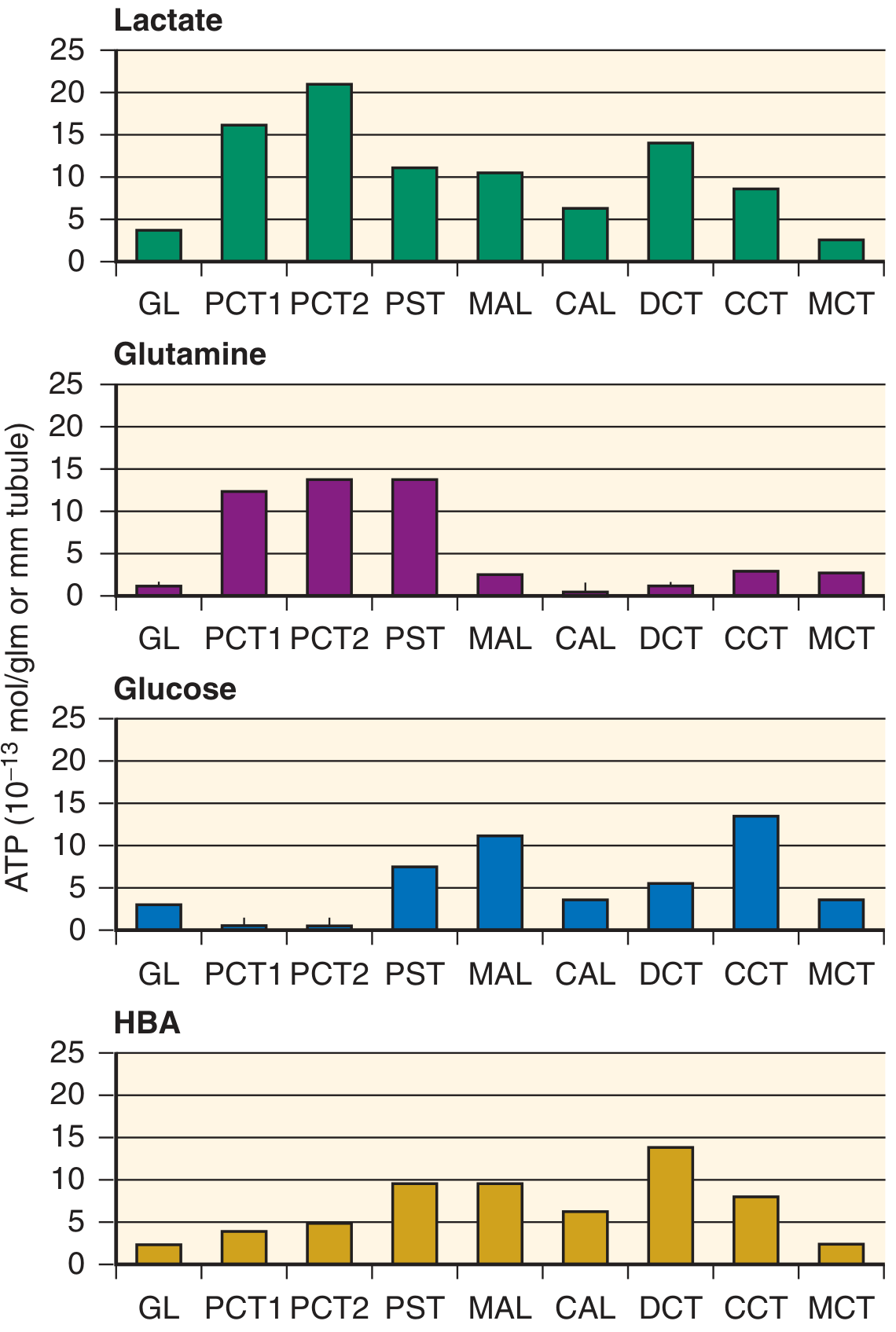
Fig: Lactate is the dominant fuel for the proximal convoluted tubule (PCT1, PCT2) - generating the highest ATP yield compared to glucose in these segments. Glucose becomes the dominant fuel in distal nephron segments (MAL, CCT) which lack gluconeogenic capacity.
The Cori Cycle
The kidney participates in the classic Cori cycle: vigorously exercising muscles produce lactate → released into blood → taken up by liver and kidney → converted to glucose in the proximal tubule → returned to circulation. The capacity for renal gluconeogenesis from lactate is large - the kidney can consume up to 25% as much energy converting lactate to glucose as it spends reabsorbing sodium.
- Brenner and Rector's The Kidney, Chapter 5 (Renal Gluconeogenesis and Lactate Handling)
3. Why Lactate Increases in CKD
3a. Loss of Renal Lactate Clearance Capacity
As GFR declines in CKD:
- Fewer functioning proximal tubule cells means reduced lactate-to-glucose conversion capacity
- The kidney's contribution to whole-body lactate clearance (~30%) diminishes progressively
- This creates a baseline shift toward higher circulating lactate
3b. Metabolic Acidosis Amplifies the Problem
CKD produces a progressive metabolic acidosis through two overlapping mechanisms:
| CKD Stage | Type of Acidosis | Mechanism |
|---|---|---|
| Mild-Moderate CKD | Normal anion gap (hyperchloremic) | Impaired NH₄⁺ excretion and bicarbonate reabsorption, but GFR relatively preserved |
| Advanced CKD (uremia) | High anion gap | Retention of unmeasured anions: phosphate, sulfate, urate, organic acids |
Both lactic acidosis AND uremic acidosis appear together in the high anion gap differential (MUDPILES mnemonic) - Harrison's Principles of Internal Medicine 22E, Table 36-4.
The acidosis itself can worsen lactate production because:
- NaHCO₃ therapy, if given, stimulates phosphofructokinase, which increases glycolytic flux and lactate generation
- Metabolic acidosis causes protein catabolism, releasing amino acids that fuel anaerobic pathways
3c. Glycolytic Reprogramming in CKD (New Mechanism)
Recent research has revealed that CKD actively reprograms tubular cell metabolism toward anaerobic glycolysis:
- In CKD, the expression of PFKFB3 (6-phosphofructo-2-kinase/fructose-2,6-bisphosphatase 3) is positively correlated with the severity of renal fibrosis
- PFKFB3-driven glycolytic reprogramming in renal tubules generates excess lactate
- This lactate then promotes histone lactylation (H4K12la), activating NF-κB and driving further fibrosis
- This creates a pathological feed-forward cycle: CKD → lactate → lactylation → more fibrosis → worse CKD
3d. Lactylation - A New Concept (2025)
A 2025 review in Cell Proliferation (PMID: 40207870) summarized the concept of protein lactylation in kidney disease:
- Lactate is not merely a metabolic waste product - it acts as a signaling molecule and protein modifier (post-translational modification of histone lysine residues)
- In diabetic nephropathy, elevated lactate enhances H3K14la (histone H3 lysine 14 lactylation), promoting KLF5 expression and driving epithelial-mesenchymal transition (EMT) - a key mechanism of fibrosis
- These epigenetic modifications contribute to AKI-to-CKD progression
3e. Type B Lactic Acidosis - Multiple CKD-Associated Causes
CKD patients are vulnerable to several concurrent causes of Type B lactic acidosis (not from tissue hypoperfusion):
| Cause | Mechanism |
|---|---|
| Metformin | Inhibits mitochondrial complex I → impairs lactate oxidation; accumulates in renal failure |
| Hepatic dysfunction (common in CKD) | Reduces hepatic lactate clearance |
| Infection/sepsis | Type A superimposed on compromised baseline |
| Thiamine deficiency | Common in CKD patients on dialysis; thiamine is a cofactor for pyruvate dehydrogenase - deficiency blocks pyruvate entry into TCA cycle → all pyruvate becomes lactate |
| Malnutrition | 5-oxoproline (pyroglutamic acid) accumulation, especially in CKD + paracetamol use |
- Frameworks for Internal Medicine, p. 438; Harrison's 22E, Section 58
3f. Specific Warning: Metformin in CKD
Metformin is contraindicated or requires dose adjustment when eGFR <45 mL/min/1.73m² (hold if <30), precisely because:
- Metformin accumulates due to reduced renal clearance
- Inhibits hepatic mitochondrial Complex I → blocks lactate clearance → metformin-associated lactic acidosis (MALA)
- MALA carries up to 50% mortality
4. Clinical Consequences of Elevated Lactate in CKD
Acid-Base Disturbance
- Lactic acid dissociates: lactate⁻ + H⁺ → raises the anion gap
- Anion gap = Na⁺ - (Cl⁻ + HCO₃⁻); normal ~8-12 mEq/L; elevated when >12 mEq/L
- In advanced CKD, the acidosis is mixed: both high-AG (uremic anions + lactate) and normal-AG components can coexist
Consequences of Acidosis in CKD
As stated in The Washington Manual of Medical Therapeutics: "As renal function deteriorates, the kidneys are unable to appropriately excrete sufficient acid, resulting in metabolic acidosis (mixed high and normal anion gap). To compensate, alkaline buffer is released from bone but can ultimately worsen bone mineral disease."
Metabolic acidosis in CKD causes:
- Increased protein catabolism (muscle wasting)
- Bone disease (buffering H⁺ with carbonate from bone)
- Insulin resistance
- Increased cortisol and PTH
- Faster CKD progression (acidosis increases ammoniagenesis → tubulointerstitial injury)
- Elevated fibrosis via lactate-mediated histone lactylation
5. Management: Correcting Acidosis and Lactate in CKD
Bicarbonate Supplementation
- Target serum HCO₃⁻ ≥22 mEq/L (some guidelines suggest 22-23 mEq/L)
- Harrison's 22E notes: "Recent studies suggest that this replacement should be considered when the serum bicarbonate concentration falls below 20-23 mmol/L"
- Oral NaHCO₃ tablets or Shohl's solution
- Correction of acidosis has been shown to slow GFR decline in multiple RCTs (Brenner & Rector's The Kidney, Chapter 47)
- Diet rich in fruits and vegetables is an alternative alkali source
Caution with NaHCO₃ in Frank Lactic Acidosis
- If lactic acidosis is present (pH <7.00), alkali therapy is controversial - NaHCO₃ paradoxically depresses cardiac performance and stimulates phosphofructokinase, which can worsen lactate production
- Target: raise pH to no more than 7.2 and HCO₃⁻ to no more than 12 mmol/L acutely
- Volume overload is a significant risk in the oliguric CKD patient
Treat Underlying Causes
- Stop metformin if eGFR <30 (or 45 in high-risk)
- Correct sepsis, hypoperfusion (Type A component)
- Thiamine supplementation in malnourished dialysis patients
- Dialysis (hemodialysis clears lactate directly in MALA)
Summary Table: Lactate in CKD at a Glance
| Aspect | Key Point |
|---|---|
| Normal renal lactate handling | Proximal tubule: oxidize or convert to glucose via Cori cycle |
| Primary cause of elevated lactate in CKD | Loss of proximal tubule mass → reduced clearance |
| Metabolic acidosis type in mild CKD | Normal anion gap (hyperchloremic) |
| Metabolic acidosis type in advanced CKD | High anion gap (uremic + mixed) |
| New mechanism | PFKFB3-driven glycolysis → lactate → histone lactylation → fibrosis |
| Key drug risk | Metformin-associated lactic acidosis (MALA) |
| Treatment target | HCO₃⁻ ≥22 mEq/L; pH >7.2 in acute setting |
| Lactate level defining lactic acidosis | >5 mmol/L with pH <7.35 |
Sources:
- Brenner and Rector's The Kidney, Chapters 5 & 47 (Renal Gluconeogenesis, Lactate Handling, and CKD Progression)
- Harrison's Principles of Internal Medicine 22E, Chapters 36 & 58 (Metabolic Acidosis, High-AG Acidoses)
- Frameworks for Internal Medicine, p. 438 (Uremic acidosis mechanism)
- The Washington Manual of Medical Therapeutics (Metabolic acidosis in CKD)
- Hou et al. (2025), "Lactate and Lactylation in AKI-to-CKD," Cell Proliferation (PMID: 40207870) - covers epigenetic mechanisms of lactylation in CKD
This is a shared conversation. Sign in to Orris to start your own chat.