
From NCERT
What NCERT topic or subject are you asking about?
- What subject - Biology, Chemistry, Physics, Mathematics, History, Geography, etc.?
- What topic or chapter - e.g., "photosynthesis," "quadratic equations," "French Revolution"?
- What do you need - explanation, summary, key points, solved examples, diagrams, or something else?

I have exam
NCERT Units and Dimensions Class 11 Physics key concepts NEET
NCERT Mole concept atomic structure Class 11 Chemistry NEET important points
https://ncert.nic.in/textbook/pdf/keph101.pdf
NCERT Class 11 Cell unit of life cell cycle mitosis breathing exchange of gases NEET notes
🎯 NEET Minor Test - 5th July 2026
⚡ PHYSICS - Units and Dimensions
1. Physical Quantities
- Fundamental (Base) quantities: Cannot be derived - Length, Mass, Time, Electric Current, Temperature, Luminous Intensity, Amount of Substance
- Derived quantities: Derived from fundamental quantities (e.g., velocity = length/time)
2. SI System - 7 Base Units
| Quantity | Unit | Symbol |
|---|---|---|
| Length | metre | m |
| Mass | kilogram | kg |
| Time | second | s |
| Electric current | ampere | A |
| Temperature | kelvin | K |
| Luminous intensity | candela | cd |
| Amount of substance | mole | mol |
Supplementary units: Radian (rad) - plane angle; Steradian (sr) - solid angle
3. Important Prefixes
| Prefix | Symbol | Value |
|---|---|---|
| Pico | p | 10⁻¹² |
| Nano | n | 10⁻⁹ |
| Micro | µ | 10⁻⁶ |
| Milli | m | 10⁻³ |
| Kilo | k | 10³ |
| Mega | M | 10⁶ |
| Giga | G | 10⁹ |
4. Dimensions
- Represented using [M], [L], [T], [A], [K], [cd], [mol]
- Dimension of a quantity = powers to which base quantities are raised
| Quantity | Formula | Dimensional Formula |
|---|---|---|
| Force | F = ma | [MLT⁻²] |
| Energy/Work | W = F·d | [ML²T⁻²] |
| Power | P = W/t | [ML²T⁻³] |
| Pressure | P = F/A | [ML⁻¹T⁻²] |
| Velocity | v = d/t | [LT⁻¹] |
| Acceleration | a = v/t | [LT⁻²] |
| Momentum | p = mv | [MLT⁻¹] |
| Frequency | f = 1/T | [T⁻¹] |
| Gravitational Constant | G | [M⁻¹L³T⁻²] |
| Planck's Constant | h | [ML²T⁻¹] |
5. Principle of Homogeneity
- Every term in a physical equation must have the same dimensions
- Used to: (a) check correctness of equations, (b) derive relations, (c) convert units
6. Dimensionless Quantities
- Pure numbers, angles (in radians), relative density, strain, refractive index, e^x, log x, sin θ
7. Significant Figures - Rules
- All non-zero digits are significant
- Zeros between non-zero digits are significant (e.g., 2005 → 4 sig figs)
- Trailing zeros after decimal are significant (e.g., 3.500 → 4 sig figs)
- Leading zeros are NOT significant (e.g., 0.0023 → 2 sig figs)
🧪 CHEMISTRY
Part A: Mole Concept (Some Basic Concepts of Chemistry)
Laws of Chemical Combination
- Law of Conservation of Mass - Matter is neither created nor destroyed
- Law of Definite Proportions (Proust) - A compound always has elements in fixed mass ratio
- Law of Multiple Proportions (Dalton) - Masses of one element combining with fixed mass of another are in simple whole-number ratios
- Law of Gaseous Volumes (Gay-Lussac) - Gases combine in simple whole-number volume ratios
- Avogadro's Law - Equal volumes of gases at same T & P contain equal number of molecules
Atomic and Molecular Mass
- 1 amu (atomic mass unit) = 1/12 the mass of ¹²C atom = 1.66 × 10⁻²⁷ kg
- Atomic mass = mass of one atom in amu
- Molecular mass = sum of atomic masses of all atoms in a molecule
Mole Concept - THE MOST IMPORTANT PART
- 1 mole = 6.022 × 10²³ particles (Avogadro's number, Nₐ)
- Molar mass = mass of 1 mole in grams (numerically = atomic/molecular mass)
Number of moles (n) = Given mass (W) / Molar mass (M)
Number of particles = n × 6.022 × 10²³
Volume at STP (for gas) = n × 22.4 L
| Substance | 1 mole contains | Mass |
|---|---|---|
| H₂O | 6.022×10²³ molecules | 18 g |
| CO₂ | 6.022×10²³ molecules | 44 g |
| NaCl | 6.022×10²³ formula units | 58.5 g |
| H₂ | 6.022×10²³ molecules | 2 g |
Percentage Composition & Empirical Formula
- % of element = (mass of element in 1 mole of compound / molar mass) × 100
- Empirical formula = simplest whole-number ratio of atoms
- Molecular formula = actual number of atoms (= n × empirical formula)
- n = Molar mass / Empirical formula mass
Stoichiometry
- Limiting reagent = reactant consumed first; determines amount of product
- Always calculate moles from given mass before comparing
Part B: Atomic Structure
Sub-atomic Particles
| Particle | Discovered by | Charge | Mass |
|---|---|---|---|
| Electron | J.J. Thomson (1897) | -1 (−1.6×10⁻¹⁹ C) | 9.1×10⁻³¹ kg |
| Proton | Goldstein / Rutherford | +1 | 1.67×10⁻²⁷ kg |
| Neutron | James Chadwick (1932) | 0 | 1.67×10⁻²⁷ kg |
Atomic Models
- Atom = positively charged sphere with electrons embedded in it
- Disproved by Rutherford's experiment
- Gold foil experiment - α-particles fired at gold foil
- Conclusions:
- Atom is mostly empty space
- Nucleus is small, dense, positively charged
- Electrons revolve around the nucleus
- Failure: Could not explain atomic spectra; electrons should spiral inward (unstable)
- Electrons revolve in fixed circular orbits (shells) with definite energy
- Energy is quantized: E = -13.6/n² eV (for hydrogen)
- Electron jumps: absorbs energy → excited; emits energy → falls to lower orbit
- Radius of nth orbit: rₙ = 0.529 × n² Å (for H)
- Energy of nth orbit: Eₙ = -13.6/n² eV
Quantum Numbers (for NEET - 4 types)
| Quantum Number | Symbol | Values | Describes |
|---|---|---|---|
| Principal | n | 1, 2, 3... | Shell/energy level |
| Azimuthal | l | 0 to n-1 | Subshell (s,p,d,f) |
| Magnetic | mₗ | -l to +l | Orbital orientation |
| Spin | mₛ | +½ or -½ | Electron spin |
- s: l=0, 1 orbital; p: l=1, 3 orbitals; d: l=2, 5 orbitals; f: l=3, 7 orbitals
Electronic Configuration Rules
- Aufbau Principle - Fill orbitals in order of increasing energy (1s < 2s < 2p < 3s...)
- Pauli Exclusion Principle - No two electrons can have all 4 same quantum numbers; max 2 electrons per orbital with opposite spins
- Hund's Rule - Electrons occupy orbitals singly before pairing; all unpaired electrons have same spin
Energy Order of Filling (n+l rule)
🌿 BIOLOGY - BOTANY
Cell: The Unit of Life (Ch. 8, NCERT Class 11)
Cell Theory
- Robert Hooke (1665) - first described cells (in cork)
- Leeuwenhoek - first observed living cells
- Cell Theory (Schleiden + Schwann, 1838-39): All living organisms are composed of cells; cell is the basic unit of life
- Virchow (1855) added: New cells arise from pre-existing cells ("Omnis cellula e cellula")
Prokaryotic vs. Eukaryotic Cells
| Feature | Prokaryotic | Eukaryotic |
|---|---|---|
| Nucleus | Absent (nucleoid) | Present (membrane-bound) |
| Size | 1-10 µm | 10-100 µm |
| Membrane-bound organelles | Absent | Present |
| Ribosomes | 70S (50S+30S) | 80S (60S+40S) |
| Examples | Bacteria, Cyanobacteria | Plants, Animals, Fungi |
| Cell wall | Present (peptidoglycan) | Present in plants (cellulose) |
Cell Organelles - Key Points
- Fluid mosaic model (Singer & Nicolson, 1972)
- Selectively permeable; made of phospholipid bilayer + proteins
- Cholesterol provides fluidity
- Primary wall: cellulose (flexible)
- Secondary wall: lignin (rigid)
- Middle lamella: calcium pectate (cements adjacent cells)
- Plasmodesmata: cytoplasmic connections between cells
- Bounded by nuclear envelope (double membrane with nuclear pores)
- Contains nucleoplasm, chromatin, nucleolus
- Nucleolus: site of rRNA synthesis
- Chromosomes: DNA + histone proteins
- RER (rough): has ribosomes; synthesizes proteins for secretion
- SER (smooth): no ribosomes; lipid synthesis, detoxification
- Stack of flattened sacs (cisternae)
- Cis face (forming face) - receives from ER; Trans face (maturing face) - releases vesicles
- Functions: glycosylation, packaging, secretion; forms lysosomes
- "Powerhouse of the cell" - site of ATP synthesis (aerobic respiration)
- Double membrane: outer membrane + inner membrane (cristae)
- Matrix contains: mtDNA, ribosomes (70S), enzymes of Krebs cycle
- Semi-autonomous (own DNA + ribosomes)
- Double membrane; inner membrane encloses stroma
- Thylakoids arranged in grana; light reactions occur on thylakoid membrane
- Dark reactions (Calvin cycle) in stroma
- Contain 70S ribosomes; own DNA
- Membrane-bound; contain hydrolytic enzymes
- "Suicidal bags of the cell" (de Duve)
- Digest worn-out organelles (autophagy); involved in phagocytosis
- Large central vacuole in plant cells (up to 90% of cell volume)
- Bounded by tonoplast; contains cell sap
- Maintains turgor pressure
- Absent in higher plant cells; present in animal cells
- Form spindle fibres during cell division
- Made of tubulin protein (9+0 triplet arrangement)
- Site of protein synthesis
- 80S in eukaryotes (60S + 40S); 70S in prokaryotes (50S + 30S)
- Made of rRNA + proteins
Cell Cycle and Cell Division (Upto Mitosis)
Cell Cycle
- G₁ phase (First Gap): Cell grows; organelle duplication; RNA/protein synthesis
- S phase (Synthesis): DNA replication; histone synthesis; chromosome number stays same but DNA doubles
- G₂ phase (Second Gap): Further growth; preparation for division; tubulin synthesis
- M phase (Mitosis): Actual cell division
Cells that stop dividing enter G₀ phase (quiescent/senescent)
Interphase
Mitosis (Equational Division)
- Occurs in: somatic (body) cells
- Result: 2 genetically identical daughter cells with same chromosome number as parent (2n → 2n)
Phases of Mitosis:
- Chromatin condenses into visible chromosomes
- Each chromosome consists of 2 sister chromatids joined at centromere
- Nucleolus disappears; nuclear envelope breaks down
- Spindle apparatus begins to form
- Chromosomes align at metaphase plate (equatorial plane)
- Spindle fibres attach to centromeres via kinetochores
- Chromosomes are maximally condensed - BEST STAGE TO COUNT CHROMOSOMES
- Centromeres split; sister chromatids separate
- Chromatids (now called chromosomes) move to opposite poles
- Cell elongates; V, J, L, I shapes depending on centromere position
- Chromosomes reach poles; start to decondense
- Nuclear envelope reforms; nucleolus reappears
- Spindle fibres disappear
Cytokinesis (after telophase):
- Animals: cleavage furrow (actin-myosin ring)
- Plants: cell plate forms (from Golgi vesicles, phragmoplast); becomes new cell wall
Significance of Mitosis
- Growth and repair of tissues
- Maintains chromosome number (2n → 2n)
- Produces genetically identical cells
🫁 BIOLOGY - ZOOLOGY
Breathing and Exchange of Gases (Ch. 17, NCERT Class 11)
Human Respiratory System - Structure
- Nostrils → nasal cavity (lined with mucus and cilia - filter, warm, moisten air)
- Pharynx → larynx (voice box; epiglottis prevents food entry)
- Trachea (windpipe): C-shaped cartilaginous rings; lined with cilia + goblet cells
- Bronchi → bronchioles → alveolar ducts → alveoli
- Alveoli: actual site of gas exchange; ~300 million in lungs; immense surface area (~75 m²)
- Lungs enclosed by pleura (double membrane); pleural fluid reduces friction
Mechanism of Breathing
- Diaphragm contracts → moves down; external intercostal muscles contract → ribs move up + out
- Thoracic volume increases → intrapulmonary pressure decreases → air flows in
- Diaphragm relaxes → moves up; internal intercostal muscles contract
- Thoracic volume decreases → pressure increases → air flows out
Lung Volumes and Capacities
| Term | Definition | Value |
|---|---|---|
| Tidal Volume (TV) | Air in normal breath | ~500 mL |
| Inspiratory Reserve Volume (IRV) | Extra air inspired forcibly | ~2500-3000 mL |
| Expiratory Reserve Volume (ERV) | Extra air expired forcibly | ~1000-1100 mL |
| Residual Volume (RV) | Air remaining after max expiration | ~1100-1200 mL |
| Inspiratory Capacity (IC) | TV + IRV | ~3500 mL |
| Expiratory Capacity (EC) | TV + ERV | ~1500 mL |
| Functional Residual Capacity (FRC) | ERV + RV | ~2200-2300 mL |
| Vital Capacity (VC) | IRV + TV + ERV | ~3500-4500 mL |
| Total Lung Capacity (TLC) | VC + RV | ~6000 mL |
VC = IRV + TV + ERV (cannot be measured by spirometry alone) TLC = VC + RV (dead air is included)
Exchange of Gases
- O₂ diffuses from alveoli → blood (pO₂ alveoli = 104 mmHg; pO₂ blood = 40 mmHg)
- CO₂ diffuses from blood → alveoli (pCO₂ blood = 45 mmHg; pCO₂ alveoli = 40 mmHg)
- Diffusion membrane: alveolar epithelium + basement membrane + capillary endothelium (< 1 mm thick)
- O₂ diffuses from blood → tissues; CO₂ from tissues → blood
Transport of Gases
- ~97% as oxyhaemoglobin (HbO₂) in RBCs
- ~3% dissolved in plasma
- Haemoglobin: 4 subunits; each binds 1 O₂; cooperative binding
- Oxygen dissociation curve: sigmoidal (S-shaped)
- Right shift (Bohr effect): increased CO₂, decreased pH, increased temp → Hb releases O₂ more easily (to active tissues)
- ~70% as bicarbonate ions (HCO₃⁻) in plasma (most important)
- ~20-25% as carbaminohaemoglobin (bound to Hb)
- ~7% dissolved in plasma
Chloride Shift (Hamburger phenomenon): When CO₂ enters RBC → forms HCO₃⁻ → moves to plasma; Cl⁻ enters RBC to maintain electrical neutrality
Regulation of Breathing
- Respiratory Rhythm Centre: medulla oblongata (primary center)
- Pneumotaxic Centre: pons - moderates respiratory rhythm
- Chemoreceptors: in aortic arch, carotid body (peripheral) and medulla (central)
- Sensitive to CO₂, H⁺, and O₂ levels
- Increased CO₂ / decreased pH → increased breathing rate
📌 Quick Revision Mnemonics
| Topic | Mnemonic |
|---|---|
| SI base units | My Kind Teacher Calls Me A Lion (Mass, K-temp, Time, Current, Moles, Amount, Length) |
| Filling order of orbitals | 1s 2s 2p 3s 3p 4s 3d 4p... (n+l rule) |
| Mitosis phases | PMAT - Prophase, Metaphase, Anaphase, Telophase |
| Lung capacities | TLC = VC + RV; VC = IRV + TV + ERV |
| CO₂ transport | 70% bicarb, 25% carbamino, 7% dissolved |
✅ High-Yield NEET Points to Remember
- Dimensionless quantities: angle, relative density, strain, refractive index
- 1 mole = 6.022 × 10²³ particles = molar mass in grams = 22.4 L at STP (gas)
- Ribosomes: 70S in prokaryotes/mitochondria/chloroplasts; 80S in eukaryotic cytoplasm
- Metaphase: best stage to count chromosomes (most condensed)
- Centromere splits in Anaphase (not in meiosis I, but in meiosis II and mitosis)
- Alveoli: ~300 million; actual site of gas exchange
- Residual Volume: cannot be expelled even after max expiration - dead air
- Bohr effect: CO₂ increases → pH falls → Hb releases O₂ (right shift of dissociation curve)
- Medulla oblongata controls respiratory rhythm
- Plant cytokinesis = cell plate; Animal cytokinesis = cleavage furrow
Create labeled diagrams - cell organelles, mitosis phases
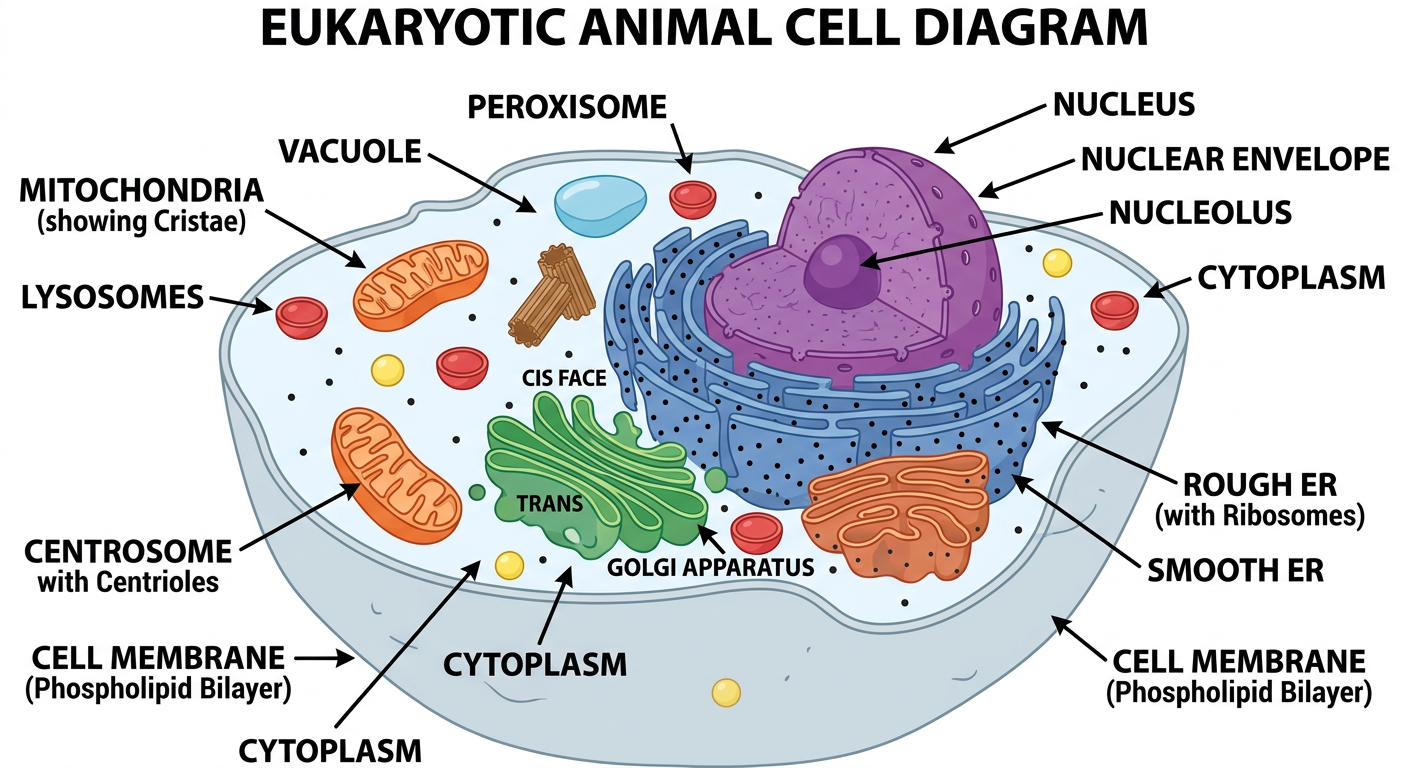
Detailed labeled scientific diagram of a eukaryotic animal cell showing all major organelles with clear labels and arrows: nucleus (with nucleolus and nuclear envelope), mitochondria (showing cristae), endoplasmic reticulum (rough ER with ribosomes and smooth ER), Golgi apparatus (with cis and trans face labeled), lysosomes, ribosomes, cell membrane (with phospholipid bilayer detail), cytoplasm, centrosome with centrioles, vacuole, peroxisome. Clean white background, educational textbook style, each organelle in a different color, all labels in bold black text with leader lines
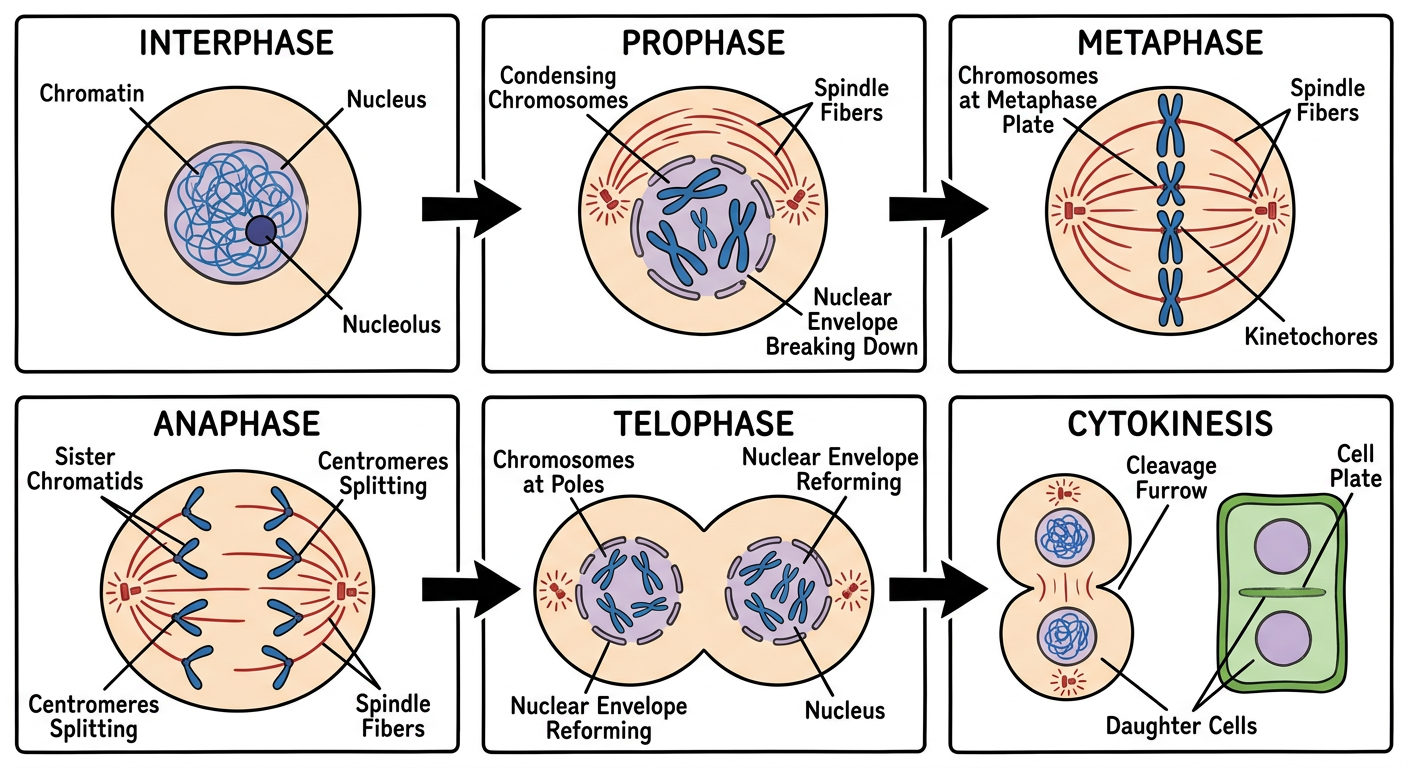
Detailed labeled scientific diagram showing all phases of mitosis in sequence: Interphase (showing chromatin, nucleus, nucleolus), Prophase (chromosomes condensing, spindle forming, nuclear envelope breaking down), Metaphase (chromosomes aligned at metaphase plate, spindle fibers attached to kinetochores), Anaphase (centromeres splitting, sister chromatids moving to opposite poles), Telophase (chromosomes at poles, nuclear envelope reforming), and Cytokinesis (cleavage furrow in animal cell, cell plate in plant cell). Each phase in its own box with bold title, chromosomes shown in blue, spindle fibers in red, clear arrows showing progression, white background, educational NCERT textbook style with all structures labeled
🔬 Diagram 1 - Eukaryotic Animal Cell Organelles
🧬 Diagram 2 - Phases of Mitosis
📝 Key things to notice in these diagrams for NEET:
- RER has ribosomes on its surface; SER does not
- Mitochondria has double membrane - outer smooth + inner folded (cristae)
- Golgi apparatus has a distinct cis face (receiving) and trans face (secreting)
- Centrosome with centrioles is present in animal cells, absent in higher plants
- Prophase - chromatin condenses, nuclear envelope breaks down
- Metaphase - chromosomes at equatorial plate (best stage to count chromosomes!)
- Anaphase - centromere splits, chromatids pulled to poles
- Telophase - nuclear envelope reforms, chromosomes decondense
- Cytokinesis - cell plate in plants / cleavage furrow in animals
Yes
Detailed labeled scientific diagram of the human respiratory system showing: nasal cavity, pharynx, larynx with epiglottis, trachea with C-shaped cartilage rings, left and right bronchi, bronchioles, alveolar ducts, alveoli clusters. Include a zoomed inset showing alveoli gas exchange with labeled: alveolar epithelium, capillary, O2 diffusing in, CO2 diffusing out, partial pressure values (pO2=104mmHg in alveoli, pO2=40mmHg in blood, pCO2=45mmHg in blood, pCO2=40mmHg in alveoli). Also show pleura (visceral and parietal) around lungs, diaphragm at bottom. Educational NCERT textbook style, clean white background, color coded sections, bold black labels with arrows
Detailed labeled scientific diagram of Bohr's atomic model for hydrogen atom showing: nucleus at center (with protons and neutrons labeled), electron orbits/shells labeled n=1, n=2, n=3, n=4 with corresponding energy levels E=-13.6eV, E=-3.4eV, E=-1.51eV, E=-0.85eV. Show electron transition arrows: electron jumping up absorbing energy (absorption), electron falling down emitting energy (emission). Also include a separate panel showing orbital shapes: s orbital (spherical), p orbital (dumbbell shaped with px py pz), d orbital (cloverleaf). Show energy level order: 1s 2s 2p 3s 3p 4s 3d 4p with Aufbau diagonal arrow rule. Clean white background, educational NCERT Class 11 Chemistry style, bold labels, different colors for each shell