
Give me a a detail overview for general anatomy lympathiic system and CVS
Reading File
Now let me search the library for both lymphatic system and cardiovascular system anatomy simultaneously.
Finding Sources
Finding Sources
Gray's Anatomy for Students is the ideal source for general anatomy. Let me read both the lymphatic and CVS sections from it, plus Guyton for physiology.
Reading File
Finding Sources
Finding Sources
Reading File
Finding Sources
Finding Sources
Reading File
Now let me get the CVS section from Gray's and the Guyton physiology section for both topics.
Finding Sources
Finding Sources
Reading File
Now let me fetch the key anatomy images and get the Guyton physiology section on the lymphatic system and CVS.
Loading Image
Reading File
Searching Images
cardiovascular system heart anatomy blood vessels diagram
Loading Image
Loading Image
Loading Image
I now have comprehensive content from Gray's Anatomy for Students and Guyton's Medical Physiology. Let me compile the full detailed overview.
General Anatomy: Lymphatic System & Cardiovascular System
Sources: Gray's Anatomy for Students; Guyton and Hall Textbook of Medical Physiology
PART I — LYMPHATIC SYSTEM
1. Overview & Function
The lymphatic system is an extensive, interconnected network of channels that begins as blind-ended lymphatic capillaries in the tissues and converges into progressively larger vessels, ultimately draining into large veins at the root of the neck. Its primary roles are:
- Fluid return: Collects interstitial fluid (lost from vascular capillary beds during nutrient exchange) and returns it to the venous circulation
- Immune surveillance: Transports pathogens, lymphocytes, macrophages, cell products (hormones), and cell debris
- Fat absorption: In the small intestine, special lymphatic capillaries called lacteals absorb dietary fats packaged as chylomicrons; this fluid (called chyle, which is opaque and milky) is transported to the venous system in the neck
- Protein rescue: Returns plasma proteins from the interstitial space to the bloodstream — without this function, life could not be sustained beyond ~24 hours (Guyton)
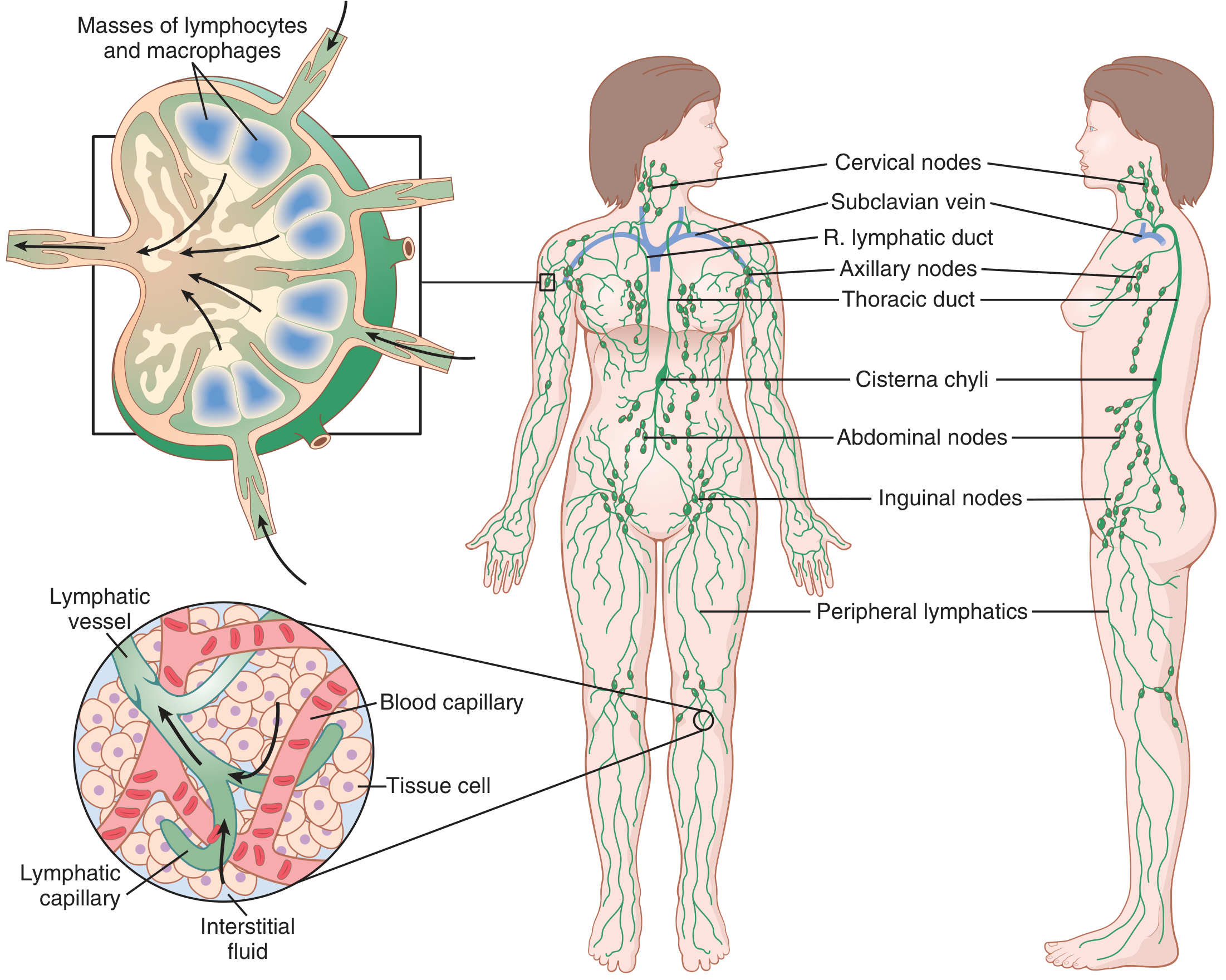
Fig. 16.6 — Guyton: The full lymphatic system, showing cervical, axillary, abdominal, and inguinal nodes, thoracic duct, cisterna chyli, and the relationship between lymphatic capillaries and blood capillaries at tissue level.
2. Lymphatic Vessels
| Type | Description |
|---|---|
| Lymphatic capillaries | Blind-ended, "porous" — allow interstitial fluid, proteins, and cells to enter |
| Lacteals | Specialized capillaries in the small intestinal villi; absorb dietary fat |
| Collecting lymphatics | Larger vessels with smooth muscle walls and valves to maintain unidirectional flow |
| Lymphatic trunks | Major regional channels (see table below) |
| Thoracic duct | The largest lymphatic vessel; drains most of the body |
| Right lymphatic duct | Drains the right side of head/neck and right upper limb |
Movement of lymph is generated mainly by:
- Contraction of skeletal muscles (indirect compression)
- Arterial pulsations from adjacent arteries
- Valves maintain unidirectional flow toward the venous system
3. Major Lymphatic Trunks & Drainage Areas
(Gray's Anatomy for Students, Table 4.4)
| Lymphatic Vessel | Area Drained |
|---|---|
| Right jugular trunk | Right side of head and neck |
| Left jugular trunk | Left side of head and neck |
| Right subclavian trunk | Right upper limb; superficial thoracic and upper abdominal walls |
| Left subclavian trunk | Left upper limb; superficial thoracic and upper abdominal walls |
| Right bronchomediastinal trunk | Right lung and bronchi, mediastinal structures, thoracic wall |
| Left bronchomediastinal trunk | Left lung and bronchi, mediastinal structures, thoracic wall |
| Thoracic duct | Lower limbs, abdominal walls and viscera, pelvic walls and viscera, thoracic wall |
The right jugular, right subclavian, and right bronchomediastinal trunks typically unite to form the right lymphatic duct, which drains into the junction of the right internal jugular and right subclavian veins. The thoracic duct drains into the left venous angle (junction of left internal jugular and left subclavian veins).
4. Cisterna Chyli & Thoracic Duct
- The right and left lumbar trunks (from lateral aortic/para-aortic nodes) and the intestinal trunk (from pre-aortic nodes around the celiac, superior mesenteric, and inferior mesenteric arteries) converge on the posterior right side of the abdominal aorta.
- Their confluence sometimes forms a saccular dilation called the cisterna chyli.
- The thoracic duct arises from the cisterna chyli, ascends through the posterior mediastinum, and empties into the left venous angle.
5. Lymph Nodes
- Small (0.1–2.5 cm), encapsulated structures that interrupt lymphatic channels
- Contain lymphocytes and macrophages organized into nodules
- Act as elaborate filters — trap and phagocytose particulate matter; detect and respond to foreign antigens
- Because flow through nodes is slow, metastatic tumor cells frequently lodge and grow here → used clinically to track disease spread
- Nodes that drain infected or diseased areas become enlarged, hard, or tender — clinically detectable
Major regional node groups:
| Region | Drainage |
|---|---|
| Cervical nodes | Head and neck |
| Axillary nodes | Upper limb, breast, thoracic wall |
| Inguinal nodes | Lower limb, perineum, external genitalia |
| Para-aortic (lumbar) nodes | Kidneys, suprarenal glands, gonads, body wall |
| Pre-aortic (celiac, mesenteric) nodes | GI tract, liver, pancreas, spleen, gallbladder |
| Mediastinal nodes | Lungs, bronchi, heart |
6. Lymphatics of the CNS (Glymphatic System)
True lymphatic vessels are found only in the meninges of the brain and spinal cord. The glymphatic system (Guyton) operates via:
- Cerebrospinal fluid flowing into perivascular spaces around cerebral blood vessels (formed by astrocytic glia)
- CSF enters the brain parenchyma along periarterial spaces, exchanges with interstitial fluid, and exits via perivenous routes
- Waste products and macromolecules (including potentially amyloid-β) are cleared into meningeal lymphatics → ultimately enter the blood
7. Areas Without Lymphatics
Lymphatic vessels are absent in:
- Bone marrow
- Avascular tissues (epithelia, cartilage)
- Superficial skin epidermis
- Endomysium of muscle
- Bones
However, these areas have prelymphatic channels (minute interstitial channels) that drain into proper lymphatics.
PART II — CARDIOVASCULAR SYSTEM (CVS)
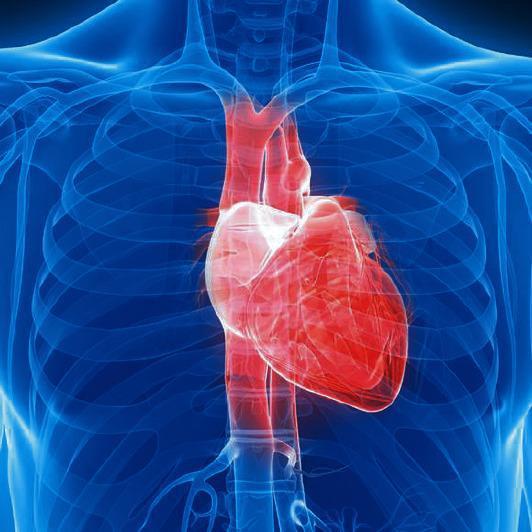
The heart within the thoracic cage, with the ascending aorta, aortic arch, and superior vena cava visible superiorly.
1. Overview
The cardiovascular system consists of:
- The heart — a muscular pump
- Blood vessels — a closed network of arteries, veins, and capillaries
It operates as two circuits in series:
- Pulmonary circulation: Right heart → pulmonary arteries → lungs → pulmonary veins → left heart (gas exchange)
- Systemic circulation: Left heart → aorta → body tissues → venae cavae → right heart (nutrient/waste exchange)
2. Blood Vessel Wall Structure
All blood vessels share a common three-layer (tunic) plan:
| Layer | Name | Composition |
|---|---|---|
| Outer | Tunica externa (adventitia) | Connective tissue |
| Middle | Tunica media | Smooth muscle ± elastic fibers |
| Inner | Tunica intima | Endothelial lining |
3. Classification of Arteries
| Class | Key Features | Examples |
|---|---|---|
| Large elastic arteries | Abundant elastic fibers in tunica media; expand during systole, recoil during diastole → maintain flow during diastole | Aorta, brachiocephalic trunk, left common carotid, left subclavian, pulmonary trunk |
| Medium muscular arteries | Tunica media predominantly smooth muscle → regulate diameter and regional blood flow distribution | Femoral, axillary, radial, most named arteries |
| Small arteries & arterioles | Control capillary filling; major determinants of peripheral vascular resistance and arterial pressure | Terminal branches throughout the body |
4. Classification of Veins
| Class | Key Features | Examples |
|---|---|---|
| Large veins | Some smooth muscle in media; thickest layer is tunica externa | Superior & inferior vena cava, hepatic portal vein |
| Small & medium veins | Small amounts of smooth muscle; thickest layer is tunica externa | Superficial limb veins, deep forearm veins |
| Venules | Smallest veins; drain capillary beds | Throughout tissues |
Distinguishing features of veins vs. arteries:
- Thinner tunica media (lower pressure)
- Larger luminal diameter
- Often paired as venae comitantes alongside arteries in peripheral regions
- Contain valves (especially in limb veins inferior to the heart) — paired cusps to prevent backflow and assist venous return
5. Capillaries
- Smallest vessels — 1 cell thick (endothelium only)
- Site of gas exchange, nutrient delivery, and waste removal between blood and tissues
- Connect arterioles (arterial side) to venules (venous side)
6. The Heart
Position and orientation:
- Located in the middle mediastinum, within the pericardial sac
- Oriented obliquely: base faces superiorly/posteriorly; apex points inferiorly/anteriorly toward the left (5th intercostal space, midclavicular line)
Chambers:
| Chamber | Function |
|---|---|
| Right atrium | Receives deoxygenated blood from superior and inferior venae cavae + coronary sinus |
| Right ventricle | Pumps blood to lungs via pulmonary trunk |
| Left atrium | Receives oxygenated blood from 4 pulmonary veins |
| Left ventricle | Pumps blood to the body via the aorta; wall is 3× thicker than right |
Valves:
| Valve | Location | Function |
|---|---|---|
| Tricuspid (right AV) | Between right atrium and right ventricle | Prevents backflow into right atrium during systole |
| Pulmonary (semilunar) | At root of pulmonary trunk | Prevents backflow into right ventricle during diastole |
| Mitral/Bicuspid (left AV) | Between left atrium and left ventricle | Prevents backflow into left atrium during systole |
| Aortic (semilunar) | At root of aorta | Prevents backflow into left ventricle during diastole |
7. Key Vessels of Systemic Circulation
Arterial side (from the heart):
- Aorta → Aortic arch (brachiocephalic trunk, left common carotid, left subclavian) → Thoracic aorta → Abdominal aorta → Common iliac arteries
Venous return:
- Superior vena cava (SVC): drains head, neck, upper limbs, thorax
- Inferior vena cava (IVC): drains abdomen, pelvis, lower limbs
- Coronary sinus: drains the heart wall itself → right atrium
8. Coronary Circulation
- Right coronary artery (RCA): Supplies right ventricle, SA node (in ~60% of people), AV node (in ~80%), and the inferior/posterior left ventricle in right-dominant systems
- Left coronary artery (LCA): Divides into:
- Left anterior descending (LAD): Supplies anterior left ventricle and interventricular septum
- Circumflex (LCx): Supplies lateral and posterior left ventricle
- Venous drainage: mostly via coronary sinus into the right atrium; anterior cardiac veins drain directly
9. Clinical Correlations
Atherosclerosis (Gray's Anatomy):
- Chronic inflammatory reaction in arterial walls with cholesterol/fatty protein deposition → secondary calcification → reduced lumen diameter
- Plaque may cause distal embolism or fissure to form acute thrombus
- Clinical impact depends on which vessel is affected (coronary → MI; carotid → stroke; peripheral → limb ischemia)
Venous valves and varicose veins: Incompetent valves in superficial leg veins → venous pooling → varicosities; risk worsened by prolonged standing, pregnancy
Lymphedema: Obstruction of lymphatic drainage (surgery, radiation, filariasis) → accumulation of protein-rich interstitial fluid → chronic tissue swelling
Relationship Between the Two Systems
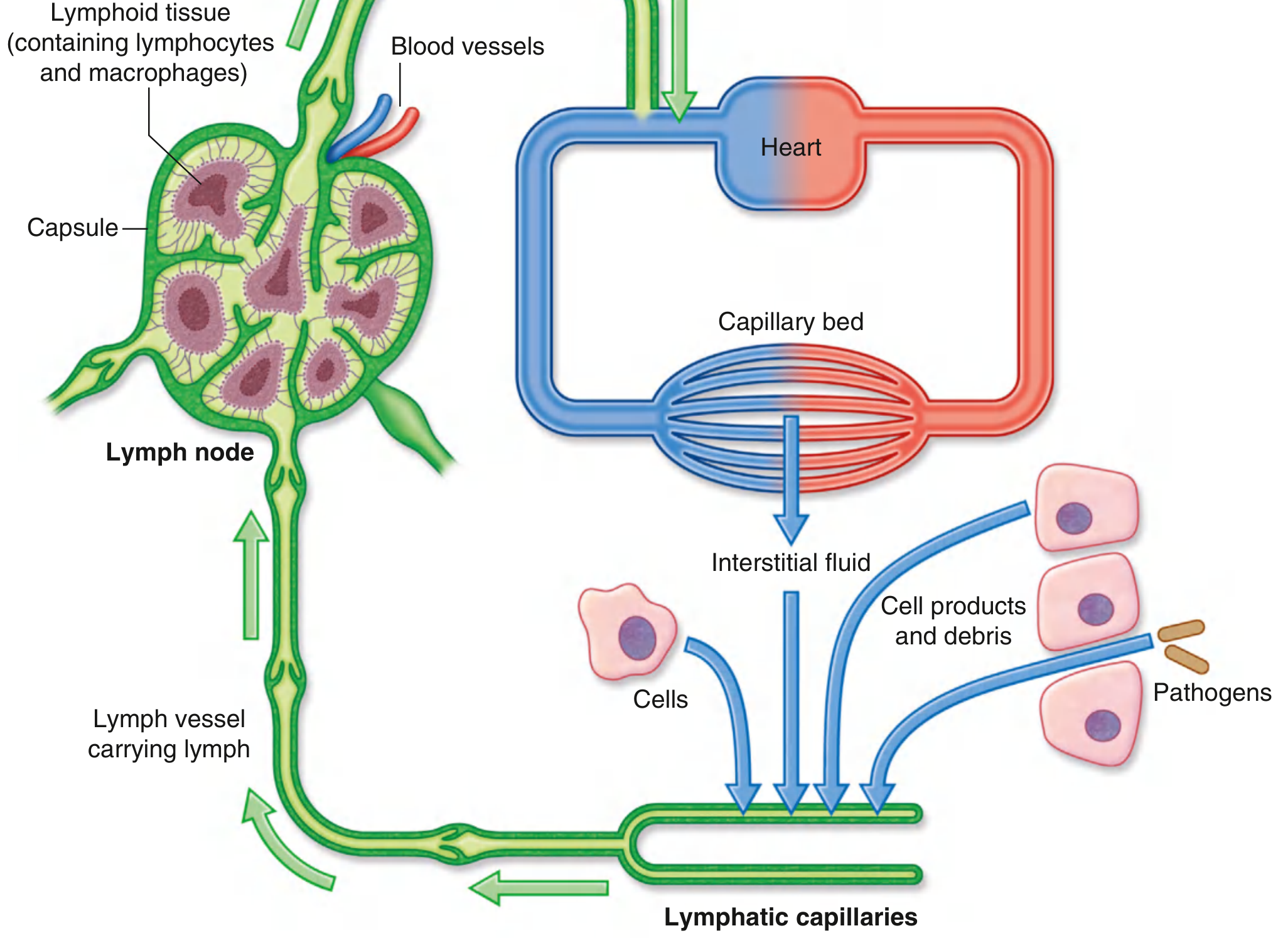
The CVS and lymphatic system are functionally interdependent: fluid filtered at capillary beds is partly reabsorbed by venules and partly drained by lymphatic capillaries — both returning fluid to the venous system.
| Feature | CVS | Lymphatic System |
|---|---|---|
| Circuit type | Closed loop | One-way (tissue → veins) |
| Pump | Heart | Skeletal muscle / arterial pulsations |
| Fluid transported | Blood (cells + plasma) | Lymph (interstitial fluid + proteins + cells) |
| Key exchange site | Capillaries | Lymphatic capillaries |
| Filtration/immunity | — | Lymph nodes |
| Fat absorption | — | Lacteals (intestinal lymphatics) |
— Gray's Anatomy for Students (9780323934237), Chapter 1 & Chapter 4; Guyton and Hall Textbook of Medical Physiology (9780443111013), Chapter 16
This is a shared conversation. Sign in to Orris to start your own chat.