
Give me explanation on rigor mortis
Reading File
Searching sources...
Rigor mortis is the stiffening of muscles after death due to depletion of ATP, which prevents actin-myosin cross-bridges from releasing. It typically begins 2-6 hours after death, peaks around 12 hours, and resolves by 24-48 hours as autolysis breaks down muscle proteins.
Now let me pull detailed content from the medical library.
Finding Sources
Finding Sources
Good - I have several excellent sources. Let me read the detailed content from all the key sections in parallel.
Reading File
Reading File
Reading File
Excellent content retrieved. Let me read more from Parikh's (conditions simulating rigor mortis) and the continuation of the Essentials textbook.
Reading File
Reading File
Reading File
Now let me also get the "Conditions Simulating Rigor Mortis" section and fetch the image.
Reading File
Loading Image
I now have comprehensive, detailed information from multiple authoritative forensic medicine textbooks. Let me compose the full answer.
Rigor Mortis
Definition
Rigor mortis (Latin: rigor = rigidity, mortis = of death) is the postmortem stiffening and shortening of muscles that follows the stage of primary relaxation after death. It is caused by chemical changes in the structural proteins of muscle fibres and is regarded as an indicator of molecular death of the cells.
- Parikh's Textbook of Medical Jurisprudence, Forensic Medicine and Toxicology, p. 181
Mechanism (Biochemistry)
In a living muscle, two contractile protein filaments - myosin and actin - interdigitate. Contraction and relaxation both require ATP (adenosine triphosphate). Three metabolic systems supply ATP continuously:
| System | Duration of maximal supply |
|---|---|
| Phosphagen system | ~10-15 seconds |
| Glycogen-lactic acid system | ~30-40 seconds |
| Aerobic system | Unlimited (while alive) |
After death, ATP generation stops but consumption continues. The body resynthesises ATP briefly using residual glycogen, but once this runs out:
- ATP is fully depleted
- Actin and myosin filaments permanently complex together - they cannot release
- Muscles stiffen and shorten into a dehydrated stiff gel = rigor mortis
- Muscle pH drops from slightly alkaline to distinctly acidic due to lactic acid accumulation
Rigor persists until autolysis of the myosin and actin filaments occurs as part of putrefaction, at which point muscles soften and secondary relaxation sets in.
- DiMaio's Forensic Pathology, 3rd Edition, p. 34
- Parikh's Textbook of Medical Jurisprudence, p. 181
Time of Onset
In Temperate Countries (Rule of 12)
| Event | Time After Death |
|---|---|
| Onset | 3-6 hours |
| Full development (head to toe) | ~12 hours |
| Persists | ~12 hours |
| Passes off | ~12 hours (total ~36 hours) |
In India / Tropical Climates
- Begins: 1-3 hours after death
- Fully established: ~6-12 hours in summer
- Lasts: 18-36 hours in summer, 24-48 hours in winter
Note: The classical "Rule of 12" (starts at 12 hours, persists 12 hours, resolves over 12 hours) is not applicable in tropical countries due to higher ambient temperatures.
Onset range (Mallach's computed data from literature):
-
Beginning: 0.5 to 7 hours post-mortem
-
Maximum: 2 to 20 hours post-mortem
-
The Essentials of Forensic Medicine and Toxicology, 36th ed., Table 7.5
Sequence of Development
Rigor mortis develops simultaneously in all muscles at the same rate, but becomes most evident first in the smaller muscles. The sequence of detection is:
- Involuntary muscles first - heart (within ~1 hour); left ventricle appears more affected than right (thicker wall)
- Voluntary muscles - in this order:
- Eyelids: 3-4 hours
- Face: 4-5 hours
- Neck and trunk: 5-7 hours
- Upper extremities: 7-9 hours
- Lower extremities: 9-11 hours
- Small muscles of fingers and toes: 11-12 hours (last to be affected)
When fully established: arms are bent at elbows, legs at knees and hips, fingers and toes show marked flexion.
Rigor passes off in the same order it appeared.
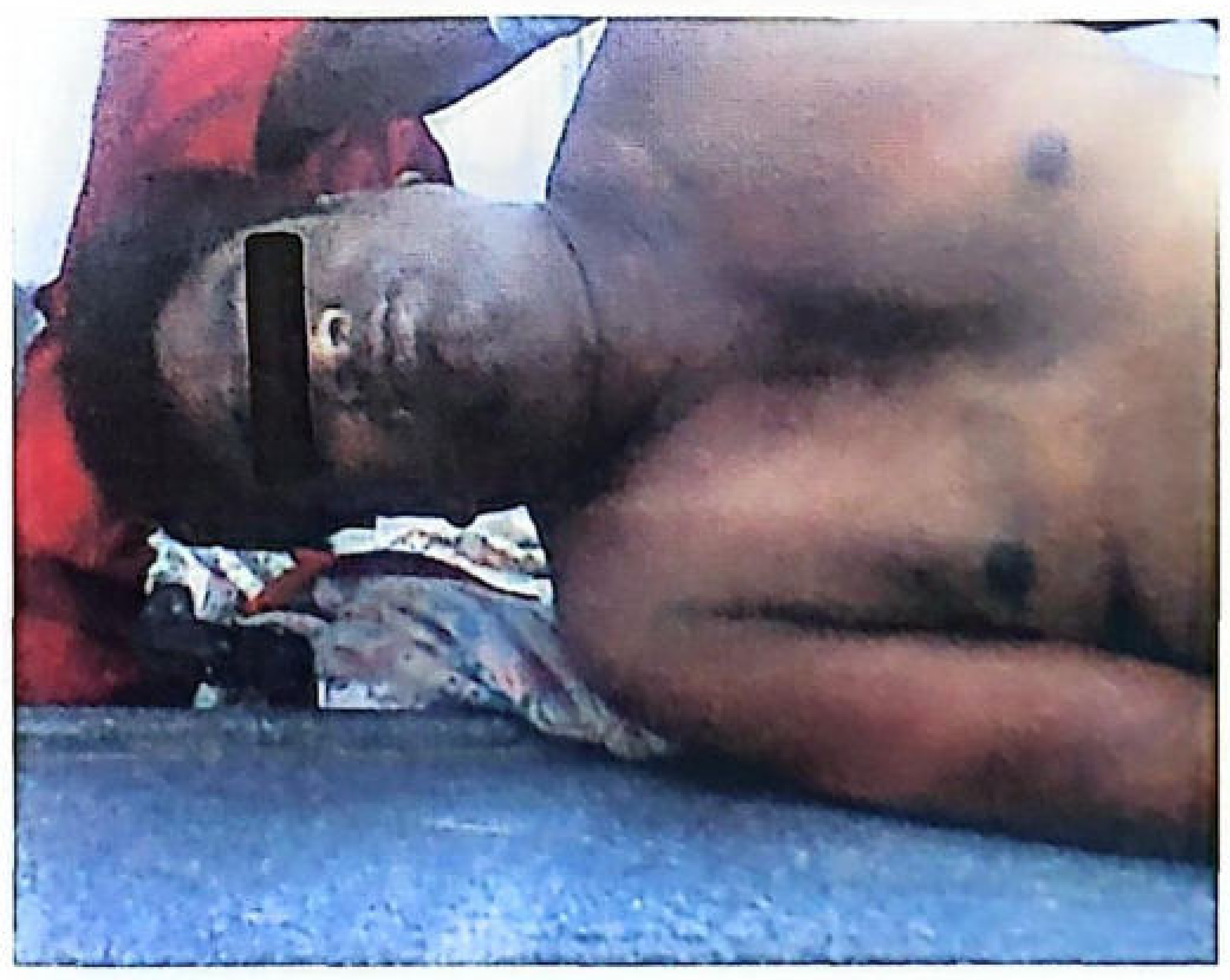
- Parikh's Textbook of Medical Jurisprudence, p. 181-182
Features When Fully Developed
- Entire body is stiff, muscles are shortened, hard, and opaque
- Knees, hips, shoulders, and elbows: slightly flexed
- Fingers and toes: markedly flexed
- Cutis anserina (goose skin): Rigor of erector pili muscles causes skin dimpling, puckering, and hair standing on end. Mainly affects extremities.
- Scrotal rigor: Rigor of the dartos muscle can compress the testes, causing postmortem extrusion of semen from the urethral meatus
- In labor: if the uterus was in labor at the time of death, rigor may cause uterine contraction and expulsion of the fetus
- Pupils may be partially contracted
Factors Affecting Rigor Mortis
Factors That Accelerate Onset
| Factor | Mechanism |
|---|---|
| Violent exercise before death | Pre-depletes ATP |
| Severe convulsions | Pre-depletes ATP |
| High body temperature / fever | Speeds metabolic depletion |
| Strychnine poisoning | Induces convulsions |
| Excited delirium | Muscle exhaustion |
| Drowning (violent struggling) | ATP exhausted; rigor in 2-3 hours |
| Infants | Less muscle mass; rigor faster |
Factors That Delay Onset
- Cold / freezing temperatures - also prolong duration
- Emaciation - rigor may be delayed and weak (less glycogen/ATP reserve)
- Paralysed limbs (rigor develops more slowly)
Breaking of Rigor Mortis
Rigor can be mechanically broken by passively stretching or forcibly flexing a stiff limb at a joint. Once broken, it does not return. However:
- If only partial rigor has set in before stretching, the residual unbroken rigor can still develop later, fixing the limb in its new position (though with less intensity)
- Frequent body handling causes patchy rigor distribution
- This is forensically important: body movement during transport to the mortuary may partially break rigor, misleading estimation of time of death
Forensic Importance (Medico-Legal Value)
- Estimating time of death - presence, extent, and stage of rigor helps narrow the post-mortem interval
- Rigor absent: death within ~2 hours
- Rigor present throughout: death ~12-24 hours ago
- Posture at death - if rigor fixes the body in an unusual position, it may reveal the position at the time of death
- "Breaking" as evidence of body movement - partial or asymmetric rigor may indicate the body was moved after death
- Cadaveric spasm (see below) - forensic significance in suicide/homicide
Special Related Condition: Cadaveric Spasm (Instantaneous Rigor)
Cadaveric spasm is rigor that sets in immediately at the moment of death, without the preceding stage of primary relaxation. It is rare and requires:
- Somatic death occurring with extreme rapidity
- Great emotional tension at the time of death
- The muscles actively contracting at that moment
Forensic significance: An object (weapon, grass, letter) found firmly clenched in the hand indicates it was held at the moment of death and cannot be placed there afterwards. This distinguishes homicide from staged scenes.
Common in: drowning deaths (hands clenching weeds), gunshot wounds, war casualties.
- DiMaio's Forensic Pathology, 3rd Edition, p. 34
- Parikh's Textbook of Medical Jurisprudence, p. 183
Conditions Simulating Rigor Mortis
| Condition | Cause | Key Difference |
|---|---|---|
| Freezing (cold stiffening) | Solidification of tissue fluid and fat at <0°C | Disappears on thawing; body then enters true rigor (shorter, weaker) |
| Heat coagulation (heat stiffening) | Protein coagulation by heat >70°C (burns, electrocution) | "Pugilistic attitude" (semi-flexed limbs, clenched fists); no true rigor develops |
| Putrefactive stiffening | Gas accumulation in tissues | Limbs remain raised without support; false rigidity |
| Cadaveric spasm | Instantaneous onset with no primary relaxation | Limited to active muscles; object tightly gripped |
Effects on Autopsy Findings
- Rigor in the heart causes the ventricles to contract, which can mimic left ventricular hypertrophy on gross exam - must check wall thickness and weight
- Secondary muscular flaccidity causes atrial/ventricular distension - should not be mistaken for antemortem chamber dilatation or myocardial degeneration
- It is not possible to determine at autopsy whether the heart stopped in systole or diastole due to these postmortem changes
- Facial grimacing after death (eyes and mouth fixed open by rigor) does not indicate fear or suffering
Sources:
- DiMaio's Forensic Pathology, 3rd Edition (Practical Aspects of Criminal Investigation)
- Parikh's Textbook of Medical Jurisprudence, Forensic Medicine and Toxicology
- The Essentials of Forensic Medicine and Toxicology, 36th Edition (2026)
This is a shared conversation. Sign in to Orris to start your own chat.