
heart attack in detail point wise manner
"myocardial infarction"[MeSH Terms] AND management
Heart Attack (Myocardial Infarction) - A Complete Point-wise Overview
1. Definition
- Myocardial infarction (MI), commonly called a "heart attack," is necrosis of the heart muscle resulting from ischemia.
- The 2018 joint U.S./European Cardiology task force defines it as: "The presence of acute myocardial injury detected by abnormal cardiac biomarkers in the setting of evidence of acute myocardial ischemia."
- The underlying damage is irreversible once ischemia persists beyond 20-40 minutes - Robbins & Kumar Basic Pathology, p. 354
2. Epidemiology & Risk Factors
- ~10% of MIs occur before age 40; ~45% occur before age 65.
- Men are at greater risk than women; however, the gap narrows with age.
- Women are relatively protected during reproductive years, but menopause (declining estrogen) accelerates coronary artery disease.
- IHD is the most common cause of death in older adult women.
- Risk factors mirror those for atherosclerosis: hypertension, dyslipidemia, diabetes, smoking, obesity, family history, sedentary lifestyle - Robbins & Kumar Basic Pathology, p. 353
3. Classification (Types of MI)
- Caused by atherosclerotic plaque rupture with acute thrombosis.
- Divided into STEMI (ST-elevation MI) and NSTEMI (non-ST-elevation MI).
- Treatment is revascularization (PCI or thrombolysis).
- Caused by supply-demand mismatch (demand ischemia) - not plaque rupture.
- Examples: severe anemia, tachycardia, hypotension, hypertensive crisis.
- Treatment targets reducing cardiac oxygen demand.
- STEMI → NSTEMI → Unstable Angina (no biomarker elevation in UA).
-
- Sabiston Textbook of Surgery, p. 2928
4. Pathogenesis - The Step-by-Step Sequence
- Plaque disruption - An atheromatous plaque is eroded or suddenly disrupted by endothelial injury, intraplaque hemorrhage, or mechanical forces, exposing subendothelial collagen and necrotic plaque contents to blood.
- Platelet activation - Platelets adhere, aggregate, and release thromboxane A₂, ADP, and serotonin, causing further platelet aggregation and vasospasm.
- Coagulation cascade activation - Exposure of tissue factor activates coagulation, adding to the growing thrombus.
- Complete occlusion - The enlarging thrombus may completely occlude the coronary artery lumen within minutes.
- Angiography within 4 hours shows coronary thrombosis in ~90% of cases; by 12-24 hours, only 60% (some occlusions spontaneously lyse).
- 10% of MIs occur without occlusive atherosclerosis - causes include vasospasm, embolism from atrial fibrillation, or valve vegetations. - Robbins & Kumar Basic Pathology, p. 353
5. Progression of Myocardial Necrosis
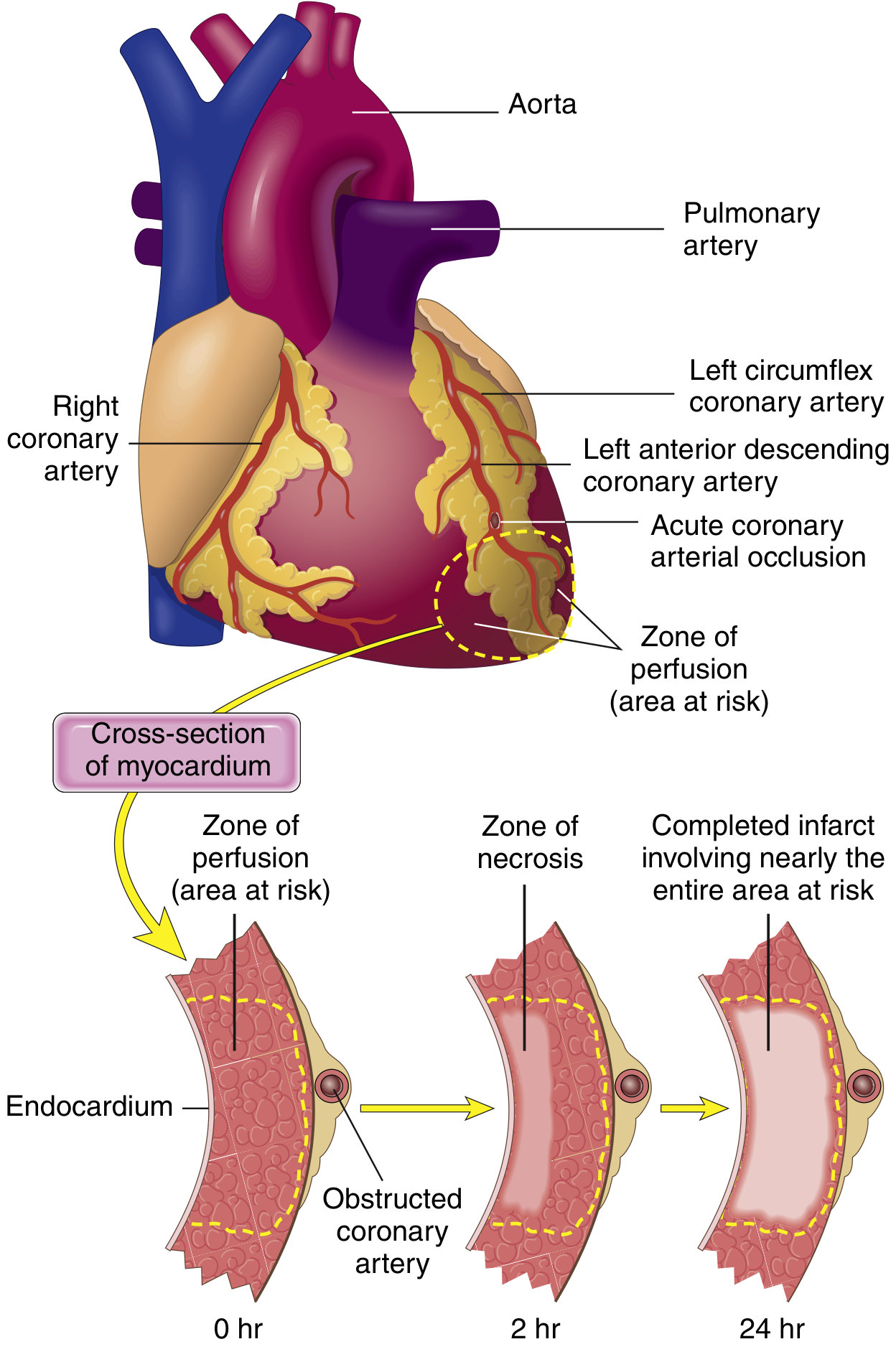
- Within seconds: aerobic metabolism ceases; ATP drops; lactic acid accumulates.
- Within minutes: loss of contractility (reversible at this stage).
- 20-40 minutes: irreversible damage begins; sarcolemmal membrane disruption allows intracellular macromolecules (troponins) to leak out.
- Necrosis begins in the subendocardial zone (most vulnerable - furthest from epicardial vessels, highest intramural pressure).
- A wavefront of cell death then moves outward toward the epicardium.
- Without intervention, a transmural infarct develops fully in 3-6 hours. - Robbins & Kumar Basic Pathology, p. 354-355
6. Infarct Location by Artery Involved
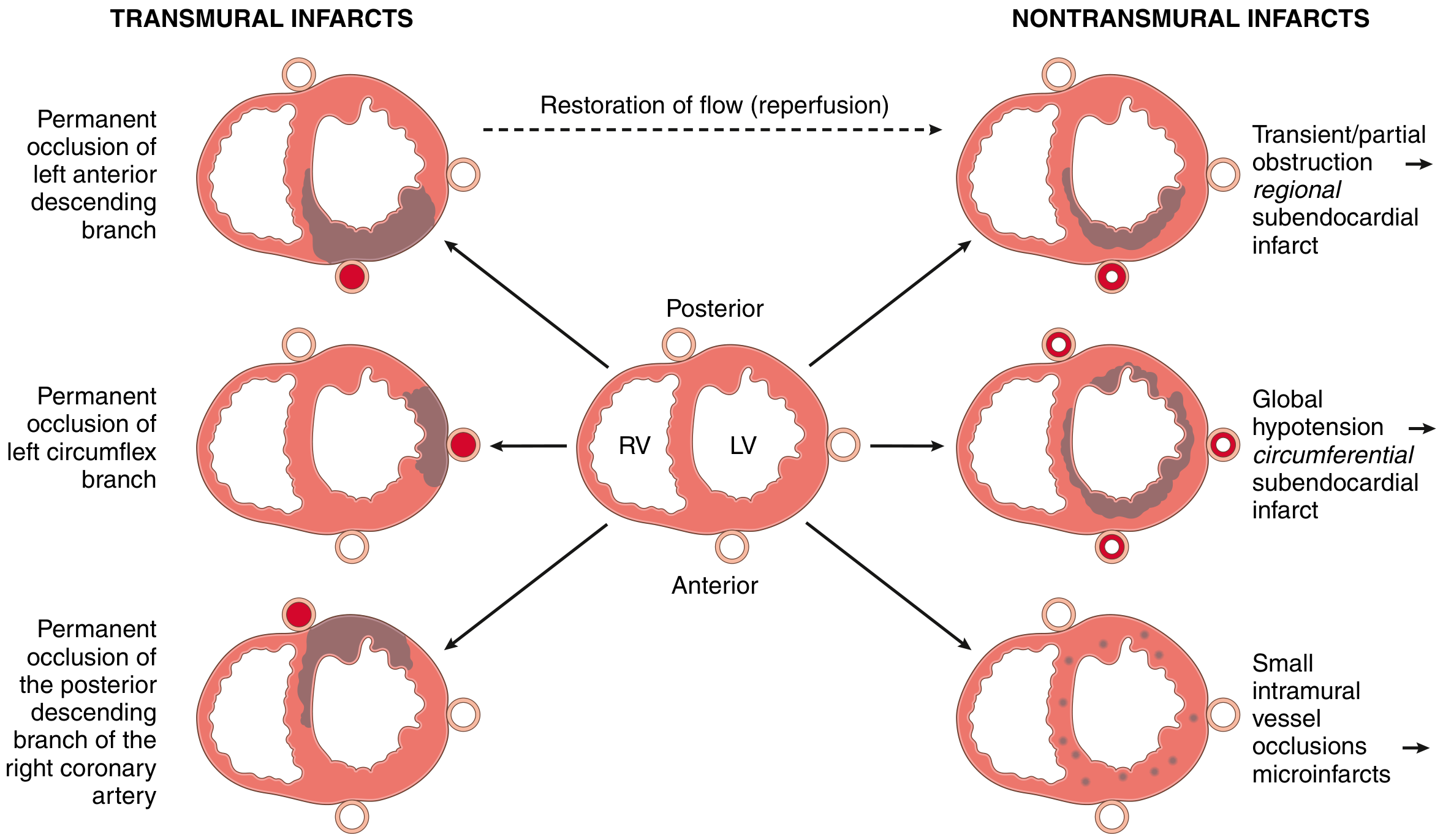
| Artery | % of MIs | Territory Affected |
|---|---|---|
| Left Anterior Descending (LAD) | 40-50% | Anterior LV wall, anterior 2/3 of septum, cardiac apex |
| Right Coronary Artery (RCA) | 30-40% | Right ventricle, posterior LV wall, posterior 1/3 of septum |
| Left Circumflex (LCX) | 15-20% | Lateral left ventricle |
- Proximal LAD occlusions are often fatal; distal occlusions may affect only the apex.
- Isolated RV infarcts occur in only 1-3% of IHD cases.
-
- Robbins & Kumar Basic Pathology, p. 355-356
Types of Infarcts:
- Transmural infarct - Full thickness of ventricular wall; from total epicardial vessel occlusion (classic STEMI).
- Subendocardial infarct - Limited to inner 1/3 of myocardium; often from partial/transient occlusion or severe global hypoperfusion (NSTEMI pattern).
- Microscopic infarct - Small-vessel occlusions (vasculitis, emboli, cocaine-induced vasospasm); may show no ECG changes.
7. Morphological Changes Over Time (Pathological Timeline)
| Time Frame | Gross Features | Light Microscopy | Electron Microscopy |
|---|---|---|---|
| 0-30 min | None (reversible) | None | Relaxation of myofibrils; glycogen loss; mitochondrial swelling |
| 30 min - 4 hrs | None | Variable fiber waviness at border | Sarcolemmal disruption; mitochondrial amorphous densities |
| 4-12 hrs | Occasional dark mottling | Coagulation necrosis onset; edema; hemorrhage | - |
| 12-24 hrs | Dark mottling | Coagulation necrosis; pyknotic nuclei; hypereosinophilic myocytes; early neutrophilic infiltrate | - |
| 1-3 days | Yellow-tan infarct center | Coagulation necrosis with loss of nuclei and striations; increased neutrophils | - |
| 3-7 days | Hyperemic border; central softening | Neutrophil disintegration; macrophage phagocytosis begins at border | - |
| 7-10 days | Maximally yellow-tan and soft | Well-developed macrophage phagocytosis; early granulation tissue at margins | - |
| 10-14 days | Red-gray depressed borders | Well-established granulation tissue | - |
| 2-8 weeks | Gray-white scar forming | Collagen deposition | - |
| >2 months | Dense white scar | Dense collagen scar; fully healed | - |
- Myocardial necrosis proceeds invariably to scar - no significant regeneration occurs. - Robbins & Kumar Basic Pathology, p. 357
8. Clinical Features (Symptoms)
- Crushing/squeezing chest pain - central, often described as "pressure," "tightness," or "heaviness"
- Radiation - to left arm, jaw, neck, back, or epigastrium
- Duration - typically >30 minutes (unlike angina which resolves within 20 min)
- Diaphoresis (profuse sweating)
- Nausea and vomiting
- Dyspnea (shortness of breath)
- Anxiety and sense of impending doom
- Palpitations (from arrhythmias)
- Epigastric pain or indigestion
- Fatigue, weakness
- Jaw or arm pain alone
- Silent MI (no pain, detected only on ECG or biomarkers)
- Women more often present without chest pain, which leads to delayed and less aggressive care - Symptom to Diagnosis, p. 175
9. ECG Changes
- Rapid repolarization of infarcted cells → current flows out of infarct → ST segment elevation
- Decreased resting membrane potential (K⁺ leaks out) → current flows into infarct during diastole → TQ depression (recorded as ST elevation)
- Delayed depolarization of infarcted cells → also causes ST segment elevation
- Acute (hours): ST segment elevation in leads overlying the infarct; reciprocal ST depression in opposite leads
- Days to weeks: ST changes subside; Q waves appear (electrically silent dead muscle)
- Chronic: Q waves persist as a permanent marker of prior infarction
- NSTEMI: ST depression or T-wave changes, but no ST elevation; no Q waves typically
- Non-Q-wave infarcts tend to be less severe but carry high risk of reinfarction - Ganong's Review of Medical Physiology, p. 534-535
10. Cardiac Biomarkers
- Cardiac Troponin I and T - Most specific and sensitive; rise within 3-6 hours, peak at 12-24 hours, remain elevated 7-14 days (troponin T can persist up to 2 weeks).
- CK-MB - Rises within 3-6 hours; returns to normal within 48-72 hours (useful for detecting reinfarction).
- Myoglobin - Earliest to rise (1-3 hours) but not cardiac-specific; used for early rule-out.
- LDH - Rises later (24-48 hrs); was used historically but largely replaced by troponins.
- The 4th Universal Definition of MI classifies infarction based on rising/falling troponin pattern with at least one value above the 99th percentile. - Tietz Textbook of Laboratory Medicine, 7th Edition
11. Causes of Death After Acute MI
- Decreased cardiac output (Cardiogenic shock) - Occurs when >40% of left ventricle is infarcted; mortality 40-50%. The infarcted segment undergoes systolic stretch (bulges outward during systole instead of contracting), further reducing effective pumping force.
- Pulmonary edema - Blood backs up into pulmonary circulation; elevated capillary pressure causes pulmonary edema, often days after the event as reduced renal perfusion leads to fluid retention.
- Ventricular fibrillation - Most common mechanism of sudden cardiac death; occurs in 80-90% of cardiac deaths from ischemia. Two danger windows: within 10 minutes and at 1-2 hours post-infarction. Caused by:
- Extracellular K⁺ elevation from leaking ischemic cells (increases irritability)
- Injury currents from partially depolarized ischemic areas
- Sympathetic activation (baroreceptor reflex response to low BP)
- Ventricular dilation increasing conduction pathway length
- Cardiac rupture - Rare; most likely between days 3-7 when the infarct is maximally soft (neutrophil-mediated dissolution), before adequate scar forms.
-
- Guyton & Hall Textbook of Medical Physiology, p. 271-272
12. Complications
- Arrhythmias (ventricular fibrillation, ventricular tachycardia, heart block, AF)
- Cardiogenic shock
- Acute left ventricular failure / pulmonary edema
- Right ventricular infarction (with proximal RCA occlusion) - gives low-output state with clear lungs
- Pericarditis (early, within 24-72 hours - overlies the infarct zone)
- Papillary muscle rupture (mitral regurgitation)
- Interventricular septum rupture (new VSD)
- Free wall rupture (cardiac tamponade)
- Mural thrombus formation (with risk of systemic embolism)
- Left ventricular aneurysm
- Dressler's syndrome (autoimmune pericarditis, 2-10 weeks post-MI)
- Chronic heart failure
- Sudden cardiac death from late arrhythmia (persistent risk)
13. Diagnosis - Summary
| Test | Finding |
|---|---|
| ECG | ST elevation (STEMI) or ST/T changes (NSTEMI); Q waves (old MI) |
| Troponin I/T | Rise and fall pattern; most definitive |
| Echo | Wall motion abnormality; LV function |
| Coronary angiography | Confirms occlusion; guides revascularization |
| CXR | May show pulmonary edema or widened mediastinum |
14. Treatment
Acute Management (STEMI):
- Aspirin - Immediate 300 mg loading dose; antiplatelet (inhibits TXA₂)
- P2Y12 inhibitors - Clopidogrel, ticagrelor, or prasugrel; dual antiplatelet therapy
- Anticoagulation - Unfractionated heparin, LMWH, fondaparinux, or bivalirudin
- Nitroglycerin - Sublingual or IV; reduces preload, relieves chest pain (avoid in RV infarction as it reduces preload and can cause catastrophic hypotension)
- Beta-blockers - Cardioprotective; reduce oxygen demand and risk of arrhythmia (avoid if hypotension, reduced EF, bradycardia, or cardiogenic shock)
- High-intensity statins - Early HMG-CoA reductase inhibitors (target LDL <70 mg/dL)
- Oxygen - Only if patient is hypoxic (SpO₂ <90%)
- Morphine - For pain not relieved by nitrates (though routine use now questioned)
- Primary PCI (percutaneous coronary intervention) with stent placement is the gold standard - lower mortality, lower hemorrhagic stroke risk vs. thrombolysis
- Systemic thrombolysis (tPA, streptokinase) - Only if PCI cannot be delivered within 2 hours of presentation
- Both are most effective within 12 hours of symptom onset
- Even patients requiring transfer to a PCI-capable center have better outcomes with PCI than bedside thrombolysis
- Beta-blockers (survival benefit)
- ACE inhibitors (reduce remodeling, especially if EF is reduced)
- Aspirin (lifelong)
- P2Y12 inhibitor (duration based on stent type and bleeding risk)
- High-intensity statins
- Glycoprotein IIb/IIIa inhibitors (recommended if stenting was performed)
- Similar medical therapy; PCI can be delayed up to 72 hours in many cases
- No systemic thrombolysis
- Treat the underlying cause (correct anemia, control heart rate, treat hypotension)
-
- Symptom to Diagnosis, p. 175; Sabiston Textbook of Surgery, p. 2934-2936
15. Reperfusion Injury
- Restoring blood flow saves myocardium but can paradoxically cause additional injury.
- Mechanisms: calcium overload, oxidative stress from reactive oxygen species, inflammatory mediators.
- Stunned myocardium - Post-ischemic myocardium remains non-contractile for days despite restored flow; this is transient and reversible.
-
- Robbins & Kumar Basic Pathology, p. 354
16. Prognosis
- In-hospital mortality: ~10.3% in men, ~14.6% in women.
- Women have worse outcomes partly due to presentation without chest pain, leading to delayed diagnosis and less aggressive treatment.
- Mortality difference between sexes narrows and eventually reverses with advancing age.
- Cardiogenic shock (>40% LV infarction) carries 40-50% short-term mortality.
- Exercise stress testing is recommended within 3 weeks of MI (for patients not undergoing PCI/angiography) for risk stratification and functional assessment.
- A recent 2025 meta-analysis (PMID 39298680) found that beta-blocker benefit for secondary prevention post-MI may be limited in patients without reduced ejection fraction or heart failure, suggesting potential refinement of current guidelines. - Symptom to Diagnosis, p. 175
17. Special Considerations
- Cardiac muscle requires ~1.3 mL O₂/100g/min just to stay alive vs. ~8 mL O₂/100g/min delivered normally. Even 15-30% of normal resting flow can prevent cell death in marginal zones. The central infarct with near-zero flow is what undergoes irreversible necrosis. - Guyton & Hall Textbook of Medical Physiology, p. 271
- In the perioperative setting, the critical distinction between Type 1 (plaque rupture - needs revascularization) and Type 2 (demand ischemia - needs oxygen demand reduction) is essential because anticoagulation for PCI may be contraindicated after recent neurosurgery or major procedures. - Sabiston Textbook of Surgery, p. 2932
- Causes vasospasm and microscopic infarcts even in young patients without atherosclerosis - Robbins & Kumar Basic Pathology, p. 356
Generate a PDF quick reference guide on MI diagnosis and treatment
ls /home/daytona/workspace/ 2>/dev/null || echo "workspace empty or not found"
~/mi-quickref/generate_mi_pdf.py
from reportlab.lib.pagesizes import A4
from reportlab.lib import colors
from reportlab.lib.units import mm, cm
from reportlab.lib.styles import getSampleStyleSheet, ParagraphStyle
from reportlab.lib.enums import TA_CENTER, TA_LEFT, TA_JUSTIFY
from reportlab.platypus import (
SimpleDocTemplate, Paragraph, Spacer, Table, TableStyle,
HRFlowable, KeepTogether
)
from reportlab.platypus.flowables import HRFlowable
import os
OUTPUT_PATH = "/home/daytona/workspace/mi-quickref/MI_Quick_Reference_Guide.pdf"
os.makedirs(os.path.dirname(OUTPUT_PATH), exist_ok=True)
# ── Colour palette ──────────────────────────────────────────────────────────
RED = colors.HexColor("#C0392B")
DARK_RED = colors.HexColor("#922B21")
ORANGE = colors.HexColor("#E67E22")
TEAL = colors.HexColor("#1A6B7C")
TEAL_LIGHT= colors.HexColor("#D6EEF3")
GREY_BG = colors.HexColor("#F4F6F7")
GREY_LINE = colors.HexColor("#BDC3C7")
WHITE = colors.white
BLACK = colors.HexColor("#1C2833")
GREEN = colors.HexColor("#1E8449")
GREEN_LIGHT= colors.HexColor("#D5F5E3")
AMBER = colors.HexColor("#D68910")
AMBER_LIGHT= colors.HexColor("#FEF9E7")
BLUE_HEAD = colors.HexColor("#1B4F72")
# ── Styles ───────────────────────────────────────────────────────────────────
styles = getSampleStyleSheet()
def S(name, **kw):
return ParagraphStyle(name, **kw)
Title = S("Title",
fontName="Helvetica-Bold", fontSize=22, textColor=WHITE,
leading=28, alignment=TA_CENTER, spaceAfter=2)
Subtitle = S("Subtitle",
fontName="Helvetica", fontSize=11, textColor=colors.HexColor("#FDFEFE"),
leading=16, alignment=TA_CENTER)
SectionHead = S("SectionHead",
fontName="Helvetica-Bold", fontSize=11, textColor=WHITE,
leading=15, spaceBefore=6, spaceAfter=3,
leftIndent=6, rightIndent=6)
SubHead = S("SubHead",
fontName="Helvetica-Bold", fontSize=9.5, textColor=BLUE_HEAD,
leading=13, spaceBefore=5, spaceAfter=2)
Body = S("Body",
fontName="Helvetica", fontSize=8.5, textColor=BLACK,
leading=12, spaceAfter=2)
BulletStyle = S("Bullet",
fontName="Helvetica", fontSize=8.5, textColor=BLACK,
leading=12, leftIndent=12, firstLineIndent=-8, spaceAfter=1)
BoldBody = S("BoldBody",
fontName="Helvetica-Bold", fontSize=8.5, textColor=BLACK,
leading=12, spaceAfter=2)
SmallGrey = S("SmallGrey",
fontName="Helvetica-Oblique", fontSize=7.5, textColor=colors.HexColor("#7F8C8D"),
leading=10, alignment=TA_CENTER)
CellHead = S("CellHead",
fontName="Helvetica-Bold", fontSize=8.5, textColor=WHITE,
leading=11, alignment=TA_CENTER)
CellBody = S("CellBody",
fontName="Helvetica", fontSize=8, textColor=BLACK, leading=11)
CellBold = S("CellBold",
fontName="Helvetica-Bold", fontSize=8, textColor=BLACK, leading=11)
AlertRed = S("AlertRed",
fontName="Helvetica-Bold", fontSize=9, textColor=RED,
leading=13, spaceAfter=2)
def bullet(text, bold_prefix=None):
if bold_prefix:
return Paragraph(f'<bullet>\u2022</bullet> <b>{bold_prefix}</b> {text}', BulletStyle)
return Paragraph(f'<bullet>\u2022</bullet> {text}', BulletStyle)
def section_bar(text, bg=TEAL):
data = [[Paragraph(text, SectionHead)]]
t = Table(data, colWidths=[175*mm])
t.setStyle(TableStyle([
('BACKGROUND', (0,0), (-1,-1), bg),
('TOPPADDING', (0,0), (-1,-1), 5),
('BOTTOMPADDING', (0,0), (-1,-1), 5),
('LEFTPADDING', (0,0), (-1,-1), 8),
('RIGHTPADDING', (0,0), (-1,-1), 8),
('ROUNDEDCORNERS', [4, 4, 4, 4]),
]))
return t
def hr(color=GREY_LINE, thickness=0.5):
return HRFlowable(width="100%", thickness=thickness, color=color, spaceAfter=3, spaceBefore=3)
# ── Document setup ────────────────────────────────────────────────────────────
doc = SimpleDocTemplate(
OUTPUT_PATH,
pagesize=A4,
leftMargin=15*mm, rightMargin=15*mm,
topMargin=12*mm, bottomMargin=12*mm,
title="MI Quick Reference Guide",
author="Orris Medical Reference",
subject="Myocardial Infarction – Diagnosis & Treatment"
)
story = []
W = 175*mm # usable width
# ═══════════════════════════════════════════════════════════════════════════
# HEADER BANNER
# ═══════════════════════════════════════════════════════════════════════════
header_data = [[
Paragraph("MYOCARDIAL INFARCTION", Title),
Paragraph("Quick Reference Guide | Diagnosis & Treatment", Subtitle),
Paragraph("Based on Braunwald's, Robbins, Harrison's, Guyton & Hall", SmallGrey)
]]
header = Table([[
Paragraph("MYOCARDIAL INFARCTION", Title)
], [
Paragraph("Quick Reference Guide \u2022 Diagnosis & Treatment", Subtitle)
], [
Paragraph("Braunwald's \u2022 Robbins \u2022 Harrison's \u2022 Guyton & Hall \u2022 Sabiston", SmallGrey)
]], colWidths=[W])
header.setStyle(TableStyle([
('BACKGROUND', (0,0), (-1,-1), RED),
('TOPPADDING', (0,0), (-1,-1), 10),
('BOTTOMPADDING', (0,0), (-1,-1), 10),
('LEFTPADDING', (0,0), (-1,-1), 10),
('RIGHTPADDING', (0,0), (-1,-1), 10),
('ROUNDEDCORNERS', [6, 6, 6, 6]),
]))
story.append(header)
story.append(Spacer(1, 6))
# ═══════════════════════════════════════════════════════════════════════════
# ROW 1: DEFINITION + CLASSIFICATION (2 columns)
# ═══════════════════════════════════════════════════════════════════════════
def box(content_rows, bg=GREY_BG, width=None):
t = Table([[c] for c in content_rows], colWidths=[width or 84*mm])
t.setStyle(TableStyle([
('BACKGROUND', (0,0), (-1,-1), bg),
('TOPPADDING', (0,0), (-1,-1), 5),
('BOTTOMPADDING', (0,0), (-1,-1), 5),
('LEFTPADDING', (0,0), (-1,-1), 7),
('RIGHTPADDING', (0,0), (-1,-1), 7),
('BOX', (0,0), (-1,-1), 0.5, GREY_LINE),
('ROUNDEDCORNERS', [4, 4, 4, 4]),
]))
return t
col_w = 84*mm
gap = 7*mm
# ── DEFINITION box ──────────────────────────────────────────────────────────
def_content = [
section_bar("DEFINITION", DARK_RED),
Spacer(1, 4),
Paragraph("Necrosis of heart muscle from sustained ischemia.", Body),
Paragraph('<b>2018 Universal Definition:</b> "Acute myocardial injury detected by abnormal cardiac biomarkers in the setting of evidence of acute myocardial ischemia."', Body),
hr(),
Paragraph("<b>Key time thresholds:</b>", BoldBody),
bullet("<b>Seconds:</b> Aerobic metabolism ceases; ATP falls"),
bullet("<b>Minutes:</b> Loss of contractility (reversible)"),
bullet("<b>20-40 min:</b> Irreversible cell death begins"),
bullet("<b>3-6 hrs:</b> Full transmural infarct if untreated"),
]
# ── CLASSIFICATION box ───────────────────────────────────────────────────────
class_content = [
section_bar("CLASSIFICATION", TEAL),
Spacer(1, 4),
Paragraph("<b>Type 1 MI</b> – Plaque rupture / thrombosis", BoldBody),
bullet("STEMI: ST elevation + biomarker rise"),
bullet("NSTEMI: No ST elevation; biomarker rise"),
bullet("UA: Ischemia symptoms; no biomarker rise"),
hr(),
Paragraph("<b>Type 2 MI</b> – Supply/demand mismatch", BoldBody),
bullet("Tachycardia, anemia, hypotension, hypertension"),
bullet("Treatment: reduce cardiac O<sub rise='2'>2</sub> demand"),
hr(),
Paragraph("<b>ACS Spectrum:</b> STEMI > NSTEMI > Unstable Angina", Body),
]
row1 = Table([[
Table([[c] for c in def_content], colWidths=[col_w]),
Spacer(gap, 1),
Table([[c] for c in class_content], colWidths=[col_w]),
]], colWidths=[col_w, gap, col_w])
row1.setStyle(TableStyle([
('VALIGN', (0,0), (-1,-1), 'TOP'),
('LEFTPADDING', (0,0), (-1,-1), 0),
('RIGHTPADDING', (0,0), (-1,-1), 0),
('TOPPADDING', (0,0), (-1,-1), 0),
('BOTTOMPADDING', (0,0), (-1,-1), 0),
]))
story.append(row1)
story.append(Spacer(1, 5))
# ═══════════════════════════════════════════════════════════════════════════
# SYMPTOMS & ECG (2 columns)
# ═══════════════════════════════════════════════════════════════════════════
symp_content = [
section_bar("SYMPTOMS", colors.HexColor("#6C3483")),
Spacer(1, 4),
Paragraph("<b>Classic (Type 1):</b>", BoldBody),
bullet("Central crushing/squeezing chest pain >30 min"),
bullet("Radiation: left arm, jaw, neck, back, epigastrium"),
bullet("Diaphoresis, nausea/vomiting, dyspnea"),
bullet("Anxiety, sense of impending doom"),
hr(),
Paragraph("<b>Atypical</b> (women, elderly, diabetics):", BoldBody),
bullet("Epigastric pain or indigestion"),
bullet("Fatigue, jaw or arm pain alone"),
bullet("Silent MI (no pain) – ECG/biomarkers only"),
Paragraph('<font color="#C0392B"><b>! Women presenting without chest pain receive delayed care – higher in-hospital mortality (14.6% vs 10.3%)</b></font>', Body),
]
ecg_content = [
section_bar("ECG CHANGES", colors.HexColor("#1A5276")),
Spacer(1, 4),
Paragraph("<b>Hyperacute (minutes):</b>", BoldBody),
bullet("Tall, peaked T waves"),
Paragraph("<b>Acute STEMI:</b>", BoldBody),
bullet("ST elevation in leads over infarct"),
bullet("Reciprocal ST depression in opposite leads"),
Paragraph("<b>Hours to days:</b>", BoldBody),
bullet("T-wave inversion"),
bullet("Q waves appear (electrically silent necrosis)"),
Paragraph("<b>NSTEMI / UA:</b>", BoldBody),
bullet("ST depression or T-wave changes"),
bullet("No ST elevation; no Q waves"),
hr(),
Paragraph("<b>Lead localisation:</b>", BoldBody),
bullet("V1-V4: Anterior (LAD)"),
bullet("II, III, aVF: Inferior (RCA)"),
bullet("I, aVL, V5-V6: Lateral (LCX)"),
]
row2 = Table([[
Table([[c] for c in symp_content], colWidths=[col_w]),
Spacer(gap, 1),
Table([[c] for c in ecg_content], colWidths=[col_w]),
]], colWidths=[col_w, gap, col_w])
row2.setStyle(TableStyle([
('VALIGN', (0,0), (-1,-1), 'TOP'),
('LEFTPADDING', (0,0), (-1,-1), 0),
('RIGHTPADDING', (0,0), (-1,-1), 0),
('TOPPADDING', (0,0), (-1,-1), 0),
('BOTTOMPADDING', (0,0), (-1,-1), 0),
]))
story.append(row2)
story.append(Spacer(1, 5))
# ═══════════════════════════════════════════════════════════════════════════
# BIOMARKERS TABLE (full width)
# ═══════════════════════════════════════════════════════════════════════════
story.append(section_bar("CARDIAC BIOMARKERS", colors.HexColor("#784212")))
story.append(Spacer(1, 3))
bio_head = [
Paragraph("Marker", CellHead),
Paragraph("Rises", CellHead),
Paragraph("Peaks", CellHead),
Paragraph("Returns to Normal", CellHead),
Paragraph("Notes", CellHead),
]
bio_data = [
["Troponin I / T", "3-6 hrs", "12-24 hrs", "7-14 days (TnT up to 2 wks)", "Most specific & sensitive. Gold standard."],
["CK-MB", "3-6 hrs", "18-24 hrs", "48-72 hrs", "Useful for reinfarction detection"],
["Myoglobin", "1-3 hrs", "6-9 hrs", "24 hrs", "Earliest; not cardiac-specific. Rule-out only."],
["LDH", "24-48 hrs", "3-6 days", "8-14 days", "Historical; largely replaced by troponins"],
]
bio_rows = [bio_head] + [[Paragraph(c, CellBody) for c in row] for row in bio_data]
bio_col = [28*mm, 18*mm, 18*mm, 45*mm, 66*mm]
bio_table = Table(bio_rows, colWidths=bio_col, repeatRows=1)
bio_table.setStyle(TableStyle([
('BACKGROUND', (0,0), (-1,0), colors.HexColor("#784212")),
('BACKGROUND', (0,1), (-1,1), GREY_BG),
('BACKGROUND', (0,2), (-1,2), WHITE),
('BACKGROUND', (0,3), (-1,3), GREY_BG),
('BACKGROUND', (0,4), (-1,4), WHITE),
('GRID', (0,0), (-1,-1), 0.4, GREY_LINE),
('TOPPADDING', (0,0), (-1,-1), 4),
('BOTTOMPADDING', (0,0), (-1,-1), 4),
('LEFTPADDING', (0,0), (-1,-1), 5),
('RIGHTPADDING', (0,0), (-1,-1), 5),
('VALIGN', (0,0), (-1,-1), 'MIDDLE'),
]))
story.append(bio_table)
story.append(Spacer(1, 5))
# ═══════════════════════════════════════════════════════════════════════════
# INFARCT LOCATION TABLE (full width)
# ═══════════════════════════════════════════════════════════════════════════
story.append(section_bar("INFARCT LOCATION BY VESSEL", colors.HexColor("#1A6B7C")))
story.append(Spacer(1, 3))
loc_head = [
Paragraph("Artery", CellHead),
Paragraph("% of MIs", CellHead),
Paragraph("Territory Affected", CellHead),
Paragraph("ECG Leads", CellHead),
]
loc_data = [
["Left Anterior Descending (LAD)", "40-50%", "Anterior LV wall, anterior 2/3 septum, cardiac apex", "V1-V4"],
["Right Coronary Artery (RCA)", "30-40%", "Right ventricle, posterior LV wall, posterior 1/3 septum", "II, III, aVF"],
["Left Circumflex (LCX)", "15-20%", "Lateral left ventricle", "I, aVL, V5-V6"],
]
loc_rows = [loc_head] + [[Paragraph(c, CellBody) for c in row] for row in loc_data]
loc_col = [50*mm, 22*mm, 73*mm, 30*mm]
loc_table = Table(loc_rows, colWidths=loc_col, repeatRows=1)
loc_table.setStyle(TableStyle([
('BACKGROUND', (0,0), (-1,0), TEAL),
('BACKGROUND', (0,1), (-1,1), TEAL_LIGHT),
('BACKGROUND', (0,2), (-1,2), WHITE),
('BACKGROUND', (0,3), (-1,3), TEAL_LIGHT),
('GRID', (0,0), (-1,-1), 0.4, GREY_LINE),
('TOPPADDING', (0,0), (-1,-1), 4),
('BOTTOMPADDING', (0,0), (-1,-1), 4),
('LEFTPADDING', (0,0), (-1,-1), 5),
('RIGHTPADDING', (0,0), (-1,-1), 5),
('VALIGN', (0,0), (-1,-1), 'MIDDLE'),
]))
story.append(loc_table)
story.append(Spacer(1, 5))
# ═══════════════════════════════════════════════════════════════════════════
# TREATMENT (2 columns: Acute Meds | Reperfusion)
# ═══════════════════════════════════════════════════════════════════════════
med_content = [
section_bar("ACUTE MEDICATIONS", RED),
Spacer(1, 4),
Paragraph("<b>Antiplatelet:</b>", BoldBody),
bullet("Aspirin 300 mg loading (immediate)"),
bullet("P2Y12 inhibitor: clopidogrel / ticagrelor / prasugrel"),
bullet("GP IIb/IIIa inhibitor (if PCI performed)"),
Paragraph("<b>Anticoagulation:</b>", BoldBody),
bullet("UFH, LMWH, fondaparinux, or bivalirudin"),
Paragraph("<b>Nitrates:</b>", BoldBody),
bullet("Sublingual or IV nitroglycerin"),
Paragraph('<font color="#C0392B"><b>! Avoid nitrates in RV infarction – reduces preload causing catastrophic hypotension</b></font>', Body),
Paragraph("<b>Beta-blockers:</b>", BoldBody),
bullet("Cardioprotective; reduce O2 demand + arrhythmia risk"),
Paragraph('<font color="#C0392B"><b>! Avoid if: hypotension, low EF, bradycardia, cardiogenic shock</b></font>', Body),
Paragraph("<b>Statins:</b>", BoldBody),
bullet("High-intensity (target LDL <70 mg/dL); start early"),
Paragraph("<b>ACE Inhibitors:</b>", BoldBody),
bullet("Reduce ventricular remodeling; start within 24 hrs"),
Paragraph("<b>Oxygen:</b>", BoldBody),
bullet("Only if SpO2 <90% (hyperoxia is harmful)"),
Paragraph("<b>Morphine:</b>", BoldBody),
bullet("Pain unrelieved by nitrates (routine use now questioned)"),
]
reperf_content = [
section_bar("REPERFUSION STRATEGY", GREEN),
Spacer(1, 4),
Paragraph('<b><font color="#1E8449">Primary PCI</font></b> – Gold Standard', BoldBody),
bullet("Percutaneous coronary intervention + stent"),
bullet("Lower mortality than thrombolysis"),
bullet("Lower hemorrhagic stroke risk"),
bullet("<b>Target: <90 min door-to-balloon time</b>"),
bullet("Effective up to 12 hrs from symptom onset"),
hr(),
Paragraph('<b><font color="#D68910">Thrombolysis</font></b> – If PCI unavailable within 2 hrs', BoldBody),
bullet("tPA (alteplase), streptokinase, tenecteplase"),
bullet("Most effective within 12 hrs of symptom onset"),
bullet("Higher bleeding/stroke risk than PCI"),
bullet("Contraindicated: recent surgery, stroke, active bleeding"),
hr(),
Paragraph("<b>NSTEMI:</b>", BoldBody),
bullet("PCI can be delayed up to 72 hrs in stable patients"),
bullet("No systemic thrombolysis"),
hr(),
Paragraph("<b>Post-Reperfusion (long-term):</b>", BoldBody),
bullet("Beta-blockers + ACE inhibitors + Aspirin"),
bullet("P2Y12 inhibitor (duration per stent/bleeding risk)"),
bullet("High-intensity statin"),
bullet("Exercise test 3 wks post-MI (if no angio/PCI)"),
]
row3 = Table([[
Table([[c] for c in med_content], colWidths=[col_w]),
Spacer(gap, 1),
Table([[c] for c in reperf_content], colWidths=[col_w]),
]], colWidths=[col_w, gap, col_w])
row3.setStyle(TableStyle([
('VALIGN', (0,0), (-1,-1), 'TOP'),
('LEFTPADDING', (0,0), (-1,-1), 0),
('RIGHTPADDING', (0,0), (-1,-1), 0),
('TOPPADDING', (0,0), (-1,-1), 0),
('BOTTOMPADDING', (0,0), (-1,-1), 0),
]))
story.append(row3)
story.append(Spacer(1, 5))
# ═══════════════════════════════════════════════════════════════════════════
# COMPLICATIONS (full width, 2-col layout inside table)
# ═══════════════════════════════════════════════════════════════════════════
story.append(section_bar("COMPLICATIONS", colors.HexColor("#6E2F12")))
story.append(Spacer(1, 3))
comp_early = [
Paragraph("<b>Early (hours - days):</b>", BoldBody),
bullet("Ventricular fibrillation / tachycardia"),
bullet("Cardiogenic shock (>40% LV involved; mortality 40-50%)"),
bullet("Acute LV failure / pulmonary oedema"),
bullet("Heart block / bradyarrhythmia (inferior MI - RCA)"),
bullet("RV infarction: low output + clear lungs + JVD"),
bullet("Early pericarditis (24-72 hrs; overlying infarct)"),
]
comp_late = [
Paragraph("<b>Subacute / Late (days - weeks):</b>", BoldBody),
bullet("Papillary muscle rupture - acute mitral regurgitation"),
bullet("VSD from septal rupture (new pansystolic murmur)"),
bullet("Free wall rupture - cardiac tamponade (days 3-7)"),
bullet("Mural thrombus - systemic embolism"),
bullet("LV aneurysm (weeks to months)"),
bullet("Dressler's syndrome: autoimmune pericarditis (2-10 wks)"),
bullet("Chronic heart failure"),
]
comp_table = Table([[
Table([[c] for c in comp_early], colWidths=[col_w]),
Spacer(gap, 1),
Table([[c] for c in comp_late], colWidths=[col_w]),
]], colWidths=[col_w, gap, col_w])
comp_table.setStyle(TableStyle([
('VALIGN', (0,0), (-1,-1), 'TOP'),
('LEFTPADDING', (0,0), (-1,-1), 0),
('RIGHTPADDING', (0,0), (-1,-1), 0),
('TOPPADDING', (0,0), (-1,-1), 0),
('BOTTOMPADDING', (0,0), (-1,-1), 0),
]))
story.append(comp_table)
story.append(Spacer(1, 5))
# ═══════════════════════════════════════════════════════════════════════════
# MORPHOLOGY TIMELINE (condensed table)
# ═══════════════════════════════════════════════════════════════════════════
story.append(section_bar("MORPHOLOGICAL TIMELINE OF MI (Robbins Pathology)", colors.HexColor("#4A235A")))
story.append(Spacer(1, 3))
morph_head = [
Paragraph("Time", CellHead),
Paragraph("Gross Features", CellHead),
Paragraph("Microscopy", CellHead),
]
morph_data = [
["0-4 hrs", "None visible", "Waviness of fibers at border; sarcolemmal disruption on EM"],
["4-24 hrs", "Dark mottling", "Coagulation necrosis; pyknotic nuclei; hypereosinophilic myocytes; neutrophil infiltrate"],
["1-3 days", "Yellow-tan center", "Necrosis with loss of nuclei/striations; heavy neutrophil infiltrate"],
["3-10 days", "Hyperemic border; yellow-tan soft center", "Neutrophil disintegration; macrophage phagocytosis; early granulation tissue"],
["10 days - 8 wks", "Red-gray depressed borders; grey-white scar forming", "Progressive collagen deposition; granulation tissue replaced by scar"],
[">2 months", "Dense white scar", "Dense collagen scar - fully healed (no regeneration)"],
]
morph_rows = [morph_head] + [[Paragraph(c, CellBody) for c in row] for row in morph_data]
morph_col = [28*mm, 45*mm, 102*mm]
morph_table = Table(morph_rows, colWidths=morph_col, repeatRows=1)
row_colors = [colors.HexColor("#4A235A"), GREY_BG, WHITE, GREY_BG, WHITE, GREY_BG, WHITE]
morph_style = [
('BACKGROUND', (0,0), (-1,0), colors.HexColor("#4A235A")),
('GRID', (0,0), (-1,-1), 0.4, GREY_LINE),
('TOPPADDING', (0,0), (-1,-1), 3),
('BOTTOMPADDING', (0,0), (-1,-1), 3),
('LEFTPADDING', (0,0), (-1,-1), 5),
('RIGHTPADDING', (0,0), (-1,-1), 5),
('VALIGN', (0,0), (-1,-1), 'TOP'),
]
for i, c in enumerate(row_colors[1:], 1):
morph_style.append(('BACKGROUND', (0,i), (-1,i), c))
morph_table.setStyle(TableStyle(morph_style))
story.append(morph_table)
story.append(Spacer(1, 5))
# ═══════════════════════════════════════════════════════════════════════════
# FOOTER
# ═══════════════════════════════════════════════════════════════════════════
footer_data = [[
Paragraph(
"Sources: Robbins & Kumar Basic Pathology | Braunwald's Heart Disease | Guyton & Hall Medical Physiology | "
"Ganong's Review of Medical Physiology | Sabiston Textbook of Surgery | Symptom to Diagnosis (4th Ed) | "
"Tietz Textbook of Laboratory Medicine | Harrison's Principles of Internal Medicine",
SmallGrey
)
]]
footer = Table(footer_data, colWidths=[W])
footer.setStyle(TableStyle([
('BACKGROUND', (0,0), (-1,-1), colors.HexColor("#EAECEE")),
('TOPPADDING', (0,0), (-1,-1), 5),
('BOTTOMPADDING', (0,0), (-1,-1), 5),
('LEFTPADDING', (0,0), (-1,-1), 8),
('RIGHTPADDING', (0,0), (-1,-1), 8),
('BOX', (0,0), (-1,-1), 0.5, GREY_LINE),
]))
story.append(footer)
# ── Build ─────────────────────────────────────────────────────────────────
doc.build(story)
print(f"PDF created: {OUTPUT_PATH}")
cd /home/daytona/workspace/mi-quickref && python generate_mi_pdf.py 2>&1
ls -lh /home/daytona/workspace/mi-quickref/MI_Quick_Reference_Guide.pdf
cd /home/daytona/workspace/mi-quickref && python -c " from pypdf import PdfReader r = PdfReader('MI_Quick_Reference_Guide.pdf') print(f'Pages: {len(r.pages)}') for i, p in enumerate(r.pages): txt = p.extract_text() print(f'Page {i+1}: {len(txt)} chars -- snippet: {txt[:120]}') "
cd /home/daytona/workspace/mi-quickref && python -c " from pypdf import PdfReader r = PdfReader('MI_Quick_Reference_Guide.pdf') for i, p in enumerate(r.pages): print(f'=== PAGE {i+1} ===') print(p.extract_text()[:800]) print() "
MI Quick Reference Guide
PDF Document · PDF
| Section | Content |
|---|---|
| Header | Red title banner with source attribution |
| Definition & Classification | 2018 Universal Definition, key time thresholds, Type 1 vs Type 2 MI, ACS spectrum |
| Symptoms & ECG Changes | Classic vs atypical presentation, ECG evolution (hyperacute → acute → chronic), lead localisation table |
| Cardiac Biomarkers | Colour-coded table: Troponin I/T, CK-MB, Myoglobin, LDH - with rise/peak/normalisation times |
| Infarct Location | LAD / RCA / LCX with % frequency, territory, and ECG leads |
| Acute Medications | Antiplatelet, anticoagulation, nitrates, beta-blockers, statins, ACE inhibitors, oxygen - with red warning boxes for nitrates in RV infarction and beta-blocker contraindications |
| Reperfusion Strategy | Primary PCI vs thrombolysis decision guide, door-to-balloon target, NSTEMI approach, post-reperfusion secondary prevention |
| Complications | Early (VF, cardiogenic shock, pulmonary oedema) and late (papillary rupture, VSD, free wall rupture, Dressler's) |
| Morphological Timeline | Robbins-based table from 0 hrs to >2 months |
| Footer | Full source list from 8 authoritative textbooks |