
Hypertension management of 133/88mm hg of 35 year old male
Reading File
A 133/88 mmHg reading in a 35-year-old male falls into Stage 1 hypertension (130-139/80-89 mmHg) per current ACC/AHA guidelines. At this age and stage, management typically starts with lifestyle modifications for 3-6 months if cardiovascular risk is low, with pharmacotherapy added if targets aren't met or if the patient has additional risk factors.
Searching sources...
Finding Sources
Searching PubMed
"hypertension" AND "stage 1" AND "lifestyle" AND "treatment"
Searching the Web
ACC AHA 2024 hypertension guidelines Stage 1 management young adults
Finding Sources
Finding Sources
Reading File
Reading File
Reading File
Reading File
Reading File
Now I have comprehensive information. Let me also fetch the treatment flowchart image referenced.
Loading Image
Here is a thorough, evidence-based management plan for this patient.
Hypertension Management: 133/88 mmHg in a 35-Year-Old Male
Classification
By ACC/AHA 2017 guidelines (still the standard U.S. reference as of 2025):
- Stage 1 Hypertension: SBP 130-139 mmHg or DBP 80-89 mmHg
- This patient meets both criteria (133 systolic AND 88 diastolic)
Important: Confirm the reading is an average of 2+ readings on 2+ separate occasions. Rule out white-coat hypertension (consider ambulatory BP monitoring).
Step 1: Initial Assessment
Before any treatment decision, obtain:
| Test | Purpose |
|---|---|
| CBC, CMP (electrolytes, creatinine, eGFR) | Baseline, detect CKD |
| Fasting glucose / HbA1c | Rule out diabetes |
| Lipid panel | Calculate ASCVD risk |
| TSH | Rule out secondary (thyroid) cause |
| Urine albumin-to-creatinine ratio | Early kidney damage |
| 12-lead ECG | Left ventricular hypertrophy |
| Uric acid | If considering diuretics |
Screen for secondary causes (especially important in patients under 40):
- Primary aldosteronism (serum aldosterone/renin ratio)
- Renovascular hypertension (renal artery Doppler)
- Sleep apnea (STOP-BANG questionnaire) - 2024 ESC specifically recommends sleep apnea screening first in young obese adults
- Pheochromocytoma (24-hour urine metanephrines if symptomatic)
Step 2: CVD Risk Stratification (The Key Decision Point)
Calculate his 10-year ASCVD risk using the ACC/AHA Pooled Cohort Equations (PCE calculator). At 35 years old, the 10-year risk is often low, but lifetime risk can be substantial.
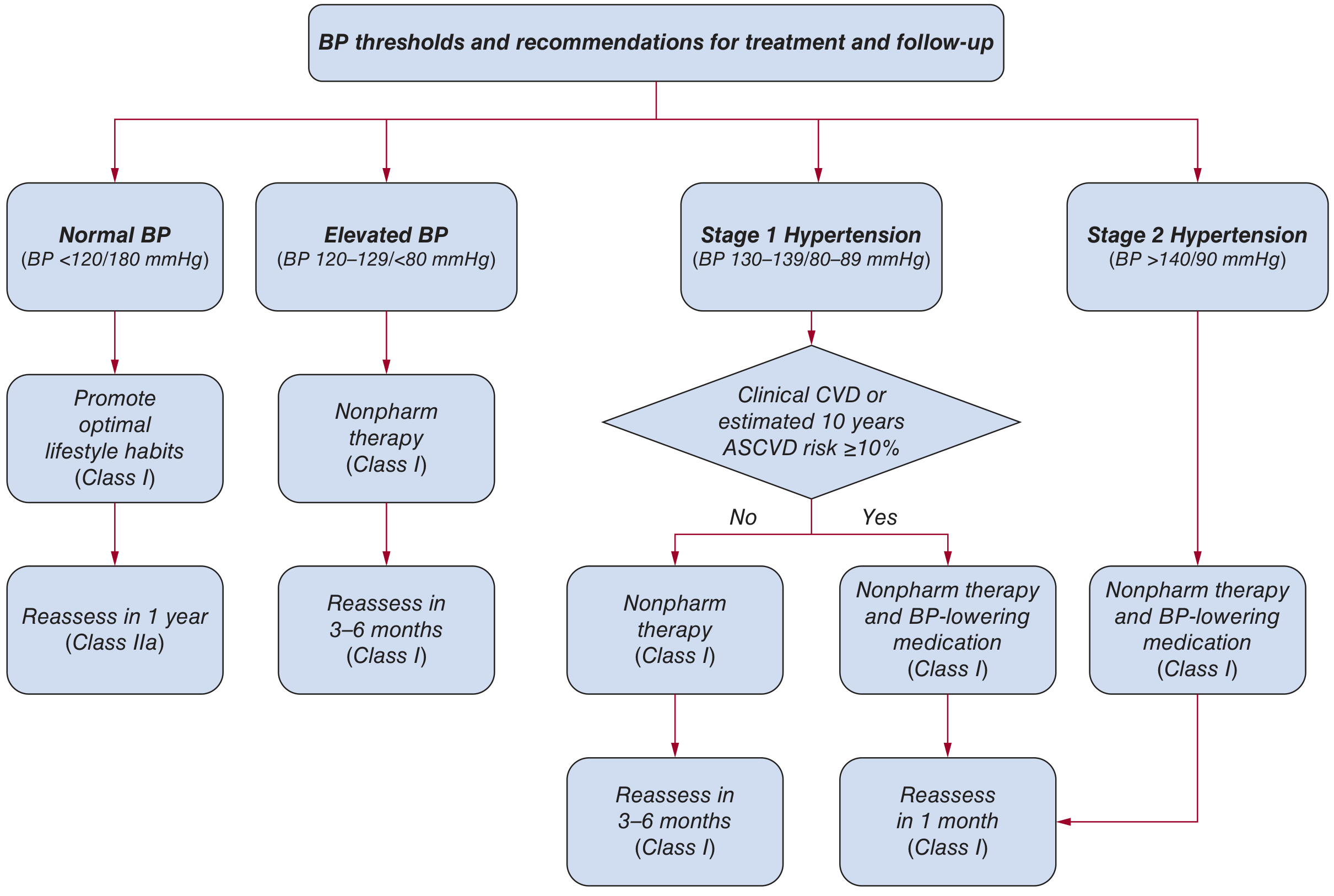
Two paths based on risk:
Path A - Low CVD Risk (10-year ASCVD < 10%, no DM, no CKD, no CVD history)
- Start with nonpharmacologic therapy alone
- Reassess in 3-6 months
- Add medication if BP remains ≥130/80 after 6 months of lifestyle changes (especially given his high lifetime risk as a young adult)
Path B - High CVD Risk (10-year ASCVD ≥ 10%, OR has DM/CKD/known CVD)
- Nonpharmacologic therapy + antihypertensive medication immediately
- Reassess in 1 month
Step 3: Lifestyle (Nonpharmacologic) Interventions
These are mandatory regardless of whether medications are started and can reduce SBP by 5-15+ mmHg when combined.
| Intervention | Goal | Expected SBP Reduction |
|---|---|---|
| Weight loss (if overweight/obese) | ~1 mmHg per 1 kg lost; target ideal BMI | -5 mmHg |
| DASH diet | Rich in fruits, vegetables, low-fat dairy, reduced saturated fat | -4 to 11 mmHg |
| Sodium restriction | Target <1500 mg/day; minimum reduction of 1000 mg/day | -5 to 6 mmHg |
| Increased potassium intake | >3400 mg/day via food (fruits, vegetables) | -4 to 5 mmHg |
| Aerobic exercise | 90-150 min/week at 65-75% heart rate reserve (brisk walking, swimming, cycling) | -5 to 7 mmHg |
| Limit alcohol | ≤2 standard drinks/day for men | -4 mmHg |
| Smoking cessation | Complete cessation | Cardiovascular risk reduction |
Combined interventions can achieve SBP reductions >10 mmHg - Harrison's Principles of Internal Medicine 22E, p. 2186
Step 4: Pharmacotherapy (if indicated)
When to Start Medications at This BP Level
- Immediately if high CVD risk, DM, CKD, established CVD, or target organ damage
- After 6 months of lifestyle trial if low-risk but BP still ≥130/80 mmHg
- At 35 years old, even with low 10-year risk, his high lifetime ASCVD risk is a valid argument for earlier pharmacotherapy
First-Line Drug Classes (choose based on comorbidities)
| Class | Examples | Key Notes |
|---|---|---|
| Thiazide-like diuretics | Chlorthalidone 12.5-25 mg/day; Indapamide | "Best in class" per meta-analyses for CVD prevention; preferred over HCTZ (longer half-life, better nighttime control) |
| ACE Inhibitors | Lisinopril 10-40 mg/day; Ramipril | Preferred if DM or proteinuria; dry cough in ~10-15% |
| ARBs | Losartan, Valsartan, Olmesartan | Use if ACEI cough; do NOT combine ACEI + ARB |
| Calcium channel blockers | Amlodipine 5-10 mg/day | Excellent for stroke prevention; good add-on agent |
Beta-blockers are NOT first-line for uncomplicated primary hypertension - they have been inferior to other classes (especially for stroke prevention) in head-to-head RCTs. Reserve for compelling indications (angina, post-MI, HFrEF, rate control).
Drug Selection Considerations for a 35-Year-Old Male
- Black race: Thiazide diuretics or CCBs preferred (ACEIs/ARBs are less effective as monotherapy in Black patients)
- Active/athletic: Avoid beta-blockers (reduce exercise capacity)
- Sexually active: Be aware thiazides and beta-blockers can cause sexual dysfunction
- Planning parenthood: Avoid ACEIs/ARBs (teratogenic - relevant if partner is or could become pregnant; counsel accordingly)
BP Target
- < 130/80 mmHg per ACC/AHA guidelines
Step 5: Follow-Up
| Scenario | Reassessment |
|---|---|
| Lifestyle only | 3-6 months |
| Started medication | 1 month |
| At target BP | Every 3-6 months ongoing |
At each visit: check BP in both arms (seated after 5 min rest), assess adherence, side effects, lifestyle progress, and repeat relevant labs (electrolytes, creatinine) after starting/adjusting medications.
Summary Decision Algorithm for This Patient
- Confirm hypertension with repeat measurements / ambulatory BP monitoring
- Order baseline labs + ECG
- Screen for secondary causes (he is <40 years old)
- Calculate 10-year ASCVD risk (PCE calculator)
- If low risk: Start lifestyle modifications, reassess in 3-6 months - add medication if not at target
- If high risk: Start lifestyle modifications + a thiazide, ACEI, ARB, or CCB simultaneously
- BP target: <130/80 mmHg
Sources: Harrison's Principles of Internal Medicine 22E (2025), p. 2186-2190; Fuster and Hurst's The Heart, 15th Ed., p. 248-249; 2024 ESC Guidelines (ACC.org); AHA Scientific Statement on Young Adult Hypertension
This is a shared conversation. Sign in to Orris to start your own chat.