
Anatomy of hand
Reading File
Searching sources...
Finding Sources
Searching the Web
anatomy of the hand bones muscles tendons nerves overview
Reading File
Reading File
Reading File
Now let me fetch the key anatomical images from the textbook to enrich the answer:
Loading Image
Reading File
I now have comprehensive information from Schwartz's Principles of Surgery to provide a thorough answer. Let me compile the full anatomy of the hand.
Anatomy of the Hand
The hand is a regional specialty that integrates components of neurologic, orthopedic, plastic, and vascular surgery. Understanding its anatomy is the key to proper diagnosis of injury, infection, and degenerative disease.
Directional Terminology
Because the hand can rotate in space, standard anatomical terms need clarification:
- Palmar (volar): anterior surface in anatomic position
- Dorsal: posterior surface
- Pronation: rotation that brings the palm down
- Supination: rotation that brings the palm up
- Radial/Ulnar: used instead of lateral/medial (invariant with rotation)
- Abduction/Adduction: movement of digits away from or toward the middle finger
1. Bones
The hand contains 19 bones arranged in 5 rays. A ray = one digit (thumb or finger) from the metacarpal base to the fingertip, numbered 1-5 (thumb to small finger).
Metacarpals (5 bones)
Form the visible palm. Each metacarpal connects to a digit at the metacarpophalangeal (MP) joint, which allows ~90° of flexion with slight hyperextension, plus active abduction and adduction of the fingers.
Phalanges (14 bones)
- Each finger has 3 phalanges: proximal, middle, distal
- The thumb has only 2: proximal and distal
- PIP joint (proximal interphalangeal): motion 0-95° - the most critical joint for finger mobility
- DIP joint (distal interphalangeal): flexion-extension only; normally 0-70°
Carpal Bones (8 bones - wrist)
Divided into two rows:
Proximal row:
| Bone | Key Features |
|---|---|
| Scaphoid | Bears 55% of load from hand to forearm; links proximal and distal rows; keel-shaped |
| Lunate | Principle axis of motion; bears ~35% of load |
| Triquetrum | Ulnar-most; articulates with the TFCC (not the ulna directly) |
| Pisiform | Sesamoid within FCU tendon; bears no load; can be excised without consequence |
Distal row:
| Bone | Key Features |
|---|---|
| Trapezium | Saddle-shaped, articulates with thumb metacarpal - allows thumb opposition |
| Trapezoid | Between scaphoid and index metacarpal |
| Capitate | Largest carpal bone; first to ossify in children |
| Hamate | Has a hook; articulates with ring and small finger metacarpals (mobile CMC joints) |
The remaining 10% of load from hand to forearm is transmitted through the triangular fibrocartilage complex (TFCC), a cartilage suspended between the ulnar styloid and distal radius.
The index and middle finger CMC joints are highly stable with minimal mobility. The ring and small finger CMC joints allow flexion-extension movement, which "cups" the palm.
Collateral Ligaments
Each MP and IP joint has radial and ulnar collateral ligaments:
- IP joint collateral ligaments: on tension in full extension
- MP joint collateral ligaments (fingers): on tension at 90° flexion
This is clinically important for splinting: keep MP joints flexed, IP joints extended to prevent ligament contracture.
2. Muscles and Tendons
Wrist Flexors (origin: medial epicondyle of humerus)
| Muscle | Nerve | Insertion |
|---|---|---|
| Flexor carpi radialis (FCR) | Median | Volar base of index metacarpal; also radially deviates wrist |
| Flexor carpi ulnaris (FCU) | Ulnar | Volar base of small metacarpal; also ulnarly deviates wrist |
| Palmaris longus (PL) | Median | Palmar fascia (absent in up to 15% of people) |
Wrist Extensors (all radial nerve innervated)
| Muscle | Insertion |
|---|---|
| Extensor carpi radialis longus (ECRL) | Base of index metacarpal |
| Extensor carpi radialis brevis (ECRB) | Base of middle metacarpal |
| Extensor carpi ulnaris (ECU) | Base of small metacarpal |
Extrinsic Finger Flexors (origin: forearm)
| Muscle | Action |
|---|---|
| Flexor digitorum superficialis (FDS) | Flexes PIP joint |
| Flexor digitorum profundus (FDP) | Flexes DIP joint |
| Flexor pollicis longus (FPL) | Flexes thumb IP joint |
Extrinsic Finger Extensors
| Muscle | Action |
|---|---|
| Extensor digitorum communis (EDC) | Extends MP joints of all four fingers |
| Extensor indicis proprius (EIP) | Independent extension of index finger |
| Extensor digiti quinti (EDQ) | Independent extension of small finger |
| Extensor pollicis longus (EPL) | Extends thumb IP joint |
| Extensor pollicis brevis (EPB) | Extends thumb MP joint |
| Abductor pollicis longus (APL) | Abducts thumb metacarpal |
Intrinsic Muscles of the Hand
These allow fine, subtle movements - unique to humans.
Thenar muscles (base of thumb, origin: scaphoid, trapezium, flexor retinaculum):
| Muscle | Action | Nerve |
|---|---|---|
| Abductor pollicis brevis (APB) | Abducts thumb radially and volarly | Median (thenar branch) |
| Opponens pollicis (OP) | Draws thumb across palm toward small finger | Median |
| Flexor pollicis brevis (FPB) - superficial head | Flexes thumb MP joint | Median |
Hypothenar muscles (base of small finger, origin: pisiform, hamate, flexor retinaculum):
| Muscle | Action | Nerve |
|---|---|---|
| Abductor digiti quinti (ADQ) | Abducts small finger | Ulnar |
| Opponens digiti quinti (ODQ) | Brings small finger across palm | Ulnar |
| Flexor digiti quinti (FDQ) | Flexes small finger | Ulnar |
Lumbricals (4): Originate from FDP tendons in palm (unique - originate from a tendon!). Pass along radial aspect of each digit. Action: flex MP joint, extend IP joints.
- Index & middle: median nerve innervated
- Ring & small: ulnar nerve innervated
Interosseous muscles: Occupy spaces between metacarpals; insert on bases of proximal phalanges.
- 3 palmar interossei: adduct fingers (PAD)
- 4 dorsal interossei: abduct fingers (DAB)
- Adductor pollicis: adducts thumb (origin: middle finger metacarpal; ulnar nerve)
- All interossei + deep head of FPB: ulnar nerve innervated
3. Tendons and Pulleys
Pulleys maintain tendons close to bone, maximizing translation of tendon excursion into joint motion.
Flexor Side (Volar)
- Flexor retinaculum (transverse carpal ligament): Attaches radially to scaphoid tubercle + trapezium, ulnarly to hook of hamate + pisiform. Forms the roof of the carpal tunnel.
- Carpal tunnel contents: FDS, FDP, FPL tendons + median nerve
- Digital pulleys (A1-A5 annular, C1-C3 cruciate): Maintain tendons against phalanges. The A2 (over proximal phalanx) and A4 (over middle phalanx) pulleys are most critical.
Extensor Side (Dorsal)
The extensor retinaculum is divided into 6 compartments (radial to ulnar):
| Compartment | Contents |
|---|---|
| 1st | APL + EPB |
| 2nd | ECRL + ECRB |
| 3rd | EPL |
| 4th | EIP + EDC |
| 5th | EDQ |
| 6th | ECU (on distal ulna) |
4. Neurovascular Supply
Nerves
Median nerve:
- Enters hand through carpal tunnel (deep to flexor retinaculum)
- Thenar motor branch: innervates APB, OP, FPB superficial head
- Sensory: palmar surface of thumb, index, middle, radial half of ring finger
- Lumbricals to index and middle fingers
Ulnar nerve:
- Enters hand through Guyon's canal (superficial to flexor retinaculum)
- Motor: all hypothenar muscles, all interossei, adductor pollicis, FPB deep head, ring and small lumbricals
- Sensory: small finger and ulnar half of ring finger (palmar and dorsal)
Radial nerve:
- Primarily sensory in the hand (dorsum of thumb, index, middle, radial ring finger)
- Motor supply ends at the wrist (extensor muscles of forearm)
Blood Supply
- Radial artery: passes through anatomic snuffbox, forms the deep palmar arch
- Ulnar artery: forms the superficial palmar arch (dominant arch)
- The superficial arch gives rise to common digital arteries → proper digital arteries running along each side of fingers
- Rich anastomotic connections between radial and ulnar systems
5. Palmar Fascia
The palmar fascia (palmar aponeurosis) lies deep to the skin of the central palm, receiving the insertion of palmaris longus. It sends fibrous bands (pretendinous bands) to each finger. Pathologic thickening of this fascia causes Dupuytren's contracture, drawing the fingers into flexion.
6. Clinical Imaging
| Modality | Best Use |
|---|---|
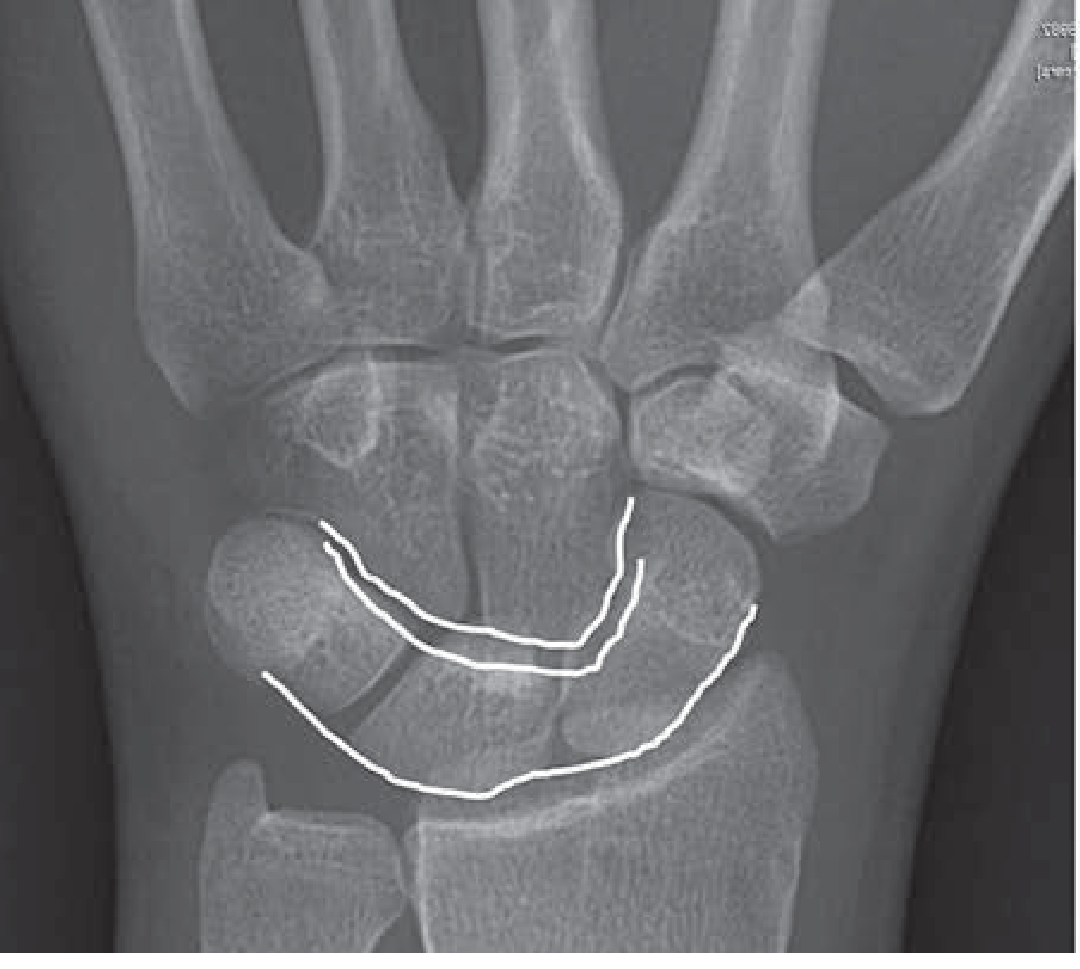
| Plain X-ray (AP, lateral, oblique) | First-line for fractures, joint congruency, Gilula's arcs |
| CT scan | Comminuted fractures, scaphoid fracture displacement/union |
| MRI | Soft tissue injuries, ligament tears, osteonecrosis |
| Ultrasound | Soft tissue (tendon, abscess); operator-dependent |
Summary: Key Nerve-Muscle Mnemonics
| Nerve | Key Muscles | Sensory |
|---|---|---|
| Median | Thenar eminence (APB, OP, FPB), lateral 2 lumbricals, FDS, FDP (index/middle), FPL | Lateral 3.5 fingers (palmar) |
| Ulnar | Hypothenar, interossei, medial 2 lumbricals, adductor pollicis | Medial 1.5 fingers |
| Radial | Wrist + finger extensors | Dorsal lateral hand |
"LOAF" for median nerve intrinsics: Lumbricals (1st & 2nd), Opponens pollicis, Abductor pollicis brevis, Flexor pollicis brevis.
Source: Schwartz's Principles of Surgery, 11th Edition, Chapter 44 - Hand Surgery
This is a shared conversation. Sign in to Orris to start your own chat.