
Syndromic approach from PARK TEXTBOOK OF SPM
Reading File
The syndromic approach in Park's SPM involves managing STIs/RTIs based on presenting symptoms rather than laboratory diagnosis. Let me fetch the full content from the textbook now.
Searching sources...
Finding Sources
Finding Sources
Found it. Now let me read the full section on syndromic approach from Park's textbook.
Reading File
Reading File
Reading File
Reading File
Reading File
Now let me also fetch the flowchart images and the vaginal discharge section which was partially cut off.
Reading File
Loading Image
Reading File
Reading File
I now have comprehensive content from all the syndromes. Let me also fetch the key images for the remaining syndromes and check a key text block I missed.
Reading File
I now have all the key content. Let me compile the full comprehensive answer.
Syndromic Approach to STD - Park's Textbook of Preventive and Social Medicine
- Park's Textbook of Preventive and Social Medicine, pp. 381-387
What is the Syndromic Approach?
Many different agents cause sexually transmitted diseases. However, some of these agents give rise to similar or overlapping clinical manifestations. The traditional method of diagnosing STD is by laboratory tests - but these are often not available or are expensive.
Since 1990, WHO has recommended syndromic management of STDs in patients presenting with consistently recognized signs and symptoms of STD. The syndromic approach is a scientifically derived approach that offers:
- Accessible and immediate treatment
- Effective and efficient management using flowcharts
- More cost-effective than diagnosis based on laboratory tests
Common Syndromes (Table 3)
Common syndromes and sequelae for which sexual transmission is of epidemiological importance:
| Syndrome / Sequela |
|---|
| Male urethritis |
| Lower genital syndromes in women: vaginitis / cervicitis / urethritis |
| Genital ulceration |
| Proctitis / colitis |
| Salpingitis |
| Epididymitis / orchitis |
| Infertility / ectopic pregnancy |
| Postnatal and perinatal morbidity |
| Hepatitis / hepatic carcinoma |
| Genital carcinoma |
| Pelvic pain |
| Acquired Immuno Deficiency Syndrome (AIDS) |
Syndrome 1: Urethral Discharge (Males) - Fig. 1
Flowchart:
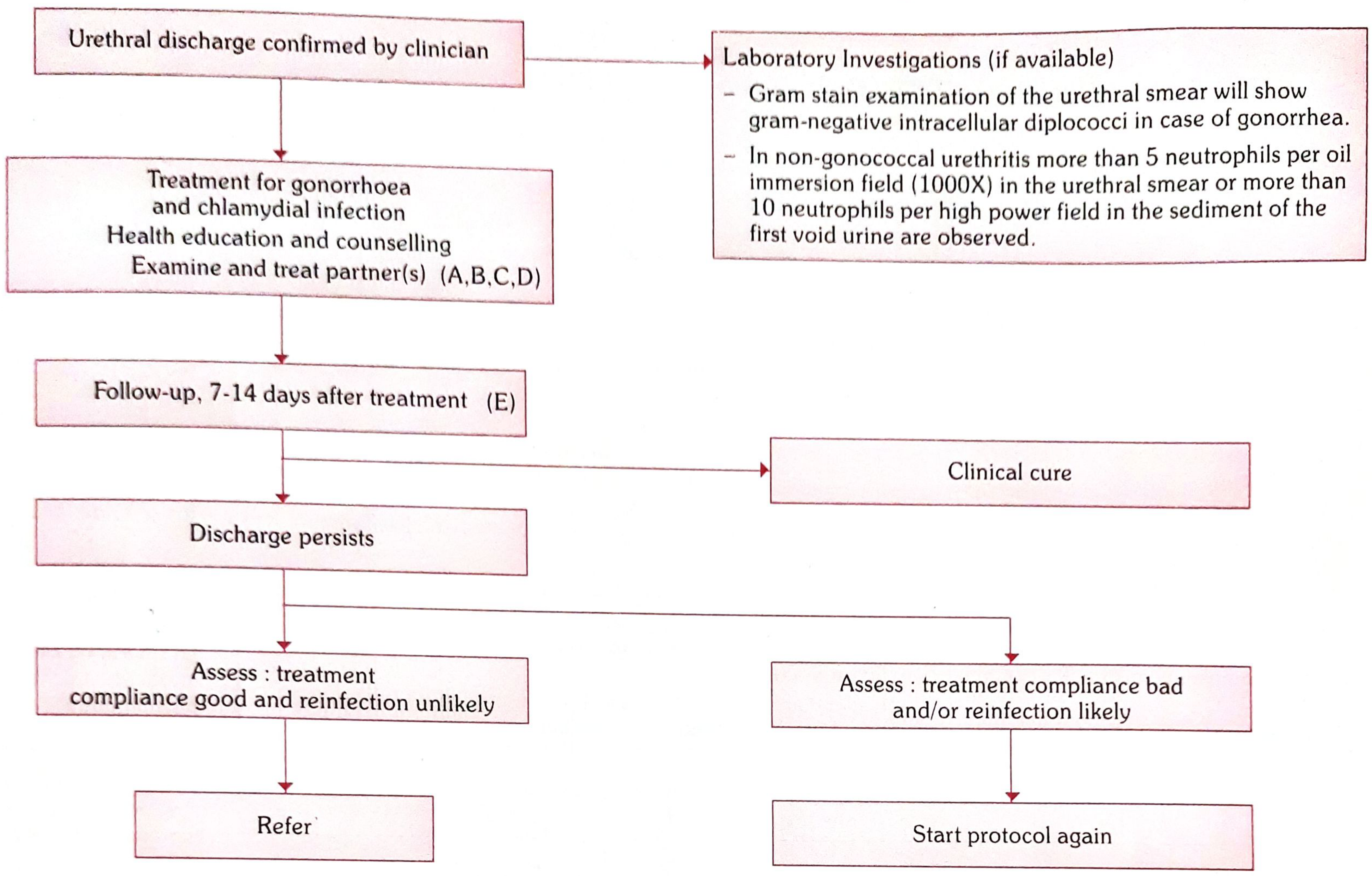
(A) Partner Notification
Notification and treatment of female partners of men with urethritis is the highest priority - best way to identify women at high risk of asymptomatic gonococcal and chlamydial infections.
(B) Treatment
As dual infection is common, treatment must cover both gonorrhea and chlamydia.
Recommended regimen:
- Tab. Cefixime 400 mg orally, single dose
- PLUS Tab. Azithromycin 1 g orally, single dose (supervised)
- Advise patient to return after 7 days
If discharge/dysuria persists after 7 days (treat for Trichomonas vaginalis):
- Tab. Secnidazole 2 g orally, single dose
If symptoms still persist (non-gonococcal urethritis):
- Tab. Doxycycline 100 mg twice daily for 7 days
If allergic to Azithromycin:
- Erythromycin 500 mg four times daily for 7 days
(C) Partner Management
- Treat all recent partners (female partners for gonorrhea and chlamydia)
- Advise sexual abstinence during treatment
- Provide condoms and educate on correct and consistent use
- Refer for voluntary counselling and testing for HIV, syphilis, and Hepatitis B
- Schedule return visit after 7 days
(D) Pregnant Partner Management
- Tab. Cefixime 400 mg orally, single dose OR Ceftriaxone 125 mg IM
- PLUS Tab. Erythromycin 500 mg four times daily for 7 days OR Cap. Amoxicillin 500 mg three times daily for 7 days
- Contraindicated in pregnancy: Quinolones (ofloxacin, ciprofloxacin), Doxycycline
(E) Follow-up at 7 days
- Check HIV, syphilis, and Hepatitis B test reports
- Assess treatment failure vs. re-infection
- Prompt referral if required
Syndrome 2: Vaginal Discharge (Females) - Fig. 2
Causative Organisms
| Type | Organisms |
|---|---|
| Vaginitis | Trichomonas vaginalis (TV), Candida albicans, Gardnerella vaginalis / Mycoplasma (bacterial vaginosis) |
| Cervicitis | Neisseria gonorrhoeae, Chlamydia trachomatis, Trichomonas vaginalis, Herpes simplex virus |
History
- Menstrual history (rule out pregnancy)
- Nature and type of discharge (amount, smell, color, consistency)
- Genital itching
- Burning/frequency of urination
- Ulcer or swelling on vulval/inguinal region
- Genital complaints in sexual partners
- Low backache
Examination (per speculum)
Vaginitis differentiation:
- Trichomoniasis - greenish frothy discharge
- Candidiasis - curdy white discharge
- Bacterial vaginosis - adherent discharge
Cervicitis:
- Cervical erosion / cervical ulcer / mucopurulent cervical discharge
- Bimanual pelvic examination to rule out PID
- If speculum examination not possible, treat for BOTH vaginitis and cervicitis
Laboratory Investigations (if available)
- Wet mount microscopy for T. vaginalis and clue cells
- 10% KOH preparation for Candida albicans
- Gram's stain of vaginal smear for clue cells (bacterial vaginosis)
- Gram's stain of endocervical smear for gonococci
Treatment
For Vaginitis (TV + BV + Candida):
- Tab. Secnidazole 2 g orally, single dose OR Tab. Tinidazole 500 mg orally twice daily for 5 days
- Tab. Metoclopramide 30 minutes before Secnidazole (to prevent gastric intolerance)
- Tab. Fluconazole 150 mg orally single dose OR local Clotrimazole 500 mg vaginal pessary (for candidiasis)
For Cervicitis (Chlamydia + Gonorrhea):
- Tab. Cefixime 400 mg orally, single dose
- PLUS Azithromycin 1 g (1 hour before lunch; if vomiting within 1 hour, give antiemetic and repeat)
If vaginitis and cervicitis both present - treat for both. Follow-up after one week.
Management in Pregnant Women
First trimester:
- Local Clotrimazole vaginal pessary/cream only (for candidiasis) - oral Fluconazole is contraindicated in pregnancy
- Metronidazole pessaries/cream intravaginally for trichomoniasis or BV
Second and third trimester: Oral metronidazole can be given
- Tab. Secnidazole 2 g orally, single dose OR Tab. Tinidazole 500 mg twice daily for 5 days
Partner Management (Vaginal Discharge)
- Treat current partner only if no improvement after initial treatment
- If partner is symptomatic, treat client and partner with above protocols
- Advise sexual abstinence during treatment
- Provide condoms
- Schedule return visit after 7 days
Syndrome 3: Lower Abdominal Pain in Females (PID) - Fig. 3
Causative Organisms
- Neisseria gonorrhoeae
- Chlamydia trachomatis
- Mycoplasma, Gardnerella, Anaerobic bacteria (Bacteroides, gram-positive cocci)
Differential Diagnoses: Ectopic pregnancy, twisted ovarian cyst, ovarian tumor, appendicitis, abdominal tuberculosis
History
- Lower abdominal pain, fever, vaginal discharge
- Menstrual irregularities (heavy, irregular bleeding)
- Dysmenorrhoea, dyspareunia, dysuria, tenesmus, low backache
- Contraceptive use (IUD)
Examination
- General: temperature, pulse, BP
- Per speculum: vaginal/cervical discharge, congestion, ulcers
- Per abdomen: lower abdominal tenderness or guarding
- Pelvic: uterine/adnexal tenderness, cervical movement tenderness
Note: A urine pregnancy test should be done in ALL women suspected of having PID to rule out ectopic pregnancy.
Lab Investigations (if available)
- Wet smear examination
- Gram stain for gonorrhea
- Complete blood count and ESR
- Urine microscopy for pus cells
Treatment (Outpatient - Mild/Moderate PID)
Treatment must cover N. gonorrhoeae, C. trachomatis, and anaerobes:
- Tab. Cefixime 400 mg orally twice daily for 7 days
- PLUS Tab. Metronidazole 400 mg orally twice daily for 14 days
- PLUS Doxycycline 100 mg orally twice daily for 2 weeks (for chlamydia)
- Tab. Ibuprofen 400 mg three times daily for 3-5 days (analgesic)
- Tab. Ranitidine 150 mg twice daily (to prevent gastritis)
- Remove IUD (if present) under antibiotic cover of 24-48 hours
Observe for 3 days. If no improvement (no reduction in fever, tenderness, cervical movement tenderness) - REFER for inpatient treatment.
Indications for Hospitalization
- Diagnosis is uncertain
- Surgical emergency (appendicitis, ectopic pregnancy) cannot be excluded
- Pelvic abscess is suspected
- Severe illness
- Woman is pregnant
- Patient cannot tolerate/follow outpatient regimen
- Failed to respond to outpatient therapy
Pregnancy in PID
- Doxycycline is contraindicated in pregnancy
- Metronidazole generally not recommended in first 3 months (but do not withhold in severely acute PID)
Partner Management (PID)
- Treat all partners in past 2 months
- Treat male partners for urethral discharge (gonorrhea and chlamydia)
- Schedule return visit after 3 days, 7 days, and 14 days
Syndrome 4: Genital Ulcer Disease - Fig. 4 & 5
Causative Organisms
- Treponema pallidum (syphilis)
- Haemophilus ducreyi (chancroid)
- Herpes simplex virus type 2
History
- Single painless ulcer - suggestive of syphilis
- Painful ulcer (single or multiple) - suggestive of chancroid or herpes
- Painful ulcer usually single, sometimes with painful bubo - chancroid
Lab Investigations
- RPR test for syphilis
- For further investigations, refer to higher centre
Treatment
If vesicles or multiple painful ulcers present (herpes):
- Tab. Acyclovir 400 mg orally, three times a day for 7 days
If vesicles absent and only ulcer present (syphilis + chancroid), treat both:
To cover syphilis:
- Inj. Benzathine penicillin 2.4 million IU IM after test dose, in two divided doses (with emergency tray ready)
- If allergic to penicillin: Doxycycline 100 mg twice daily for 14 days
PLUS to cover chancroid:
- Tab. Azithromycin 1 g orally single dose OR Tab. Ciprofloxacin 500 mg twice daily for 3 days
Treatment extended beyond 7 days if ulcers have not epithelialized.
Refer to higher centre if:
- Not responding to treatment
- Genital ulcers co-existent with HIV
- Recurrent lesion
Partner Management (Genital Ulcer)
- Treat all partners who had contact in the last 3 months
- Partners should be treated for syphilis and chancroid
- Advise sexual abstinence during treatment
- Refer for voluntary counselling and testing for HIV, syphilis, and Hepatitis B
- Schedule return visit after 7 days
Management of Pregnant Women (Genital Ulcer)
- Contraindicated: Quinolones, doxycycline, sulfonamides
- Inj. Benzathine penicillin 2.4 million IU IM after test dose
- For primary/secondary/early latent syphilis: second dose 1 week after initial dose
- If allergic to penicillin: Tab. Erythromycin 500 mg four times daily for 15 days
- (Erythromycin estolate is contraindicated in pregnancy due to hepatotoxicity - use erythromycin base or ethyl succinate only)
- Neonate should be treated for syphilis after delivery
Syndrome 5: Inguinal Bubo - Fig. 6
Syndromic management of inguinal bubo (lymphogranuloma venereum, chancroid with bubo).
Key Principles of the Syndromic Approach
| Principle | Detail |
|---|---|
| When to use | When lab support unavailable or unaffordable |
| WHO recommendation | Since 1990 |
| Management tool | Flowcharts (Figs. 1-6) |
| Advantage | Immediate, accessible, cost-effective treatment |
| Dual coverage | Treat for multiple likely pathogens simultaneously |
| Partner management | Essential component for all syndromes |
| Follow-up | Mandatory at 7 days (3 days for PID) |
| Referral | Treatment failure, co-existing HIV, severe illness, pregnancy complications |
"The syndromic approach is a scientifically derived approach and offers accessible and immediate treatment, that is effective and efficient; management of STD using flowcharts is more cost-effective than diagnosis based on laboratory tests." - Park's SPM
Summary Table: Syndromic Treatment at a Glance
| Syndrome | Key Pathogens | First-line Treatment |
|---|---|---|
| Urethral discharge (M) | Gonorrhea + Chlamydia | Cefixime 400 mg + Azithromycin 1 g |
| Vaginal discharge - vaginitis | TV + BV + Candida | Secnidazole 2 g + Fluconazole 150 mg |
| Vaginal discharge - cervicitis | Gonorrhea + Chlamydia | Cefixime 400 mg + Azithromycin 1 g |
| Lower abdominal pain (PID) | GC + CT + Anaerobes | Cefixime + Metronidazole + Doxycycline |
| Genital ulcer (vesicles) | Herpes | Acyclovir 400 mg TDS x 7 days |
| Genital ulcer (no vesicles) | Syphilis + Chancroid | Benzathine penicillin 2.4 MU + Azithromycin 1 g |
| Inguinal bubo | LGV, Chancroid | Per flowchart (Fig. 6) |
This is a shared conversation. Sign in to Orris to start your own chat.