
Tell me what all drugs to give in case of Stemi
I'll read the medical library skill first before answering.
Reading File
Now let me search the medical library for STEMI management drugs in parallel.
Finding Sources
Finding Sources
Searching PubMed
"ST elevation myocardial infarction" AND "pharmacotherapy"
Let me search more broadly and read the relevant textbook sections.
Finding Sources
Finding Sources
Good - found The Washington Manual. Let me read that section thoroughly, plus search for more drug-specific content.
Reading File
Finding Sources
Excellent content from Washington Manual. Let me read a bit more of this section and also look for the earlier part covering initial management.
Reading File
Reading File
Let me read the key section covering initial drug therapy and thrombolytics.
Reading File
I now have comprehensive data. Let me compile the full, well-structured answer.
Drugs in STEMI - Complete Management
Based on The Washington Manual of Medical Therapeutics and standard ACC/AHA guidelines, here is the full drug regimen for STEMI, organized by category and timing.
1. IMMEDIATE / INITIAL DRUGS (given to ALL STEMI patients on arrival)
Antiplatelet Therapy - DAPT (Dual Antiplatelet Therapy)
Aspirin (ASA)
- Dose: 162-325 mg orally (chewed) or rectally IMMEDIATELY
- 325 mg preferred for ASA-naive patients
- Maintenance: 81 mg/day indefinitely after PCI
P2Y12 Inhibitor (add one - as soon as possible after presentation)
| Drug | Loading Dose | Maintenance | Notes |
|---|---|---|---|
| Ticagrelor (preferred) | 180 mg PO | 90 mg twice daily x 12 months | Preferred - mortality benefit over clopidogrel. ASA maintenance must be <100 mg/day |
| Prasugrel | 60 mg PO | 10 mg daily x 12 months | Only give AFTER diagnostic angiography or within 1 hour of PCI. Contraindicated in prior CVA/TIA, weight <60 kg, age >75 yrs |
| Clopidogrel | 600 mg PO (PCI) or 300 mg (fibrinolysis, first 24h) | 75 mg daily x 12 months | If fibrinolysis patient >75 yrs - NO loading dose |
2. ANTICOAGULANT THERAPY (ALL patients, regardless of reperfusion strategy)
| Drug | Dose | Context |
|---|---|---|
| UFH (Unfractionated Heparin) | 60 units/kg IV bolus (max 4000 units), then 12 units/kg/h | Preferred for primary PCI - real-time monitoring with ACTs |
| Enoxaparin (LMWH) | 30 mg IV bolus, then 1 mg/kg SC q12h (age >75: no bolus, 0.75 mg/kg SC) | Validated with thrombolysis and rescue PCI. Give extra 0.3 mg/kg if last dose was >8h before PCI |
| Bivalirudin | 0.75 mg/kg IV bolus, then 1.75 mg/kg/h | PCI patients already on ASA + clopidogrel. Lower bleeding vs UFH. Administer a heparin bolus first to reduce stent thrombosis |
| Fondaparinux | 2.5 mg IV bolus, then 2.5 mg SC daily | Preferred with thrombolysis (lower bleeding vs UFH). NOT for primary PCI (risk of catheter thrombosis) |
3. REPERFUSION DRUGS (Fibrinolytics - when primary PCI is unavailable or delayed >120 min)
Choose ONE fibrinolytic agent:
| Drug | Dose | Notes |
|---|---|---|
| Alteplase (tPA) | 15 mg IV bolus, then 0.75 mg/kg over 30 min (max 50 mg), then 0.5 mg/kg over 60 min (max 35 mg) | Fibrin-specific |
| Tenecteplase (TNK-tPA) | Single weight-based IV bolus (30-50 mg) | Easiest to administer - single bolus. Reduce dose by 50% in age >75 yrs |
| Reteplase (rPA) | 10 units IV over 2 min, repeat in 30 min | Double bolus |
| Streptokinase | 1.5 million units over 60 min | Non-fibrin-specific, antigenic - do NOT repeat after 5 days. No heparin needed |
Use fibrinolytics within 12 hours of symptom onset. Door-to-needle target: <30 minutes.
4. ADJUNCT / SUPPORTIVE DRUGS
Nitrates
- Nitroglycerin: 0.4 mg SL or aerosol q5 min x 3 doses for chest discomfort
- IV nitroglycerin: 10-200 mcg/min for uncontrolled pain
- Avoid in: hypotension (SBP <90), right ventricular infarction, recent PDE-5 inhibitor use
Beta-Blockers
- Metoprolol: 25 mg PO q6h (titrate), or metoprolol succinate 25-50 mg
- IV metoprolol (5 mg q5 min x 3 doses) if hemodynamically stable and tachycardic
- Avoid in: acute heart failure, hemodynamic instability, AV block (significant), bronchospasm
- Reduces infarct size, limits arrhythmias, reduces mortality
Oxygen
- Give if SpO2 <90% or respiratory distress. Routine oxygen in normoxic patients is NOT recommended.
Morphine
- 2-4 mg IV for pain refractory to nitrates - use cautiously (may reduce efficacy of oral antiplatelets)
ACE Inhibitor / ARB (start within 24 hours)
- Ramipril or Lisinopril or Captopril - start low, titrate up
- Especially indicated with EF <40%, anterior MI, hypertension, or diabetes
- ARB (Valsartan) if ACE inhibitor not tolerated
Statin (High-Intensity - start immediately)
- Atorvastatin 80 mg or Rosuvastatin 40 mg - start as early as possible
- Reduces mortality, plaque stabilization, anti-inflammatory effects
- Do NOT withhold in the acute setting
Aldosterone Antagonist (within 3-14 days if EF <40% + heart failure or diabetes)
- Eplerenone 25-50 mg/day or Spironolactone 25-50 mg/day
- Avoid if serum Cr >2.5 mg/dL (men) or >2.0 mg/dL (women), or K+ >5 mEq/L
QUICK MNEMONIC - "MONABASH"
| Letter | Drug |
|---|---|
| M | Morphine (pain control) |
| O | Oxygen (if SpO2 <90%) |
| N | Nitrates |
| A | Aspirin |
| B | Beta-blocker |
| A | Anticoagulant (heparin/LMWH) |
| S | Statin |
| H | Heparin + P2Y12 (DAPT) |
Summary Table by Timeline
| Phase | Drugs |
|---|---|
| Immediately (0-10 min) | Aspirin 325 mg, P2Y12 inhibitor, Heparin/anticoagulant, Nitrates, Oxygen, Morphine |
| Reperfusion | Fibrinolytic (if no PCI) OR PCI with anticoagulant + DAPT |
| Within 24 hours | Beta-blocker, ACE inhibitor, High-intensity statin |
| 3-14 days (if indicated) | Aldosterone antagonist (if EF <40% + HF/DM) |
| Indefinite (post-discharge) | Aspirin 81 mg, P2Y12 x 12 months, Beta-blocker, ACE-I/ARB, Statin |
Source: The Washington Manual of Medical Therapeutics, Acute Coronary Reperfusion section; ACC/AHA STEMI Guidelines
And for nstemj?
NSTEMI drug management shares many agents with STEMI but differs in reperfusion strategy (no routine fibrinolytics) and timing of invasive approach. Let me pull the textbook content.
Searching sources...
Finding Sources
Finding Sources
Finding Sources
Finding Sources
Finding Sources
Finding Sources
Let me search the Washington Manual directly since it had the STEMI section - the NSTEMI section should be nearby.
Finding Sources
Reading File
Good - I'm right in the UA/NSTEMI section. Let me read back to find the start of this section and also forward to cover anticoagulants.
Reading File
Reading File
Excellent data. Let me also read the antiplatelet section for UA/NSTEMI specifically.
Reading File
Reading File
I now have comprehensive content for NSTEMI. Here is the full answer:
Drugs in NSTEMI (UA/NSTEMI) - Complete Management
Source: The Washington Manual of Medical Therapeutics, UA/NSTEMI section
The key difference from STEMI: NO fibrinolytics are used in NSTEMI. Management centers on antithrombotic therapy, symptom control, and a risk-stratified invasive strategy.
1. ANTIPLATELET THERAPY - DAPT
Aspirin (ASA) - given to ALL patients immediately
- Dose: 162-325 mg (chewed) initially, then 75-100 mg/day maintenance
- If on ticagrelor, maintenance ASA must not exceed 100 mg/day
P2Y12 Inhibitor (add one - as early as possible)
| Drug | Loading Dose | Maintenance | Notes |
|---|---|---|---|
| Ticagrelor (preferred) | 180 mg PO | 90 mg twice daily x 12 months | Reduced vascular death/MI/CVA vs clopidogrel (9.8% vs 11%). Higher non-CABG bleeding |
| Clopidogrel | 300-600 mg PO | 75 mg daily x 12 months | Reduces CV death/MI/stroke by 18-30% combined with ASA |
| Prasugrel | 60 mg PO | 10 mg daily | Higher potency. Avoid in prior CVA/TIA, age >75, weight <60 kg. Give only after diagnostic angiography |
| Cangrelor | 30 mcg/kg IV bolus | 4 mcg/kg/min infusion | IV only - FDA approved for PCI only. Reserved for those unable to take oral agents |
GPIIb/IIIa Inhibitors (selective use - mainly at time of PCI or high-risk features)
| Drug | Dose | Notes |
|---|---|---|
| Eptifibatide | 180 mcg/kg IV bolus, then 2 mcg/kg/min | Most commonly used. Reduces death or MI in invasive + conservative strategies |
| Tirofiban | 0.4 mcg/kg IV bolus, then 0.1 mcg/kg/min | Alternative to eptifibatide |
| Abciximab | 0.25 mg/kg IV bolus, then 10 mcg/min | Reduces death/MI in ACS undergoing PCI. Long platelet binding duration |
GPIIb/IIIa inhibitors are NOT used routinely upfront - reserved for high-risk patients (troponin-positive, refractory ischemia) or at time of PCI.
2. ANTICOAGULANT THERAPY (ALL patients, regardless of strategy)
| Drug | Dose | Notes |
|---|---|---|
| UFH | 60 units/kg IV bolus (max 4000 units), then 12-14 units/kg/h | aPTT target 1.5-2.0x control. Reduces death/MI by up to 60% with ASA. Easily reversible. Risk of HIT |
| Enoxaparin (LMWH) | 1 mg/kg SC twice daily | At least as efficacious as UFH, possibly superior. No monitoring needed. Reduce to 50% if CrCl <30 or Cr >2 mg/dL. Cannot be fully reversed |
| Fondaparinux | 2.5 mg SC daily | Similar efficacy to LMWH with possibly lower bleeding rates. Preferred in conservative (ischemia-driven) strategy. Do NOT use alone during PCI (catheter thrombosis risk) |
| Bivalirudin | 0.75 mg/kg IV bolus, then 1.75 mg/kg/h | At PCI: as effective as UFH + GPIIb/IIIa, with less bleeding. Risk of stent thrombosis. Dose-adjust if GFR <30 |
3. ANTI-ISCHEMIC / SUPPORTIVE DRUGS
Nitrates
- Nitroglycerin SL 0.4 mg q5 min x 3 doses for ongoing chest pain
- IV nitroglycerin 10-200 mcg/min for refractory pain
- Avoid if: SBP <90 mmHg, RV infarction, recent PDE-5 inhibitor use
Beta-Blockers (start within 24 hours if no contraindication)
- Metoprolol 25-50 mg PO q6-8h, titrate to heart rate 50-60 bpm
- IV metoprolol 5 mg q5 min x 3 doses if hemodynamically stable + tachycardic/hypertensive
- Avoid in: decompensated heart failure, cardiogenic shock, high-degree AV block, severe bronchospasm
- Reduces infarct size, limits arrhythmias
Oxygen
- Only if SpO2 <90% or respiratory distress. Routine oxygen is NOT recommended and may be harmful.
Morphine
- 2-4 mg IV for pain refractory to nitrates. Use cautiously - may reduce absorption of oral P2Y12 inhibitors.
4. SECONDARY PREVENTION DRUGS (start in hospital, continue indefinitely)
High-Intensity Statin (start immediately)
- Atorvastatin 80 mg or Rosuvastatin 40 mg daily
- Plaque stabilization, anti-inflammatory, mortality benefit
ACE Inhibitor (start within 24 hours, especially if EF <40%, diabetes, or HTN)
- Ramipril, Lisinopril, or Enalapril - start low, titrate
- ARB (Valsartan, Losartan) if ACE-I not tolerated
Aldosterone Antagonist (if EF <40% + heart failure OR diabetes, after stabilization)
- Eplerenone 25-50 mg/day or Spironolactone 25-50 mg/day
- Avoid if K+ >5 mEq/L or significant renal impairment
PPI (if on DAPT with high GI bleeding risk)
- Pantoprazole or Omeprazole - in elderly, known ulcers, H. pylori, or co-prescribed with NSAIDs/steroids/anticoagulants
- Pharmacokinetic interaction between omeprazole and clopidogrel is not clinically significant per randomized data
KEY DIFFERENCE: NSTEMI vs STEMI Drug Approach
| Feature | STEMI | NSTEMI |
|---|---|---|
| Fibrinolytics | YES (if no PCI available) | NEVER |
| GPIIb/IIIa inhibitors | Not routine | Selective use (high-risk/PCI) |
| P2Y12 timing | Immediately | Immediately (or after angiography for prasugrel) |
| Anticoagulant | UFH preferred for primary PCI | UFH / LMWH / Fondaparinux / Bivalirudin |
| Reperfusion urgency | Door-to-balloon <90 min | Risk-stratified (2h / 24h / 24-72h window) |
NSTEMI Risk-Stratified Invasive Timing
| Timing | Indication |
|---|---|
| Urgent (<2h) - like STEMI | Refractory angina, hemodynamic instability, cardiogenic shock, sustained VT/VF |
| Early invasive (<24h) | TIMI ≥3 or GRACE >140, new ST depressions, rapidly rising troponins |
| Delayed invasive (24-72h) | Diabetes, GFR <60, EF <40%, prior PCI within 6 months, prior CABG, TIMI ≥2 |
| Ischemia-driven (conservative) | Low risk (TIMI ≤1, GRACE <109), low-risk biomarker-negative patients |
Source: The Washington Manual of Medical Therapeutics, UA/NSTEMI Medications section
I am in emergency ward A patient comes with CVA How to manage What drugs What doses and in case of both ischemic and haemorrhagic
Reading File
This is a broad clinical scenario - launching parallel searches for ischemic stroke and hemorrhagic stroke management simultaneously.
Finding Sources
Finding Sources
Finding Sources
Rosen's Emergency Medicine is in the library - perfect. Let me search it directly.
Finding Sources
Finding Sources
Excellent - Rosen's Emergency Medicine has a dedicated Stroke section (block15). Also Bradley & Daroff's Neurology. Let me read both in parallel.
Finding Sources
Finding Sources
Both Rosen's (block15) and Bradley & Daroff have the content. Let me read the key sections in parallel.
Reading File
Reading File
Good start - I have hemorrhagic stroke content but need the specific drug treatment sections. Let me read the treatment/management parts.
Reading File
Reading File
Now let me jump directly to the treatment sections.
Reading File
Reading File
I now have comprehensive content from Rosen's Emergency Medicine covering both ischemic and hemorrhagic stroke management. I have enough to provide a complete, thorough answer.
CVA Emergency Management - Complete Drug Guide
Source: Rosen's Emergency Medicine, Chapter 87 (Stroke)
FIRST: IMMEDIATE STEPS FOR ALL CVA (Before Knowing the Type)
| Action | Target Time |
|---|---|
| Doctor sees patient | <10 min |
| CT scan completed | <25 min |
| CT read | <45 min |
| Treatment decision | <60 min ("door-to-needle") |
Initial stabilization (ALL stroke patients):
- ABC - Airway, Breathing, Circulation
- Oxygen - only if SpO2 <95%. Do NOT give routine oxygen to normoxic patients
- IV access - use Normal Saline (NOT dextrose - hyperglycemia worsens ischemic deficit)
- Blood glucose STAT - treat hypoglycemia immediately (it mimics stroke)
- ECG - identify AF or arrhythmias
- Non-contrast CT head STAT - to differentiate ischemic vs hemorrhagic
⚠️ You CANNOT give tPA until CT rules out hemorrhage
PART 1: ISCHEMIC STROKE
A. Blood Pressure Management
| Situation | Target BP | Drug |
|---|---|---|
| tPA candidate (before thrombolysis) | Must be <185/110 mmHg | Labetalol 10-20 mg IV over 1-2 min (repeat x1) OR Nicardipine 5 mg/h IV (titrate up by 2.5 mg/h q5-15 min, max 15 mg/h) |
| tPA candidate (after thrombolysis) | Maintain <180/105 mmHg | Same agents |
| NOT a tPA candidate | Do NOT lower BP unless >220/120 mmHg | Lower by only 15-20% in first 24h |
Rationale: Permissive hypertension maintains perfusion to ischemic penumbra. Aggressive BP lowering worsens outcomes.
Avoid in ischemic stroke: Sublingual nifedipine, aggressive IV nitroprusside
B. Thrombolysis - IV Alteplase (tPA)
ELIGIBILITY: Within 4.5 hours of symptom onset (or last seen normal)
Dose: Alteplase 0.9 mg/kg IV (maximum 90 mg total)
- 10% of total dose as IV bolus over 1 minute
- Remaining 90% as IV infusion over 60 minutes
Example: 70 kg patient = 63 mg total → 6.3 mg bolus + 56.7 mg over 60 min
Absolute Contraindications to tPA:
- Hemorrhage on CT
- Symptom onset >4.5 hours (or unknown onset)
- Prior intracranial hemorrhage ever
- Active internal bleeding
- Intracranial/spinal surgery in past 3 months
- Head trauma in past 3 months
- BP >185/110 mmHg (uncontrolled)
- Blood glucose <50 or >400 mg/dL
- INR >1.7, aPTT >40 sec, platelets <100,000
- NIHSS >25 (severe stroke - relative)
After tPA:
- No anticoagulants or antiplatelets for 24 hours
- Monitor BP every 15 min for 2 hours, then every 30 min for 6 hours, then every hour x 16 hours
- Watch for angioedema, symptomatic intracranial hemorrhage
C. Antiplatelet Therapy (if NOT a tPA candidate, or after 24h post-tPA)
| Drug | Dose | Notes |
|---|---|---|
| Aspirin | 325 mg orally within 24-48h of onset | First-line. Do NOT give within 24h of tPA |
| Aspirin + Clopidogrel (DAPT) | ASA 325 mg + Clopidogrel 75 mg | For minor stroke (NIHSS ≤3) or high-risk TIA - give within 24h, continue x 21 days |
| Clopidogrel | 75 mg daily | Alternative to aspirin if intolerant |
D. Anticoagulation (selected cases)
| Indication | Drug | Notes |
|---|---|---|
| Cardioembolic stroke (AF) | Heparin IV or LMWH | Typically delayed 24-48h to avoid hemorrhagic transformation |
| Cerebral venous sinus thrombosis (CVST) | UFH or LMWH | Even if hemorrhagic infarct present |
| Hypercoagulable state | Heparin | Individualized |
Routine heparin for all ischemic strokes is NOT recommended.
E. Glucose Management
- Treat hypoglycemia immediately: Dextrose 50% (D50W) 25-50 mL IV (if glucose <60 mg/dL)
- Treat hyperglycemia: Insulin sliding scale, keep glucose <180 mg/dL
- Avoid dextrose-containing IV fluids
F. Temperature
- Acetaminophen (Paracetamol) 650 mg PO/IV q6h for fever (target normothermia)
- Even minor hyperthermia worsens neurologic injury
G. Seizure (if occurs)
- Lorazepam 0.1 mg/kg IV (or Diazepam 0.15 mg/kg IV) for active seizure
- Prophylactic antiepileptics NOT recommended routinely in ischemic stroke
PART 2: HEMORRHAGIC STROKE (ICH / SAH)
Key Principle: The goals are OPPOSITE to ischemic stroke
- STOP the bleeding - reverse anticoagulation, lower BP aggressively
- NO tPA, NO anticoagulants, NO antiplatelets
A. Blood Pressure Management in ICH
| Target | Drug | Dose |
|---|---|---|
| SBP <140 mmHg (AHA/ASA guideline for most ICH) | Labetalol | 10-20 mg IV bolus q10-20 min, OR 2-8 mg/min IV infusion |
| Nicardipine | 5 mg/h IV, titrate by 2.5 mg/h q5-15 min, max 15 mg/h | |
| Clevidipine | 1-2 mg/h IV, double q90 sec, max 21 mg/h | |
| Enalaprilat | 1.25-5 mg IV q6h (use if LV dysfunction) | |
| Hydralazine | 10-20 mg IV q4-6h (alternative) |
Avoid nitroprusside in increased ICP (increases cerebral vasodilation)
B. Reversal of Anticoagulation (URGENT in ICH)
| Anticoagulant | Reversal Agent | Dose |
|---|---|---|
| Warfarin (elevated INR) | Vitamin K + 4-Factor PCC (Kcentra) | Vitamin K 10 mg IV slow + PCC 25-50 units/kg IV (target INR <1.4). FFP 10-15 mL/kg if PCC unavailable |
| Heparin (UFH) | Protamine sulfate | 1 mg per 100 units of heparin given in last 2 hours (max 50 mg IV slow) |
| Enoxaparin (LMWH) | Protamine sulfate (partial reversal) | 1 mg per 1 mg enoxaparin if given <8h ago |
| Dabigatran | Idarucizumab (Praxbind) | 5 g IV (two 2.5 g vials) |
| Apixaban / Rivaroxaban | Andexanet alfa | Low dose: 400 mg bolus + 480 mg infusion; High dose: 800 mg bolus + 960 mg infusion |
| Antiplatelet agents (aspirin/clopidogrel) | Platelet transfusion (controversial) | 1 apheresis unit - only if going to surgery/life-threatening |
C. Intracranial Pressure (ICP) Management
| Drug | Dose | Indication |
|---|---|---|
| Mannitol | 0.5-1 g/kg IV over 20-30 min (20% solution) | Cerebral edema, herniation signs. Repeat q6-8h. Check serum osmolarity (stop if >320 mOsm) |
| Hypertonic Saline (3% NaCl) | 150-250 mL IV over 15-30 min | Alternative to mannitol, preferred if hypotension present. Target serum Na 145-155 mEq/L |
| Dexamethasone | NOT recommended in ICH | No benefit, increases infection risk |
D. Seizure Prophylaxis / Treatment in ICH
| Situation | Drug | Dose |
|---|---|---|
| Active seizure | Lorazepam | 0.1 mg/kg IV (max 4 mg), repeat once |
| Status epilepticus | Levetiracetam (preferred) OR Phenytoin | Levetiracetam: 1000-3000 mg IV loading dose |
| Prophylaxis (lobar ICH only, controversial) | Levetiracetam | 500-1000 mg IV/PO twice daily x 7 days |
Prophylactic phenytoin is NOT recommended in ICH (associated with worse outcomes)
E. Glucose and Temperature (same as ischemic stroke)
- Treat hypoglycemia: D50W IV
- Treat hyperglycemia: Insulin, keep glucose <180 mg/dL
- Treat fever: Acetaminophen 650 mg q6h. Active cooling if needed
F. Subarachnoid Hemorrhage (SAH) - Additional Drugs
| Drug | Dose | Purpose |
|---|---|---|
| Nimodipine | 60 mg PO q4h x 21 days | Prevents cerebral vasospasm (does NOT reverse it - only prevention). Do NOT give IV - causes severe hypotension |
| Dexamethasone | 4 mg IV q6h | Reduce meningeal irritation (controversial) |
| Levetiracetam | 1000 mg IV/PO twice daily | Seizure prophylaxis |
| Stool softeners (Docusate) | 100 mg PO twice daily | Prevent Valsalva / straining |
SUMMARY COMPARISON TABLE
| Feature | Ischemic Stroke | Hemorrhagic Stroke |
|---|---|---|
| CT appearance | Hypodense (after 6-12h) | Hyperdense (bright white) immediately |
| tPA | YES (if eligible, <4.5h) | ABSOLUTELY CONTRAINDICATED |
| Aspirin | Yes (after 24h) | NO (at least first 24h) |
| Anticoagulation | Selected cases only | Reverse it if on anticoagulants |
| BP target | Permissive (allow up to 220/120 if no tPA) | Aggressive (<140 systolic) |
| Mannitol/HTS | If edema/herniation | Yes for ICP control |
| Nimodipine | No | Yes in SAH only |
| Steroids | No benefit | No (harmful) |
QUICK EMERGENCY DRUG CHECKLIST
Ischemic: D50W (if hypoglycemic) → CT → tPA 0.9 mg/kg (if eligible) → Aspirin 325 mg (after 24h) → BP control if needed (Labetalol/Nicardipine to keep <185/110 for tPA) → Normal saline fluids → Treat fever (Paracetamol)
Hemorrhagic: CT → STOP all anticoagulants → Reverse anticoagulation (PCC/Vitamin K/Idarucizumab) → BP control aggressively (SBP <140) → Mannitol/HTS if herniation → Nimodipine (SAH only) → Levetiracetam (seizures)
Source: Rosen's Emergency Medicine, 9th Ed., Chapter 87 - Stroke
Heart failure treatment
Finding Sources
Finding Sources
Finding Sources
Finding Sources
Excellent - Braunwald's Heart Disease and Washington Manual are ideal. Let me read the key treatment sections from the Washington Manual (used previously) and Goldman-Cecil.
Finding Sources
Finding Sources
The Washington Manual has a dedicated "Treatment of Heart Failure" section (line 6211), "Acute HF" (line 6624), and "HFpEF" (line 6799). Let me read all three in parallel.
Reading File
Reading File
Excellent data. Now let me read more of the chronic HF drug table and HFpEF section.
Reading File
Reading File
Now let me read the rest of the chronic HFrEF drug details (beta-blockers, ARNI, MRA, SGLT2i, ivabradine) and HFpEF section.
Reading File
Reading File
I have comprehensive data from the Washington Manual. Let me also fetch the HFrEF treatment flowchart image.
Loading Image
Reading File
I now have all the content I need for a comprehensive, well-structured answer. Here it is:
Heart Failure Treatment - Complete Drug Guide
Source: The Washington Manual of Medical Therapeutics
Understanding Heart Failure Types First
| Type | EF | Key Feature |
|---|---|---|
| HFrEF (Heart Failure with Reduced EF) | ≤40% | Systolic dysfunction - most evidence for drugs |
| HFmrEF (Mildly Reduced EF) | 41-49% | Intermediate |
| HFpEF (Preserved EF / Diastolic HF) | ≥50% | No drug proven to reduce mortality |
PART 1: CHRONIC HFrEF (LVEF ≤40%)
The "Fantastic Four" - ALL patients should be on all four (current guideline):
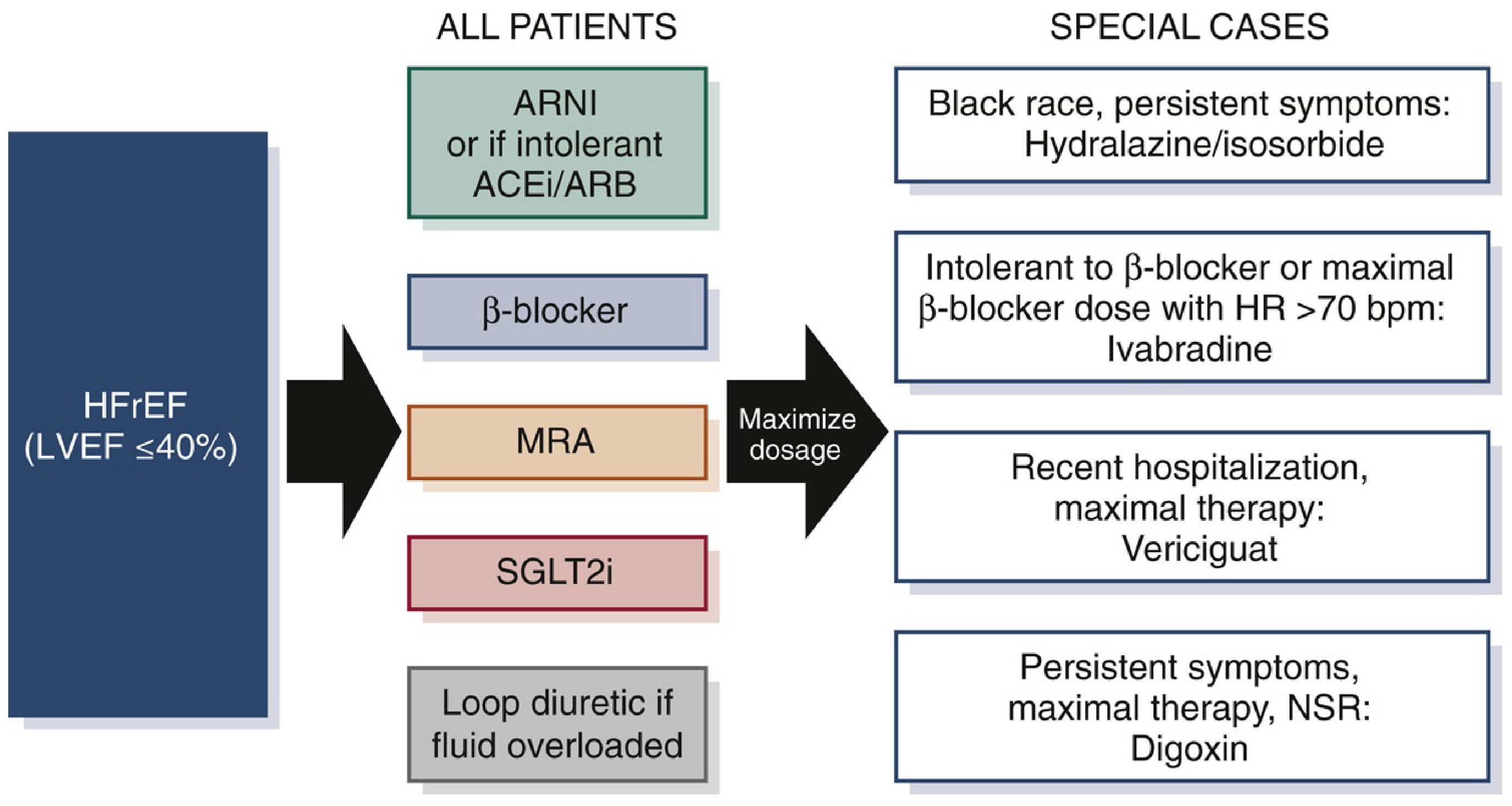
1. ARNI - Angiotensin Receptor-Neprilysin Inhibitor (Preferred over ACEi/ARB)
| Drug | Starting Dose | Target Dose |
|---|---|---|
| Sacubitril/Valsartan (Entresto) | 24/26 mg twice daily | 97/103 mg twice daily |
- Superior to enalapril in reducing death and rehospitalization (PARADIGM-HF trial)
- Mechanism: blocks neprilysin (increases natriuretic peptides) + blocks angiotensin II receptor
- MUST wash out ACE inhibitor for 36 hours before starting (risk of angioedema)
- Contraindicated: history of angioedema, pregnancy, concurrent ACEi use
- If ARNI not tolerated, use ACEi OR ARB instead (see below)
2. Beta-Blockers (only 3 proven to reduce mortality - NOT a class effect)
| Drug | Starting Dose | Target Dose |
|---|---|---|
| Carvedilol (alpha+beta blocker) | 3.125 mg twice daily | 25-50 mg twice daily |
| Metoprolol succinate (XL/CR) | 12.5-25 mg once daily | 200 mg once daily |
| Bisoprolol | 1.25 mg once daily | 10 mg once daily |
- Start LOW, titrate SLOW (every 2 weeks as tolerated)
- Survival benefit proportional to heart rate reduction achieved
- Takes 2-3 months to see LV function improvement
- Avoid in: acute decompensation, cardiogenic shock, symptomatic bradycardia, high-degree AV block, severe reactive airway disease
3. MRA - Mineralocorticoid Receptor Antagonist (Aldosterone Antagonist)
| Drug | Starting Dose | Target Dose |
|---|---|---|
| Spironolactone | 12.5-25 mg once daily | 25 mg once daily |
| Eplerenone | 25 mg once daily | 50 mg once daily |
- Reduces mortality, sudden cardiac death, and HF hospitalization
- Monitor: serum K+ and creatinine within 1 week of starting
- Avoid if: K+ >5.0 mEq/L, Cr >2.5 mg/dL (men) / >2.0 mg/dL (women), GFR <30
- Eplerenone preferred in males (fewer anti-androgenic side effects vs spironolactone)
4. SGLT2 Inhibitors (newest pillar - added to guidelines)
| Drug | Dose |
|---|---|
| Dapagliflozin (Farxiga) | 10 mg once daily |
| Empagliflozin (Jardiance) | 10 mg once daily |
- Reduces HF hospitalization and CV death regardless of diabetic status
- Well tolerated, minimal BP or renal effects
- Avoid if: eGFR <20, recurrent UTIs/genital infections
5. DIURETICS - for SYMPTOM RELIEF (volume overload)
Loop Diuretics (first choice for significant congestion)
| Drug | Starting Dose | Maximum Daily Dose |
|---|---|---|
| Furosemide | 20-40 mg once or twice daily | 400 mg/day |
| Torsemide | 10-20 mg once or twice daily | 200 mg/day |
| Bumetanide | 0.5-1 mg once or twice daily | 10 mg/day |
- Dose equivalence: Furosemide 40 mg = Torsemide 20 mg = Bumetanide 1 mg
- Torsemide/Bumetanide have >80% oral bioavailability (vs ~50% for furosemide) - preferred in resistant cases
- Monitor: K+, Na+, Mg2+, creatinine, uric acid
Thiazide Diuretics (mild congestion, normal renal function)
- Hydrochlorothiazide: 25-50 mg once daily
- Metolazone: 2.5-5 mg daily - especially useful combined with loop diuretic for diuretic resistance (acts at proximal + distal tubule)
ACEi / ARB (Use if ARNI not tolerated)
ACE Inhibitors
| Drug | Starting Dose | Target Dose |
|---|---|---|
| Enalapril | 2.5 mg twice daily | 10 mg twice daily |
| Lisinopril | 2.5-5 mg once daily | 10-20 mg twice daily |
| Captopril | 6.25-12.5 mg three times daily | 50 mg three times daily |
| Ramipril | 1.25-2.5 mg twice daily | 5 mg twice daily |
ARBs (if ACEi not tolerated - cough, angioedema)
| Drug | Starting Dose | Target Dose |
|---|---|---|
| Valsartan | 40 mg twice daily | 160 mg twice daily |
| Candesartan | 2-16 mg once daily | 32 mg once daily |
| Losartan | 25 mg once daily | 25-100 mg once daily |
SECOND-LINE / SPECIAL THERAPIES
Hydralazine + Isosorbide Dinitrate
- Dose: Start 37.5 mg/20 mg three times daily → target 75 mg/40 mg three times daily
- Reduces mortality in African-American patients (A-HeFT trial)
- Use when ACEi/ARB/ARNI not tolerated (renal failure, hyperkalemia)
Ivabradine
- Dose: Start 5 mg twice daily → target 7.5 mg twice daily
- Indication: LVEF ≤35%, sinus rhythm, resting HR >70 bpm despite maximally tolerated beta-blocker
- Pure HR reduction (If channel blocker) - does NOT lower BP
Digoxin
- Dose: 0.125-0.25 mg once daily (no loading dose for HF)
- Reduces HF hospitalization but NOT mortality
- Reserved for persistent symptoms despite maximized four pillars, in normal sinus rhythm
- Monitor: digoxin levels (goal 0.5-0.9 ng/mL), K+, renal function
- Avoid in: Wolff-Parkinson-White syndrome, complete heart block
Vericiguat
- Dose: 2.5 mg → 5 mg → 10 mg once daily (titrate q2 weeks)
- For: recent HF hospitalization despite maximized therapy
- Soluble guanylate cyclase stimulator
PART 2: HFpEF (LVEF ≥50%)
No drug proven to reduce mortality. Treatment is symptom control + risk factor management.
| Goal | Drug |
|---|---|
| Volume overload / dyspnea | Furosemide 20-80 mg (judicious use - avoid over-diuresis) |
| BP control (most important) | ACEi / ARB / ARNI / Beta-blocker |
| Rate control in AF | Beta-blocker, Diltiazem, Digoxin |
| Reduce HF hospitalization | SGLT2i (Empagliflozin/Dapagliflozin 10 mg), Spironolactone 25 mg, Sacubitril/Valsartan |
| Ischemia | Nitrates, revascularization |
PART 3: ACUTE DECOMPENSATED HEART FAILURE / PULMONARY EDEMA
Immediate Management:
1. Sit patient upright
2. Oxygen - if SpO2 <95%; use BiPAP/CPAP (non-invasive positive pressure ventilation) - can avoid intubation
3. IV Furosemide (first drug)
- 40-80 mg IV bolus over several minutes
- Onset of vasodilation: within minutes (before diuresis starts!)
- Repeat doses up to 200 mg per dose if needed
- Furosemide reduces preload acutely by direct venodilation when given IV
4. Nitroglycerin (vasodilator)
- 10-200 mcg/min IV infusion (titrate)
- Potentiates furosemide
- Reduces preload; reduce dose if BP drops
- Avoid if SBP <90 mmHg
5. Identify and treat precipitant: HTN crisis, MI, arrhythmia, infection, dietary non-compliance
If Hypotension / Cardiogenic Shock:
| Drug | Dose | Notes |
|---|---|---|
| Norepinephrine | 0.1-0.3 mcg/kg/min IV (titrate) | Preferred vasopressor over dopamine in cardiogenic shock (less arrhythmias) |
| Dobutamine | 2-20 mcg/kg/min IV | Positive inotrope + mild vasodilator. Avoid if MAP <65 (worsens hypotension) |
| Milrinone | 0.375-0.75 mcg/kg/min IV | PDE-3 inhibitor, inotrope + vasodilator. Useful if on beta-blockers |
| Epinephrine | 0.05-0.5 mcg/kg/min IV | Refractory shock only - associated with increased mortality |
| Sodium Nitroprusside | 0.25-10 mcg/kg/min IV | Severe HF + hypertension; avoid in ischemia (coronary steal); monitor for thiocyanate toxicity |
SUMMARY TABLE: Drug Selection by EF and Scenario
| Scenario | First-Line Drugs |
|---|---|
| HFrEF chronic | ARNI + Beta-blocker + MRA + SGLT2i + Loop diuretic (if congested) |
| HFrEF, ACEi/ARB/ARNI intolerant | Hydralazine + Isosorbide dinitrate |
| HFrEF, HR >70 on max beta-blocker | Add Ivabradine |
| HFrEF, AF + HF | Beta-blocker (rate control), Warfarin/DOAC |
| HFrEF, African-American | Add Hydralazine/Isosorbide dinitrate |
| HFpEF | BP control + Diuretics + SGLT2i + Spironolactone |
| Acute pulmonary edema | IV Furosemide + IV Nitroglycerin + BiPAP + Oxygen |
| Cardiogenic shock | Norepinephrine + Dobutamine/Milrinone |
Source: The Washington Manual of Medical Therapeutics, Chapter 5 - Heart Failure
This is a shared conversation. Sign in to Orris to start your own chat.