
Dry pericarditis, pericardial effusion
Reading File
Now I'll search the library in parallel for both topics:
Finding Sources
Finding Sources
Searching PubMed
"pericarditis" AND "pericardial effusion"
Now let me read the most comprehensive sources in parallel — Braunwald's for both topics, Goldman-Cecil for pericardial effusion, and Robbins for pathology:
Reading File
Reading File
Reading File
Reading File
Now let me get the detailed clinical content from Braunwald's main pericarditis section and Goldman-Cecil's effusion section:
Reading File
Reading File
Reading File
Let me get more content from Rosen's (ECG, management) and the Goldman-Cecil pericarditis section:
Reading File
Reading File
Now let me search for ECG images and cardiac tamponade content from the Goldman-Cecil section:
Finding Sources
Searching Images
pericarditis ECG diffuse ST elevation PR depression
Now let me also get the cardiac tamponade content from Rosen's and a pericardial effusion echo image:
Reading File
Searching Images
pericardial effusion echocardiogram cardiac tamponade
I now have comprehensive material. Let me compose the full response.
Dry Pericarditis & Pericardial Effusion
PART 1 — DRY (FIBRINOUS) PERICARDITIS
Definition & Pathophysiology
Pericarditis is inflammation of the pericardium caused by granulocytic and lymphocytic infiltration. "Dry" or fibrinous pericarditis refers to the form without significant fluid accumulation — the exudate is fibrinous, depositing on the pericardial surface and creating the characteristic shaggy, bread-and-butter appearance on gross pathology. It accounts for ~5% of all non-ischemic chest pain presentations.
Etiology
| Category | Examples |
|---|---|
| Infectious (viral/idiopathic) | Coxsackievirus, echovirus, influenza, EBV, HIV; 80–90% labeled idiopathic in Western countries |
| Post-cardiac injury | Acute MI (early), Dressler syndrome (weeks later — anti-myocardial antibodies), post-cardiac surgery, radiation |
| Systemic inflammatory | SLE, RA, SSc, rheumatic fever, sarcoidosis, amyloidosis |
| Uremia | Most common systemic disorder associated with pericarditis |
| Malignancy | Metastatic (lung, breast, lymphoma); primary cardiac tumors |
| Drugs | High-dose anthracyclines, cyclophosphamide, hydralazine, isoniazid, clozapine |
| Other | Trauma (blunt/penetrating), aortic dissection, fungal/parasitic infection, TB (common in developing countries) |
Clinical Features
- Chest pain: sharp, pleuritic, retrosternal; radiates to trapezius ridge or back; relieved by leaning forward, worsened by lying flat, deep inspiration, or swallowing — the single most characteristic feature
- Pericardial friction rub: best heard at the lower left sternal border with diaphragm of stethoscope, patient leaning forward in full expiration; triphasic (atrial systole + ventricular systole + early diastole); intermittent and migratory — may disappear as effusion develops
- Fever and myalgias: common, especially in viral/idiopathic cases
- Classic chest pain and ECG patterns are seen in only ~two-thirds of patients
ECG Changes — Four Stages
The ECG is the most reliable diagnostic tool. It evolves through classic stages:
| Stage | Timing | ECG Findings |
|---|---|---|
| Stage 1 | Hours to days | Diffuse concave ("saddle-shaped") ST elevation in nearly all leads; PR depression (most sensitive early sign) in all leads except aVR (reciprocal PR elevation in aVR); Spodick's sign (downsloping TP segment) |
| Stage 2 | Days | ST and PR normalize; T waves flatten |
| Stage 3 | 1–3 weeks | Deep, symmetric T-wave inversion across leads |
| Stage 4 | Weeks–months | ECG returns to normal (T-wave inversions may persist) |
Key ECG differences from STEMI:
- ST elevation is concave up (not convex/dome-shaped)
- Diffuse across multiple vascular territories, not regionalised
- No reciprocal ST depression (except aVR/aVL)
- No Q-wave development
- Simultaneous T-wave inversion does NOT occur during ST elevation
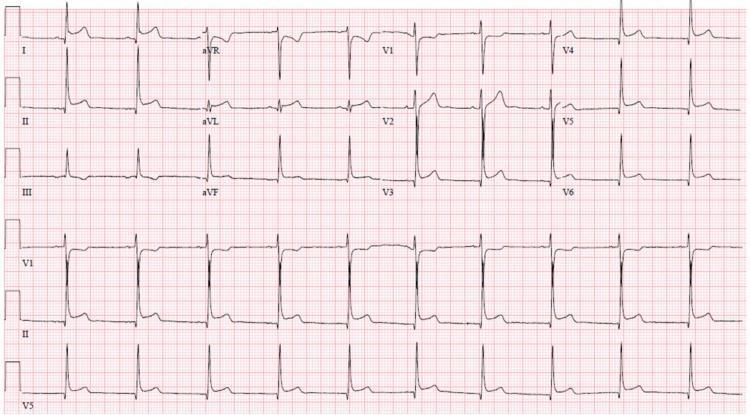
Classic Stage 1 pericarditis ECG: diffuse concave ST elevation, PR depression in inferior/lateral leads, reciprocal PR elevation and ST depression in aVR, and Spodick's sign (downsloping TP segment).
Diagnostic Criteria
Diagnosis requires ≥2 of 4:
- Typical pleuritic chest pain (worse supine, relieved sitting forward)
- Pericardial friction rub
- New widespread ST elevation / PR depression on ECG
- New or worsening pericardial effusion
Investigations
- ECG: staged changes as above
- Echo (POCUS): up to 60% have an effusion; a normal echo does not exclude pericarditis
- CRP: elevated (useful to guide treatment duration)
- CBC: elevated WBC (non-specific)
- Troponin: if elevated → concurrent myopericarditis
- Targeted workup for non-idiopathic causes: ANA, ANCA, dsDNA, RF, TSH, urea/creatinine, HIV serology, Quantiferon-TB
- Cardiac MRI: pericardial delayed gadolinium enhancement confirms active inflammation
Management
Acute pericarditis (aspirin/NSAID + colchicine backbone):
- NSAIDs (first-line): ibuprofen 600 mg QID or indomethacin 25–50 mg TID for 2 weeks; OR aspirin 650–1000 mg TID for 2 weeks
- Colchicine (add-on — halves recurrence rate): 0.5 mg OD (weight <70 kg) or 0.5 mg BD (weight ≥70 kg) for 3 months; start in ED if possible
- Corticosteroids (second-line, use only if NSAIDs/aspirin are contraindicated or ineffective): low-moderate dose prednisone 0.2–0.5 mg/kg/day; higher doses (≥1 mg/kg/day) associated with increased recurrence
- Activity restriction until asymptomatic + CRP normalized (athletes: 3 months minimum)
- If specific etiology found → treat underlying cause
Recurrent pericarditis: same NSAID + colchicine; consider IL-1 antagonists (anakinra, rilonacept) in colchicine-resistant cases
PART 2 — PERICARDIAL EFFUSION
Definition & Normal Values
The pericardial space normally contains 15–35 mL of ultrafiltrate. A pericardial effusion is any excess fluid accumulation in this space. The rate of accumulation matters more than volume — a rapidly accumulating 150 mL can cause tamponade, whereas a slowly developing 1–2 L may be tolerated.
Etiology
Most common: viral/idiopathic pericarditis, malignancy, uremia, trauma, radiation therapy. Less common: drug reactions, autoimmune diseases.
In cancer patients with effusion: ~40% are radiation-induced or idiopathic — only a minority are true malignant effusions. Most common associated cancers: lung, breast, lymphoma, gastrointestinal.
Classification by Size (Echo)
| Size | Volume |
|---|---|
| Small | <10 mm separation |
| Moderate | 10–20 mm |
| Large | >20 mm; requires 200–250 mL to show cardiomegaly on CXR |
Clinical Features
- Often asymptomatic unless large or rapidly accumulating
- Symptoms: cough, dyspnea, chest pain, fever
- Water-bottle sign on CXR: massive symmetric enlargement of cardiac silhouette (loss of normal contours), with obscured hilar vessels — distinguishes large effusion from cardiac chamber enlargement (where hilar structures are conspicuous)
- Posterior displacement of pericardial fat stripe on lateral CXR
Diagnosis
- POCUS/Echo: gold standard — anechoic space between visceral and parietal pericardium; differentiates fluid from chamber enlargement; assesses for tamponade physiology
- CT/MRI: when echo is technically limited; CT may detect purulent or loculated effusions; MRI characterizes fluid composition
- Minimum 200–250 mL needed to produce cardiomegaly on CXR
Pericardial Fluid Analysis
Indicated when infective pericarditis is suspected. Rarely useful otherwise. In autoimmune disease: immune complexes, ANA, anti-dsDNA may be detected in fluid but add little to serum testing.
Cardiac Tamponade
The critical complication — compression of the myocardium by pericardial contents.
Pathophysiology (three-stage continuum):
- Fluid fills pericardial recesses
- Fluid accumulates faster than pericardium can stretch
- Accumulation exceeds compensatory blood volume increase → ↑ intrapericardial pressure → ↓ ventricular compliance → ↓ diastolic filling → ↓ stroke volume → ↓ CO
- Heart compensates with tachycardia until late decompensation
Beck's Triad:
- Hypotension (↓ CO)
- Distended neck veins (↑ venous pressure)
- Muffled heart sounds
(May be absent if tamponade develops rapidly)
Additional findings:
- Pulsus paradoxus: >10 mmHg fall in systolic BP during inspiration (exaggerated ventricular interdependence)
- Kussmaul's sign: absent (differentiates from constrictive pericarditis)
ECG in tamponade:
- Low voltage (fluid attenuates electrical signal)
- Electrical alternans: alternating QRS axis beat-to-beat (pathognomonic — heart swinging in large effusion)
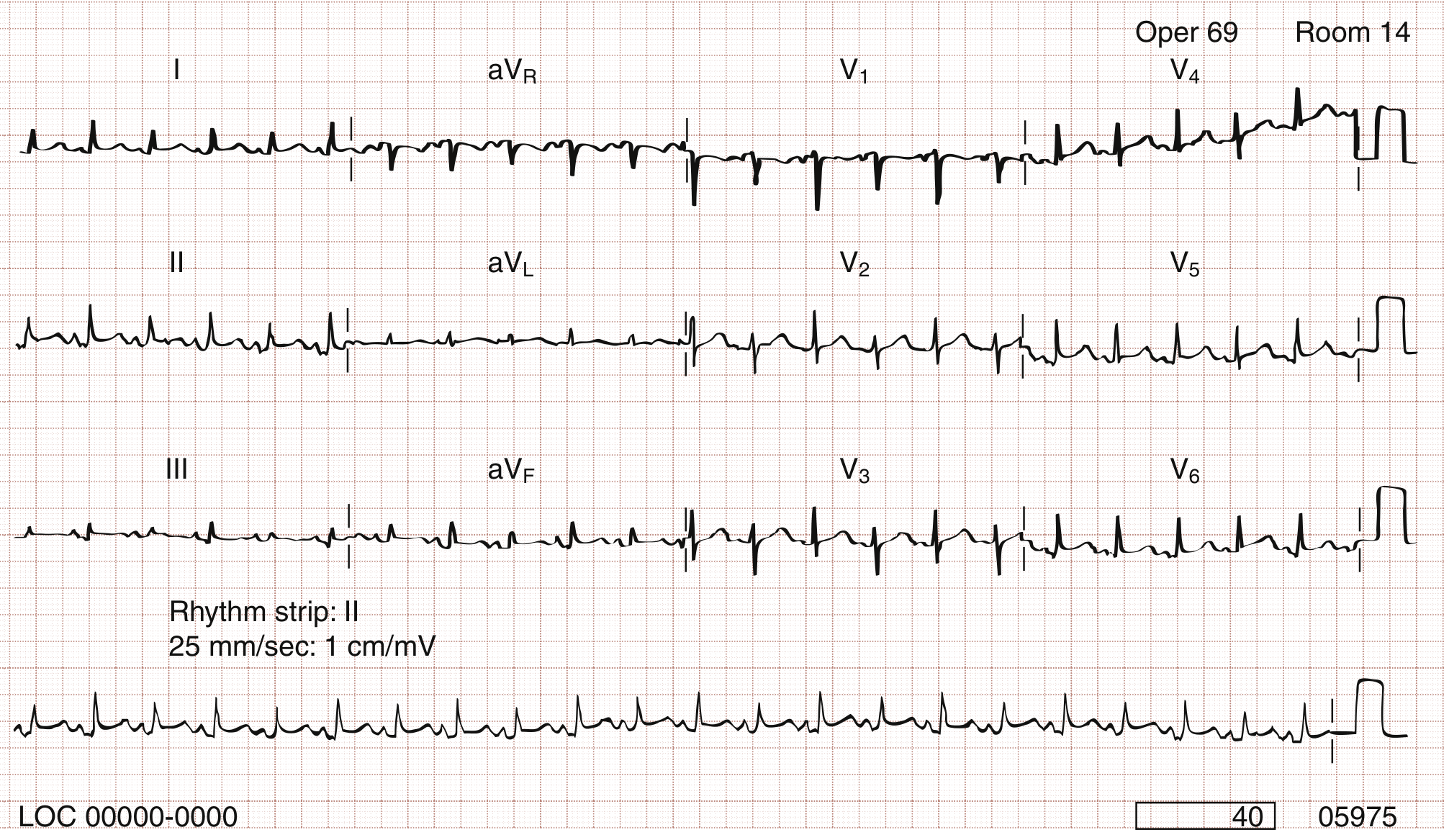
ECG showing electrical alternans — beat-to-beat alternation of QRS amplitude and axis, seen in large pericardial effusions causing cardiac tamponade.
Echo/POCUS in tamponade:
- Large anechoic circumferential space
- Right atrial collapse in late diastole (early sign)
- Right ventricular diastolic collapse (more specific)
- IVC plethora (>2.1 cm, <50% respiratory collapse)
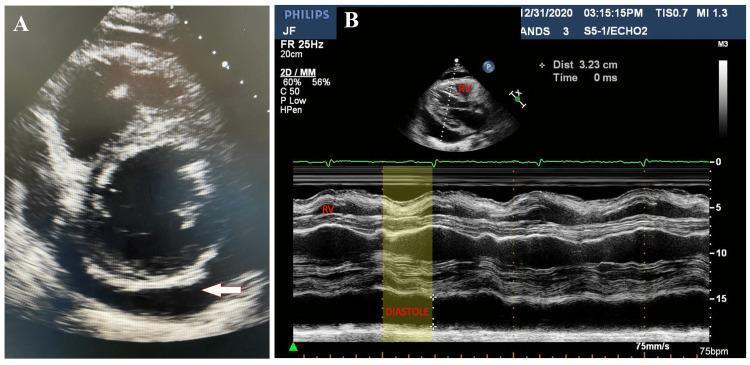
Parasternal short-axis echocardiogram (Panel A) showing large circumferential anechoic pericardial effusion; M-mode (Panel B) demonstrating early diastolic RV free wall collapse (yellow shading) — hallmark of cardiac tamponade physiology.
Hemodynamics: Equalization of right and left ventricular diastolic pressures on cardiac catheterization.
Management of Pericardial Effusion
| Scenario | Management |
|---|---|
| Small, asymptomatic | NSAIDs (ibuprofen 600 mg QID) + close follow-up |
| Moderate–large, symptomatic | Ultrasound-guided pericardiocentesis (diagnostic + therapeutic) |
| Cardiac tamponade | Emergency pericardiocentesis; initial IV fluids to ↑ right-sided filling pressure; avoid vasodilators/diuretics |
| Purulent pericarditis | Pericardiectomy or indwelling catheter + lavage + IV antibiotics ± fibrinolytics |
| Malignant effusion | Pericardiocentesis ± pericardial window/sclerosis; treat underlying malignancy |
Key Comparisons: Dry Pericarditis vs. Effusion vs. Tamponade vs. Constrictive
| Feature | Dry Pericarditis | Pericardial Effusion | Cardiac Tamponade | Constrictive Pericarditis |
|---|---|---|---|---|
| Mechanism | Fibrinous inflammation | Fluid accumulation | Pressure-mediated compression | Fibrotic encasement |
| JVP | Normal | Normal/↑ | ↑↑ | ↑↑ (Kussmaul's +) |
| Pulsus paradoxus | Absent | Absent unless large | Present (>10 mmHg) | Absent/mild |
| ECG | Staged ST/PR changes | Low voltage (if large) | Low voltage + electrical alternans | Normal/non-specific |
| Echo | Small/no effusion | Anechoic space | RV diastolic collapse | Pericardial thickening |
| Friction rub | Present | Disappears as fluid ↑ | Absent | Pericardial knock |
Sources: Rosen's Emergency Medicine 9e, p. 1121–1125; Robbins & Kumar Basic Pathology, p. 377; Braunwald's Heart Disease 12e; Goldman-Cecil Medicine, p. 446–447.
This is a shared conversation. Sign in to Orris to start your own chat.