
Renal cell carcinoma
Reading File
Now I'll run parallel searches across the medical library and recent literature.
Finding Sources
Searching PubMed
"renal cell carcinoma"[MeSH Terms] AND treatment
Excellent sources found. Now let me read the most comprehensive sections in parallel.
Reading File
Reading File
Reading File
Searching PubMed
"renal cell carcinoma" AND immunotherapy
Now let me get the detailed treatment and clinical sections from Campbell-Walsh (the urology gold standard) and Cecil Medicine.
Reading File
Reading File
Reading File
Excellent. Let me get the clinical features, staging, and treatment sections from Campbell-Walsh (the most comprehensive urology text).
Reading File
Reading File
I have rich content. Let me get the clinical presentation, staging, and management sections.
Reading File
I now have comprehensive material. Let me also quickly fetch a representative histology image for the response.
Loading Image
I now have everything needed for a thorough, well-sourced response.
Renal Cell Carcinoma (RCC)
Overview
RCC is the most lethal of the common urologic cancers, accounting for 80-85% of all primary malignant renal neoplasms and 2-3% of all adult cancers. It is not a single entity but a group of morphologically and genetically distinct tumors, each with different biology, prognosis, and treatment response.
- ~75,000 new cases/year in the United States; ~14,000 deaths annually
- Sixth most common cancer in men, ninth in women
- Male:female ratio approximately 2-3:1
- Peak incidence: 6th-7th decade of life; increasing in those under 40
- Highest incidence in Black Americans; lowest in Asian/Pacific Islanders
- Goldman-Cecil Medicine, p. 2070; Campbell-Walsh Wein Urology, p. 2846
Histologic Subtypes
| Subtype | Frequency | Key Feature | Prognosis |
|---|---|---|---|
| Clear cell | 65-80% | VHL loss, golden yellow, hypervascular | Most aggressive; 90% of metastases |
| Papillary | 10-15% | MET mutations; bilateral/multifocal | Variable (type 1 indolent, type 2 poor) |
| Chromophobe | 3-5% | Hale colloidal iron+; "plant cell" look | Most indolent (except sarcomatoid variant) |
| Oncocytoma | ~10% | Benign; mahogany brown | Benign |
- Robbins & Kumar Basic Pathology, p. 531-536; Campbell-Walsh, p. 2860
Clear Cell RCC - Molecular Pathogenesis
The hallmark is loss/inactivation of both VHL alleles on chromosome 3p25 (sporadic mutation + deletion, or germline in von Hippel-Lindau disease). Without functional VHL protein, hypoxia-inducible factor (HIF) is not degraded and accumulates even in normoxia. HIF then drives transcription of:
- VEGF - promotes tumor angiogenesis (the basis for anti-VEGF/anti-VEGFR therapies)
- Metabolic reprogramming via MYC collaboration
- Additional frequent mutations: PBRM1, SETD2, BAP1 (epigenome regulators)
- Robbins Basic Pathology, p. 531
Papillary RCC
- Type 1: MET proto-oncogene activating mutations; associated with Hereditary Papillary RCC Syndrome (autosomal dominant, chromosome 7q31); multifocal/bilateral; indolent
- Type 2: Higher grade, eosinophilic cells, associated with HLRCC (hereditary leiomyomatosis and RCC); poor prognosis
Chromophobe RCC
- Derived from distal convoluted tubule
- Massive chromosomal losses (chromosomes 1, 2, 6, 10, 13, 17)
- Perinuclear "halo" on histology; stains + for Hale colloidal iron
- Associated with Birt-Hogg-Dube (BHD) syndrome
- Poor outcome only when sarcomatoid dedifferentiation occurs
- Campbell-Walsh, p. 2860
Risk Factors
- Cigarette smoking
- Obesity (risk rises with BMI)
- Hypertension / diuretic use
- Chronic renal failure / hemodialysis (30-fold increased risk with acquired cystic disease)
- Pre-existing renal conditions: polycystic kidney disease, horseshoe kidney
- Occupational cadmium exposure
- Familial: VHL disease, hereditary papillary RCC syndrome, BHD syndrome, HLRCC (~4-6% of all RCC is familial)
Clinical Presentation
The classic triad of flank pain, hematuria, and palpable flank mass is now seen in fewer than 10% of patients (late presentation). Today, >50% of RCCs are discovered incidentally on abdominal CT or MRI done for other reasons.
Symptoms when present:
- Gross or microscopic hematuria (most common presenting symptom)
- Dull flank/back pain
- Palpable mass (late finding)
- Constitutional: fatigue, weight loss, fever
Paraneoplastic syndromes (occur in ~20% of patients):
- Polycythemia (ectopic EPO)
- Hypercalcemia (PTHrP)
- Hypertension (renin secretion)
- Stauffer syndrome (non-metastatic hepatic dysfunction - reverses after nephrectomy)
- Amyloidosis
Metastatic disease (present in ~25-30% at diagnosis):
- Lung (most common)
- Bone (osteolytic)
- Liver, adrenal, brain
- RCC has a marked tendency to invade the renal vein and IVC (tumor thrombus) - seen in ~4-10% of cases
Imaging and Diagnosis
MRI of RCC mass:
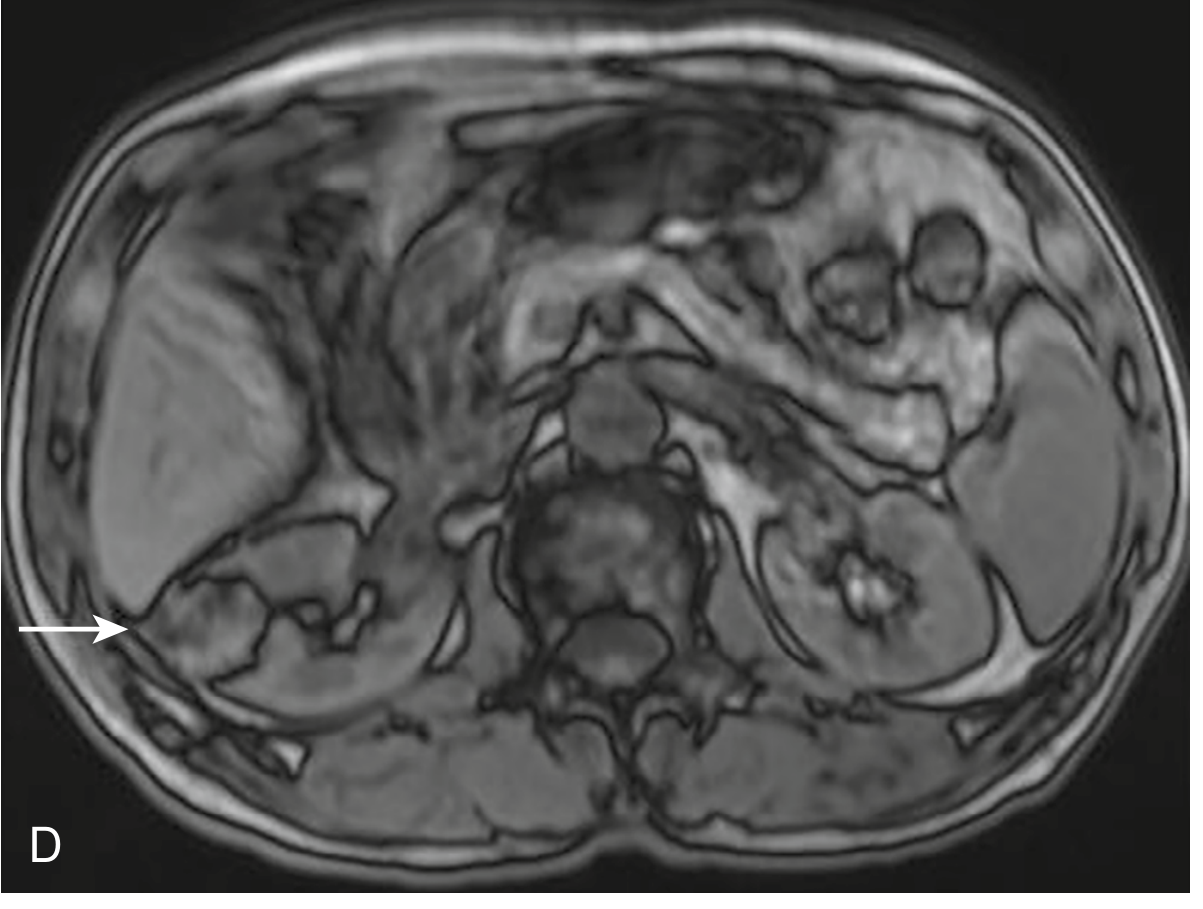
Axial MRI showing a right-sided renal mass (arrow) - National Kidney Foundation Primer, p. 78
- Ultrasound: Low sensitivity for small lesions; can be solid, cystic, or mixed echogenicity
- Multiphasic contrast CT (gold standard): Demonstrates enhancement (key feature distinguishing from cysts). Clear cell RCC shows avid corticomedullary enhancement that becomes hypoenhancing in the nephrographic phase
- MRI: Superior for venous involvement, complex cysts, subtraction imaging; chromophobe RCC enhances avidly in corticomedullary phase (less than clear cell); papillary RCC is hypointense on T2 and hypoenhancing on all phases
- Bosniak classification: Used to stratify cystic renal masses (I-IV) for malignancy risk; Bosniak III-IV lesions require surgical evaluation
- CT chest/abdomen/pelvis: Staging workup; bone scan if symptoms suggest osseous involvement
- National Kidney Foundation Primer, p. 78; Goldman-Cecil, p. 2072
Staging (TNM / AJCC)
| Stage | Description | 5-year Survival |
|---|---|---|
| I | Tumor ≤7 cm, confined to kidney | ~95% |
| II | Tumor >7 cm, confined to kidney | ~75% |
| III | Extends into major veins/perinephric tissue, or regional nodes | ~50-60% |
| IV | Invades beyond Gerota fascia or distant metastases | ~12% |
Treatment
Localized Disease (Stages I-III)
Radical nephrectomy is the standard for large or complex tumors (>7 cm, central, or multiple):
- Laparoscopic or robotic approach now preferred for suitable anatomy
- Includes ipsilateral adrenal (if suspicious), regional lymph nodes
Partial nephrectomy (nephron-sparing surgery):
- Standard of care for T1a tumors (≤4 cm) and strongly preferred for T1b (4-7 cm) when technically feasible
- Equivalent oncologic outcomes with better renal functional preservation
Ablative therapies (cryoablation, radiofrequency ablation):
- For small (<3 cm), peripheral tumors
- Higher local recurrence than surgery; appropriate for poor surgical candidates
Active surveillance: Option for small (<2 cm), incidentally detected masses in elderly or co-morbid patients; growth rate typically slow (~0.3 cm/year)
Adjuvant Therapy
- Pembrolizumab (anti-PD-1): FDA-approved adjuvant therapy for high-risk clear cell RCC after nephrectomy (KEYNOTE-564 trial); significantly improves disease-free survival
- Sunitinib failed to show overall survival benefit in the adjuvant setting
Metastatic / Advanced Disease
RCC is resistant to conventional chemotherapy. Treatment is systemic targeted therapy or immunotherapy:
First-line options (clear cell RCC):
| Drug Class | Agents | Mechanism |
|---|---|---|
| VEGFR TKIs | Sunitinib, Pazopanib, Cabozantinib | Block VEGFR, PDGFR, MET, AXL |
| mTOR inhibitors | Temsirolimus, Everolimus | Block mTOR pathway (HIF suppression) |
| Anti-VEGF antibody | Bevacizumab + IFN-α | Neutralizes VEGF |
| ICI combinations | Nivolumab + ipilimumab (anti-PD1 + anti-CTLA4) | T-cell checkpoint blockade |
| ICI + TKI | Pembrolizumab + axitinib; Nivolumab + cabozantinib; Lenvatinib + pembrolizumab | Dual pathway inhibition |
- Nivolumab + ipilimumab (CheckMate 214): Improved OS vs. sunitinib in intermediate/poor-risk patients - now a preferred first-line option
- Cabozantinib: Multi-kinase inhibitor (VEGFR, MET, AXL); superior PFS vs. sunitinib in intermediate/poor-risk patients (CABOSUN trial)
- Temsirolimus: Particularly beneficial in poor-risk metastatic RCC
- Everolimus: Second-line after TKI failure
mTOR pathway rationale: VHL loss → HIF accumulation → VEGF/mTOR upregulation - both pathways are druggable and clinically validated.
- Campbell-Walsh Urology, p. 2855
Cytoreductive nephrectomy: Removal of the primary tumor before systemic therapy; benefits selected patients with good performance status, especially before TKI therapy (less clear benefit before ICI-based regimens)
Non-clear cell RCC: Less data; MET-directed therapy (cabozantinib, savolitinib) for papillary; everolimus/temsirolimus for chromophobe; clinical trials preferred
Prognosis Factors
Favorable: Clear cell histology (responds to targeted therapy), low IMDC/MSKCC risk score, good performance status, early stage
Unfavorable:
- Sarcomatoid differentiation (any subtype)
- High Fuhrman/ISUP nuclear grade
- Venous invasion, necrosis
- IMDC poor-risk features (anemia, hypercalcemia, thrombocytosis, neutrophilia, KPS <80%, <1 year from diagnosis to treatment)
- BAP1 mutation (vs. PBRM1, which is more favorable)
Hereditary Syndromes
| Syndrome | Gene | Chromosome | Associated RCC |
|---|---|---|---|
| Von Hippel-Lindau | VHL | 3p25 | Clear cell (bilateral, multiple) |
| Hereditary Papillary RCC | c-MET | 7q31 | Type 1 papillary (bilateral, multifocal) |
| HLRCC | FH (fumarate hydratase) | 1q43 | Type 2 papillary (aggressive) |
| Birt-Hogg-Dube | FLCN (folliculin) | 17p11.2 | Chromophobe, oncocytoma |
Key Takeaways
- RCC = cortical tumor from tubular epithelium; 3 main subtypes with distinct molecular drivers
- Classic triad is rare today; most found incidentally on imaging
- VHL/HIF/VEGF axis is the molecular core of clear cell RCC and the basis of most targeted therapies
- Surgical resection (partial or radical nephrectomy) is curative for localized disease
- Metastatic RCC is treated with ICI combinations +/- TKIs; mTOR inhibitors for poor-risk or second-line
- CAR T-cell therapy targeting CD70 is an emerging investigational approach (Phase I data, PMID 38583184)
Sources: Robbins & Kumar Basic Pathology (9780323790185); Campbell-Walsh Wein Urology (9780323546423); Goldman-Cecil Medicine (9780323930345); National Kidney Foundation Primer on Kidney Diseases (9780323791229)
This is a shared conversation. Sign in to Orris to start your own chat.