
Anatomy of joints
Reading File
Finding Sources
Finding Sources
Finding Sources
Finding Sources
Good results. Let me read the key sources — the Imaging Anatomy "Joints and Cartilage" section and the Miller's Orthopaedics "Arthrology" section, plus the THIEME General Anatomy articular capsule section, all in parallel.
Reading File
Reading File
Reading File
Now let me get more detail on joint classification and synovial joint structure from the Imaging Anatomy book, and also the THIEME Atlas general anatomy section on joints.
Reading File
Finding Sources
Reading File
Reading File
I now have rich content. Let me also fetch key images to display inline.
Reading File
I now have comprehensive content. Let me compile the full answer.
Anatomy of Joints (Arthrology)
1. Definition
A joint (articulation/junctura) is the site where two or more bones meet. Joints may be structurally simple (united by fibrous tissue) or anatomically elaborate (enclosed by a capsule with synovial fluid). They are studied both structurally and functionally.
2. Classification of Joints
A. Structural Classification
| Type | Uniting Medium | Mobility | Examples |
|---|---|---|---|
| Fibrous | Fibrous connective tissue | None or slight | Skull sutures, gomphosis, syndesmosis |
| Cartilaginous | Hyaline or fibrocartilage | Slight | Epiphyseal plates, pubic symphysis, IVDs |
| Synovial | Joint cavity + synovial fluid | Freely mobile | Knee, hip, shoulder, elbow |
B. Functional Classification
| Term | Movement | Examples |
|---|---|---|
| Synarthrosis | Immobile | Skull sutures, sternomanubrial joint, gomphosis |
| Amphiarthrosis | Slightly mobile | Intervertebral disks, pubic symphysis |
| Diarthrosis | Freely mobile | All synovial joints |
The diarthrosis is the most common type of joint. — Imaging Anatomy, Vol. 3
3. Fibrous Joints
Bones are united by fibrous connective tissue with no joint cavity. Three subtypes:
- Sutures — found only between skull bones; interlocking edges held by Sharpey's fibers. In adults they fuse (synostosis).
- Syndesmosis — bones connected by an interosseous membrane or ligament (e.g., tibiofibular syndesmosis, interosseous membrane of forearm).
- Gomphosis — peg-and-socket joint; tooth root anchored into the jaw socket by the periodontal ligament.
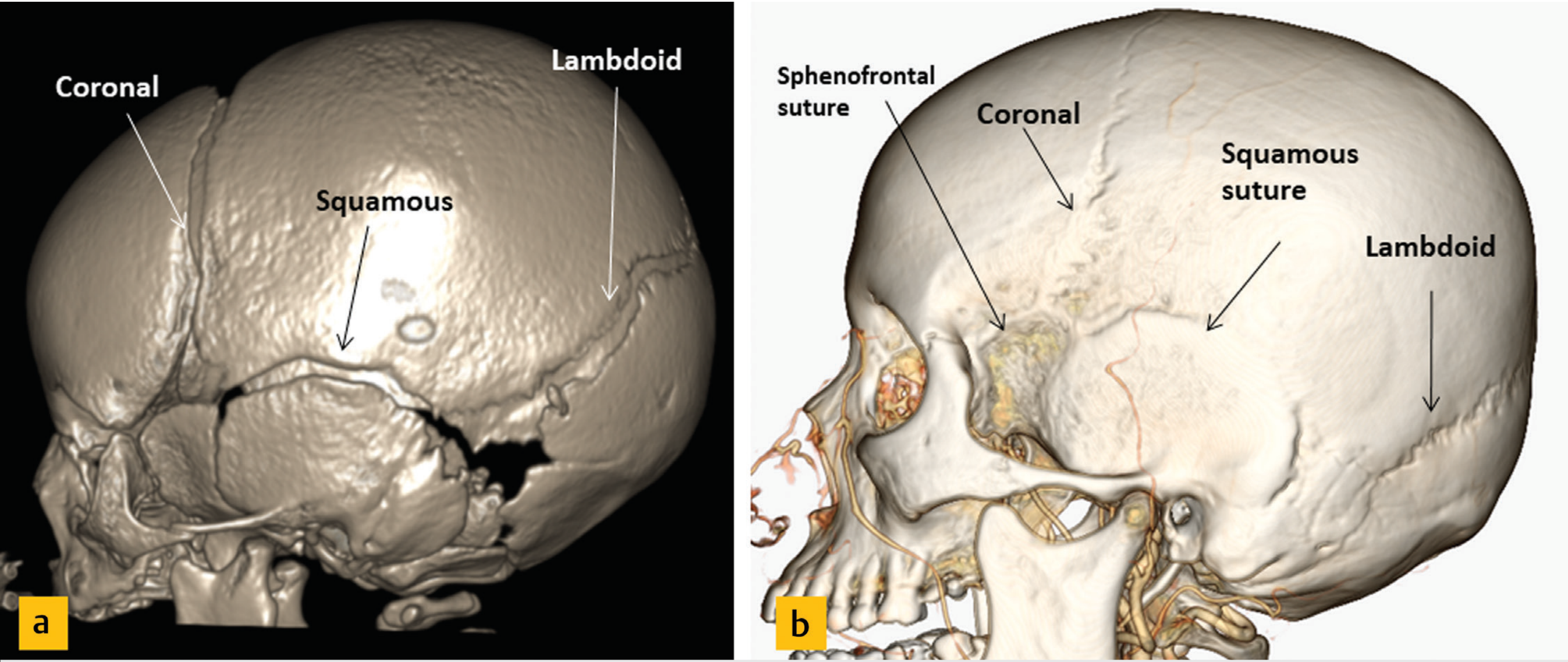
4. Cartilaginous Joints
Bones are united by hyaline cartilage or fibrocartilage; no joint cavity. Two subtypes:
Synchondrosis (hyaline cartilage)
- Temporary: Epiphyseal growth plates; Y-shaped triradiate cartilage of the acetabulum (ossifies ~age 25). Injury leads to limb deformity.
- Permanent: Costochondral junctions; first sternocostal joint.
Symphysis (fibrocartilage disk)
- Located in the midline of the body.
- Strong fibrocartilage disk reinforced by periarticular ligaments.
- Pubic symphysis: ends of pubic bones covered by hyaline cartilage attached to a fibrocartilage disk; functionally an amphiarthrosis.
- Intervertebral disks: wide symphyses with nucleus pulposus + anulus fibrosus.
- Manubriosternal joint: symphysis at the sternal angle.
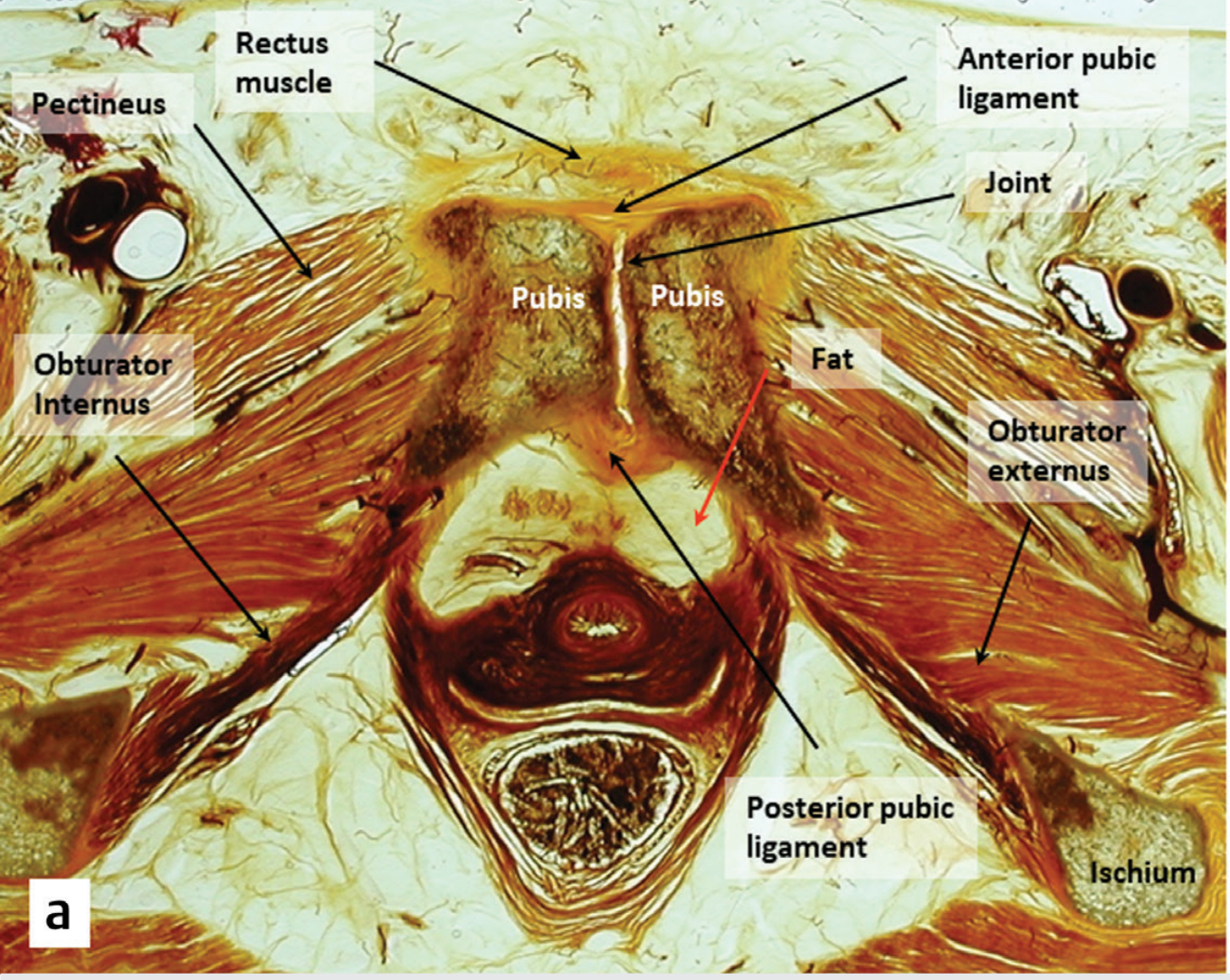
5. Synovial Joints
The most common and clinically important joint type. Key features:
Structural Components
| Component | Description |
|---|---|
| Articular cartilage | Hyaline cartilage covers bone ends (except TMJ, which has fibrocartilage); avascular, aneural — nourished by synovial fluid |
| Joint (synovial) cavity | Space between articular surfaces; filled with synovial fluid |
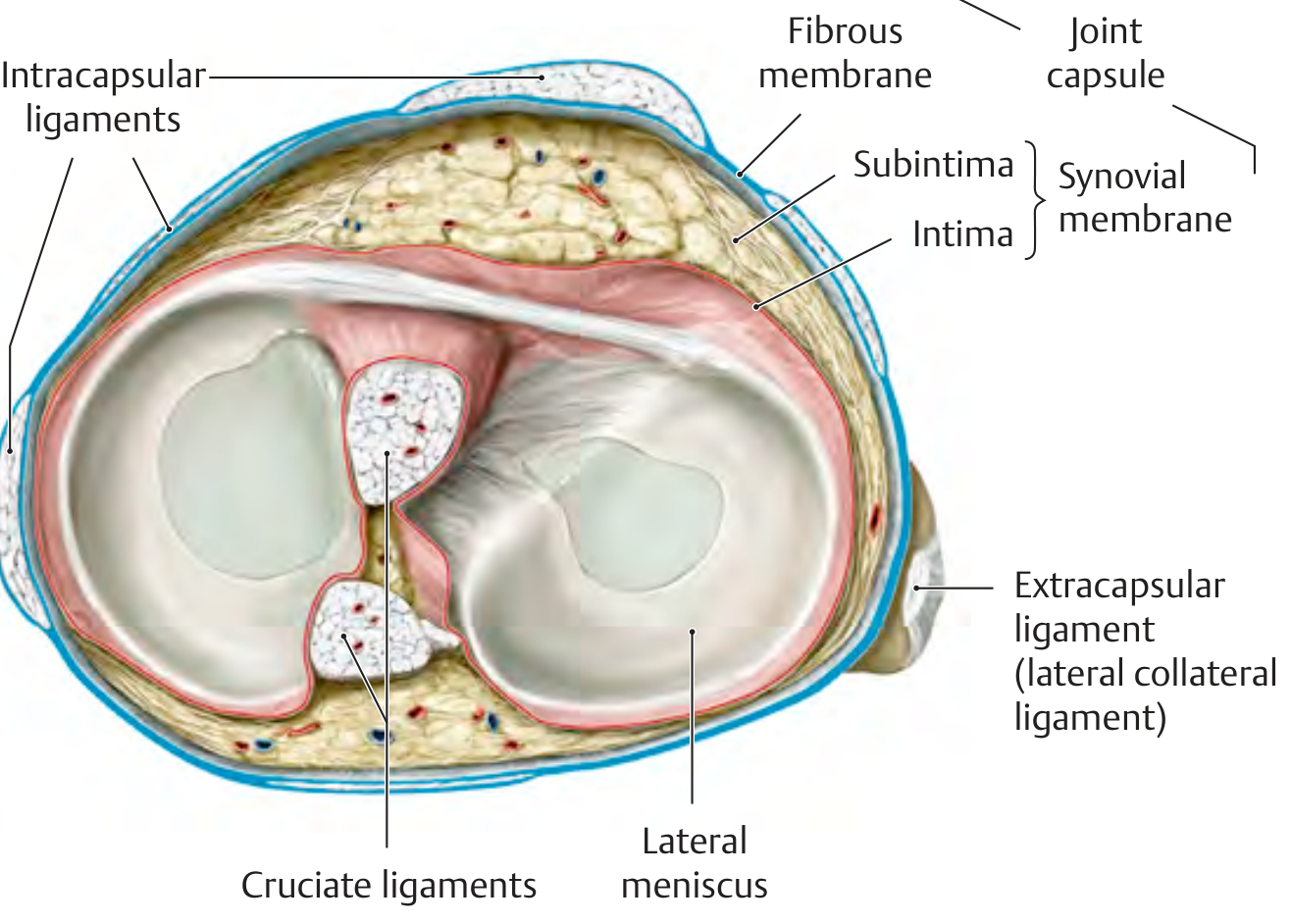
| Articular capsule | Outer fibrous layer (dense CT, reinforced by ligaments) + inner synovial membrane |
| Synovial membrane | Lines the capsule and intra-articular structures (except articular surfaces); secretes synovial fluid |
| Synovial fluid | Viscous, lubricating ultrafiltrate of plasma + hyaluronic acid; nourishes avascular cartilage |
| Ligaments | Stabilize the joint; may be capsular (thickenings of fibrous capsule), extracapsular, or intracapsular |
| Articular disks/menisci | Fibrocartilage pads that improve congruity and shock absorption (e.g., knee menisci, TMJ disk) |
| Bursae | Fluid-filled sacs that reduce friction near joints |
| Fat pads | Intra-articular fat (e.g., infrapatellar fat pad) that fills dead space |
Note: Cruciate ligaments are intracapsular but extra-articular (surrounded by synovial subtima); menisci are intra-articular (not covered by synovial intima, in direct contact with synovial fluid). — THIEME Atlas of General Anatomy
Development of Synovial Joints
Interzonal mesenchyme between developing bones differentiates:
- Peripherally → joint capsule and ligaments
- Centrally → undergoes cavitation (late embryogenesis to postnatal) → synovial cavity
- Lining layer → synovial membrane (secretes fluid)
Movement in utero is required for normal joint formation; restricted fetal movement causes joint fixation. — The Developing Human, Moore
6. Types of Synovial Joints (by Shape)
| Type | Axes of Movement | Movement | Examples |
|---|---|---|---|
| Plane (gliding) | 0 (non-axial) | Gliding only | Intercarpal, intertarsal, facet joints |
| Hinge (ginglymus) | 1 (uniaxial) | Flexion/extension | Elbow, interphalangeal joints, ankle |
| Pivot (trochoid) | 1 (uniaxial) | Rotation only | Atlantoaxial, proximal radioulnar |
| Condyloid (ellipsoid) | 2 (biaxial) | Flex/ext + ab/adduction | Metacarpophalangeal joints, wrist |
| Saddle (sellar) | 2 (biaxial) | Flex/ext + ab/adduction | 1st carpometacarpal (thumb CMC) |
| Ball-and-socket (spheroid) | 3 (multiaxial) | All planes | Hip, shoulder (glenohumeral) |
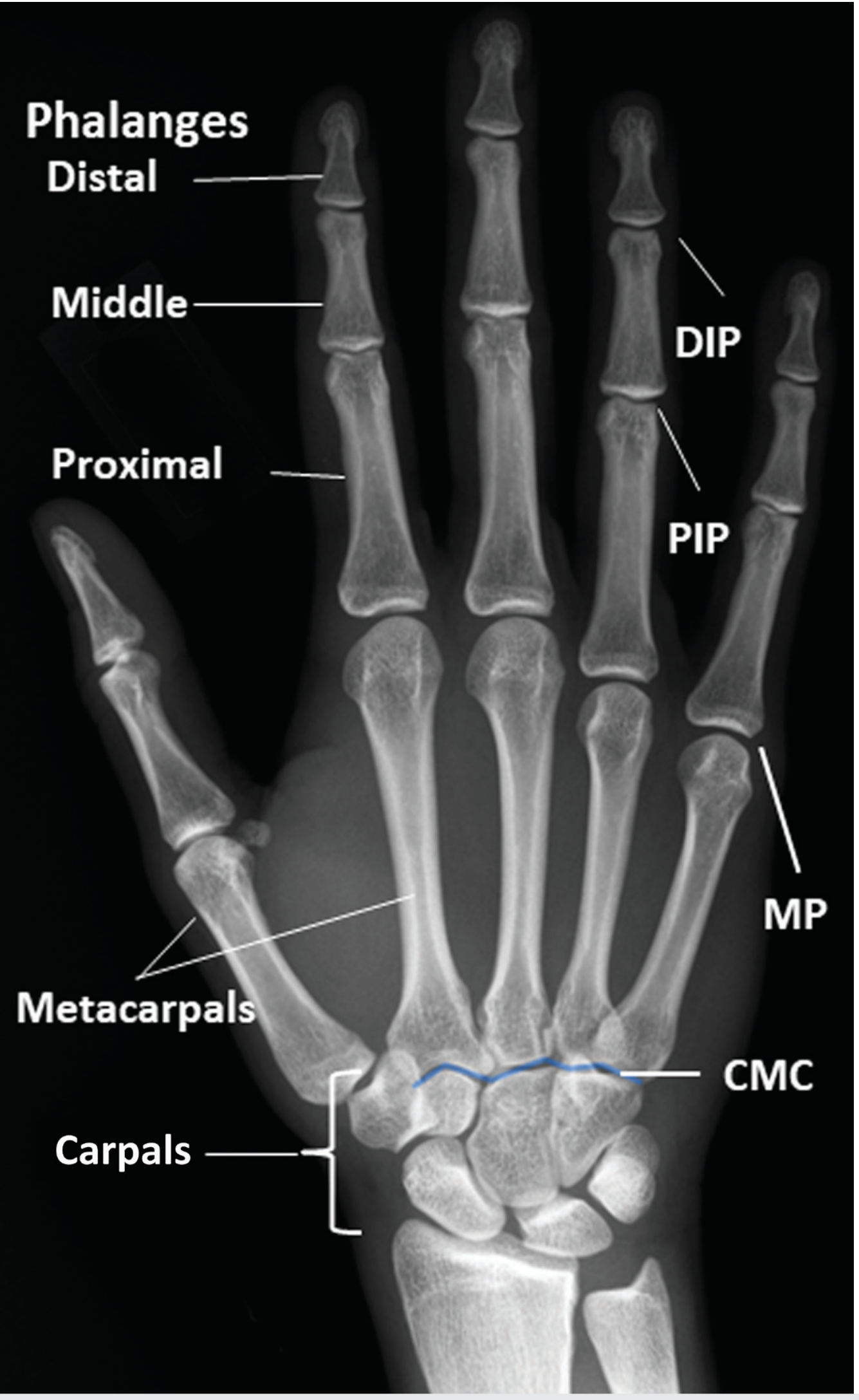
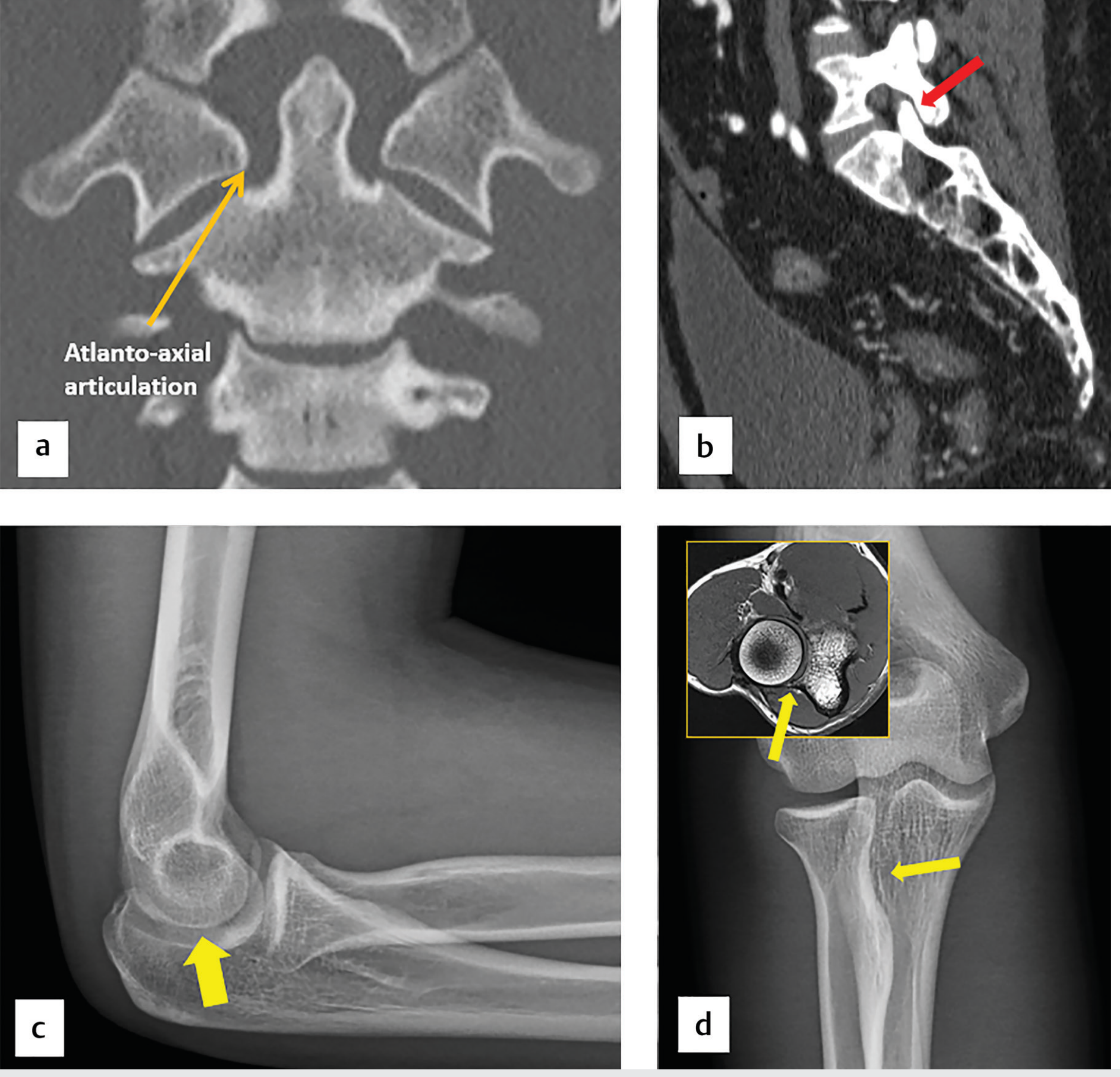
7. Articular Cartilage — Structure and Zones
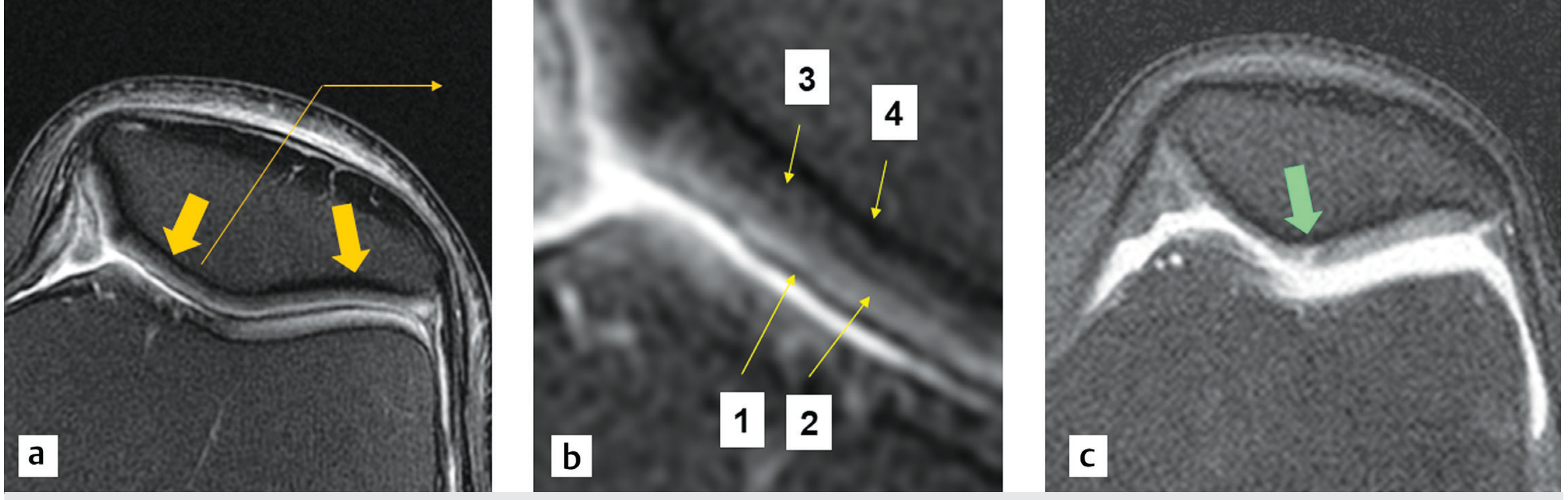
Articular cartilage is hyaline cartilage, and its normal layered architecture is visible on high-resolution MRI:
| Zone | Characteristics |
|---|---|
| Superficial (lamina splendens) | Tangential collagen fibers; dark on MRI; resists shear forces |
| Intermediate (transitional) | Oblique fibers; brightest layer on MRI |
| Deep (radial) | Perpendicular collagen fibers; highest proteoglycan content |
| Calcified cartilage | Interface with subchondral bone; separated from deep zone by the tidemark |
- Avascular and aneural — nourished entirely by diffusion from synovial fluid and, in part, from subchondral bone.
- Limited regenerative capacity → damage progresses to osteoarthritis.
- In osteoarthritis: proteoglycan + collagen loss → increased water content → cartilage softening → subchondral sclerosis and osteophyte formation.
8. Knee Joint — A Paradigm of Synovial Joint Anatomy
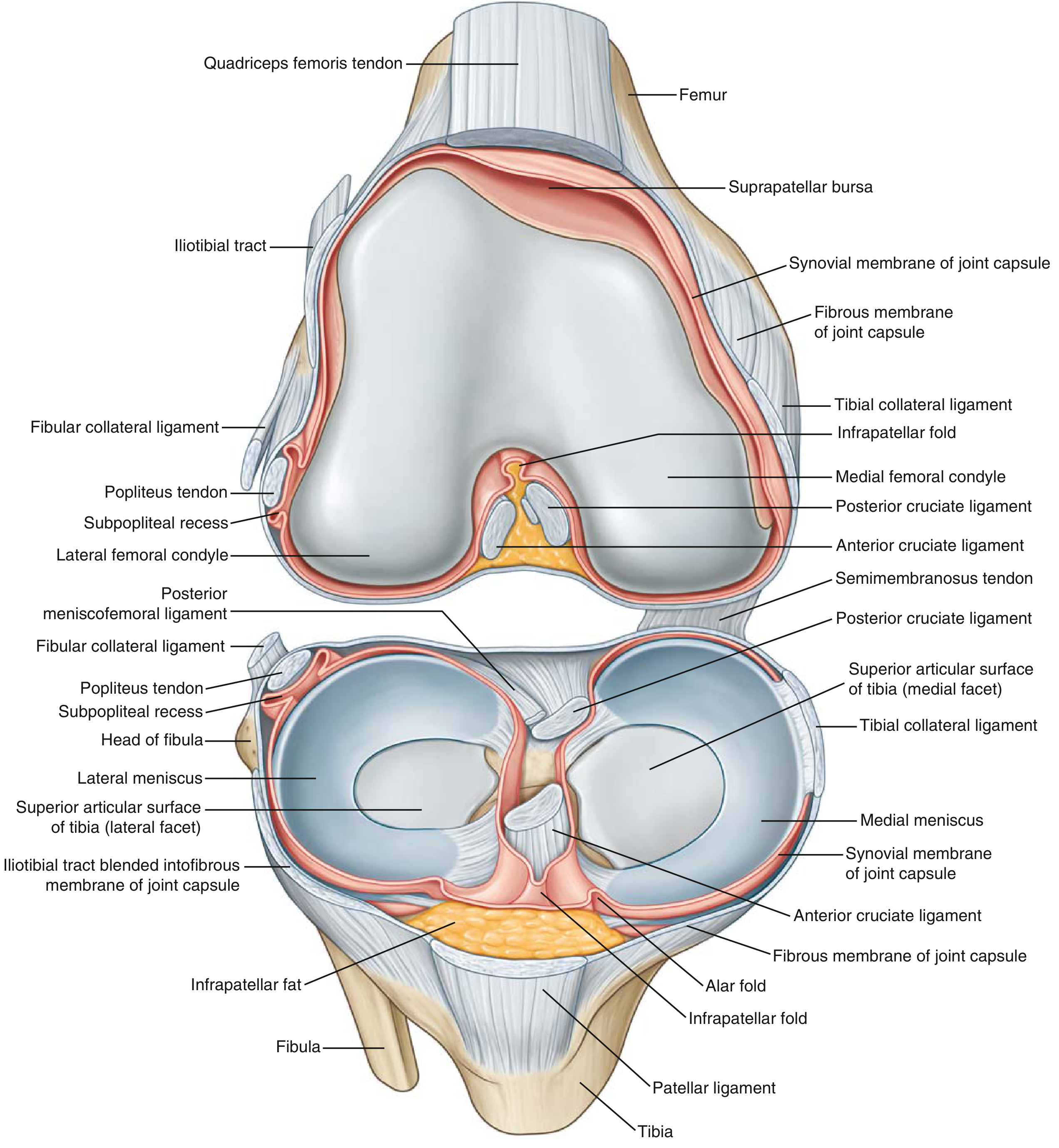
The knee is the body's largest synovial joint and illustrates all key joint components:
- Capsule extends 15 mm distal to the joint line.
- Menisci (medial & lateral): fibrocartilage; deepen the tibial concavity; assist rotation.
- Peripheral 1/3 = red zone (vascular, repairable); inner 2/3 = white zone (avascular, poor healing).
- Medial meniscus is less mobile (attached to deep MCL) and tears more often.
- Cruciate ligaments: intracapsular but extra-articular; ACL (anteromedial + posterolateral bundles), PCL (anterolateral + posteromedial bundles).
- MCL: superficial (attaches 5–7 cm distal to joint) + deep components.
- Bursae: suprapatellar pouch (extension of joint cavity), prepatellar bursa, infrapatellar bursa.
- Screw-home mechanism: tibia externally rotates ~10° at full extension (locks the joint).
9. Summary Table
| Feature | Fibrous | Cartilaginous | Synovial |
|---|---|---|---|
| Joint cavity | No | No | Yes |
| Uniting tissue | Fibrous CT | Hyaline/fibrocartilage | Synovial fluid |
| Mobility | None–slight | Slight | Free |
| Articular cartilage | No | Yes (hyaline) | Yes (hyaline) |
| Synovial membrane | No | No | Yes |
| Capsule | No | No | Yes |
Sources:
- Imaging Anatomy: Text and Atlas, Vol. 3 — Bones, Joints, Vessels and Nerves, Classification and Joints & Cartilage sections
- THIEME Atlas of General Anatomy and Musculoskeletal System, Structure of the Articular Capsule
- The Developing Human: Clinically Oriented Embryology, Synovial Joints
- Miller's Review of Orthopaedics, 9th ed., Arthrology
This is a shared conversation. Sign in to Orris to start your own chat.