
JR circuit 5 mark answer for anesthesia exam
Reading File
The JR circuit (Jackson-Rees circuit, also called Mapleson F) is a classic anesthesia exam topic. Let me pull the best content from the textbook library.
Searching sources...
Finding Sources
Finding Sources
Reading File
Reading File
Reading File
Searching Images
Jackson Rees circuit Mapleson F diagram pediatric anesthesia
Loading Image
Finding Sources
I now have everything needed for a complete 5-mark exam answer. Here it is:
Jackson-Rees (JR) Circuit
Definition and Classification
The Jackson-Rees (JR) circuit is a Mapleson F breathing system. It was introduced by Gordon Jackson Rees in 1950 as a modification of the Ayre's T-piece (Mapleson E), specifically designed for use in pediatric anesthesia.
Structure / Components
The circuit consists of:
- Fresh Gas Flow (FGF) inlet - enters near the patient end (T-piece junction)
- Corrugated reservoir tubing - connects T-piece to the bag
- Expiratory limb (open tail) - a breathing bag with an adjustable open-tail valve at the distal end
The key modification over Mapleson E (Ayre's T-piece): addition of a double-ended bag (open-tail bag) to the expiratory limb. The open tail may have an adjustable valve, allowing:
- Closed - for positive-pressure / controlled ventilation
- Open - for spontaneous ventilation
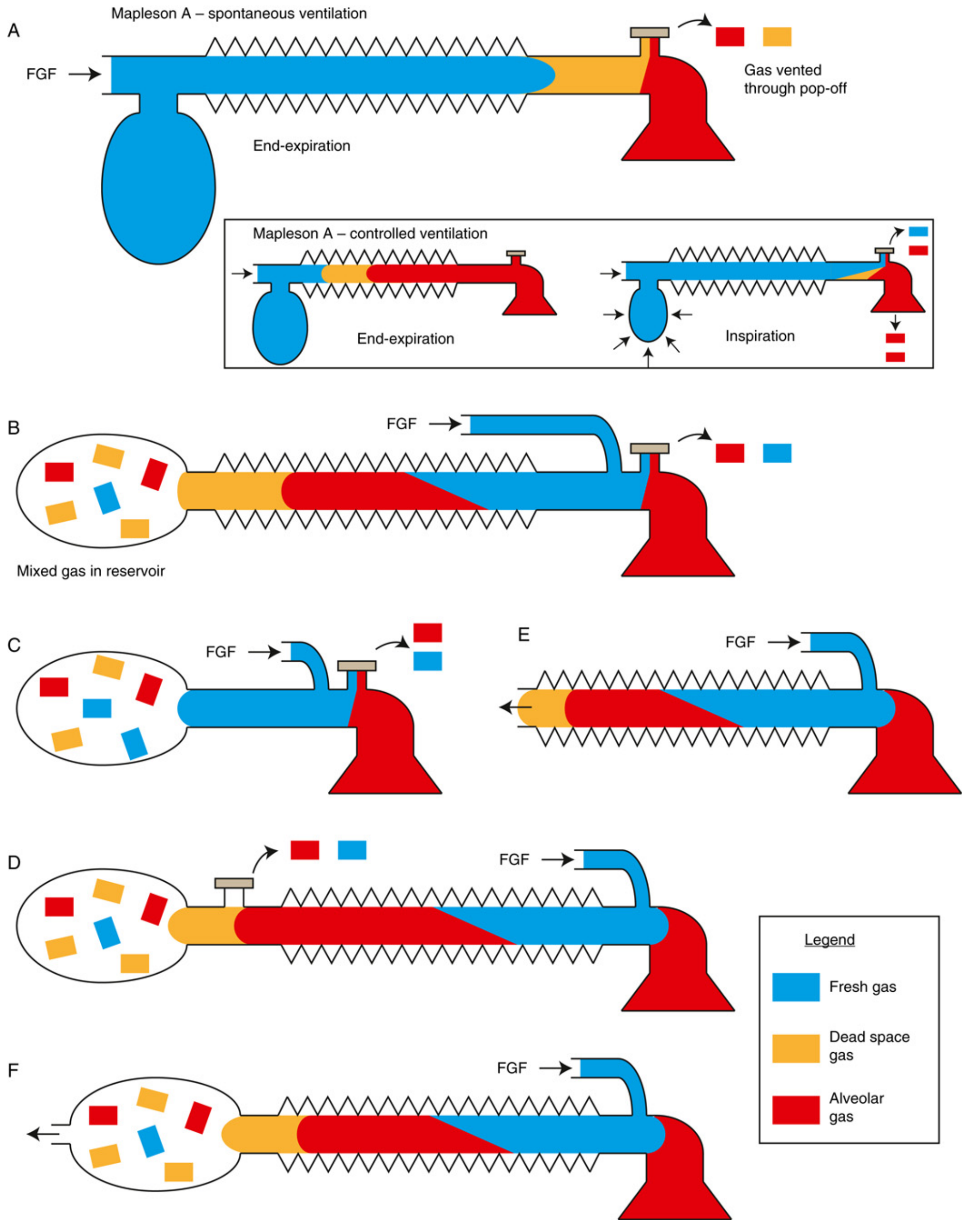
(Mapleson F = bottom circuit in image)
Fresh Gas Flow (FGF) Requirements
To prevent rebreathing of CO2:
| Mode | FGF Required |
|---|---|
| Spontaneous ventilation | 2.5-3 × minute ventilation |
| Controlled / IPPV | 1.5-2 × minute ventilation |
- Example: A child with minute ventilation of 1 L/min requires FGF of ~2.5-3 L/min for spontaneous breathing.
- The FGF requirement is similar to the Mapleson D circuit.
Advantages
- Low resistance - very low resistance to gas flow; ideal for small pediatric patients
- Minimal dead space - fresh gas enters near the patient
- Lightweight and simple - few components, easy to use
- Both spontaneous and controlled ventilation possible
- No CO2 absorber - no risk of volatile agent degradation by soda lime
- Rapid changes in inspired gas composition - useful for quickly adjusting anesthetic depth
- Allows monitoring of ventilation - movement of the bag provides visual feedback on breathing
Disadvantages
- High FGF required - not economical; increases gas/volatile agent usage
- Heat and humidity loss - no conservation of exhaled humidity/heat
- Difficult to scavenge - waste gas scavenging is challenging (open tail design)
- Risk of rebreathing - if FGF is inadequate
- Less useful in adults - large tidal volumes make the high FGF requirement impractical
Uses
- Primary use: Pediatric anesthesia (especially neonates and infants)
- Patient transport (ICU/post-op)
- ICU ventilation and weaning from mechanical ventilation
- Manual ventilation during cardiopulmonary resuscitation in children
Comparison with Ayre's T-piece (Mapleson E)
| Feature | Ayre's T-piece (E) | Jackson-Rees (F) |
|---|---|---|
| Bag | None | Open-tail bag |
| Controlled ventilation | Not possible | Possible |
| CPAP | Not possible | Possible |
| Monitoring ventilation | Difficult | Easy (bag movement) |
Key exam point: The JR circuit = Mapleson F = modification of Ayre's T-piece (Mapleson E) by adding an open-tail bag. FGF for spontaneous ventilation = 2.5× minute ventilation.
(Sources: Barash Clinical Anesthesia 9e; Miller's Anesthesia 10e)
This is a shared conversation. Sign in to Orris to start your own chat.